Spatial Audio & Immersive Music for Jazz: Complete Guide
Spatial9 Team · · Updated
Part of the series Spatial audio and immersive music by genre.
Jazz is a conversation. The magic is in how the players react to one another in real time, and that is much easier to follow when each one has a clear place in front of you. Spatial audio for jazz gives you that seat at the front table. This guide shows how to place a jazz group in 3D. For the basics, read what spatial audio is.
Why jazz shines in spatial audio
In stereo, a quartet is squeezed onto one line, and parts often overlap: the piano's left hand and the bass, the ride cymbal and the horn's upper notes. In a spatial mix, every instrument sits where it would on a real stage, so you can follow each line separately.
The goal is not spectacle. It is to feel as if you are in the room while the band plays.
Immersive music for jazz: what listeners hear
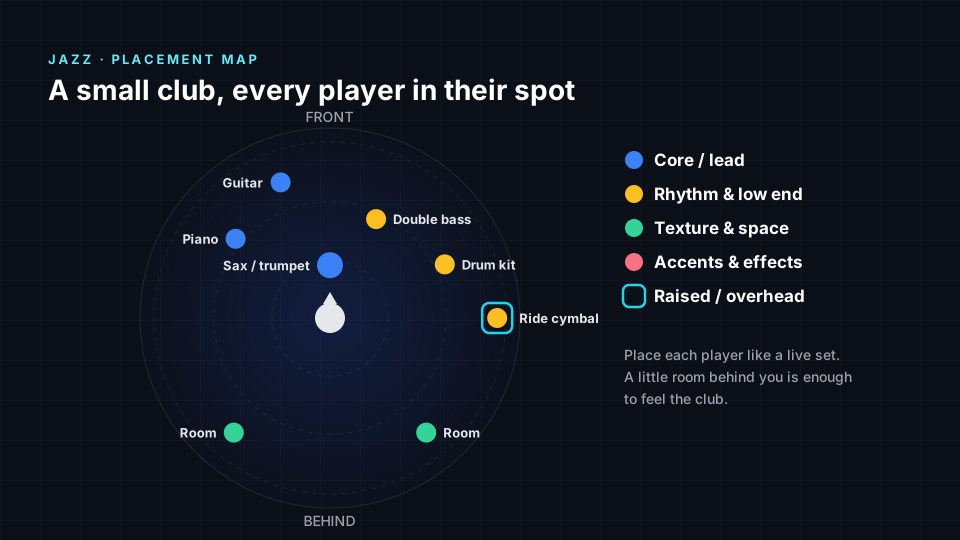
- Each player in their spot. You can point to where the piano, bass and drums are, just as you could in a club.
- The conversation. When the drummer answers a phrase from the sax, you hear it come from across the stage.
- The room. A touch of club ambience behind you makes the recording feel live and warm.
Where to place each instrument in a jazz mix
| Instrument | Position | Height | Why it works |
|---|---|---|---|
| Sax or trumpet | Front centre | Ear level | The lead voice in most small groups |
| Piano | Front left | Ear level | Classic stage position beside the horn |
| Guitar | Front left, further back | Ear level | Separates comping from the piano |
| Double bass | Front right of centre | Ear level | Keeps the walking line clear |
| Drum kit | Front right | Ear level | Recreates the stage layout |
| Ride cymbal | Right | Slightly raised | Matches the shape of the kit and adds air |
| Room ambience | Behind left and right | Ear level | Puts the listener in the club |
Every band sets up a little differently. If you know how the group stood when it recorded, follow that.
The psychoacoustics behind jazz placement
Every position in the table above follows how the ear and brain locate sound. Here is the reason behind the main choices for jazz.
- Sax or trumpet in front. Hearing is sharpest straight ahead: listeners can tell apart sources about 1 degree apart in front of them, but need far larger gaps at the sides (Mills, 1958). The lead voice carries the improvisation, so it gets the sharpest position.
- Piano left, bass and drums right. Sounds that overlap in pitch mask each other less when they arrive from different directions, so spreading them keeps every part clear without extra EQ. Separating the rhythm section keeps every voice audible in a small group where everyone plays at once.
- Guitar further back than the piano. We judge distance from loudness, treble and the balance of direct sound to room sound. A dry, close, bright source feels intimate, and more room sound pushes a part back. A little more room sound separates comping guitar from the piano on the same side.
- Room ambience behind. Thanks to the precedence effect, early reflections from a room do not pull a source sideways. They are heard as size and space around it. The club sound surrounds the listener while the players keep their positions.
The immersion profile for jazz
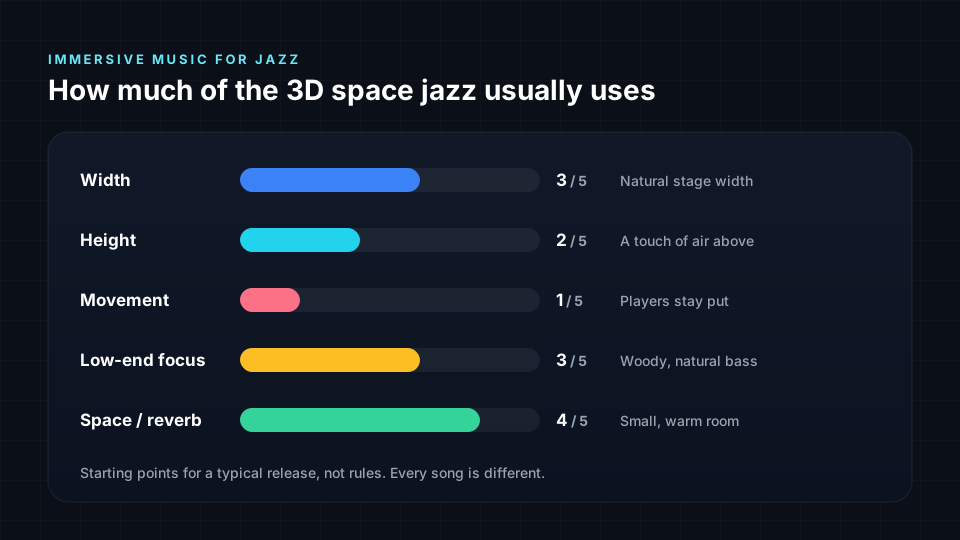
Jazz uses a natural width, about the size of a real stage, and a warm room. Players do not walk around while they play, so movement stays low. A little height on the cymbals gives the kit some air.
Tips for an immersive jazz mix
- Think like a live engineer. Place the band as the audience would see it from a good table.
- Keep the bass audible. Walking bass lines carry the harmony, so give the bass a clear spot near the centre.
- Use the room, not effects. A natural ambience behind the listener works better than artificial reverb.
- Let solos step forward. Bring a soloist slightly closer instead of moving them around.
- Preserve the dynamics. Jazz breathes. Do not compress it flat to make the 3D effect stand out.
How to make immersive jazz from a stereo recording
Spatial9 can create spatial audio from a stereo recording:
- Upload your stereo master, or stems for each player.
- Spatial9's AI separates the instruments and places each one in 3D space.
- Listen in binaural on headphones. Read binaural vs spatial audio to learn how it works.
- Export Eclipsa Audio, ADM, binaural or Ambisonics.
- Share the session. Create a YouTube-ready video with your immersive audio and your own footage, and publish it directly.
For larger acoustic ensembles, read spatial audio for classical. For mellow, jazz-influenced beats, see spatial audio for lo-fi. Every genre is listed in spatial audio and immersive music by genre.
Frequently asked questions
Can I make a jazz mix in Dolby Atmos or Eclipsa Audio?
Yes. The placements in this guide work for both. Spatial9 exports ADM, the standard file used by Dolby Atmos studios, as well as Eclipsa Audio for YouTube, so one immersive jazz mix covers both. You may also hear this called a 3D jazz mix or jazz in spatial audio. It is the same idea.
Is spatial audio good for jazz?
Yes. Spatial audio for jazz places each player in a clear spot on stage, so listeners can follow the conversation between the instruments.
How should a jazz quartet be placed in spatial audio?
A common layout puts the horn front and centre, the piano front left, and the bass and drums front right, with room ambience behind the listener.
Should a jazz spatial mix use movement?
Rarely. Jazz sounds most natural when the players stay in place. Bring a soloist slightly forward rather than moving them around.
Can old jazz recordings be turned into spatial audio?
Yes. Spatial9 uses AI to separate a stereo recording into its instruments and create an immersive mix, which is a great way to give a catalog new life.
Will immersive jazz sound natural on headphones?
Yes. The binaural render recreates the stage and the room on any regular headphones.
Dolby and Dolby Atmos are trademarks of Dolby Laboratories. Spatial9 is not affiliated with or endorsed by Dolby Laboratories.
Sources
- Blauert, J. (1997). Spatial Hearing: The Psychophysics of Human Sound Localization, revised edition. MIT Press. Low-frequency, elevation, distance and motion cues.
- Mills, A. W. (1958). On the minimum audible angle. Journal of the Acoustical Society of America, 30(4), 237-246.
- Hebrank, J. and Wright, D. (1974). Spectral cues used in the localization of sound sources on the median plane. Journal of the Acoustical Society of America, 56(6), 1829-1834.
- Bronkhorst, A. W. (2000). The cocktail party phenomenon: a review of research on speech intelligibility in multiple-talker conditions. Acta Acustica united with Acustica, 86, 117-128.
- Litovsky, R. Y., Colburn, H. S., Yost, W. A. and Guzman, S. J. (1999). The precedence effect. Journal of the Acoustical Society of America, 106(4), 1633-1654.
- Barron, M. and Marshall, A. H. (1981). Spatial impression due to early lateral reflections in concert halls. Journal of Sound and Vibration, 77(2), 211-232.
- Neuhoff, J. G. (1998). Perceptual bias for rising tones. Nature, 395, 123-124.
- Bregman, A. S. (1990). Auditory Scene Analysis: The Perceptual Organization of Sound. MIT Press.
Hear your band in 3D
Upload a track to Spatial9 and hear your group on a 3D stage in minutes.