Spatial Audio & Immersive Music for Hyperpop: Complete Guide
Spatial9 Team · · 7 min read
Part of the series Spatial audio and immersive music by genre.
Key takeaways
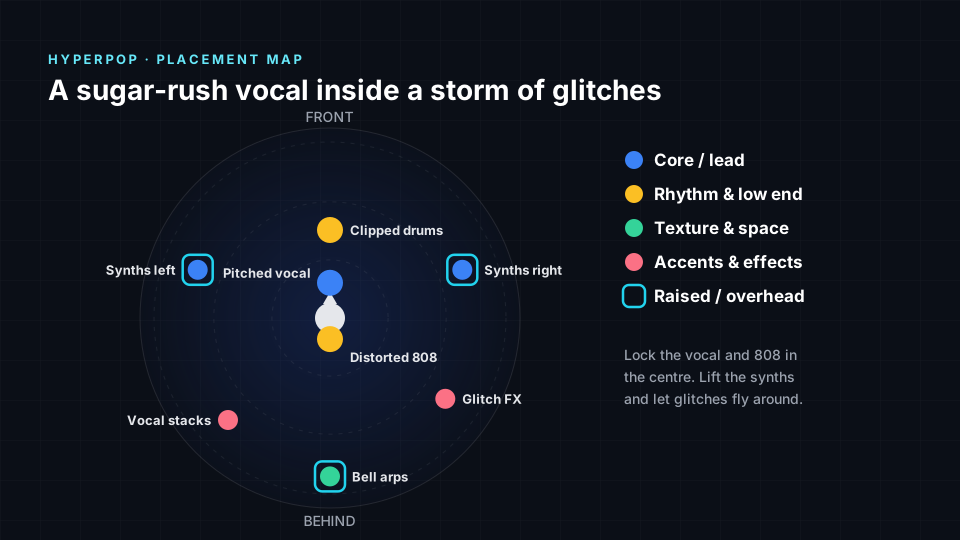
- In a spatial hyperpop mix the pitched lead vocal, clipped drums and distorted 808 stay centred, while sugary synths sit raised on both sides and vocal stacks, glitch effects and bell arps fill the space behind the listener.
- Hyperpop glitch effects work best moving behind and to the side of the listener, because a sound arriving from its own direction is heard as a separate stream and stops cluttering the lead vocal.
- Bright synths and bell arps are the most convincing height layer in hyperpop, because the outer ear encodes elevation mainly in frequencies above roughly 4 kHz.
- The hyperpop immersion profile scores width 5, height 4, movement 5, low-end focus 5 and space 2 out of 5.
Hyperpop is internet-born pop pushed to extremes. It grew out of the 2010s scene around the London label PC Music and spread through online communities such as digicore, where producers working in bedrooms took pop hooks and made them louder, brighter and stranger. Its defining sound is easy to recognise: heavily pitched and auto-tuned vocals, distorted 808s, sugary supersaw and bell synths, chiptune-style arps, sudden genre switches and glitchy cut-up edits, all compressed until they almost break. In stereo that density can feel like a wall. Spatial audio gives each overloaded layer its own direction, so the chaos becomes thrilling instead of tiring. This guide covers how spatial audio for hyperpop works, where to place each element and how to make an immersive hyperpop mix. For the basics, see what spatial audio is.
Why hyperpop is ideal for spatial audio
Hyperpop stacks more bright, aggressive sounds into one track than almost any other pop style. Squeezed into two speakers, the vocal, synths and glitches all fight for the same upper mid range, and mixers often have to choose which one survives. Spread around the listener, every layer can stay loud and still be heard.
The rule: a solid core, a storm around it. The vocal and 808 hold the song together while the effects and synths are free to go wild.
Immersive music for hyperpop: what listeners hear
- A vocal right in your face. The pitched lead stays close, clear and centred.
- Synths that tower over you. Sugary supersaws rise on both sides like a neon skyline.
- Glitches that dart past. Stutters, bitcrushed hits and reversed fragments fly behind and around you.
- An 808 that never lets go. The distorted low end stays heavy and steady wherever you sit.
Where to place each element in a hyperpop mix
| Element | Position | Height | Why it works |
|---|---|---|---|
| Pitched vocal | Front centre | Ear level | The hook and emotional focus |
| Clipped drums | Front centre | Ear level | Punchy, consistent impact |
| Distorted 808 | Centre | Ear level | Heavy and grounded |
| Synths left | Left | Raised | Half of the sugary chord wall |
| Synths right | Right | Raised | Mirrors the left side for width |
| Glitch FX | Behind right, moving | Ear level | Chaos that never blocks the vocal |
| Vocal stacks | Behind left | Ear level | Doubles and harmonies around you |
| Bell arps | Behind | Raised | Sparkling detail overhead |
The psychoacoustics behind Hyperpop placement
Every position in the table above follows how the ear and brain locate sound. Here is the reason behind the main choices for Hyperpop.
- The 808 stays centred. The fundamental of an 808 sits well below roughly 80 to 100 Hz, where the brain finds very little usable direction, so there is nothing to gain by moving it. Hyperpop 808s are often heavily distorted, though, and those added harmonics do carry direction. Keeping the whole 808, distortion included, in the centre stops the low end from pulling to one side.
- Vocal in front, synths and stacks elsewhere. The pitched lead vocal and bright synths crowd the same frequency band. Separating sounds in direction makes each one easier to hear, an effect known as spatial release from masking. Lifting the synths to the sides and moving the vocal stacks behind lets the lead cut through without extra harsh EQ.
- Synths and bell arps raised. The folds of the outer ear shape frequencies above about 4 kHz differently depending on elevation, which is how we hear height. Hyperpop synths and bells are packed with high treble, so they are the parts that sound genuinely overhead rather than simply louder.
- Glitch FX moving behind. The brain groups sounds into separate streams using cues such as pitch, timbre and location. Giving the cut-up stutters and bitcrushed hits their own moving position behind the listener keeps them heard as a separate layer of chaos, instead of fragments that seem to break the vocal itself.
The immersion profile for hyperpop
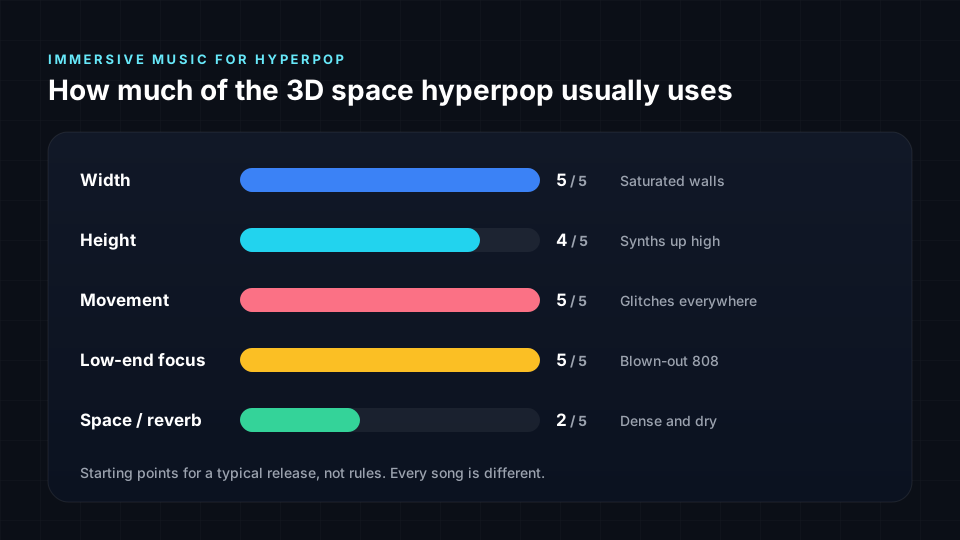
Width and movement are at maximum because the synths and glitches fill and cross the whole field. Low-end focus is at maximum too, thanks to the distorted 808. Space stays low: hyperpop is close, compressed and dry, so long reverbs would wash out its sharp edges.
Tips for an immersive hyperpop mix
- Anchor the vocal. It is the reference point for all the chaos, so keep it centred and close.
- Keep the 808 and its distortion together. Do not let the saturated harmonics drift away from the sub.
- Move the glitches, not the hook. Stutters and edits can fly around, but the main vocal and drums should never jump.
- Use the switches. When the track flips genre or drops into a new section, change the spatial picture too, for example by collapsing to mono and then exploding wide.
- Stay dry. Short, bright ambiences keep the hyperreal feel. Save big reverb for a single dramatic moment.
How to make immersive hyperpop from stereo
Spatial9 can create spatial audio from a stereo track in a few steps:
- Upload your stereo master or your stems.
- Spatial9's AI separates and places each part, keeping the vocal and 808 centred while spreading synths and glitches around you.
- Preview it in binaural on headphones.
- Export Eclipsa Audio, ADM, binaural or Ambisonics.
- Publish a video. Create a YouTube-ready video with your immersive audio and publish it directly.
For related guides, read spatial audio for future bass and spatial audio for chiptune. Every guide is listed in spatial audio and immersive music by genre.
Frequently asked questions
Can I make a hyperpop mix in Dolby Atmos or Eclipsa Audio?
Yes. The placements in this guide work for both. Spatial9 exports ADM, the standard file used by Dolby Atmos studios, as well as Eclipsa Audio for YouTube, so one immersive hyperpop mix covers both. If you plan to release the Atmos version on Apple Music, build it from your original stems or multitracks, because Apple does not accept Atmos made from a finished stereo master. See where to publish spatial audio. You may also hear this called a 3D hyperpop mix or hyperpop in spatial audio.
Is spatial audio good for hyperpop?
Yes. Hyperpop packs many bright, loud layers into one track, and spreading them around the listener lets each one be heard without losing the intensity.
Where should glitch effects go in an immersive hyperpop mix?
Behind and to the sides of the listener, ideally moving. That keeps the chaos exciting while the vocal stays clear in front.
Should the pitched vocal move around?
No. The lead vocal is the hook that holds the song together. Keep it centred and close, and let vocal stacks, chops and effects do the moving.
Can I convert a finished hyperpop track to spatial audio?
Yes. Spatial9 uses AI to generate an immersive mix from a stereo master and exports it as Eclipsa Audio, ADM, binaural or Ambisonics.
Does immersive hyperpop work on normal headphones?
Yes. The mix is rendered binaurally, so the synths and glitches surround you on any regular headphones.
Dolby and Dolby Atmos are trademarks of Dolby Laboratories. Spatial9 is not affiliated with or endorsed by Dolby Laboratories.
Sources
- Blauert, J. (1997). Spatial Hearing: The Psychophysics of Human Sound Localization, revised edition. MIT Press. Low-frequency, elevation, distance and motion cues.
- Mills, A. W. (1958). On the minimum audible angle. Journal of the Acoustical Society of America, 30(4), 237-246.
- Hebrank, J. and Wright, D. (1974). Spectral cues used in the localization of sound sources on the median plane. Journal of the Acoustical Society of America, 56(6), 1829-1834.
- Bronkhorst, A. W. (2000). The cocktail party phenomenon: a review of research on speech intelligibility in multiple-talker conditions. Acta Acustica united with Acustica, 86, 117-128.
- Litovsky, R. Y., Colburn, H. S., Yost, W. A. and Guzman, S. J. (1999). The precedence effect. Journal of the Acoustical Society of America, 106(4), 1633-1654.
- Barron, M. and Marshall, A. H. (1981). Spatial impression due to early lateral reflections in concert halls. Journal of Sound and Vibration, 77(2), 211-232.
- Neuhoff, J. G. (1998). Perceptual bias for rising tones. Nature, 395, 123-124.
- Bregman, A. S. (1990). Auditory Scene Analysis: The Perceptual Organization of Sound. MIT Press.
Put your listeners inside the storm
Upload a track to Spatial9 and hear your synths and glitches surround you in minutes. Then export it or publish it straight to YouTube.