Spatial Audio & Immersive Music for Pop: Complete Guide
Spatial9 Team · · Updated
Part of the series Spatial audio and immersive music by genre.
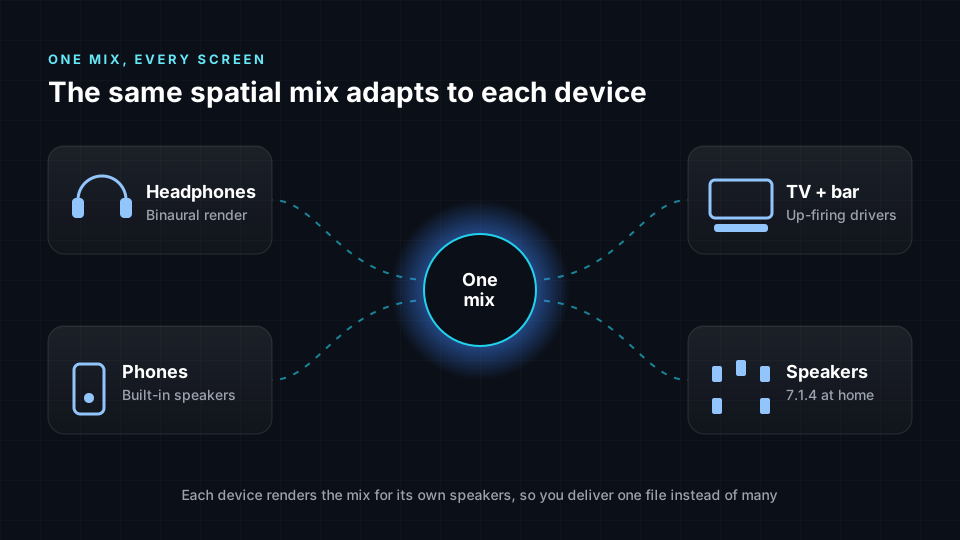
Pop is built to be heard everywhere: in earbuds on the bus, on a phone speaker, in the car, at a party. That makes it a perfect fit for spatial audio, because one immersive mix adapts to every one of those devices. This guide explains how spatial audio for pop works, what listeners notice in immersive pop music, and how to create a 3D version of your own song. For the basics, see what spatial audio is.
Why pop works so well in spatial audio
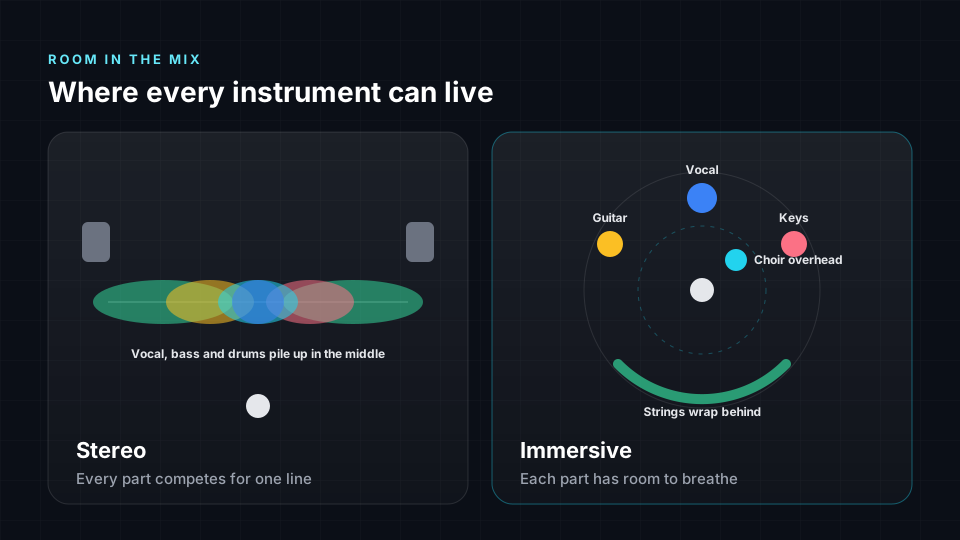
Modern pop productions are dense. A single chorus can stack a lead vocal, a dozen harmony layers, synths, guitars, a full drum programme and effects. In stereo, all of that has to fight for space on one line between two speakers, so mixers often compress and carve the arrangement until it fits.
Spatial audio gives every layer a place of its own. The vocal can stay clear and centred while the production blooms around it. Instead of turning things down to make room, you move them somewhere else.
Immersive music for pop: what listeners hear
When people first hear immersive pop music, three things usually stand out:
- The vocal feels closer. With less clutter around it, the lead sounds more intimate, as if the singer is right in front of you.
- The chorus lifts. Pads and harmonies open up around and above the listener, so the drop into the chorus feels physically bigger.
- Small details come alive. Ad-libs, vocal chops and production tricks that disappear in stereo suddenly have their own place.
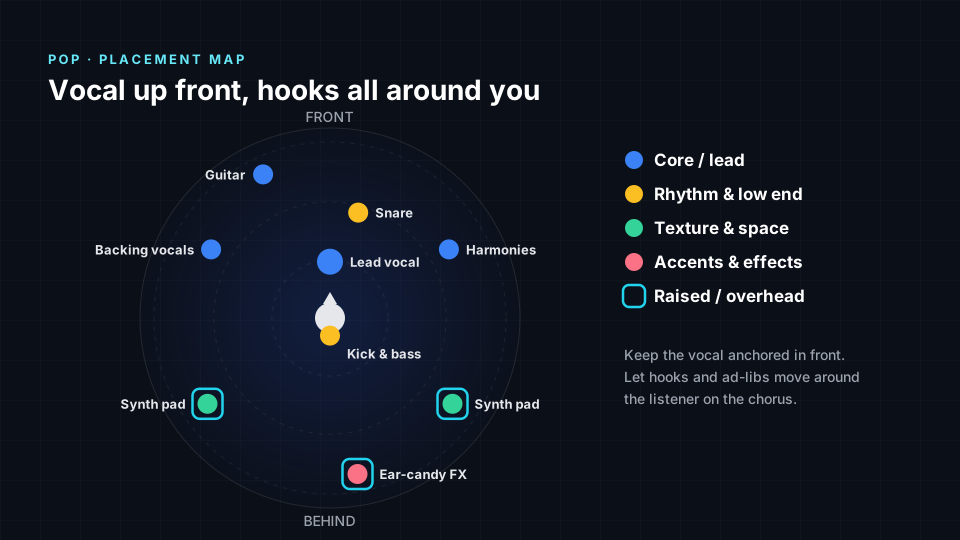
Where to place each element in a pop mix
| Element | Position | Height | Why it works |
|---|---|---|---|
| Lead vocal | Front centre, close | Ear level | Keeps the hook clear on every device |
| Kick and bass | Centre | Ear level | A steady low end keeps the song driving |
| Snare and claps | Front, slightly wide | Ear level | Gives the groove a clear focus |
| Backing vocals and harmonies | Left and right sides | Ear level or slightly raised | Wraps the listener in the chorus |
| Synth pads | Behind and to the sides | Raised | Creates a sense of size without masking the vocal |
| Guitars and keys | Front left and right | Ear level | Keeps the band feel in front |
| Ear candy and effects | Behind or overhead | Raised | Surprises the listener and rewards repeat listens |
The psychoacoustics behind pop placement
Every position in the table above follows how the ear and brain locate sound. Here is the reason behind the main choices for pop.
- Lead vocal close and in front. Hearing is sharpest straight ahead: listeners can tell apart sources about 1 degree apart in front of them, but need far larger gaps at the sides (Mills, 1958). The vocal is the song in pop, so it gets the sharpest position.
- Kick and bass centred. In real rooms and on most playback systems, sub-bass below roughly 80 to 100 Hz gives the brain very little usable direction, which is why a single subwoofer can serve a whole speaker layout. The low end must translate to phones, cars and earbuds.
- Backing vocals and harmonies on the sides. When two sounds share a frequency range, separating them in direction makes each one easier to hear. Researchers call this spatial release from masking, the same effect that lets you follow one voice at a busy party. Spreading the stacks keeps them big without masking the lead.
- Ear candy behind or overhead. Height is heard mainly through treble: the folds of the outer ear colour frequencies above roughly 4 kHz differently for each elevation, so airy, bright parts are the ones that truly sound overhead. Bright sparkles and effects are exactly the sounds that read as height.
The immersion profile for pop
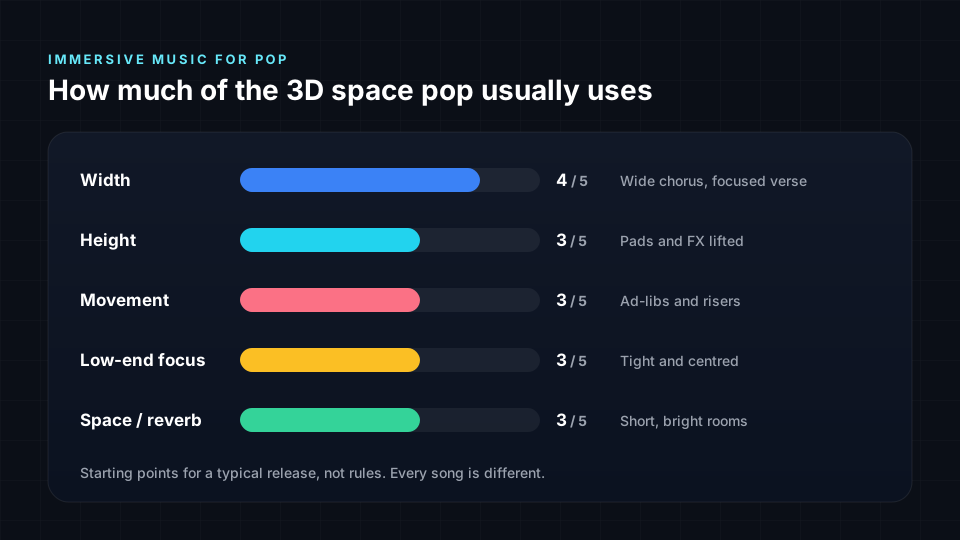
Pop scores high on width because choruses benefit from a big, wrapping sound. Height and movement work best in moderation. Raise pads and effects, and save moving sounds for transitions, ad-libs and risers. A vocal that drifts around the room is the quickest way to lose a pop listener.
Tips for an immersive pop mix
- Build contrast between verse and chorus. Keep the verse narrower and let the chorus open up. The change in space becomes part of the arrangement.
- Never move the lead vocal. Movement belongs to secondary parts such as ad-libs, sweeps and fills.
- Use height for air, not for the hook. Overhead positions are perfect for pads, reverb and shimmer. Keep the melody at ear level.
- Check on headphones. Most pop listeners will hear your mix on earbuds, so make sure it translates through binaural rendering.
- Keep a matching stereo master. Platforms usually deliver both, so the two versions should feel like the same record.
How to make immersive pop music from a stereo song
You do not need a room full of speakers to make spatial audio for pop. With Spatial9, you can create spatial audio from a stereo song:
- Upload your stereo master or, for more control, your exported stems.
- Let the AI place the arrangement. Spatial9 separates the vocal, drums, bass and other parts, then places each one in 3D space.
- Listen on headphones in binaural to hear the result straight away.
- Export the format you need: Eclipsa Audio, ADM, binaural or Ambisonics.
- Publish a video. Create a YouTube-ready video with your immersive audio, cover art or your own footage, and publish it directly.
If pop with a soulful edge is more your sound, see spatial audio for R&B. If your pop leans electronic, read spatial audio for EDM. Every genre in this series is listed in our guide to spatial audio and immersive music by genre.
Frequently asked questions
Can I make a pop mix in Dolby Atmos or Eclipsa Audio?
Yes. The placements in this guide work for both. Spatial9 exports ADM, the standard file used by Dolby Atmos studios, as well as Eclipsa Audio for YouTube, so one immersive pop mix covers both. You may also hear this called a 3D pop mix or pop in spatial audio. It is the same idea.
Is spatial audio good for pop music?
Yes. Pop arrangements are dense, and spatial audio gives each layer its own space. The vocal stays clear while harmonies, synths and effects surround the listener.
Where should the vocal go in a spatial pop mix?
Keep the lead vocal in front and centre at ear level, and do not move it. Harmonies and ad-libs can sit to the sides, behind or above.
Will my immersive pop mix sound good on earbuds?
It should, as long as you check it on headphones. Devices render immersive mixes binaurally for headphones, so test there before you release.
Can I make an immersive version of a pop song that is already finished?
Yes. Spatial9 uses AI to create an immersive mix from a finished stereo master and exports it as Eclipsa Audio, ADM, binaural or Ambisonics.
What is the difference between spatial audio for pop and immersive music for pop?
They mean the same thing from two angles. Spatial audio is the technology that places sound in 3D. Immersive pop music is the experience your listeners get from it.
Dolby and Dolby Atmos are trademarks of Dolby Laboratories. Spatial9 is not affiliated with or endorsed by Dolby Laboratories.
Sources
- Blauert, J. (1997). Spatial Hearing: The Psychophysics of Human Sound Localization, revised edition. MIT Press. Low-frequency, elevation, distance and motion cues.
- Mills, A. W. (1958). On the minimum audible angle. Journal of the Acoustical Society of America, 30(4), 237-246.
- Hebrank, J. and Wright, D. (1974). Spectral cues used in the localization of sound sources on the median plane. Journal of the Acoustical Society of America, 56(6), 1829-1834.
- Bronkhorst, A. W. (2000). The cocktail party phenomenon: a review of research on speech intelligibility in multiple-talker conditions. Acta Acustica united with Acustica, 86, 117-128.
- Litovsky, R. Y., Colburn, H. S., Yost, W. A. and Guzman, S. J. (1999). The precedence effect. Journal of the Acoustical Society of America, 106(4), 1633-1654.
- Barron, M. and Marshall, A. H. (1981). Spatial impression due to early lateral reflections in concert halls. Journal of Sound and Vibration, 77(2), 211-232.
- Neuhoff, J. G. (1998). Perceptual bias for rising tones. Nature, 395, 123-124.
- Bregman, A. S. (1990). Auditory Scene Analysis: The Perceptual Organization of Sound. MIT Press.
Hear your pop song in 3D
Upload a track to Spatial9 and hear an immersive version of your song in minutes, then export it or publish it straight to YouTube.