Spatial Audio & Immersive Music for Shoegaze: Complete Guide
Spatial9 Team · · Updated
Part of the series Spatial audio and immersive music by genre.
Shoegaze grew out of late 1980s Britain, built on layers of distorted, effects-heavy guitars, dreamy vocals mixed into the noise and huge amounts of reverb. The music has always been about texture and immersion rather than clarity. In stereo, those walls of sound can blur together. In spatial audio, they can surround you. This guide covers how spatial audio for shoegaze works, where to place each element and how to make an immersive shoegaze mix. For the basics, see what spatial audio is.
Why shoegaze is made for spatial audio
Shoegaze is already an immersive genre in spirit. The goal is to be swallowed by sound. A 3D mix finally gives those walls of guitar and reverb a real space to fill, all around and above the listener.
The rule: the voice is part of the texture. Unlike most genres, the vocal does not need to sit on top.
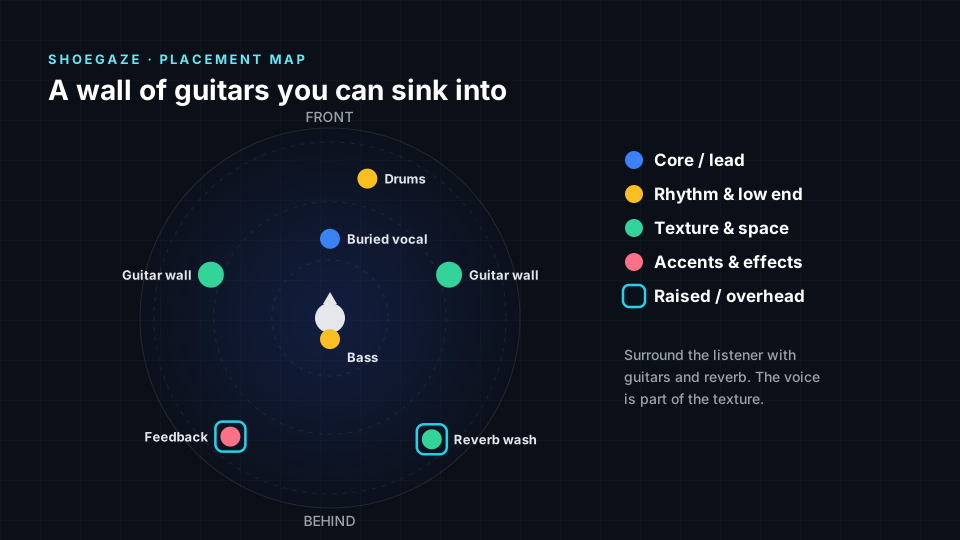
Immersive music for shoegaze: what listeners hear
- Guitars all around. Two huge walls of sound wrap the listener.
- A voice inside the noise. The vocal floats within the texture.
- Feedback that swells. Noise rises and drifts behind the listener.
- Reverb overhead. A dreamy wash fills the space above.
Where to place each element in a shoegaze mix
| Element | Position | Height | Why it works |
|---|---|---|---|
| Buried vocal | Front, slightly back | Ear level | Part of the texture |
| Guitar wall | Left and right | Ear level | The signature sound |
| Drums | Back of the stage | Ear level | Steady drive under the noise |
| Bass | Centre | Ear level | Holds the low end |
| Feedback | Behind left, swelling | Raised | Moving noise |
| Reverb wash | Behind right | Raised | Dreamy space overhead |
The psychoacoustics behind shoegaze placement
Every position in the table above follows how the ear and brain locate sound. Here is the reason behind the main choices for shoegaze.
- Buried vocal, slightly back. We judge distance from loudness, treble and the balance of direct sound to room sound. A dry, close, bright source feels intimate, and more room sound pushes a part back. In shoegaze the vocal is part of the texture, and a little more room sound pushes it back without hiding it.
- Guitar wall left and right. Concert hall research shows that reflections from the sides, not from the front, create the sense of width and of being surrounded (Barron and Marshall, 1981). A wide guitar wall reaching each ear differently creates the immersive haze the genre is known for.
- Feedback swelling behind left. Sounds that grow louder or rise in pitch are heard as approaching, and listeners tend to overestimate that change (Neuhoff, 1998). That bias is why rising sounds build tension so well. Swelling feedback feels like it is approaching, which adds tension and emotion.
- Bass centred. In real rooms and on most playback systems, sub-bass below roughly 80 to 100 Hz gives the brain very little usable direction, which is why a single subwoofer can serve a whole speaker layout. A steady low end keeps the wall of sound grounded.
The immersion profile for shoegaze
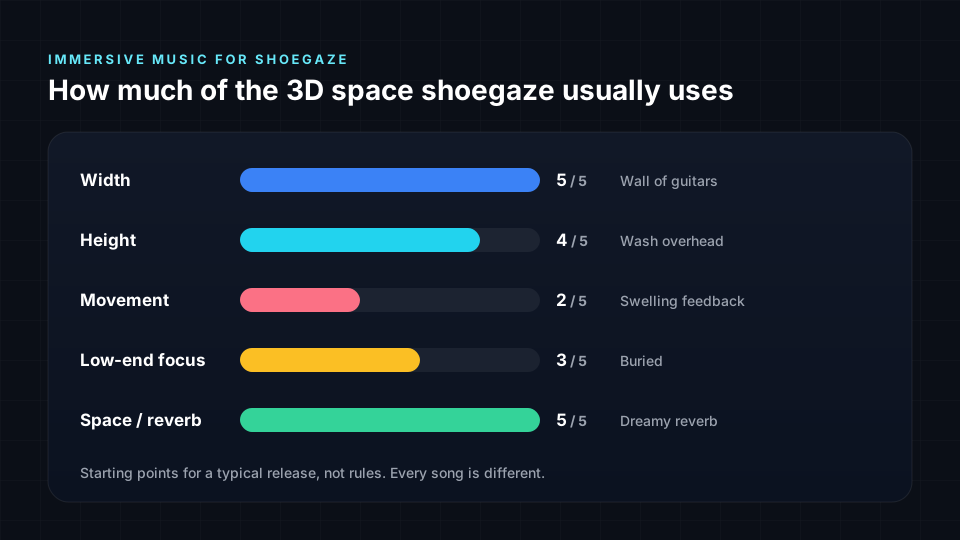
Width and space are at maximum, like ambient music, but with a much denser, louder texture. Movement stays slow and comes mostly from swelling feedback.
Tips for an immersive shoegaze mix
- Spread the guitar walls wide. They should surround, not sit in front.
- Bury the vocal gently. Keep it inside the texture, but still present.
- Raise the reverb. A wash overhead makes the space feel endless.
- Let the feedback swell. Slow movement adds life to the noise.
- Keep the bass and drums grounded. They anchor the haze.
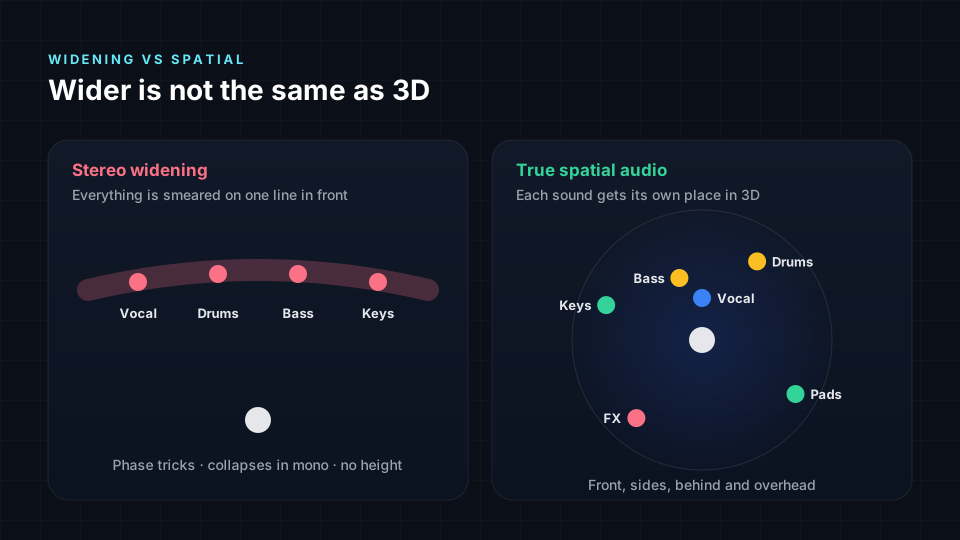
How to make immersive shoegaze from stereo
Spatial9 can create spatial audio from a stereo track in a few steps:
- Upload your stereo master or your stems.
- Spatial9's AI separates and places each part, wrapping the guitar walls around you.
- Preview it in binaural on headphones.
- Export Eclipsa Audio, ADM, binaural or Ambisonics.
- Publish a video. Create a YouTube-ready video with your immersive audio and publish it directly.
For related guides, read spatial audio for alternative and spatial audio for ambient. Every guide is listed in spatial audio and immersive music by genre.
Frequently asked questions
Can I make a shoegaze mix in Dolby Atmos or Eclipsa Audio?
Yes. The placements in this guide work for both. Spatial9 exports ADM, the standard file used by Dolby Atmos studios, as well as Eclipsa Audio for YouTube, so one immersive shoegaze mix covers both. You may also hear this called a 3D shoegaze mix or shoegaze in spatial audio.
Is spatial audio good for shoegaze?
Yes. Shoegaze is all about being surrounded by sound, and a 3D mix gives its guitars and reverb a real space to fill.
Should the vocal be buried in a 3D shoegaze mix?
Gently. Keep it inside the texture as the genre intends, but make sure it does not disappear completely.
Does this work for dream pop?
Yes. Dream pop uses similar textures with a clearer vocal, so bring the voice slightly forward.
Can I convert a finished shoegaze track to spatial audio?
Yes. Spatial9 uses AI to generate an immersive mix from a stereo master and exports it as Eclipsa Audio, ADM, binaural or Ambisonics.
Does immersive shoegaze work on normal headphones?
Yes. The mix is rendered binaurally, so the walls of sound work on any regular headphones.
Dolby and Dolby Atmos are trademarks of Dolby Laboratories. Spatial9 is not affiliated with or endorsed by Dolby Laboratories.
Sources
- Blauert, J. (1997). Spatial Hearing: The Psychophysics of Human Sound Localization, revised edition. MIT Press. Low-frequency, elevation, distance and motion cues.
- Mills, A. W. (1958). On the minimum audible angle. Journal of the Acoustical Society of America, 30(4), 237-246.
- Hebrank, J. and Wright, D. (1974). Spectral cues used in the localization of sound sources on the median plane. Journal of the Acoustical Society of America, 56(6), 1829-1834.
- Bronkhorst, A. W. (2000). The cocktail party phenomenon: a review of research on speech intelligibility in multiple-talker conditions. Acta Acustica united with Acustica, 86, 117-128.
- Litovsky, R. Y., Colburn, H. S., Yost, W. A. and Guzman, S. J. (1999). The precedence effect. Journal of the Acoustical Society of America, 106(4), 1633-1654.
- Barron, M. and Marshall, A. H. (1981). Spatial impression due to early lateral reflections in concert halls. Journal of Sound and Vibration, 77(2), 211-232.
- Neuhoff, J. G. (1998). Perceptual bias for rising tones. Nature, 395, 123-124.
- Bregman, A. S. (1990). Auditory Scene Analysis: The Perceptual Organization of Sound. MIT Press.
Sink into the sound
Upload a track to Spatial9 and hear your shoegaze wrap around you in minutes. Then export it or publish it straight to YouTube.