Spatial Audio & Immersive Music for Chamber Music: String Quartet, Piano Trio & Art Song
Spatial9 Team · · 10 min read
Part of the series Spatial audio and immersive music by genre.
Key takeaways
- In a spatial chamber music mix the players sit in a close, steady arc in front of the listener, first violin on the left and cello on the right, with the piano centred behind and an art song singer close at front centre.
- Because the ear can separate sources only a few degrees apart, an effect measured as the minimum audible angle, a quartet needs only a modest arc for every player to have a clear seat.
- Chamber music was written for rooms rather than arenas, so early side reflections and a soft, slightly raised hall tail matter more than width or movement.
- The chamber music immersion profile scores width 3, height 2, movement 1, low-end focus 1 and space 4 out of 5.
Chamber music is music for a small group of players, one to a part, written for a room rather than a large hall. The name comes from the palace chambers where it was heard in the 18th century. Joseph Haydn shaped the string quartet of two violins, viola and cello in the 1760s and 1770s, and Mozart, Beethoven and Schubert carried it forward. The piano trio of piano, violin and cello grew alongside it, and art song, or Lied, set poetry for voice and piano, with Schubert writing more than 600 songs. Most works are sonata cycles in three or four movements, from slow adagios to brisk prestos. Recordings run from the acoustic era through mono LPs and stereo from the late 1950s to modern high-resolution sessions. It suits spatial audio because every line is a voice in a conversation, and giving each player a seat makes the dialogue easy to follow. This guide covers how spatial audio for chamber music works, where to place each element and how to make an immersive chamber music mix. For the basics, see what spatial audio is.
Why chamber music works in spatial audio
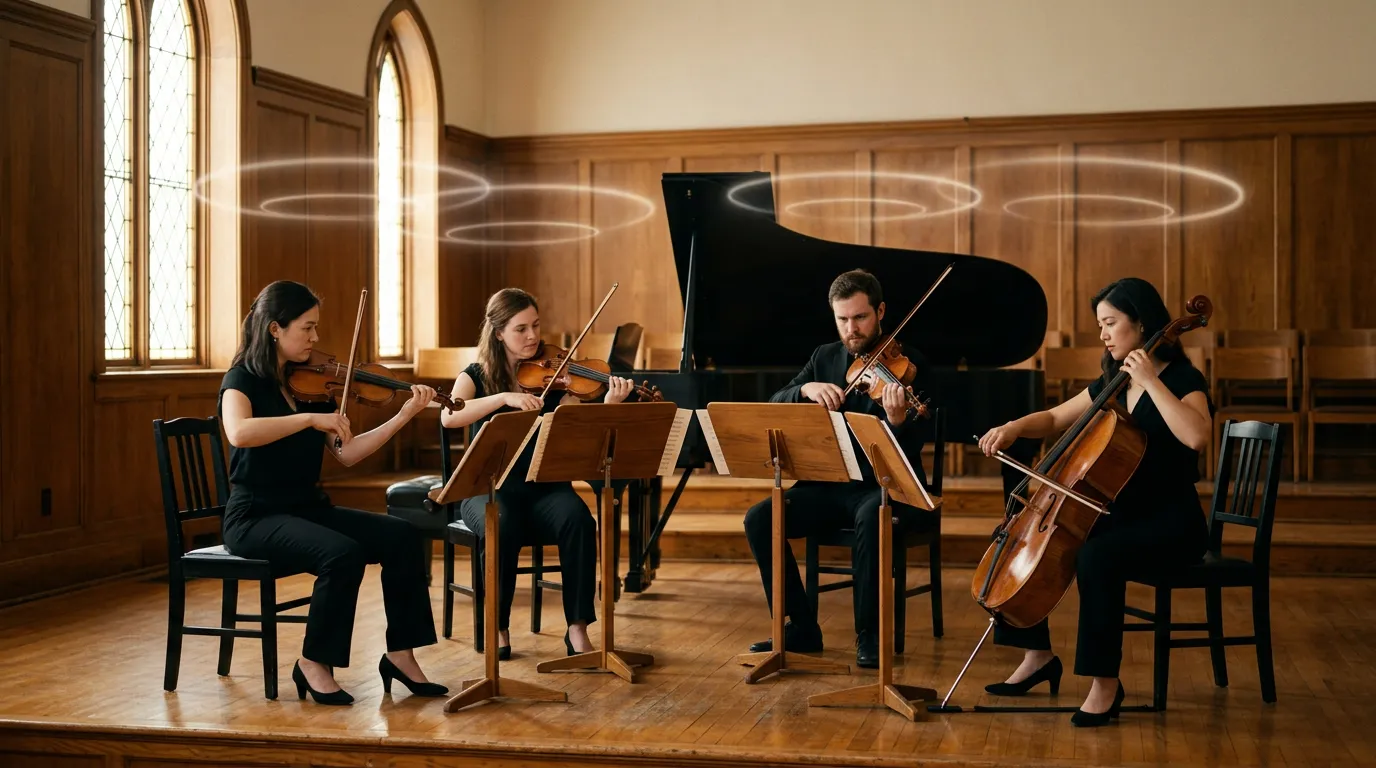
Chamber music is a conversation between equals. In a string quartet the first violin often leads, but the second violin and viola answer and fill the inner harmony, while the cello grounds the bass and steps forward with melodies of its own. In narrow stereo these close-pitched voices merge into one string sound. In an immersive mix each player keeps a fixed seat in a shallow arc in front, so you can follow a phrase from violin to viola to cello, as from the front rows of a small hall.
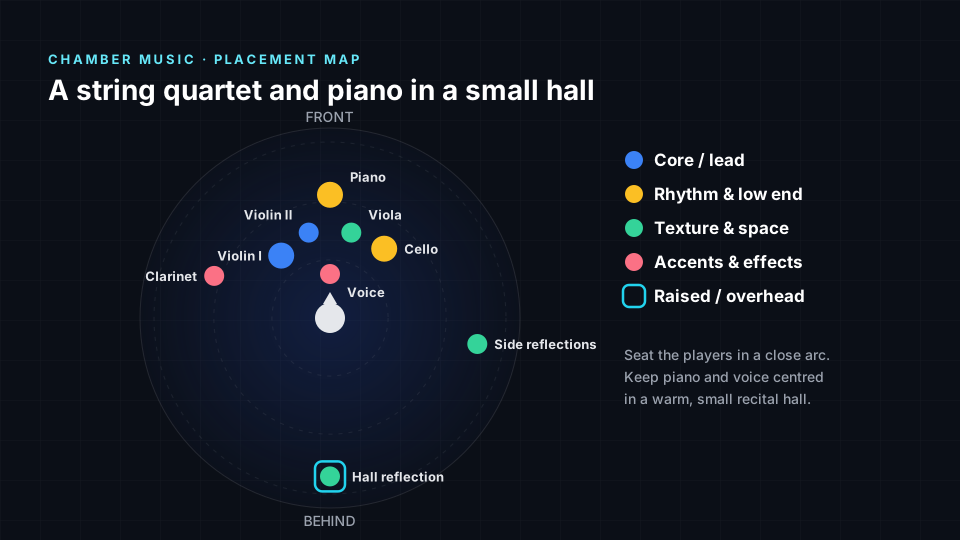
The rule: a close, stable arc of players in front, with the room around you. Keep every instrument in front at ear level, only as wide as a real ensemble sits, and let the reflections supply the space.
Immersive music for chamber music: what listeners hear
- Every player in their own seat. Each string player comes from a clear, steady direction.
- Inner voices you can follow. The second violin and viola stop hiding under the melody.
- A singer close enough to hear the words. In art song the voice sits just in front of the piano.
- A warm, small hall. Side reflections and a gentle tail wrap around you without blurring detail.
Where to place each element in a chamber music mix
| Element | Position | Height | Why it works |
|---|---|---|---|
| Violin I | Front left | Ear level | The leading line, in its usual concert seat |
| Violin II | Front left of centre | Ear level | Answers the first violin and fills the harmony |
| Viola | Front right of centre | Ear level | The warm inner voice, kept clear of the violins |
| Cello | Front right | Ear level | The bass line and singing tenor melodies |
| Piano | Centre, behind the strings | Ear level | The full-range partner in trios and quintets |
| Voice | Front centre, close | Ear level | Art song text delivered intimately to the listener |
| Clarinet | Left, further back | Ear level | A guest wind voice in quintets and trios |
| Side reflections | Right and left sides | Ear level | Early lateral reflections from the hall walls |
| Hall reflection | Behind | Raised | A soft tail from the ceiling and the back of the room |
The psychoacoustics behind chamber music placement
Every position in the table above follows how the ear and brain locate sound. Here is the reason behind the main choices for chamber music.
- Small angles between players. The ear can separate two sources in front only one or two degrees apart. This is the minimum audible angle (Mills). A modest arc is enough for each player to have a distinct seat.
- Inner voices on their own paths. The brain groups sounds into streams by pitch, timbre and direction. This is auditory stream segregation (Bregman). Separate positions let the ear follow the second violin and viola instead of one block of harmony.
- Voice and piano slightly apart. Overlapping sounds mask each other less when they arrive from different directions. This is spatial release from masking. A singer just in front of the piano keeps the words clear.
- Side walls that create envelopment. Reflections arriving from the sides soon after the direct sound make a room feel wide. This is spatial impression from early lateral reflections (Barron and Marshall). They create a real hall without moving the players.
The immersion profile for chamber music
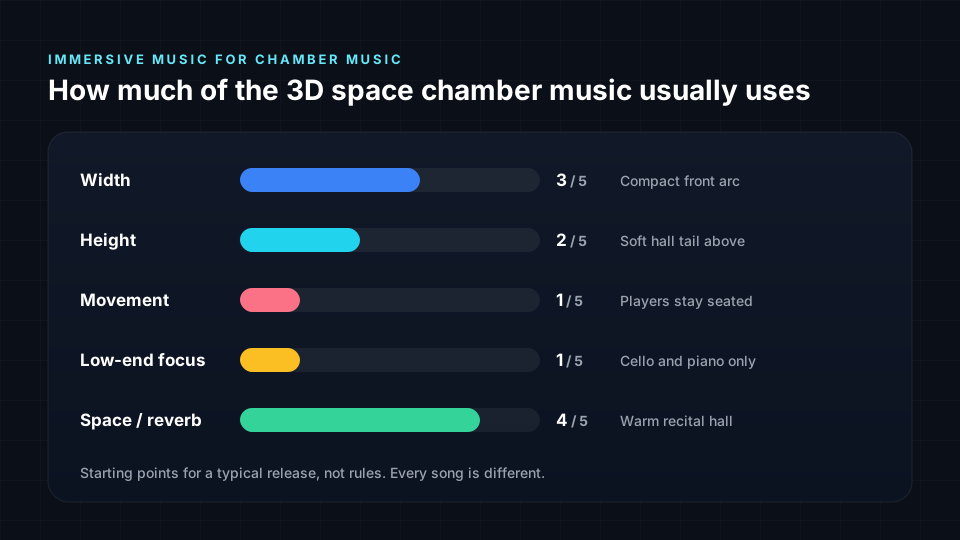
Space scores 4 because the room is part of the sound: chamber music was written for resonant salons and small halls. Width scores 3: a quartet or trio sits in a compact arc, not stretched around the listener. Height scores 2, from a soft, slightly raised hall tail. Low-end focus is 1 because only the cello and the piano's left hand carry the bass. Movement scores 1, as the players stay seated and the music moves through dialogue rather than panning.
Tips for an immersive chamber music mix
- Seat the players as they sit on stage. Use the standard quartet layout or the older one with violins facing each other.
- Keep the arc compact. About 60 to 80 degrees in front sounds natural; wider sounds like an orchestra.
- Put the piano behind and centred. It should support the strings or singer, not cover them.
- Use early reflections, not a long reverb. A long tail blurs fast passagework and bow detail.
- Do not move anything. Keep every player still, as in a real recital.
Chamber music styles: string quartet, piano trio and art song
The core placement holds for every form in this guide: players in a close arc in front, the room around and slightly above. What changes is the line-up and how close the listener should feel.
String Quartet
The string quartet is the central form of chamber music, from Haydn and Beethoven to Brahms, Debussy, Bartók and Shostakovich. The common modern seating runs first violin, second violin, viola and cello from left to right. Many groups put the cello inside the viola, and some seat the second violin on the right, facing the first. Place the four players in a shallow arc about 70 degrees wide, and keep the cello right of centre rather than in the middle, since its lines are part of the dialogue.
Piano Trio
The piano trio brings together piano, violin and cello, from Haydn and Beethoven's "Archduke" Trio through Schubert, Mendelssohn and Brahms to Ravel. On stage the piano sits at the back with its lid open, the violinist on the left and the cellist on the right. Place the piano centred and a little further back, wide enough to sound like a grand but not wrapped around the listener. Put the violin front left and the cello front right, close enough that the piano does not cover them. Piano quartets and quintets add the viola and second violin between them.
Art Song
Art song, called Lied in German and mélodie in French, sets poetry for voice and piano. Schubert, Schumann, Brahms and Hugo Wolf built the Lied tradition, and Fauré and Debussy did the same for French song. The singer stands in the bend of the piano, and the pianist is a full partner. Place the voice front centre and close, slightly in front of the piano, so every word is clear. Keep the room intimate, more salon than concert hall, and avoid widening the voice: it should feel like one person singing to you.
Related styles such as the wind quintet, the clarinet quintet and the violin sonata follow the same idea: keep every player in a close, fixed arc in front and let the hall surround you.
How to make immersive chamber music from stereo
Spatial9 can create spatial audio from a stereo track in a few steps:
- Upload your stereo master or your stems.
- Spatial9's AI separates and places each part, pulling the violins, viola, cello, piano and voice apart even from old mono or early stereo recordings and setting them in a close arc in front of a small recital hall.
- Preview it in binaural on headphones.
- Export Eclipsa Audio, ADM, binaural or Ambisonics.
- Publish a video. Create a YouTube-ready video with your immersive audio and publish it directly.
For related guides, read spatial audio for classical music and spatial audio for opera. Every guide is listed in spatial audio and immersive music by genre.
Frequently asked questions
Does this guide cover string quartet, piano trio and art song?
Yes. The string quartet sits in a shallow arc, first violin left and cello right. The piano trio centres the piano behind violin and cello. Art song puts the voice close at front centre in an intimate room.
Can I make a chamber music mix in Dolby Atmos or Eclipsa Audio?
Yes. The placements in this guide work for both. Spatial9 exports ADM, the standard file used by Dolby Atmos studios, as well as Eclipsa Audio for YouTube, so one immersive chamber music mix covers both. If you plan to release the Atmos version on Apple Music, build it from your original stems or multitracks, because Apple does not accept Atmos made from a finished stereo master. See where to publish spatial audio. You may also hear this called a 3D chamber music mix or chamber music in spatial audio.
Is spatial audio good for chamber music?
Yes. Chamber music is a dialogue between equal voices, and spatial audio gives each player a clear seat inside a real room.
Where should the cello go in an immersive string quartet mix?
Put it front right, at ear level, outside or just inside the viola depending on the seating. Never put it in the middle, because its lines answer the other players.
Should the piano surround the listener in an immersive piano trio?
No. Keep the piano centred and behind the strings. Wrapping it around the listener breaks the picture of three players sitting together.
How much reverb does immersive chamber music need?
Less than an orchestral mix. Use early side reflections and a gentle tail of around one and a half seconds, so bow strokes and fast runs stay clear.
Can I convert an old mono string quartet recording to spatial audio?
Yes. Spatial9 uses AI to separate the violins, viola and cello from a mono or early stereo master. Separation is never perfect, so keep the arc compact and the room simple.
Dolby and Dolby Atmos are trademarks of Dolby Laboratories. Spatial9 is not affiliated with or endorsed by Dolby Laboratories.
Sources
- Blauert, J. (1997). Spatial Hearing: The Psychophysics of Human Sound Localization, revised edition. MIT Press. Low-frequency, elevation, distance and motion cues.
- Mills, A. W. (1958). On the minimum audible angle. Journal of the Acoustical Society of America, 30(4), 237-246.
- Hebrank, J. and Wright, D. (1974). Spectral cues used in the localization of sound sources on the median plane. Journal of the Acoustical Society of America, 56(6), 1829-1834.
- Bronkhorst, A. W. (2000). The cocktail party phenomenon: a review of research on speech intelligibility in multiple-talker conditions. Acta Acustica united with Acustica, 86, 117-128.
- Litovsky, R. Y., Colburn, H. S., Yost, W. A. and Guzman, S. J. (1999). The precedence effect. Journal of the Acoustical Society of America, 106(4), 1633-1654.
- Barron, M. and Marshall, A. H. (1981). Spatial impression due to early lateral reflections in concert halls. Journal of Sound and Vibration, 77(2), 211-232.
- Neuhoff, J. G. (1998). Perceptual bias for rising tones. Nature, 395, 123-124.
- Bregman, A. S. (1990). Auditory Scene Analysis: The Perceptual Organization of Sound. MIT Press.
- Beranek, L. L. (2004). Concert Halls and Opera Houses: Music, Acoustics, and Architecture, second edition. Springer.
Take the best seat in the hall
Upload a track to Spatial9 and hear the violins, viola, cello and piano settle into a close arc around a small recital hall in minutes. Then export it or publish it straight to YouTube.