Spatial9 Academy: A Free Immersive Audio Course for University Students
Spatial9 Team ·
There is a moment every audio student remembers. You put on headphones, press play, and a sound appears behind you. Not on the left. Not on the right. Behind you, and a little above. Your body turns before your brain catches up. That moment is where this course begins.
Immersive audio is no longer a cinema luxury. YouTube accepts Eclipsa Audio, televisions and soundbars decode it, and AI can now do in minutes what used to take days in a specialist room. The tools are changing faster than any curriculum can follow. That is exactly why we built this course with the people who will shape what comes next: you.
Who this course is for
Spatial9 Academy is written for university students and recent graduates who want to work with sound. You might study music technology and dream of mixing albums in immersive formats. You might study film sound and want your dialogue, score and effects to wrap around an audience. You might study audio engineering and want to understand how AI models actually learn to place a sound in space.
No prior immersive experience is needed. You need curiosity, a pair of headphones and a quiet room. Each lesson explains its terms the first time they appear, and a key terms table closes every lesson so you can revise quickly before an exam or an interview.
What you will be able to do
- Explain how the brain locates sound in three dimensions and why headphones can recreate it.
- Speak the language of channels, objects, scenes and binaural with confidence.
- Describe how Spatial9 analyses music, generates a spatial arrangement with GravityLLM and renders it to open formats.
- Listen critically in a 3D audio engine and write precise, professional feedback.
- Create your first immersive mix from your own stems and export it in binaural.
- Position your skills for the roles that immersive audio and AI are creating right now.
The course map
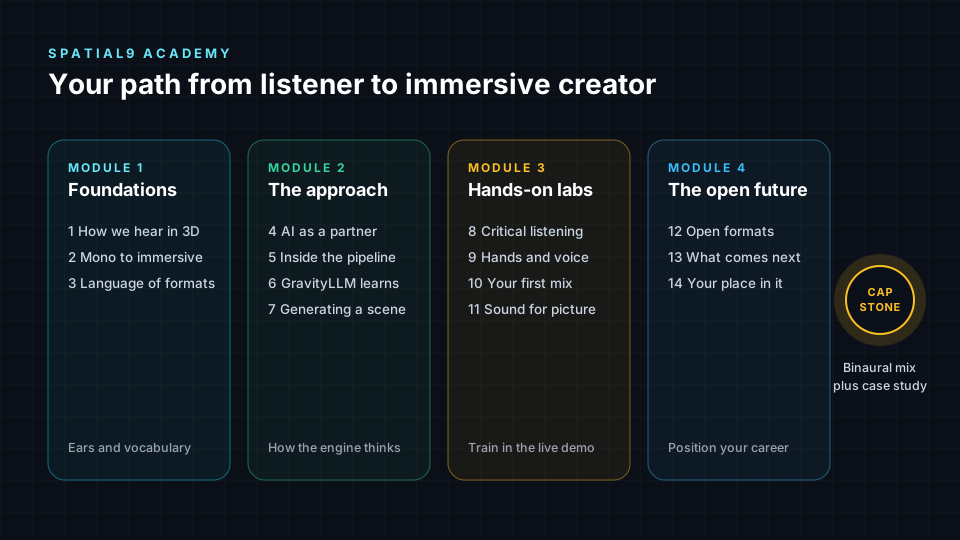
The course has four modules. Each one builds on the last, and the third module is entirely hands-on. You can follow it in order like a semester, or jump to the lesson your current project needs.
Module 1: Foundations
- How We Hear in 3D: The Science of Spatial Sound. Time and level differences, the ear's shape, distance and why head movement matters.
- From Mono to Immersive: A Short History of Spatial Audio. From the 1881 Theatrophone to Eclipsa Audio on YouTube.
- Channels, Objects, Scenes and Binaural. The four ways the industry describes space, and which delivery format fits which destination.
Module 2: The Spatial9 approach
- The Spatial9 Approach: AI as a Creative Partner. Our philosophy, where humans decide and where AI does the heavy lifting.
- Inside the Spatial9 Pipeline. From upload to publish-ready file, and when stems beat a stereo master.
- How GravityLLM Learns. Training data, loss curves, overfitting and the ethics of learning from real sessions.
- Generating a Spatial Scene. How a prompt becomes positions, distances and movement you can read and judge.
Module 3: Hands-on labs
- Lab 1: Critical Listening in a 3D Spatial Audio Engine. A five-pass listening protocol and a worksheet you will use for years.
- Lab 2: Shape an Immersive Mix With Your Hands and Voice. Gesture, voice and head movement as mixing tools.
- Lab 3: Your First Immersive Mix From Your Own Stems. Prepare stems, write a brief, review and export binaural.
- Sound for Picture: How AI Makes Video Audio Immersive. Dialogue, score, effects and off-screen space.
Module 4: The open future
- Open Formats and the Open Source Mindset. Why Eclipsa Audio and open standards protect your portfolio and your career.
- What Comes Next: AI Assistants, MCP and Acoustic Digital Twins. The research directions we are building toward.
- Your Place in the Future of Immersive Audio. Roles, skills, a 12-month roadmap and your capstone project.
How every lesson works
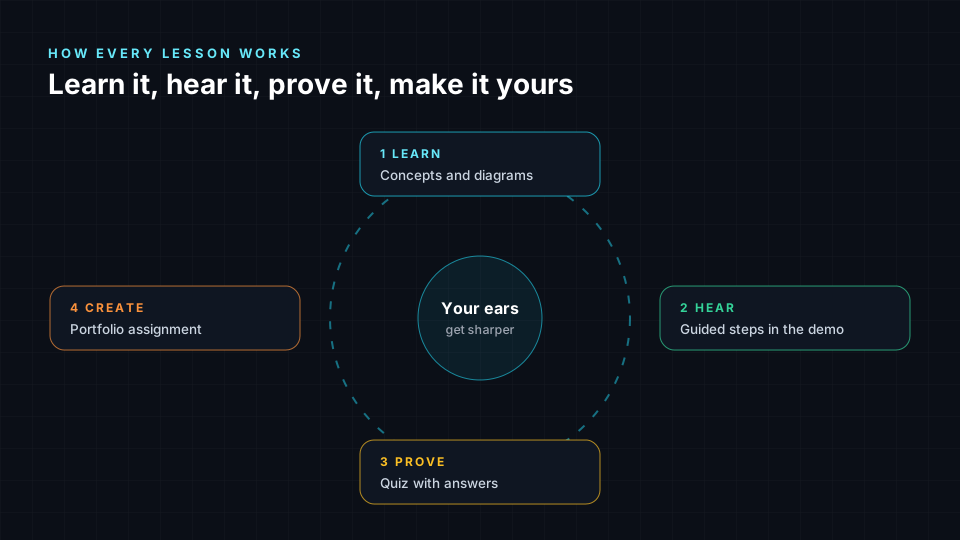
Reading about spatial audio is like reading about color. It only makes sense when you experience it. So every lesson follows the same four-step rhythm, and the second step always happens with headphones on in the Spatial9 demo.
| Step | What you do | What you keep |
|---|---|---|
| Learn | Read the concepts and study the diagrams. | A clear mental model and the key terms. |
| Hear | Follow numbered steps in the demo with exact button names. | Listening experience you can describe. |
| Prove | Answer the self-check questions, then read the answers. | Confidence that the idea has landed. |
| Create | Complete the portfolio assignment. | Evidence of skill that employers can see. |
Your training ground: the Spatial9 demo
The demo is where theory turns into sound. It is honest about what exists today and what is still on the road ahead, and learning to read those labels is part of thinking like a professional. Here is how each part of the demo connects to the course.
| Demo | Status | Where you use it |
|---|---|---|
| Music Transformation | Live | Lessons 1, 2, 3 and Labs 1, 2 and 3. |
| Video Transformation | Early access | Lesson 11. |
| Architecture | Illustration | Lessons 4 and 5. |
| Training | Illustration | Lesson 6. |
| Inference | Illustration | Lesson 7. |
| MCP Integration | Coming soon | Lesson 13. |
| Acoustic Digital Twin | Coming soon | Lesson 13. |
Live means you can hear it working right now. Early access means it is real but invite-only. Illustration means an interactive explanation of how the engine works, not a live model. Coming soon means a research direction we are actively building toward.
The student plan
Every lesson is free to read, forever. When you are ready to create, the Spatial9 student plan costs $9 and gives you two things that matter for a student: access to the demo environment and binaural exports of your own immersive mixes. Binaural plays on any pair of headphones, which makes it the easiest immersive format to share with a tutor, a client or a future employer.
You can sign up at app.spatial9.ai. You will need the student plan for Lab 3 and for the capstone project, and it is useful for the assignments in Module 3.
The capstone project
The course ends with one project that ties everything together. You take one song you have the rights to, write a creative brief, prepare the stems, create an immersive version with Spatial9, listen critically, refine it and export it in binaural. Then you write a short case study that explains your decisions. That case study is the kind of evidence that opens doors, because it shows taste, process and the ability to work with AI rather than be replaced by it.
For lecturers and educators
The course is designed to slot into an existing module on music production, sound for picture or audio technology. Lessons work as weekly pre-reading, the labs work as practical sessions in a lab with headphones, and the assignments can be marked as coursework. A full semester could run one lesson per week with the capstone as the final submission. Everything is public and free to link from your learning platform.
Frequently asked questions
Is Spatial9 Academy free?
Yes. All fourteen lessons, diagrams, quizzes and assignments are free to read on the Spatial9 blog. The optional student plan costs $9 and adds access to the demo environment and binaural exports, which you need for the hands-on mixing lab and the capstone project.
Do I need special equipment to take this immersive audio course?
No. A pair of headphones and a modern web browser are enough for every lesson. Binaural rendering recreates three-dimensional sound on ordinary headphones, so you do not need a room full of speakers to learn and practice.
Who is the course designed for?
It is designed for university students and recent graduates in music technology, film sound and audio engineering. Musicians, video creators and anyone curious about spatial audio can follow it too, because each lesson explains its terms from the ground up.
How long does the course take?
The fourteen lessons add up to roughly four hours of reading and guided practice, plus the time you spend on assignments. Many students follow one lesson per week across a semester and finish with the capstone project.
Start now
Put on your headphones and begin with Lesson 1: How We Hear in 3D. The first sound that appears behind you is the beginning of a career in a field that is still being invented, and there is room in it for you.