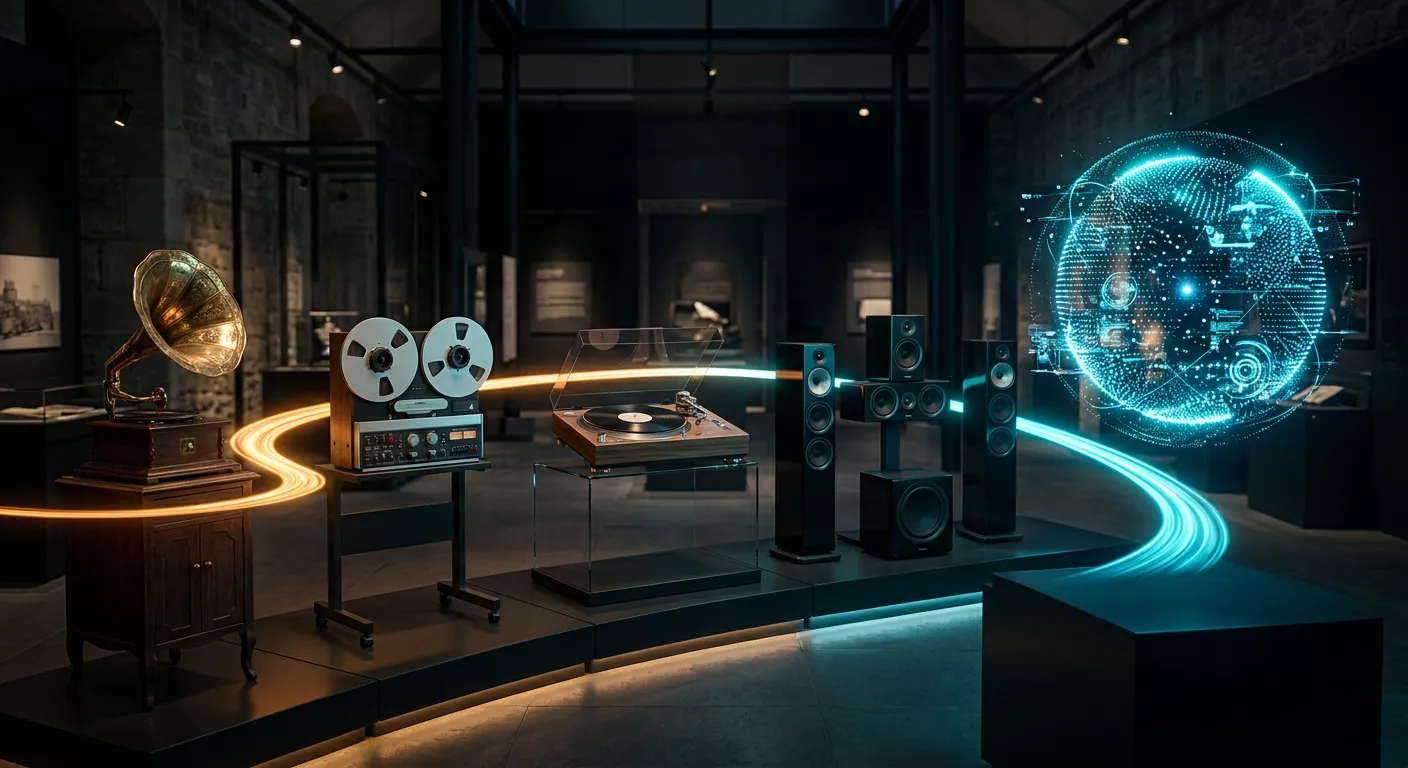
From Mono to Immersive: A Short History of Spatial Audio
Spatial9 Team ·
Lesson 2 of 14 in Spatial9 Academy, module 1: Foundations. Practice in the demo: Music Transformation.
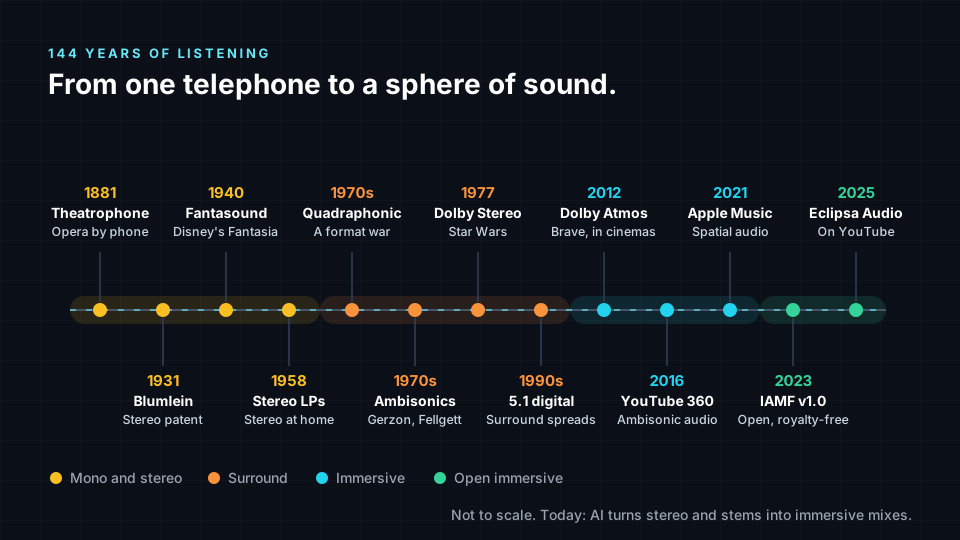
In 1881, visitors to an exhibition in Paris held two telephone receivers to their ears and heard an opera being performed elsewhere in the city. Because each ear heard a different microphone, the music had a sense of place. People were amazed.
That moment is the start of a story you are now part of. For more than a century, engineers, inventors and artists have chased one goal: to make recorded sound feel as real and as spacious as being there. Each generation got a little closer. Each one also hit a wall, and someone eventually found a way through it.
You are entering the field at a remarkable point in that story. Immersive playback is in phones, headphones, TVs and on YouTube. Open formats are free to use. AI can now do much of the heavy lifting that once took a specialist studio. The barriers that stopped earlier generations are falling, and your generation gets to decide what comes next.
What you will learn
- The key milestones of spatial audio from 1881 to 2025.
- Why stereo succeeded while quadraphonic sound struggled.
- How cinema drove surround and then immersive sound with height.
- How scene-based and object-based ideas freed mixes from fixed speaker layouts.
- The pattern behind every leap: removing a barrier of cost, equipment or format.
The first experiments: from Theatrophone to stereo
The Theatrophone was presented by Clement Ader at the Paris Electrical Exhibition in 1881. Microphones placed across the front of the stage of the Paris Opera fed pairs of telephone receivers, one for each ear. Listeners heard a left and a right signal, and with it, a sense of where the singers were. It was spatial audio before the word existed.
The next big step came from a British engineer at EMI, Alan Blumlein. In 1931 he filed a patent that described the core ideas of stereophonic sound, including ways to record and cut two channels into a single disc groove. Many of the techniques he described are still taught in recording courses today.
Cinema pushed further. For Disney's Fantasia in 1940, engineers built Fantasound, a multichannel system that could move sound around the theater. It was groundbreaking and expensive, and only a small number of theaters could install the equipment needed to play it.
Stereo reached homes when commercial stereo LPs arrived in 1958. Suddenly a family could hear a band spread across their living room. Stereo became the standard way to release music, and it still is.
The 1970s: quad, Ambisonics and cinema sound
In the 1970s, the music industry tried to go beyond stereo with quadraphonic sound: four channels, with speakers in the four corners of the room. The idea was exciting. The execution was not. Several incompatible quad systems competed, listeners needed new equipment, and nobody was sure which format would survive. That format war confused buyers, and quad faded.
At the same time, a different idea was being developed in the UK. Ambisonics, developed in the 1970s by Michael Gerzon, Peter Fellgett and colleagues, did not store speaker feeds at all. It captured the whole sound field around a point, as a scene that could be decoded later to whatever speakers you had. Ambisonics was decades ahead of its time. It would wait until virtual reality and 360 video to find its biggest audience. You can learn more in Ambisonics explained.
Cinema, meanwhile, made surround a success. Dolby Stereo brought multichannel sound to movie theaters in the 1970s, using a clever matrix that fit extra channels onto a film soundtrack. Star Wars in 1977 is the famous example. Audiences heard spaceships fly past and an orchestra fill the room, and they came back for more.
Digital surround and the home theater
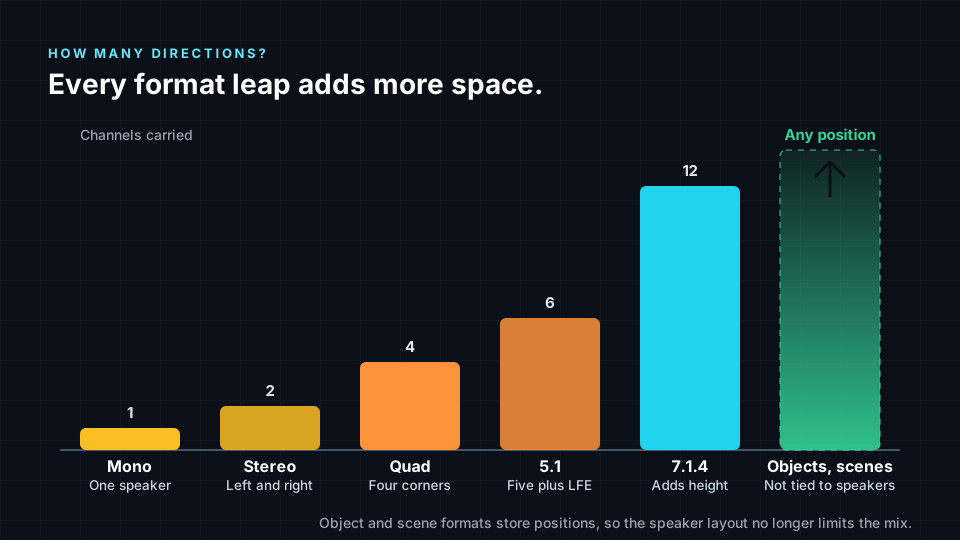
In the 1990s, 5.1 digital surround spread through cinemas and then into homes via DVD and home theater systems. The name describes the layout: five full-range channels (left, center, right, left surround, right surround) plus one low-frequency effects channel, the ".1".
Digital surround succeeded where quad failed for a simple reason: it rode on top of something people already wanted. Film fans bought DVD players for movies, and surround came with them. The barrier of special equipment shrank because the equipment was already in the room.
Surround also trained a generation of engineers to think beyond left and right. Film sound designers learned to use the rear channels for ambience and effects, and to keep dialogue anchored in the center. Those habits still shape immersive mixing today.
Immersive sound with height and objects
Surround was still flat. All the speakers sat roughly at ear level. The next leap added height.
In 2012, Dolby Atmos was introduced in cinemas, with Pixar's Brave among the first films released in the format. Atmos combined a channel bed with audio objects: individual sounds that carry position metadata and are rendered to whatever speakers a theater has. A helicopter could now be placed overhead as an object, rather than assigned to a specific speaker.
This was a conceptual revolution. With objects and scenes, a mix stores positions rather than speaker feeds. The playback system works out how to reproduce those positions. Formats stopped being tied to one room.
Headphones, streaming and open formats
The next barrier was the speakers themselves. Most people will never install ceiling speakers. But almost everyone owns headphones.
In 2016, YouTube began supporting spatial audio for 360 video, using first-order Ambisonics so the sound turned with the viewer's perspective. In 2021, Apple Music launched spatial audio, bringing immersive music to millions of headphone listeners. Binaural rendering, which you met in How We Hear in 3D, made a room full of speakers fit inside a pair of earbuds.
There was still one barrier left: licensing. Many immersive formats are proprietary. In 2023, the Alliance for Open Media published IAMF v1.0 (Immersive Audio Model and Formats), an open and royalty-free immersive audio format. Its consumer name is Eclipsa Audio. Spatial9 was part of the Eclipsa Audio debut with Google at CES 2025. YouTube has accepted Eclipsa Audio uploads since January 2025, and Samsung's 2025 TVs and soundbars play it. You can read the full story in Eclipsa Audio debuts at CES 2025 and why it matters in why open source matters for immersive audio.
Today: AI removes the next barrier
Even with open formats and headphones everywhere, one barrier remained: making the mix. Immersive mixing traditionally required stems, a specialist studio and many hours of skilled work per song. For most independent musicians, video creators and catalogs, that cost was out of reach.
This is where AI enters the story. At Spatial9, we turn stereo music or supplied stems into immersive mixes. Source separation estimates stems when needed. Our AI model, GravityLLM, generates the spatial arrangement: where each source sits, how far away it is, how high it is and how it moves. AI agents coordinate processing and rendering. And the engineer still directs the result: writing the brief, listening critically and approving delivery.
Look back at the pattern. The Theatrophone needed a telephone line. Fantasound needed custom theater equipment. Quad needed new hardware and a winning format. Surround needed a home theater. Atmos needed licensed tools and specialist rooms. Each leap that succeeded made one of those barriers smaller. AI is aimed at the last big one: the time and expertise needed to create the mix.
Try it in the demo
Wear headphones for this exercise. Music Transformation in the demo carries the badge Live, so you are hearing a real, working system.
- Open /demo/music and choose the tile "3D Spatial Audio" under "Choose a mode".
- In "Master Controls", set "Volume" to a comfortable level and press play.
- Switch the "Spatial Audio" toggle off. You are now hearing the stems without 3D positioning. Think of this as the stereo era: everything lives on a line between your ears.
- Switch "Spatial Audio" back on. Listen for sounds moving out of your head, above you and around you. This is the jump that took the industry more than a century.
- Under "Spatial Format", select "Spatial Sphere" (Higher-Order Ambisonics, HOA). Listen to how the scene feels as a continuous sphere, the idea Gerzon and Fellgett pioneered in the 1970s.
- Now select "Immersive Mix (ADM)" (Channel and Object-based spatial audio). This is the channel and object paradigm that cinema introduced with height and objects.
- Switch back and forth several times. Write down two differences you notice in width, height or envelopment. There is no right answer; train your ears to describe what they hear.
Key terms
| Term | Meaning |
|---|---|
| Theatrophone | An 1881 system that let listeners hear live opera through pairs of telephone receivers. |
| Stereophonic sound | Two-channel sound that creates a stereo image between two speakers, patented in key forms by Alan Blumlein in 1931. |
| Quadraphonic | A 1970s four-channel home format that struggled because of competing, incompatible systems. |
| Ambisonics | A scene-based method that captures a full sphere of sound, decodable to any speaker layout or headphones. |
| 5.1 | Five full-range channels plus one low-frequency effects channel. |
| Audio object | A sound plus position metadata, rendered to whatever playback system is available. |
| IAMF | Immersive Audio Model and Formats, an open royalty-free format from the Alliance for Open Media, known to consumers as Eclipsa Audio. |
Check your understanding
- What made the 1881 Theatrophone an early example of spatial audio?
- Why did quadraphonic sound struggle in the 1970s?
- What is the key difference between a channel-based mix and an object-based mix?
- Which year did YouTube begin accepting Eclipsa Audio, and who publishes IAMF?
- Name the barrier that AI-generated immersive mixing aims to remove.
Answers
- Each ear received a signal from a different microphone position, so listeners heard a sense of where performers were on stage.
- Several incompatible systems competed, listeners needed new equipment, and the uncertainty discouraged buyers.
- A channel-based mix stores feeds for specific speakers, while an object-based mix stores sounds plus positions and renders them to any layout.
- YouTube began accepting Eclipsa Audio in January 2025, and IAMF is published by the Alliance for Open Media.
- The time, cost and specialist expertise needed to create an immersive mix.
Assignment
Create a "history listening playlist" of six tracks or clips, one for each era in this lesson: mono, stereo, surround, immersive with height, headphone spatial audio and open immersive. For each item, write 80 to 120 words on what the format made possible, what barrier it removed, and what you hear. Present it as a one-page timeline poster (PDF or image) that a first-year student could understand at a glance.
Frequently asked questions
What was the first spatial audio system?
The Theatrophone, shown by Clement Ader in Paris in 1881, is often described as the first spatial audio experience, because listeners heard a live opera through two telephone receivers that each carried a different microphone signal.
Who invented stereo sound?
Alan Blumlein, an engineer at EMI, filed a 1931 patent that described the key principles of stereophonic recording and reproduction, and commercial stereo LPs reached homes in 1958.
What is the difference between surround sound and immersive audio?
Traditional surround such as 5.1 places speakers around the listener at roughly ear level, while immersive audio adds height and often uses objects or scenes so sounds can be placed anywhere in 3D space.
Is Eclipsa Audio the same as IAMF?
Yes, Eclipsa Audio is the consumer name of IAMF, the open and royalty-free Immersive Audio Model and Formats specification from the Alliance for Open Media, published as version 1.0 in 2023.
Dolby and Dolby Atmos are trademarks of Dolby Laboratories. Spatial9 is not affiliated with or endorsed by Dolby Laboratories.
Next step
You now know where immersive audio came from. In the next lesson, Channels, Objects, Scenes and Binaural: The Language of Immersive Formats, you will learn exactly how today's formats describe space and which one to deliver for each destination. Return to the Spatial9 Academy course home any time to see the full course.