
Open Formats and the Open Source Mindset: Why Eclipsa Audio Matters to Your Career
Spatial9 Team ·
Lesson 12 of 14 in Spatial9 Academy, module 4: The open future.
Every mix you make is a small piece of your future. It goes into your portfolio. It gets sent to a supervisor, a client or a festival. Years from now, someone might want to hear it again.
Whether they can depends on a choice you rarely think about: the format. Some formats are owned and controlled by one company. Others are open standards with a public specification that anyone can read, implement and build on.
This lesson opens Module 4, The open future. We start here because the formats you choose shape more than playback. They shape what you can learn, what you can build and how long your work will last. We will also share where our own open source values come from, and show you how to take your first steps as a contributor.
What you will learn
- What makes a format open, and how Eclipsa Audio (IAMF), ADM and Ambisonics fit that idea.
- Four reasons open standards matter to your career: learnable, portable, buildable and free to begin.
- The open source mindset behind Spatial9, rooted in the Apache community value of community over code.
- A practical ladder of ways to contribute to open source as an audio student.
- How to explore the public IAMF specification, the libiamf decoder and the Eclipsa Audio plugin.
What makes a format open
An open format is one where the rules are public. The specification is published. Anyone can read it, write software that follows it, and test that their software behaves correctly. No single company decides who is allowed to play your work.
Here are the three open approaches you have met in this course.
| Format | What it is | Why it counts as open |
|---|---|---|
| Eclipsa Audio (IAMF) | The consumer name for the Immersive Audio Model and Formats standard from the Alliance for Open Media. | Royalty-free licence, public specification since version 1.0 in 2023, and an open source reference decoder called libiamf. |
| ADM | The Audio Definition Model, a metadata standard that describes channels, objects and scenes. | An open ITU standard, supported by tools such as the open source EAR Production Suite. |
| Ambisonics | A way of capturing and describing a full sphere of sound. | A widely implemented open approach used across many tools and platforms. |
Eclipsa Audio supports Opus, FLAC, LPCM and AAC-LC codecs. YouTube has accepted it since January 2025. Samsung 2025 TVs and soundbars support it. Spatial9 was part of the Eclipsa Audio debut at CES 2025 with Google. If you want the full story of that launch, read Eclipsa Audio debut at CES 2025. For a refresher on the format landscape, revisit Immersive Audio Formats.
Why open standards matter to your career
You might wonder why a student should care about licensing and specifications. The answer is simple. Open standards give you four advantages that compound over a whole career.
Learnable
A public specification means you can learn exactly how the format works. You do not need to guess or wait for a training course you cannot afford. You can read how audio elements, mix presentations and loudness information are described. That depth of understanding sets you apart in interviews and in the studio.
Portable
Your portfolio needs to play wherever it is heard. Work delivered in an open format can be played by any tool that implements the standard. Because the specification is public, new players can be built in the future, even if today's tools disappear. That makes your work more likely to last.
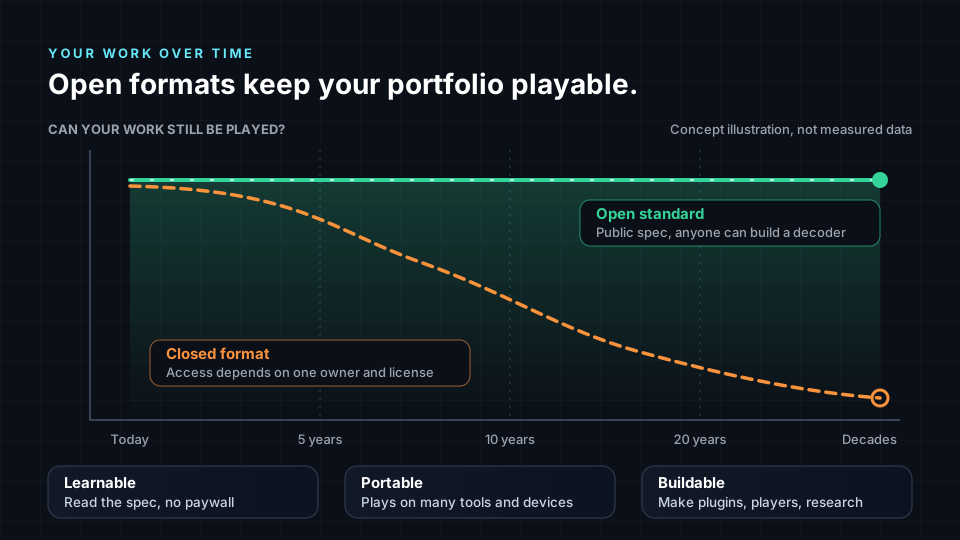
Buildable
Open standards invite you to build. You can write a plugin, a player, a conversion script, a test tool or a research prototype. Google released an open source Eclipsa Audio DAW plugin in 2025. The EAR Production Suite is an open source toolset for ADM. These projects show what is possible, and they are places where you can learn from real code.
Free to begin
Eclipsa Audio uses a royalty-free licence. You do not need to pay a fee to read the specification, experiment with the reference decoder or deliver to platforms that accept it. That lowers the barrier for students, independent artists and small studios.
The open source mindset behind Spatial9
Members of the Spatial9 team come from the Apache Software Foundation community and companies such as Cloudera and Databricks. That background shapes how we think about immersive audio.
The Apache community is known for the phrase community over code. The idea is that healthy projects depend on people who trust each other, review each other's work openly and make decisions together. Great code follows from a great community, not the other way around.
We bring that mindset to immersive audio in a few concrete ways. We deliver to open formats including Eclipsa Audio (IAMF), ADM and Ambisonics, alongside binaural. We avoid locking your mixes into a format that only one tool can open. And we share what we learn through free resources like this course. You can read more in Why open source matters for immersive audio and in The Spatial9 Approach.
For you, the lesson is broader than any one company. Open source is a way of working. It values clear documentation, honest feedback, small improvements and shared credit. Those habits will make you a better collaborator in any studio, open source or not.
How to contribute as an audio student
You do not need to be an expert programmer to contribute to open source. Many of the most valuable contributions come from people who use the tools, test them carefully and explain them well. Think of it as a ladder. Each step is a real contribution, and you can climb at your own pace.
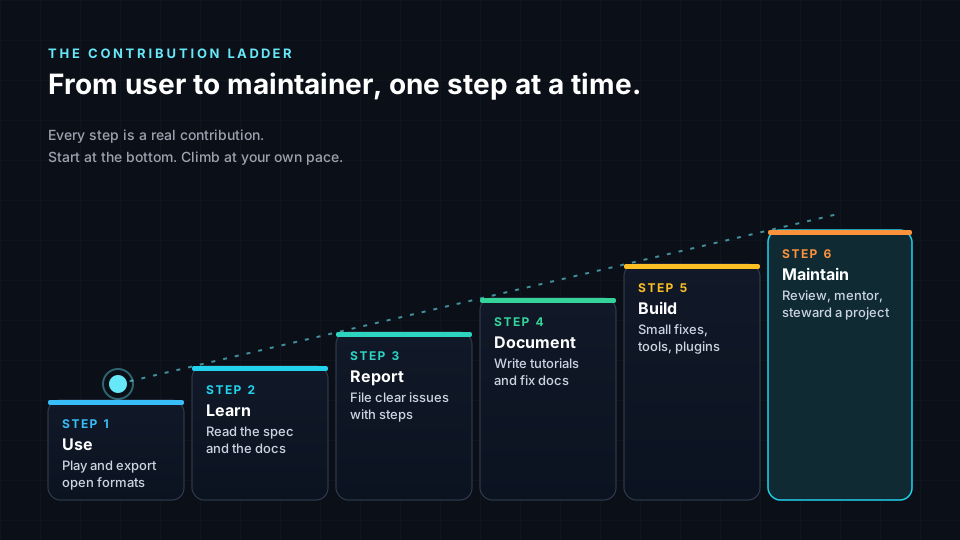
- Use. Play and export open formats. Deliver a binaural or IAMF version of your own work and notice what works and what does not.
- Learn. Read the project documentation and the public specification. Start with the overview sections and build up to the details.
- Report. File clear issues. Describe what you did, what you expected, what happened instead, and which software versions you used. A good bug report is a gift to maintainers.
- Document. Write tutorials, fix confusing passages in the docs, or record a short walkthrough. Audio students are often better at explaining workflows than the engineers who wrote the code.
- Build. Make small fixes, scripts, test files or plugin improvements. Start small. A tiny, well-tested change is far more welcome than a large, surprising one.
- Maintain. Over time, review other people's work, help newcomers and steward a project. This is where community over code becomes your daily practice.
A few habits make every contribution better.
- Read the contributing guide first. Most projects explain how they want issues and changes submitted.
- Search before you post. Your question or bug may already be answered.
- Test with conformance material. Standards projects often provide test streams so implementations can check they behave correctly. Running them and reporting results is valuable work.
- Be patient and kind. Maintainers are often volunteers or busy engineers. Clear, polite communication gets results.
Try it in the demo
There is no dedicated demo for this lesson. Instead, use this hands-on exploration to connect open formats to what you hear and to the real resources behind them.
- Put on headphones and open /demo/music. Note the "Best Experienced with Headphones" notice.
- Under "Spatial Format", select "Spatial Sphere", which uses Higher-Order Ambisonics. Press play and toggle "Spatial Audio" on and off a few times.
- Switch to "Immersive Mix (ADM)", which is channel and object-based. Listen to the same passage again with "Spatial Audio" on.
- Write three sentences describing the difference you hear between the two formats, for example in width, focus and sense of height.
- Visit the AOMedia IAMF specification page. Find the specification itself and skim the overview so you understand its main building blocks.
- Open the libiamf repository on GitHub. Read the README, look at how issues are written, and note how the project describes building and testing the decoder.
- Read Google's post Introducing the open source DAW plugin for Eclipsa Audio. List one thing you would like to try with the plugin.
- Pick one rung on the contribution ladder that you could realistically do this month, and write it down.
Key terms
| Term | Meaning |
|---|---|
| Open standard | A format whose specification is public, so anyone can implement it. |
| Royalty-free | A licence that does not require paying fees to use the standard. |
| IAMF | Immersive Audio Model and Formats, the AOMedia standard behind Eclipsa Audio. |
| Reference decoder | An implementation that shows how a format should be decoded. For IAMF this is libiamf. |
| Conformance streams | Test files used to check that an implementation follows the standard. |
| Community over code | The Apache community idea that healthy collaboration matters more than any single piece of code. |
| Issue | A report filed on a project to describe a bug, a question or a proposed improvement. |
Check your understanding
- What makes a format open rather than closed?
- Name the four career advantages of open standards covered in this lesson.
- Which organization publishes IAMF, and what is the name of its open source reference decoder?
- What does community over code mean?
- What should a good bug report include?
Answers
- An open format has a public specification that anyone can read and implement, so no single company controls who can play the work.
- Open standards are learnable, portable, buildable and free to begin.
- The Alliance for Open Media publishes IAMF, and libiamf is its open source reference decoder on GitHub.
- It is the Apache community idea that healthy projects depend on trust, open review and shared decisions, and that good code follows from a good community.
- What you did, what you expected, what actually happened, and which software versions you used, written so someone else can reproduce it.
Assignment
Write an open format portfolio statement and make one small contribution. Your deliverable has two parts. First, a one-page statement for your portfolio explaining which formats you deliver your work in and why, covering at least two of the four advantages from this lesson. Second, evidence of one contribution from the ladder. This could be a tutorial post about exporting a binaural or IAMF version of a mix, a clear issue filed on an open audio project, a correction to documentation, or a written test report from playing sample files. Include a link or screenshot and a short reflection on what you learned about how the project works.
Frequently asked questions
Do I need to know how to code to contribute to open source audio projects?
No, because using the tools carefully, filing clear issues, testing files and writing tutorials are all valuable contributions, and you can add coding later if you want to.
Is Eclipsa Audio the same as IAMF?
Yes, Eclipsa Audio is the consumer name for IAMF, the Immersive Audio Model and Formats standard published by the Alliance for Open Media under a royalty-free licence.
Where can I hear or deliver Eclipsa Audio today?
YouTube has accepted Eclipsa Audio since January 2025 and Samsung 2025 TVs and soundbars support it, while our guide on where to publish spatial audio covers other destinations.
Why does Spatial9 care so much about open formats?
Members of our team come from the Apache Software Foundation community, and we believe your mixes should stay yours and play anywhere, which is why we deliver to Eclipsa Audio (IAMF), ADM, Ambisonics and binaural.
Next step
You now understand why open formats protect your work and open doors for your career. Next, we look ahead to research that could change how you work every day. Continue to What Comes Next: AI Assistants, MCP and Acoustic Digital Twins, or return to the Spatial9 Academy course home.