The Effects Rack: 1,459 Immersive and Research Effects Explained
Spatial9 Team · · 8 min read
Lesson 13 of 24 in Spatial9 Academy, module 3: Inside the Immersive Classroom. Practice in the demo: Music Transformation.
Key takeaways
- The Effects Rack holds 1,459 effects in 16 collections and applies a chain of up to eight slots to the whole mix or to any single stem.
- Sound flows top to bottom through the chain; each slot has bypass, parameters, reordering and a 0 to 100% dry/wet Mix.
- Research collections draw on Haas, Chowning, Blauert, Karplus-Strong, Peterson and Barney, Roads, Schroeder, Moorer, Dattorro, Zwicker and ISO 226.
- The Preview player compares Dry (A) and Effect (B) on a stem, the mix or a beep, and effects are included in exports by default.
Effects shape character. A reverb tells the listener what room they are in. A delay adds rhythm and depth. A granular cloud turns a note into weather. In immersive audio, effects also shape space itself: a reverb can fill the ceiling, and a psychoacoustic trick can make a sound seem wider than its position.
The classroom Effects Rack holds 1,459 effects in 16 collections. That is a lot, so this lesson gives you a map, the science behind the most interesting collections, and a safe way to try things.
What you will learn
- How to open the Effects Rack and choose what it applies to.
- How a chain of up to eight slots processes sound from top to bottom.
- What each of the 16 collections is for, with real examples.
- The research behind Mind Tricks, Sound Hacks, Time Benders and Academic Lab.
- The 28 processors every effect is built from.
- How to use the Preview player to compare dry and effect.
Opening the rack
Open Controls and press Effects Rack ("7.1.4 reverbs, NASA & research FX"). The badge on the button shows how many effects you have loaded. The rack header reads "1459 effects in 16 collections, or describe your own".
On the left, Apply to chooses the target: Whole mix, or any single stem. Each stem has its own chain, so you can put a hall on the pad and a bit crusher on the stabs without either touching the other.
The chain
The chain shows "{n}/8 slots. Sound flows top to bottom." Order matters. A distortion before a reverb sounds like a distorted instrument in a room. A reverb before a distortion sounds like a distorted room.
Every slot has:
- A power button to bypass it without removing it.
- An expand control to open its parameters.
- Move up and Move down to change order.
- Remove.
- Mix, from 0 to 100%, an equal dry/wet blend.
Preview plays the whole chain and Clear all empties it. Chains are saved to your account; if you are not signed in you will see "Sign in to save".
The library
The library search accepts words such as "reverb", "Saturn" or "robot". It opens on NASA Sonification. Every row has a headphones button to preview and an Add button.
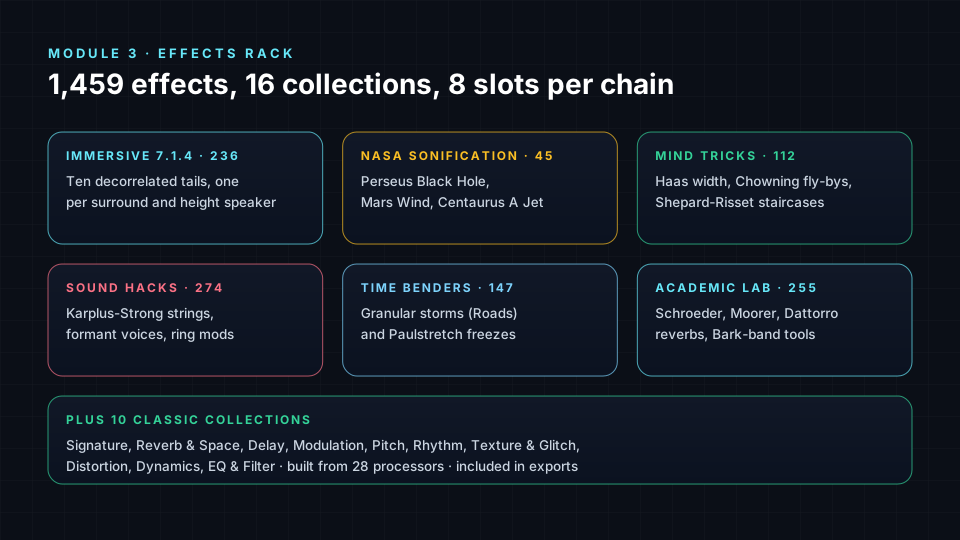
| Collection | Effects | What it is for |
|---|---|---|
| Immersive 7.1.4 | 236 | Reverbs and space designed for the 12-speaker room |
| NASA Sonification | 45 | Textures inspired by sonified space data |
| Mind Tricks | 112 | Psychoacoustic illusions of width, distance and motion |
| Sound Hacks | 274 | Synthesis and voice tricks from classic research |
| Time Benders | 147 | Granular and time-stretch effects |
| Academic Lab | 255 | Landmark reverb and hearing-model designs |
| Signature | 14 | Big, named looks for fast inspiration |
| Reverb & Space | 33 | Everyday rooms and halls |
| Delay | 48 | Echoes and rhythmic repeats |
| Modulation | 53 | Chorus, flanger, phaser and more |
| Pitch | 29 | Pitch shifting and harmonies |
| Rhythm | 17 | Gates and rhythmic chopping |
| Texture & Glitch | 46 | Grit, artefacts and broken sounds |
| Distortion | 38 | Saturation and drive |
| Dynamics | 24 | Compression and control |
| EQ & Filter | 88 | Tone shaping and sweeps |
The research collections, explained
Immersive 7.1.4
These effects use the full speaker room. Reverbs come in balances called Front-Weighted, Balanced, Enveloping and Sky Dome, with ten decorrelated tails, one for each surround and height speaker. Decorrelated means each tail is slightly different, so the room feels wide and real instead of like one reverb copied everywhere. Try "7.1.4 Cathedral Deep Sky Dome", "7.1.4 Concert Hall Close Front-Weighted", "Halo Bed Wide Open Enveloping" or "Cinema Dome Hall 60% Balanced". Others shape space more surgically: "Early Reflections 45% Treated", "Skylight Lift 8k 6dB", "Gravity Drop" and "Distance 15m Humid Air".
NASA Sonification
Sonification turns data into sound. These effects take inspiration from NASA sonification projects: "Perseus Black Hole", "Bullet Cluster Dark Matter", "Eta Carinae Outburst", "Centaurus A Jet", "Jupiter Lightning Whistlers" and "Mars Wind". They are perfect for pads and transitions that need to feel vast. The full story of these missions, and of the MIT research behind the next collections, is in Lesson 14: NASA Sonification and MIT Sound Hacks.
Mind Tricks
Psychoacoustics studies how the brain interprets sound. "Phantom Width 12ms" uses the precedence effect described by Haas in 1951: a short delay on one side makes a sound wider without moving it. "Fly-By 1/4 Wide Far" follows John Chowning's 1971 work, combining panning, distance and Doppler shift. "Gravity Well Overhead" draws on Jens Blauert's research on height cues. "Dummy Head Dome" uses MIT KEMAR head-related transfer functions. "Infinite Staircase Ascending" is a Shepard-Risset glissando, a sound that seems to rise forever.
Sound Hacks
These are classic synthesis ideas turned into effects. "Ghost String C3 Glass Bell" uses the Karplus-Strong plucked-string algorithm. "Robot Throat "Ah"" and "Ghost Choir "Ee"" use vowel formants measured by Peterson and Barney. "Metal Mouth 180Hz Square Heavy" uses ring modulation as found in Csound. "Jet Stream" is a flanger, and "Hyper Gesture" nods to Tod Machover's hyperinstruments.
Time Benders
"Particle Storm 50ms x35" follows Curtis Roads' work on microsound, cutting audio into tiny grains and scattering them. "Time Stop" freezes a moment using the Paulstretch technique.
Academic Lab
This collection rebuilds landmark designs. "Hall of Mirrors" follows Manfred Schroeder's early artificial reverb. "Velvet Room" follows James Moorer's reverb work. "Liquid Chrome Plate" follows Jon Dattorro's plate design. "Cochlea Laser" and "Cochlea Push" work in the Bark bands described by Eberhard Zwicker. "Midnight Loudness 40 phon" applies ISO 226 equal-loudness contours, so a quiet mix keeps its bass and treble.
Signature
When you want a whole look in one click: "Vaporwave", "Stadium", "Robot", "80s Gated Drum", "Cyberpunk", "Haunted House", "Hyperpop" and "Ice Cave".
The 28 processors
Every effect is built from a set of 28 processors: 7.1.4 Reverb, 7.1.4 Speaker Bed, Studio Reverb, Early Reflections, Height Cue EQ, Distance, Filter, 3-Band EQ, Compressor, Drive, Bit Crusher, Delay, Reverb, Chorus, Flanger, Phaser, Tremolo, Auto Pan, Vibrato / Wobble, Ring Modulator, Pitch Shift, Granular Cloud, Resonator, Vowel Filter, Spectral Sweep, Rhythm Gate, Stereo Widener and Split-Band Delay. Tempo-synced effects follow the session BPM, 125 for Echoes. When you expand a slot, you are editing these processors directly.
Preview before you commit
Press the headphones icon on any effect to open the Preview player, a small card you can drag anywhere. Choose Preview on: Track (the selected stem), Mix or Beep, a neutral test sound that reveals what the effect does by itself. Choose a loop of 4s, 8s, 16s or Full. Click or drag on the waveform to scrub, and drag the loop edges to focus on a phrase. It starts at the loudest part or your current playhead and pauses the main player.
The Dry (A) and Effect (B) controls crossfade between the original and the processed sound. Keyboard shortcuts make it fast: Space to play or pause, A for dry, B for effect, left and right arrows to move one second. When you like it, press Add to chain.
Effects in your export
Effects are included in exports by default, both whole-mix and per-stem chains. What you hear is what you deliver. Class share links are different: they carry positions and movements only, not effects.
Check yourself
- How many slots does a chain have, and which way does sound flow?
- What does decorrelated mean for a 7.1.4 reverb?
- Which researcher's 1951 work is behind "Phantom Width 12ms"?
- What does the Beep preview reveal?
- Are effects included in exports?
Answers
- Eight slots, flowing top to bottom.
- Each surround and height speaker gets a slightly different tail, so the space feels wide and natural.
- Haas, who described the precedence effect.
- What the effect does on its own, without the music.
- Yes, by default, for both the whole mix and each stem.
Assignment
Build three chains for Echoes: a 7.1.4 reverb on the whole mix, a Mind Trick on one pluck, and a Time Bender on a transition. For each, write the effect names, the slot order, the Mix percentage and one sentence on what you heard in the A/B preview.
Frequently asked questions
How many effects does the Spatial9 classroom include?
The Effects Rack includes 1,459 effects in 16 collections, from Immersive 7.1.4 reverbs and NASA Sonification to Academic Lab and classic EQ, delay and distortion.
Can I put different effects on different stems?
Yes, choose a stem under Apply to and it gets its own chain of up to eight slots, separate from the whole-mix chain.
What is a 7.1.4 reverb?
A 7.1.4 reverb sends a separate, decorrelated tail to each surround and height speaker so the room surrounds and covers the listener instead of sitting in front.
Are the research effects based on real studies?
Yes, collections such as Mind Tricks, Sound Hacks, Time Benders and Academic Lab are modelled on published work by researchers including Haas, Chowning, Karplus and Strong, Schroeder, Moorer, Dattorro, Zwicker and Roads.
Next step
You can now pick from 1,459 effects. Next, learn the science behind the NASA and research collections in NASA Sonification and MIT Sound Hacks: The Science Behind the Effects. After that, invent your own by describing it or making the sound with your voice in Classroom Lab 3: Design Audio Effects With Words and Your Voice, or return to the Spatial9 Academy course home.
The full lesson is free with a Spatial9 account.