Spatial Audio & Immersive Music for Thrash Metal: Speed Metal, Crossover Thrash & Bay Area Thrash
Spatial9 Team · · 10 min read
Part of the series Spatial audio and immersive music by genre.
Key takeaways
- In a spatial thrash metal mix the kick, snare and bass stay locked in the centre, while rhythm guitars sit hard left and right and solos, gang vocals and cymbals spread around the listener.
- Giving fast guitar solos their own position away from the rhythm guitars helps the brain hear the lead and the riff as separate layers, an effect known as auditory stream segregation.
- A short, dry room keeps fast picking sharp, because the brain locates a sound by its first arrival and long reverb would only smear the riff.
- The thrash metal immersion profile scores width 4, height 2, movement 3, low-end focus 4 and space 2 out of 5.
Thrash metal took shape in the early 1980s, when young bands combined the twin guitars of the New Wave of British Heavy Metal with the speed and aggression of hardcore punk. The San Francisco Bay Area became its best-known home, alongside scenes in Los Angeles, New York and New Jersey, and Germany's Ruhr region. Metallica, Slayer, Megadeth and Anthrax became known as the big four. The sound is fast, often 160 to 220 BPM or more, with downpicked, palm-muted riffs, the driving skank beat, double kick, barked vocals and fast, technical solos. Production is usually tight and dry, with little reverb, so every riff hits hard and clean. Thrash is precise rather than atmospheric, and that precision is exactly what spatial audio can separate and sharpen. This guide covers how spatial audio for thrash metal works, where to place each element and how to make an immersive thrash metal mix. For the basics, see what spatial audio is.
Why thrash metal works in spatial audio
Thrash is all about tightness. Two rhythm guitars play the same riff in perfect time, the bass locks to the kick, and the snare cracks on every beat at high speed. In stereo the solos, gang shouts and cymbals all fight that wall for space. In an immersive mix the drums and bass hold the centre, the rhythm guitars stay hard on each side, and the solos, shouts and cymbals each get their own place around the listener.
The rule: a tight, centred engine with riffs hard on each side. The drums, bass and rhythm guitars never move, while solos and gang vocals add the energy around them.
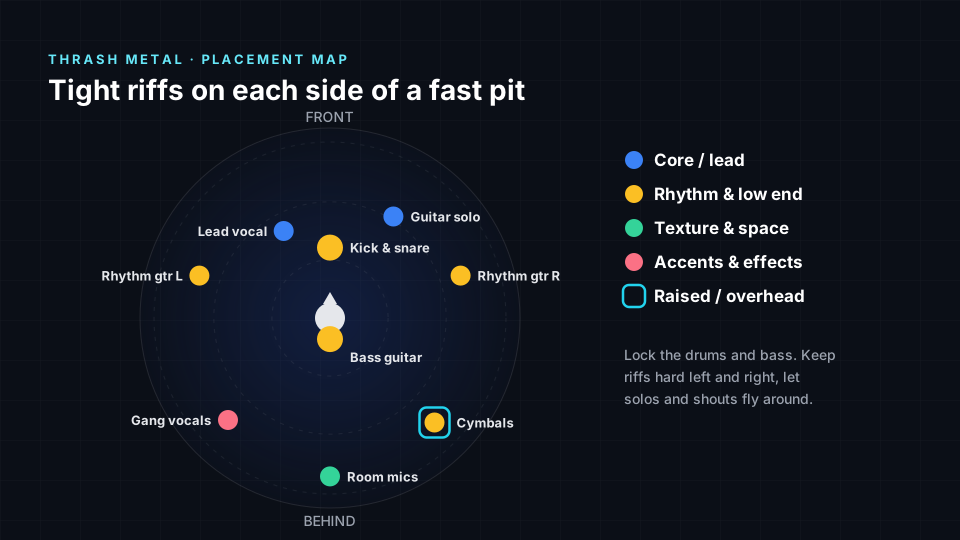
Immersive music for thrash metal: what listeners hear
- Riffs that hit from both sides. Palm-muted guitars punch from the left and right in perfect time.
- A drum engine in front. Kick and snare drive straight at the listener at full speed.
- Solos that fly past. Fast leads dart across the front of the stage.
- A crowd at your back. Gang vocals shout the chorus from behind.
Where to place each element in a thrash metal mix
| Element | Position | Height | Why it works |
|---|---|---|---|
| Kick & snare | Front centre | Ear level | Fast double kick and skank beat |
| Bass guitar | Centre | Ear level | Locks to the kick under the riff |
| Lead vocal | Front left | Ear level | Barked lines close and dry |
| Rhythm gtr L | Left | Ear level | One take of the palm-muted riff |
| Rhythm gtr R | Right | Ear level | A second take for a tight wall |
| Guitar solo | Front right, moving | Ear level | Fast solos that dart across |
| Gang vocals | Behind left | Ear level | A shouting crowd behind you |
| Cymbals | Behind right | Raised | Crashes and china hits above |
| Room mics | Behind | Ear level | A small, tight room for punch |
The psychoacoustics behind thrash metal placement
Every position in the table above follows how the ear and brain locate sound. Here is the reason behind the main choices for thrash metal.
- Bass and kick stay centred. The ear finds almost no direction in frequencies below roughly 80 to 100 Hz, so the thrash bass and kick gain nothing from being spread. Keeping them centred and mono keeps the low end tight on any system, which is what holds the fast riffs together.
- Solos split from the riff. The brain groups sounds into streams by pitch, timing and direction. This is auditory stream segregation (Bregman). Giving the solo its own position, away from the rhythm guitars, lets the ear follow fast lead lines over the riff instead of hearing one blur.
- Vocal off the guitars. A barked vocal and a distorted guitar share the same midrange. Sounds mask each other far less when they come from different directions, which is spatial release from masking, so a vocal slightly off centre stays clear over the wall.
- Tight, short room. When a sound and its reflections arrive close together, the brain locates it by the first arrival. This is the precedence effect. A short, dry room keeps every hit sharp and in place, while long reverb would smear the fast picking.
The immersion profile for thrash metal
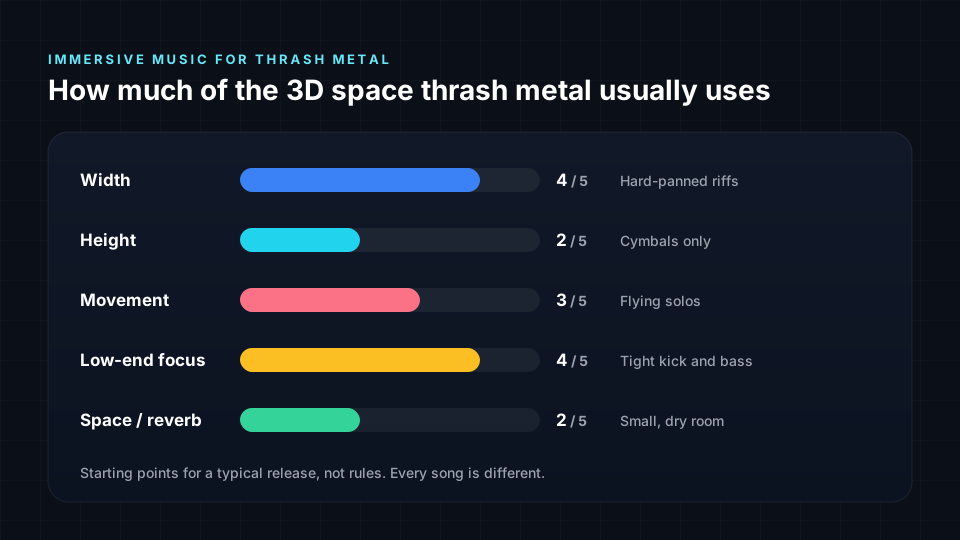
Width is high because the double-tracked rhythm guitars sit hard on each side. Low-end focus is high because the kick and bass must stay tight and punchy at high speed. Movement is moderate: the riff and drums stay fixed, while solos and gang vocals add motion. Height and space stay low because thrash lives at ear level in a small, dry room, with only the cymbals raised.
Tips for an immersive thrash metal mix
- Keep the low end mono. Kick and bass must stay locked together in the centre at every tempo.
- Keep the rhythm guitars fixed. Hard left and hard right, never moving, so the riff stays tight.
- Use the solo for motion. Let leads travel across the front, then return to their spot.
- Keep it dry. Short rooms keep fast picking clear. Long reverbs blur the riff.
- Put the gang vocals behind. Shouted choruses sound like the crowd joining in from the pit.
Thrash Metal styles: speed metal, crossover thrash and Bay Area thrash
The core placement holds for every thrash metal style: drums and bass in the middle, rhythm guitars hard on each side, solos and shouts around the listener. What changes is the speed, the punk influence and how polished the production is.
Speed Metal
Speed metal came just before thrash in the late 1970s and early 1980s, taking the twin guitars and high vocals of traditional heavy metal and playing them much faster, with Motörhead as a key influence. It is more melodic than thrash, so the vocal matters more. Keep it front and centre, with a little more room than in thrash. Place the twin harmony leads on either side of the front, slightly apart, so both lines stay clear. Keep the rhythm guitars wide and the drums tight and centred.
Crossover Thrash
Crossover thrash blends thrash riffs with hardcore punk, a mix pioneered in the mid 1980s by bands such as D.R.I., Suicidal Tendencies and Stormtroopers of Death. Songs are short and fast, with shouted vocals and gang choruses. Keep the mix close and raw, with a small room. Place the lead vocal close in front and the gang shouts wide behind, as if the crowd is on stage. Keep solos brief and centred near the front, and hold the drums, bass and rhythm guitars tight and fixed.
Bay Area Thrash
Bay Area thrash grew in San Francisco and the surrounding cities in the early 1980s, with bands such as Exodus, Testament and early Metallica playing tight, technical riffs and melodic solos. Precision is everything, so keep the rhythm guitars hard left and right with no movement at all. Let the solos travel across the front and give harmony leads a position on each side. Use a short, punchy room on the drums and keep cymbals slightly raised for clarity.
Related styles such as Teutonic thrash and technical thrash follow the same idea: lock the drums and bass, keep the riffs hard on each side, then let solos and shouts move.
How to make immersive thrash metal from stereo
Spatial9 can create spatial audio from a stereo track in a few steps:
- Upload your stereo master or your stems.
- Spatial9's AI separates and places each part, locking the kick, snare and bass in the centre, keeping the rhythm guitars hard on each side and moving solos and gang vocals around you.
- Preview it in binaural on headphones.
- Export Eclipsa Audio, ADM, binaural or Ambisonics.
- Publish a video. Create a YouTube-ready video with your immersive audio and publish it directly.
For related guides, read spatial audio for metal and spatial audio for punk. Every guide is listed in spatial audio and immersive music by genre.
Frequently asked questions
Does this guide cover speed metal, crossover thrash and Bay Area thrash?
Yes. Speed metal puts a melodic vocal front and centre with twin leads on each side. Crossover thrash keeps a close, raw room with gang shouts behind. Bay Area thrash locks the riffs hard left and right and lets technical solos travel across the front.
Can I make a thrash metal mix in Dolby Atmos or Eclipsa Audio?
Yes. The placements in this guide work for both. Spatial9 exports ADM, the standard file used by Dolby Atmos studios, as well as Eclipsa Audio for YouTube, so one immersive thrash metal mix covers both. If you plan to release the Atmos version on Apple Music, build it from your original stems or multitracks, because Apple does not accept Atmos made from a finished stereo master. See where to publish spatial audio. You may also hear this called a 3D thrash metal mix or thrash metal in spatial audio.
Is spatial audio good for thrash metal?
Yes. Thrash packs fast riffs, solos, vocals and cymbals into a tight, busy mix. Spatial audio keeps the drums, bass and riffs locked while giving solos and gang shouts their own space, so the speed stays clear.
How is thrash metal different from death metal in spatial audio?
Death metal is usually lower, denser and heavier, with downtuned riffs, guttural vocals and constant blast beats. Thrash metal is brighter, tighter and more groove-based, so its mix is drier and more open at the front, with clearer solos and gang vocals around the listener.
Should the rhythm guitars move in an immersive thrash metal mix?
No. Keep both rhythm guitars fixed hard left and right, because the tightness of the riff depends on them. Use the solos and gang vocals for movement instead.
Can I convert a finished thrash metal track to spatial audio?
Yes. Spatial9 uses AI to generate an immersive mix from a stereo master and exports it as Eclipsa Audio, ADM, binaural or Ambisonics.
Does immersive thrash metal work on normal headphones?
Yes. The mix is rendered binaurally, so the tight riffs, flying solos and gang shouts work on any regular headphones.
Dolby and Dolby Atmos are trademarks of Dolby Laboratories. Spatial9 is not affiliated with or endorsed by Dolby Laboratories.
Sources
- Blauert, J. (1997). Spatial Hearing: The Psychophysics of Human Sound Localization, revised edition. MIT Press. Low-frequency, elevation, distance and motion cues.
- Mills, A. W. (1958). On the minimum audible angle. Journal of the Acoustical Society of America, 30(4), 237-246.
- Hebrank, J. and Wright, D. (1974). Spectral cues used in the localization of sound sources on the median plane. Journal of the Acoustical Society of America, 56(6), 1829-1834.
- Bronkhorst, A. W. (2000). The cocktail party phenomenon: a review of research on speech intelligibility in multiple-talker conditions. Acta Acustica united with Acustica, 86, 117-128.
- Litovsky, R. Y., Colburn, H. S., Yost, W. A. and Guzman, S. J. (1999). The precedence effect. Journal of the Acoustical Society of America, 106(4), 1633-1654.
- Barron, M. and Marshall, A. H. (1981). Spatial impression due to early lateral reflections in concert halls. Journal of Sound and Vibration, 77(2), 211-232.
- Neuhoff, J. G. (1998). Perceptual bias for rising tones. Nature, 395, 123-124.
- Bregman, A. S. (1990). Auditory Scene Analysis: The Perceptual Organization of Sound. MIT Press.
Put yourself in the pit
Upload a track to Spatial9 and hear your riffs hit from both sides while solos and gang shouts fly around you. Then export it or publish it straight to YouTube.