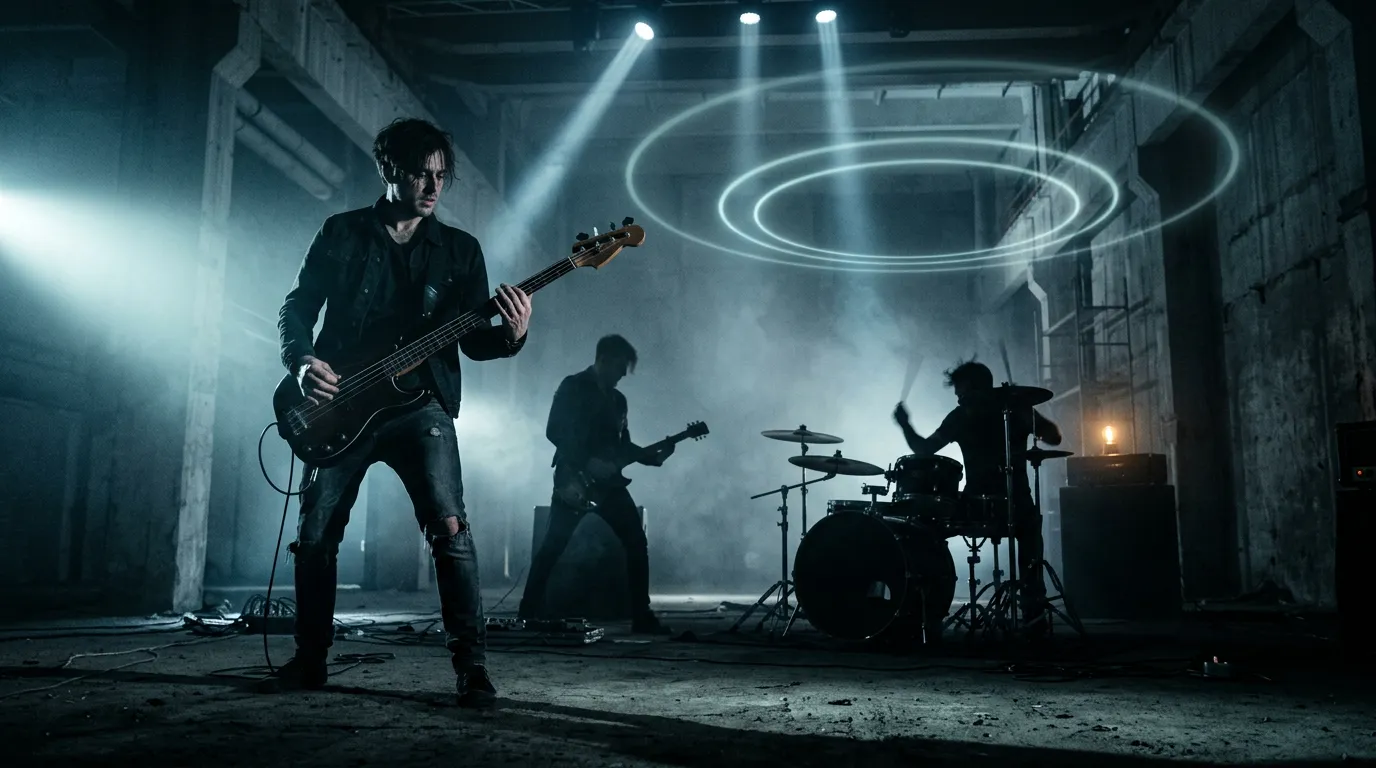
Spatial Audio & Immersive Music for Post-Punk: Gothic Rock, Cold Wave & Post-Punk Revival
Spatial9 Team · · 10 min read
Part of the series Spatial audio and immersive music by genre.
Key takeaways
- In a spatial post-punk mix the melodic bass guitar sits in front and the kick and snare stay locked in the centre, while the vocal, chorus guitar, synths, hi-hats, reverb and delay spread around the listener.
- Splitting the bass, vocal and guitar by direction reduces masking in the crowded midrange, an effect known as spatial release from masking, so the bass melody stays readable.
- Delay and drum reverb work best raised behind the listener, because the brain locates a sound by its first arrival, so the dry snare and voice stay in front while the echoes hang in a cold room.
- The post-punk immersion profile scores width 4, height 3, movement 3, low-end focus 4 and space 4 out of 5.
Post-punk grew out of punk in the UK around 1978, when bands kept the energy and the do it yourself attitude but threw out the three-chord rules. Scenes in Manchester, London, Leeds and Sheffield borrowed from dub, funk, krautrock and electronic music. Producers such as Martin Hannett, working with Joy Division at Factory Records, used digital delay, gated sounds and empty space as part of the arrangement. The result is a style built on a high, melodic bass line that often carries the tune, a tight, mechanical drum pattern or drum machine, scratchy or chorused guitar used for texture rather than power, and a detached, baritone or yelped vocal. Tempos usually run from about 120 to 160 BPM. Because post-punk is so sparse and so focused on atmosphere, it is one of the best fits in rock for spatial audio: there is space between the parts, and the space itself is part of the music. This guide covers how spatial audio for post-punk works, where to place each element and how to make an immersive post-punk mix. For the basics, see what spatial audio is.
Why post-punk works in spatial audio
Post-punk flips the usual rock roles. The bass plays the melody, the guitar plays atmosphere and the drums act like a machine. In stereo the reverb and delay that define the sound sit in the same strip as the dry parts, and the cold, empty feel gets lost. In an immersive mix the bass and drums stay as a solid spine in front, while delays, chorus and reverb move out into the room around and above the listener.
The rule: a dry, locked spine with a cold room around it. Bass and drums stay put, the guitar drifts and the effects fill the space behind and above.
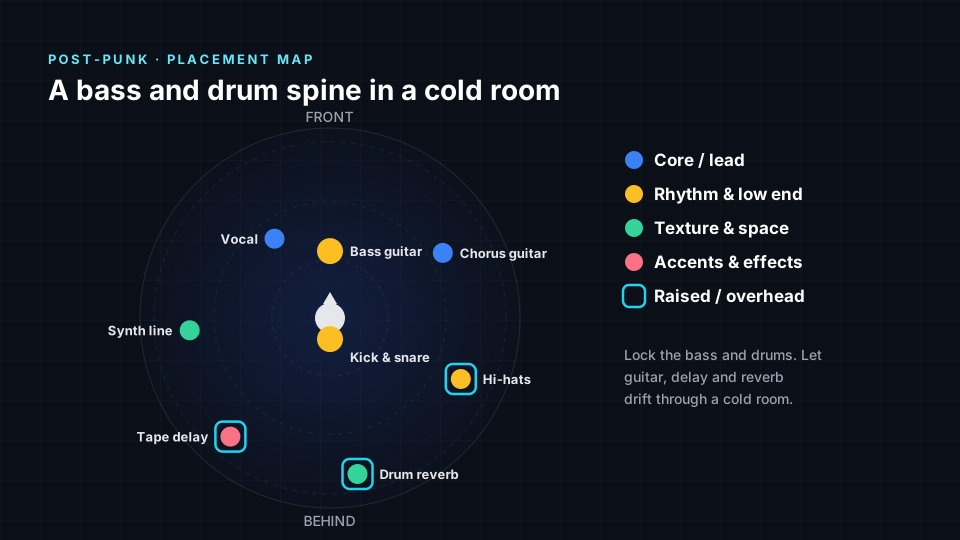
Immersive music for post-punk: what listeners hear
- A bass line that leads. The melodic bass sits in front where the ear follows it like a lead instrument.
- Drums like a machine. The kick and snare hit from one fixed point, tight and relentless.
- Guitar as weather. Chorused, flanged and delayed guitar drifts across the right side.
- A cold, empty room. Drum reverb and delay echoes hang above and behind you.
Where to place each element in a post-punk mix
| Element | Position | Height | Why it works |
|---|---|---|---|
| Bass guitar | Front centre | Ear level | The melodic lead of most post-punk songs |
| Kick & snare | Centre | Ear level | A mechanical, steady spine |
| Vocal | Front left | Ear level | Detached voice beside the bass, not over it |
| Chorus guitar | Front right, moving | Ear level | Shimmering texture that drifts slowly |
| Synth line | Left | Ear level | Cold melody balanced against the guitar |
| Hi-hats | Behind right | Raised | Bright, ticking top end above the kit |
| Drum reverb | Behind | Raised | The large, empty space around the drums |
| Tape delay | Behind left, moving | Raised | Echoes that trail around the room |
The psychoacoustics behind post-punk placement
Every position in the table above follows how the ear and brain locate sound. Here is the reason behind the main choices for post-punk.
- Kick centred, bass in front. The ear finds almost no direction in frequencies below roughly 80 to 100 Hz, so the kick and the bass fundamentals belong in the middle. The post-punk bass is played high up the neck, though, and its upper harmonics give the ear a clear direction, so it can sit in front as a lead without losing its weight.
- Vocal and guitar on opposite sides of the bass. The bass, vocal and guitar all crowd the midrange in post-punk. Separating them by direction gives spatial release from masking, so the bass melody, the voice and the guitar texture each stay readable.
- Delay and reverb behind and above. When a sound and its echoes arrive close together, the brain fixes its position by the first arrival. This is the precedence effect. The dry snare and voice stay put in front, while their delays and reverb can hang behind and overhead without pulling them back.
- Hi-hats raised. The ear judges height mostly from high frequencies, filtered by the shape of the outer ear (Hebrank and Wright). Hi-hats are almost pure treble, so they sound convincingly raised, and lifting them clears the scratchy guitar range below.
The immersion profile for post-punk
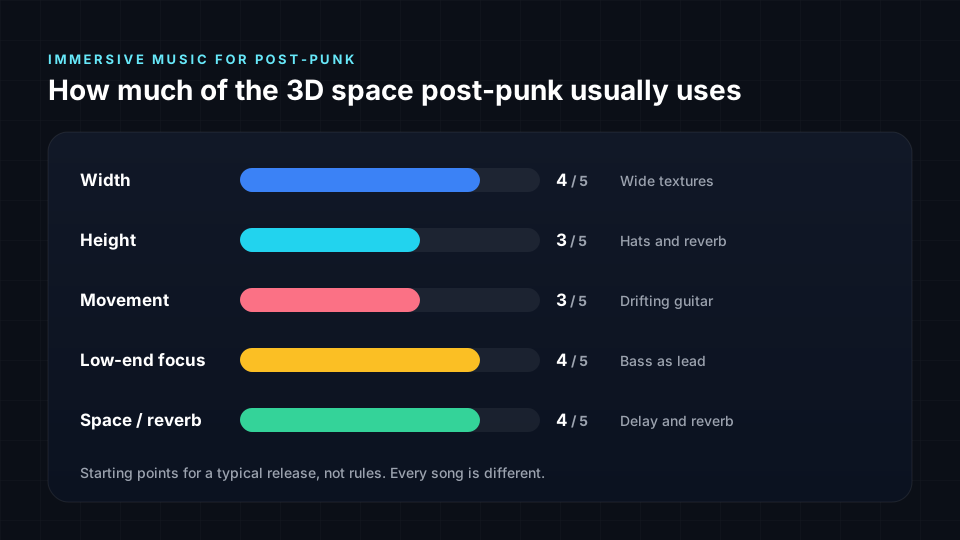
Width and space are high because post-punk is defined by atmosphere: chorused guitar, synths, delay and reverb all need room. Low-end focus is high too, because the bass guitar is the lead instrument and the drums are often heavy and mechanical. Height is moderate, with hi-hats, reverb and delay going overhead while the band itself stays at ear level. Movement is moderate: the guitar and delay drift slowly, but the spine never moves.
Tips for an immersive post-punk mix
- Treat the bass as the lead. Keep it in front and clear, with enough upper harmonics to carry the melody.
- Keep the drums dry in front. Put the reverb behind and above instead of on top of the kit.
- Let the guitar drift, not the drums. Slow movement on chorused guitar adds unease without breaking the groove.
- Use empty space. Leave gaps in the room, because silence and distance are part of the post-punk mood.
- Send delay throws behind. Let echoes on the vocal or snare trail around the back of the room, then cut them off sharply.
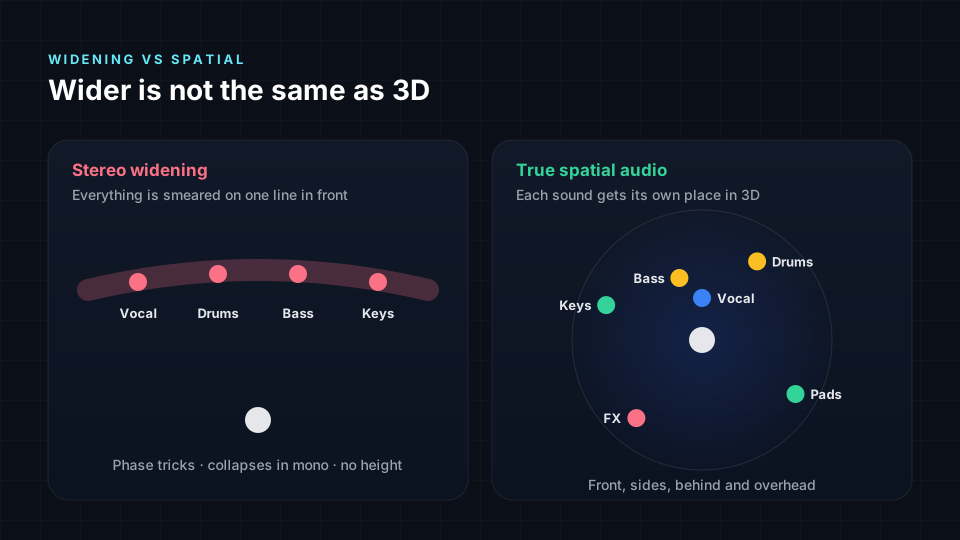
Post-Punk styles: gothic rock, cold wave and post-punk revival
The core placement holds for every post-punk style: bass and drums as a spine, guitar, synths and effects around the listener. What changes is how dark, how electronic and how polished the track is.
Gothic Rock
Gothic rock grew out of post-punk around 1979 to 1983, led by bands such as Bauhaus, Siouxsie and the Banshees and The Cure, and later by drum machine acts like The Sisters of Mercy. It adds drama: deep baritone vocals, heavy reverb, flanged guitars and tom-heavy rhythms. Keep the bass and the drum machine centred and the vocal close, but give it a long reverb raised behind. Place tom patterns wide across the front, and let flanged guitar move slowly overhead. The room should feel huge and dark, like a crypt.
Cold Wave
Cold wave, or coldwave, developed in France and Belgium in the late 1970s and 1980s, with minimal synthesisers, cheap drum machines, cold vocals and a bleak, melancholy mood. It is sparser than British post-punk. Keep the drum machine centred and dry, put the bass in front and spread one or two synth lines wide to the sides. The vocal sits close but distant in tone. Use small amounts of reverb raised behind, and leave plenty of empty space around the listener, because the cold feel depends on sparseness.
Post-Punk Revival
Post-punk revival broke through in the early 2000s, when bands in New York and the UK brought back angular guitars, driving bass and danceable four to the floor drums. The production is louder and tighter than the original era, with more guitar and less reverb. Keep the kick, snare and bass centred and punchy, and the vocal close. Place the two guitars on opposite front sides so their interlocking parts stay clear. Keep reverb shorter, with only delay throws and hi-hats raised.
Related styles such as darkwave, deathrock and new wave follow the same idea: lock the bass and drums, then give guitars, synths and effects their own place in a darker room.
How to make immersive post-punk from stereo
Spatial9 can create spatial audio from a stereo track in a few steps:
- Upload your stereo master or your stems.
- Spatial9's AI separates and places each part, keeping the bass and drums as a spine in front and sending chorus guitar, delay and reverb into the room around you.
- Preview it in binaural on headphones.
- Export Eclipsa Audio, ADM, binaural or Ambisonics.
- Publish a video. Create a YouTube-ready video with your immersive audio and publish it directly.
For related guides, read spatial audio for punk and spatial audio for shoegaze. Every guide is listed in spatial audio and immersive music by genre.
Frequently asked questions
Does this guide cover gothic rock, cold wave and post-punk revival?
Yes. Gothic rock keeps the bass and drums centred with long reverb and flanged guitar raised behind. Cold wave spreads sparse synths wide over a dry drum machine. Post-punk revival places interlocking guitars on each front side over a tight, punchy spine.
Can I make a post-punk mix in Dolby Atmos or Eclipsa Audio?
Yes. The placements in this guide work for both. Spatial9 exports ADM, the standard file used by Dolby Atmos studios, as well as Eclipsa Audio for YouTube, so one immersive post-punk mix covers both. If you plan to release the Atmos version on Apple Music, build it from your original stems or multitracks, because Apple does not accept Atmos made from a finished stereo master. See where to publish spatial audio. You may also hear this called a 3D post-punk mix or post-punk in spatial audio.
Is spatial audio good for post-punk?
Yes. Post-punk is sparse and built on atmosphere, with delay, chorus and reverb doing as much work as the notes. Spatial audio gives that space a real shape while keeping the bass and drums tight.
How is post-punk different from punk in spatial audio?
Punk is a dense, fast wall of distorted guitars with the vocal shouted over the top, so its mix is wide and full with little room effect. Post-punk is sparser, with the bass in the lead and much more delay, reverb and empty space around the listener.
Should the drum machine move in an immersive post-punk mix?
No. Keep the kick and snare fixed in the centre, because the mechanical pulse is what holds the track together. Let the reverb, the delays and the chorused guitar carry any motion instead.
Can I convert a finished post-punk track to spatial audio?
Yes. Spatial9 uses AI to generate an immersive mix from a stereo master and exports it as Eclipsa Audio, ADM, binaural or Ambisonics.
Does immersive post-punk work on normal headphones?
Yes. The mix is rendered binaurally, so the melodic bass, chorused guitar and cold reverb work on any regular headphones.
Dolby and Dolby Atmos are trademarks of Dolby Laboratories. Spatial9 is not affiliated with or endorsed by Dolby Laboratories.
Sources
- Blauert, J. (1997). Spatial Hearing: The Psychophysics of Human Sound Localization, revised edition. MIT Press. Low-frequency, elevation, distance and motion cues.
- Mills, A. W. (1958). On the minimum audible angle. Journal of the Acoustical Society of America, 30(4), 237-246.
- Hebrank, J. and Wright, D. (1974). Spectral cues used in the localization of sound sources on the median plane. Journal of the Acoustical Society of America, 56(6), 1829-1834.
- Bronkhorst, A. W. (2000). The cocktail party phenomenon: a review of research on speech intelligibility in multiple-talker conditions. Acta Acustica united with Acustica, 86, 117-128.
- Litovsky, R. Y., Colburn, H. S., Yost, W. A. and Guzman, S. J. (1999). The precedence effect. Journal of the Acoustical Society of America, 106(4), 1633-1654.
- Barron, M. and Marshall, A. H. (1981). Spatial impression due to early lateral reflections in concert halls. Journal of Sound and Vibration, 77(2), 211-232.
- Neuhoff, J. G. (1998). Perceptual bias for rising tones. Nature, 395, 123-124.
- Bregman, A. S. (1990). Auditory Scene Analysis: The Perceptual Organization of Sound. MIT Press.
Step into the cold room
Upload a track to Spatial9 and hear your bass line lead while delay and reverb open up a dark room around you in minutes. Then export it or publish it straight to YouTube.