
Spatial Audio & Immersive Music for Math Rock: Math Pop, Japanese Math Rock & Noise Rock
Spatial9 Team · · 10 min read
Part of the series Spatial audio and immersive music by genre.
Key takeaways
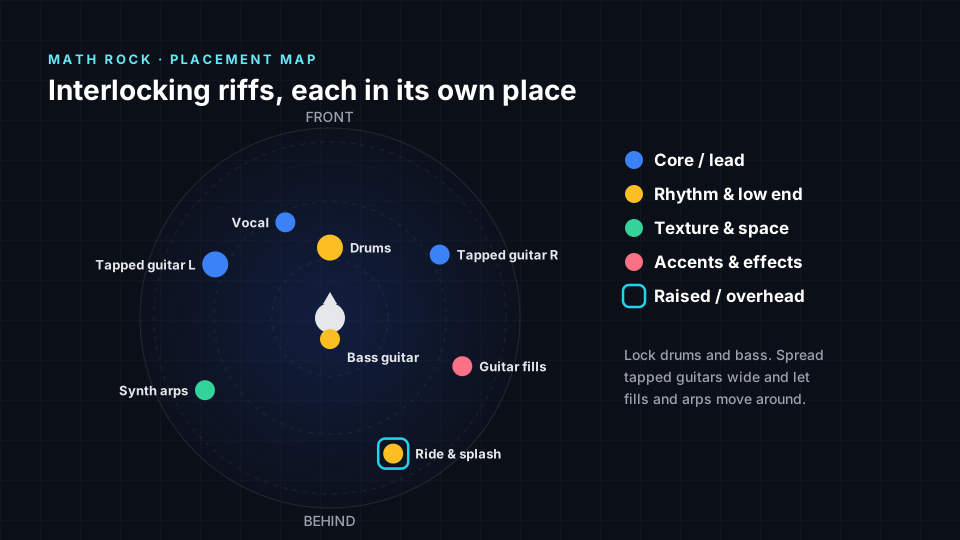
- In a spatial math rock mix the drums and bass guitar stay locked in the centre, while the vocal, two tapped guitars, guitar fills, cymbals and synth arpeggios each take their own place around the listener.
- Placing interlocking guitars on opposite sides helps the brain hear them as two separate parts instead of one busy line, an effect known as auditory stream segregation.
- Math rock needs a small, dry room, because long reverbs smear fast tapping, sudden stops and odd-metre accents.
- The math rock immersion profile scores width 4, height 2, movement 4, low-end focus 3 and space 2 out of 5.
Math rock grew out of American indie and post-hardcore in the late 1980s and early 1990s, with bands in cities such as Louisville, Chicago and Pittsburgh drawing on progressive rock, hardcore punk and minimalism. It is known for unusual time signatures such as 5/4, 7/8 and 11/8, stop-start structures, polyrhythms and clean, bright guitars played with two-handed tapping. Songs often switch metre every few bars, and tempos can jump from a slow 90 BPM to a frantic 180 BPM in one piece. By the 2000s the style had spread to the UK and to Japan, which built one of the strongest math rock scenes in the world. Because the music depends on hearing precise parts interlock, spatial audio can make it much easier to follow than stereo. This guide covers how spatial audio for math rock works, where to place each element and how to make an immersive math rock mix. For the basics, see what spatial audio is.
Why math rock works in spatial audio
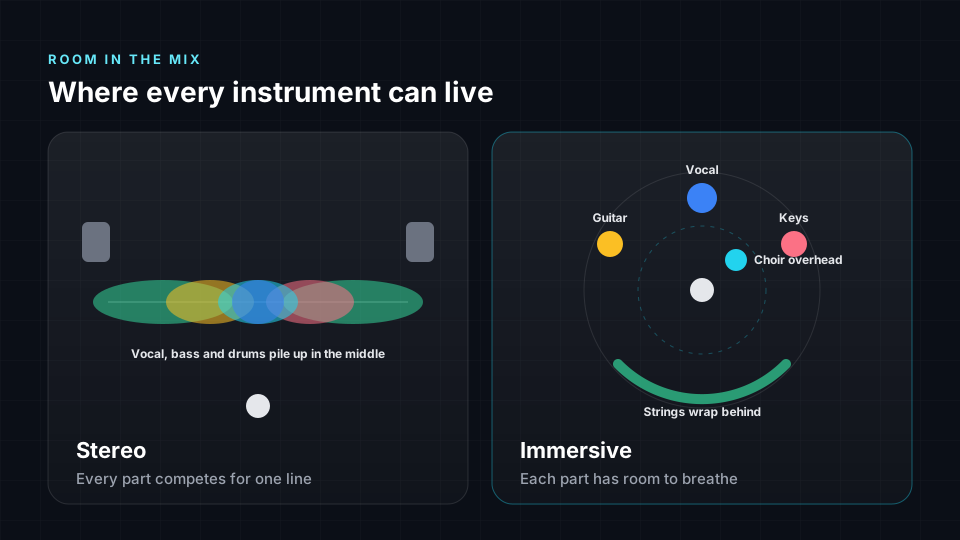
One guitar taps a looping figure in seven, the other plays a pattern in four, the bass ties them together and the drums accent the places where they meet. In stereo, the two guitars often share the same bright frequency range and blur into one busy line. In an immersive mix each guitar has its own side, the rhythm section holds the centre and the small runs and fills are free to move, so the listener can hear how the pieces fit together.
The rule: a fixed rhythm centre, with every guitar part in its own place. Drums and bass never move, the main guitars stay wide and still, and only fills and arpeggios travel.
Immersive music for math rock: what listeners hear
- Riffs that untangle. Each tapped guitar comes from its own side, so the interlocking parts are easy to follow.
- Drums you can count along to. The kit stays tight and central, so every accent in an odd metre lands clearly.
- Fills that dart past you. Quick runs and harmonics flick across the sides between the main riffs.
- A small, close room. The mix stays dry and direct, like hearing a band in a basement venue.
Where to place each element in a math rock mix
| Element | Position | Height | Why it works |
|---|---|---|---|
| Drums | Front centre | Ear level | Odd-metre patterns stay tight and readable |
| Bass guitar | Centre | Ear level | Locks the shifting riffs to the kick |
| Vocal | Front left, close | Ear level | Clear and direct over the busy guitars |
| Tapped guitar L | Front left, wide | Ear level | One half of the interlocking riff |
| Tapped guitar R | Front right, wide | Ear level | The answering part, kept separate |
| Guitar fills | Right, moving | Ear level | Runs and harmonics that dart across |
| Ride & splash | Behind right | Raised | Bright accents lifted off the kit |
| Synth arps | Behind left, moving | Ear level | Looping patterns that circle the band |
The psychoacoustics behind math rock placement
Every position in the table above follows how the ear and brain locate sound. Here is the reason behind the main choices for math rock.
- Tapped guitars on opposite sides. The brain groups sounds into streams by pitch, timing and direction. This is auditory stream segregation (Bregman). Two clean guitars in the same register merge into one line when they come from the same place, but wide apart they become two voices, which is exactly what interlocking riffs need.
- Drums and bass fixed in the centre. The ear finds almost no direction in frequencies below roughly 80 to 100 Hz, so moving the bass or kick adds nothing. A stable centre also gives the listener a fixed reference while metres change around it.
- Vocal off centre, away from the guitars. Two sounds in the same frequency range mask each other far less when they arrive from different directions. This is spatial release from masking. Keeping the vocal close at front left, between the drums and the left guitar, stops it being buried under bright tapping.
- Fills that move only short distances. The smallest change in direction the ear can detect is about one degree straight ahead, but it grows much larger towards the sides (Mills). Moving fills across the front and sides keeps their motion easy to hear without needing big, distracting sweeps.
The immersion profile for math rock
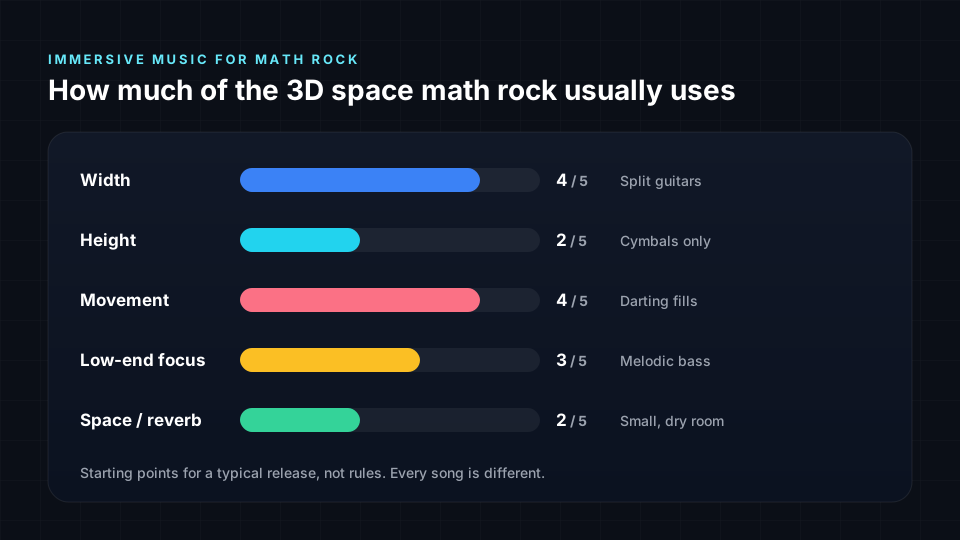
Width and movement are high because math rock is built from separate, interlocking guitar parts and quick fills that benefit from their own positions. Height is low: almost everything happens at ear level, with only the cymbals lifted. Space is low too, because long reverbs smear fast tapping and odd accents. Low-end focus sits in the middle, since the bass guitar often plays melodic lines rather than heavy sub weight.
Tips for an immersive math rock mix
- Give each guitar a fixed home. Interlocking parts only work if the listener knows where each one lives.
- Keep the room short. A small, dry space keeps fast tapping and sudden stops sharp.
- Move the details, not the riff. Let fills, harmonics and arpeggios travel while the main guitars stay still.
- Use the stops. On a hard stop, cut every direction at once, so the silence feels as precise as the riff.
- Do not overcrowd the sides. Leave gaps between parts so each new entry is heard clearly.
Math Rock styles: math pop, Japanese math rock and noise rock
The core placement holds for every math rock style: drums and bass in the centre, main guitars wide and still, fills and textures moving. What changes is the role of the vocal, the tone of the guitars and how much noise the room can take.
Math Pop
Math pop keeps the odd metres and tapped guitars but adds catchy melodies, clear vocals and brighter, more polished production. Bands from the UK and the US took this direction in the 2000s and 2010s. Here the vocal becomes the anchor, so bring it closer to front centre and keep it dry. Place the tapped guitars wide and slightly behind the voice, so the riffs support the melody instead of fighting it. Horns, synths or glockenspiel can sit raised at the back sides. Keep movement light during verses and save it for instrumental breaks.
Japanese Math Rock
Japanese math rock developed its own sound in the 2000s, with bands such as toe and LITE mixing intricate clean guitars, jazz chords, fast tapping and very precise, energetic drumming. The playing is often extremely detailed, so clarity matters most. Keep the room dry and tight, give each guitar a fixed wide position, and let the bass sit centred but clearly audible, since it often carries melody. Glittering harmonics and delay figures can move around the sides. When vocals appear, keep them close and slightly off centre.
Noise Rock
Noise rock shares math rock's angular rhythms but swaps clean tones for distortion, feedback, abrasive textures and shouted vocals, with roots in 1980s American underground scenes. The low end is heavier and the guitars harsher. Keep the drums, bass and vocal tightly centred so the core stays punchy. Spread distorted guitars wide at the front left and right, and send feedback and noise bursts behind the listener, where they surround without masking the riff. Allow slightly more room than in clean math rock, but avoid long tails.
Related styles such as mathcore and Midwest emo follow the same idea: lock the rhythm in the centre, then give every guitar part its own place.
How to make immersive math rock from stereo
Spatial9 can create spatial audio from a stereo track in a few steps:
- Upload your stereo master or your stems.
- Spatial9's AI separates and places each part, locking the drums and bass in the centre and giving each tapped guitar, fill and arpeggio its own position.
- Preview it in binaural on headphones.
- Export Eclipsa Audio, ADM, binaural or Ambisonics.
- Publish a video. Create a YouTube-ready video with your immersive audio and publish it directly.
For related guides, read spatial audio for post-rock and spatial audio for emo. Every guide is listed in spatial audio and immersive music by genre.
Frequently asked questions
Does this guide cover math pop, Japanese math rock and noise rock?
Yes. Math pop brings the vocal close to the centre with tapped guitars wide behind it. Japanese math rock keeps a dry, precise room with each clean guitar in a fixed position. Noise rock centres a punchy core and sends feedback and noise behind the listener.
Can I make a math rock mix in Dolby Atmos or Eclipsa Audio?
Yes. The placements in this guide work for both. Spatial9 exports ADM, the standard file used by Dolby Atmos studios, as well as Eclipsa Audio for YouTube, so one immersive math rock mix covers both. If you plan to release the Atmos version on Apple Music, build it from your original stems or multitracks, because Apple does not accept Atmos made from a finished stereo master. See where to publish spatial audio. You may also hear this called a 3D math rock mix or math rock in spatial audio.
Is spatial audio good for math rock?
Yes. Math rock depends on hearing several precise parts interlock. Spatial audio separates the guitars by direction, so odd-metre riffs that blur together in stereo become easy to follow.
How is math rock different from post-rock in spatial audio?
Post-rock uses long reverbs, slow builds and lots of height, so its mix fills the room. Math rock is faster, drier and more rhythmic, so its mix keeps a small room and a low ceiling and uses width and movement to separate busy guitar parts.
Should odd time signatures change how I pan a math rock mix?
No. Keep the main guitars and drums in fixed positions however often the metre changes, because the listener needs a stable reference to count against. Use movement for fills and arpeggios, not for the core riff.
Can I convert a finished math rock track to spatial audio?
Yes. Spatial9 uses AI to generate an immersive mix from a stereo master and exports it as Eclipsa Audio, ADM, binaural or Ambisonics.
Does immersive math rock work on normal headphones?
Yes. The mix is rendered binaurally, so the wide tapped guitars, moving fills and tight drums work on any regular headphones.
Dolby and Dolby Atmos are trademarks of Dolby Laboratories. Spatial9 is not affiliated with or endorsed by Dolby Laboratories.
Sources
- Blauert, J. (1997). Spatial Hearing: The Psychophysics of Human Sound Localization, revised edition. MIT Press. Low-frequency, elevation, distance and motion cues.
- Mills, A. W. (1958). On the minimum audible angle. Journal of the Acoustical Society of America, 30(4), 237-246.
- Hebrank, J. and Wright, D. (1974). Spectral cues used in the localization of sound sources on the median plane. Journal of the Acoustical Society of America, 56(6), 1829-1834.
- Bronkhorst, A. W. (2000). The cocktail party phenomenon: a review of research on speech intelligibility in multiple-talker conditions. Acta Acustica united with Acustica, 86, 117-128.
- Litovsky, R. Y., Colburn, H. S., Yost, W. A. and Guzman, S. J. (1999). The precedence effect. Journal of the Acoustical Society of America, 106(4), 1633-1654.
- Barron, M. and Marshall, A. H. (1981). Spatial impression due to early lateral reflections in concert halls. Journal of Sound and Vibration, 77(2), 211-232.
- Neuhoff, J. G. (1998). Perceptual bias for rising tones. Nature, 395, 123-124.
- Bregman, A. S. (1990). Auditory Scene Analysis: The Perceptual Organization of Sound. MIT Press.
Hear every part interlock
Upload a track to Spatial9 and hear your tapped guitars, fills and odd-metre drums separate around you in minutes. Then export it or publish it straight to YouTube.