Spatial Audio & Immersive Music for Stoner Rock: Desert Rock, Heavy Psych & Fuzz Rock
Spatial9 Team · · 10 min read
Part of the series Spatial audio and immersive music by genre.
Key takeaways
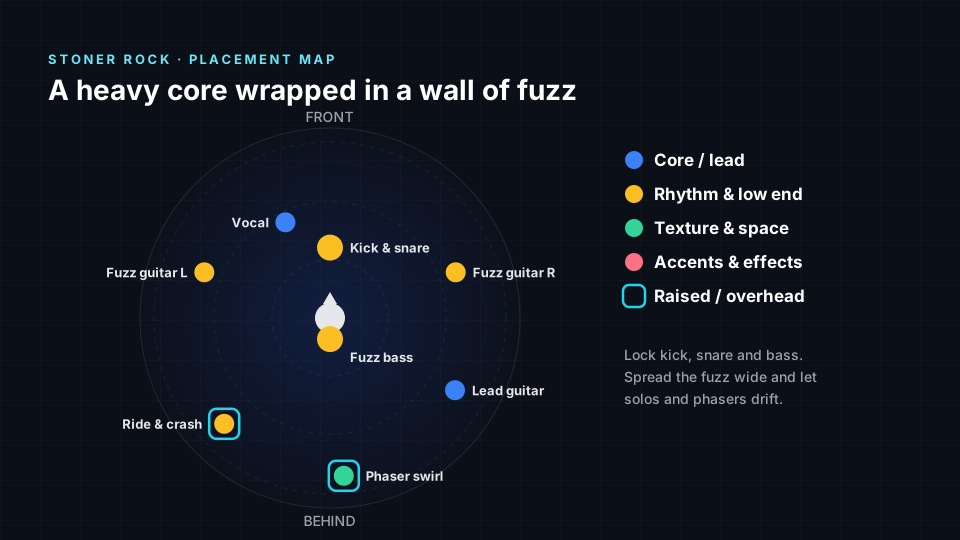
- In a spatial stoner rock mix the kick, snare and fuzz bass stay locked in the centre, while the vocal, two fuzz guitars, lead guitar, cymbals and phaser effects spread around the listener.
- Spreading the fuzz guitars wide leaves a clear path for the vocal, because sounds in the same frequency range mask each other far less when they come from different directions.
- The fuzz bass should stay mono and centred, because the ear gets almost no direction from low frequencies and spreading the bass only weakens its weight.
- The stoner rock immersion profile scores width 4, height 3, movement 3, low-end focus 5 and space 3 out of 5.
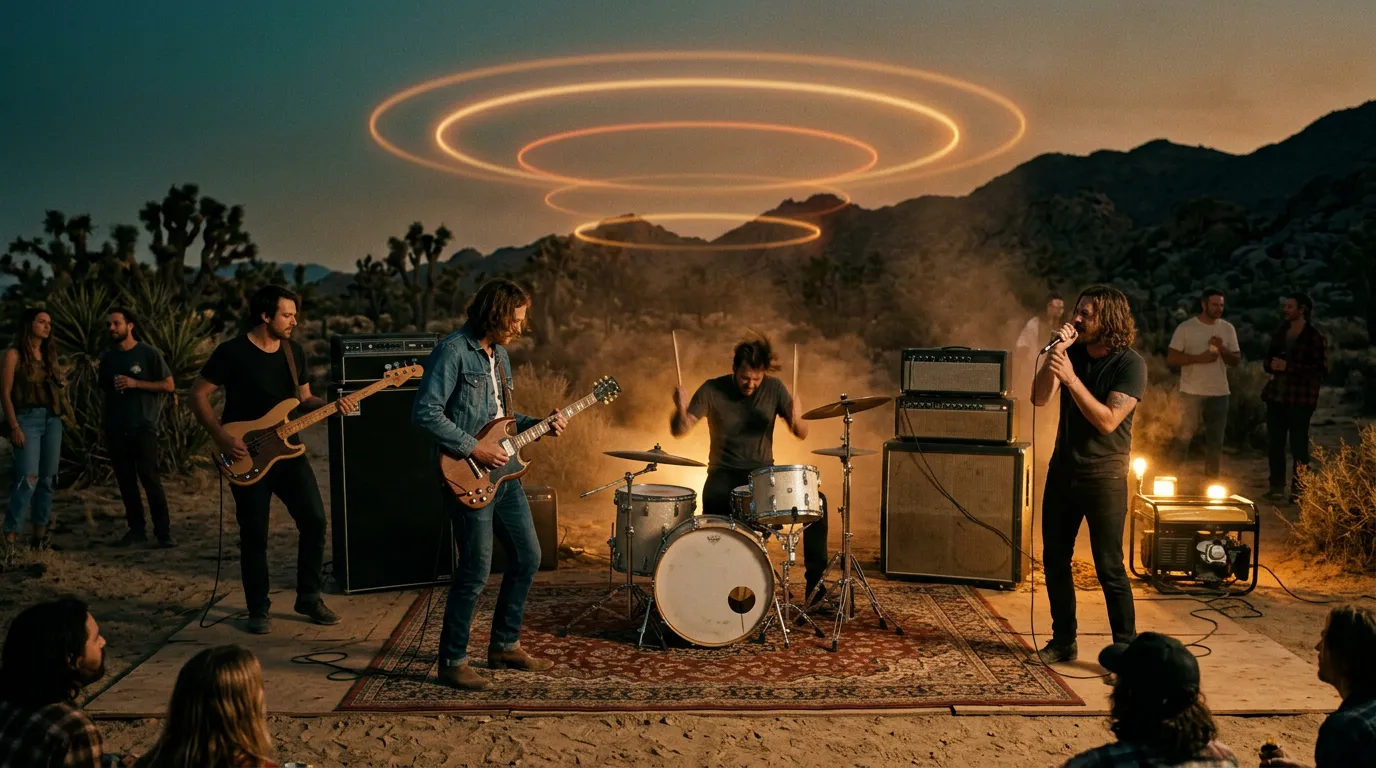
Stoner rock took shape in the early 1990s, most famously in the desert around Palm Desert in Southern California, where bands played generator-powered parties far from any club. Its roots go back to the heavy blues rock of the late 1960s and early 1970s, especially Black Sabbath and Blue Cheer, mixed with psychedelic rock and punk energy. The sound is built on down-tuned guitars pushed through fuzz pedals and sometimes bass amplifiers, thick, distorted bass, slow to mid tempos of around 70 to 120 BPM, groove-driven drumming and long, repetitive riffs that turn into jams. Because the music is about weight, tone and repetition, it gains a lot from a solid low end with fuzz and effects all around. This guide covers how spatial audio for stoner rock works, where to place each element and how to make an immersive stoner rock mix. For the basics, see what spatial audio is.
Why stoner rock works in spatial audio
Stoner rock lives in the low mids. Fuzz guitars, a distorted bass and a big kick drum all compete for the same thick band of frequencies, and in stereo the result can feel like one heavy block with the vocal buried inside it. In an immersive mix the kick, snare and bass hold a solid centre, the fuzz guitars build a wide wall at the sides, and the lead and effects get space behind and above. The riff stays as heavy as before, but now it wraps around the listener instead of pressing from the front.
The rule: a heavy, unmoving centre wrapped in a wall of fuzz. The rhythm section and bass stay fixed, the riff spreads wide, and only the lead guitar and effects drift.
Immersive music for stoner rock: what listeners hear
- Bass you feel in your body. The fuzz bass stays deep, mono and centred, so it hits on every system.
- A wall of fuzz around you. Two down-tuned guitars spread wide, so the riff surrounds the listener.
- A voice that cuts through. The vocal sits close in front of the wall rather than inside it.
- Solos that wander. Long jams and phaser effects drift behind and above during the instrumental stretches.
Where to place each element in a stoner rock mix
| Element | Position | Height | Why it works |
|---|---|---|---|
| Kick & snare | Front centre | Ear level | A slow, heavy groove that never wanders |
| Fuzz bass | Centre | Ear level | Huge, mono low end under the riff |
| Vocal | Front left, close | Ear level | Sits in front of the fuzz, not inside it |
| Fuzz guitar L | Wide left | Ear level | One side of the down-tuned riff |
| Fuzz guitar R | Wide right | Ear level | The other side, building a wall |
| Lead guitar | Behind right, moving | Ear level | Jamming solos that roam |
| Ride & crash | Behind left | Raised | Washy cymbals lifted off the riff |
| Phaser swirl | Behind, moving | Raised | Psychedelic effects that drift overhead |
The psychoacoustics behind stoner rock placement
Every position in the table above follows how the ear and brain locate sound. Here is the reason behind the main choices for stoner rock.
- Fuzz bass and kick centred. The ear finds almost no direction in frequencies below roughly 80 to 100 Hz, so spreading the bass only weakens it. Keeping the fuzz bass and kick centred and mono keeps the low end heavy and consistent, which is the whole point of the genre.
- Fuzz guitars wide, vocal in front. Guitars, bass and voice all crowd the low mids in stoner rock. Two sounds in the same range mask each other far less when they come from different directions, an effect known as spatial release from masking. Wide guitars leave a clear path for the vocal.
- Cymbals lifted. The outer ear filters high frequencies differently depending on height, and the brain reads those spectral cues as elevation (Hebrank and Wright). Washy rides and crashes carry these cues well, so raising them pulls their hiss out of the fuzz.
- Lead and effects drifting behind. The brain groups sounds into streams by pitch, timing and direction. This is auditory stream segregation (Bregman). Giving a solo or phaser swirl its own moving position keeps it clearly separate from the repeating riff, even when they share the same tone.
The immersion profile for stoner rock
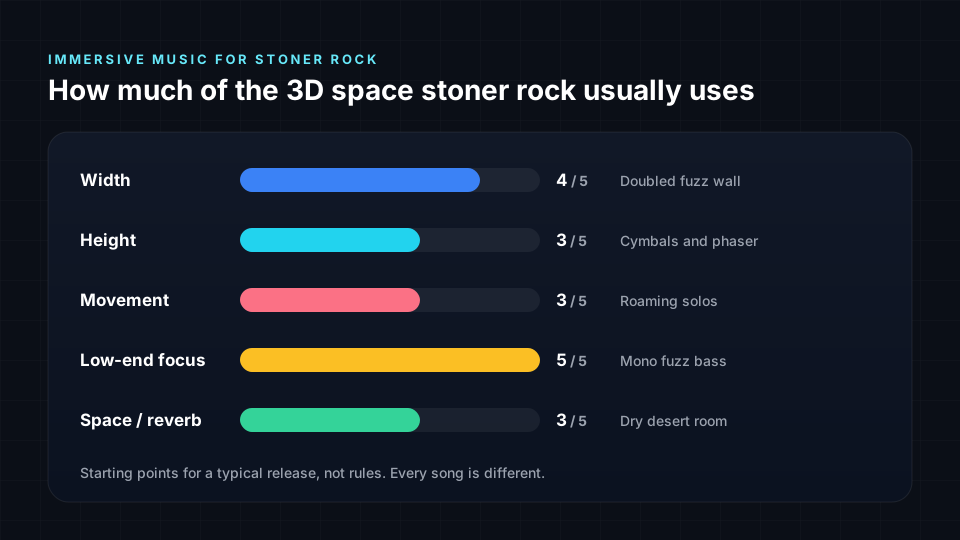
Low-end focus is at maximum because stoner rock is built on thick fuzz bass, down-tuned guitars and a heavy kick. Width is high, since the double-tracked guitar wall is the main way to make the riff feel huge. Height, movement and space are moderate: the heavy core sits at ear level and stays still, while cymbals, solos and psychedelic effects give the mix a little lift, drift and room during the long jams.
Tips for an immersive stoner rock mix
- Keep the bass mono and centred. Fuzz bass must sound the same from every direction or the weight disappears.
- Double the riff wide. Two guitar takes, hard left and right, make the wall feel enormous without extra level.
- Pull the vocal forward. A close, slightly dry vocal stops it being swallowed by the fuzz.
- Save movement for the jam. Keep the mix still during the main riff and let solos and effects roam during instrumental sections.
- Tame the low mids. If the centre gets muddy, move guitars wider rather than cutting their tone.
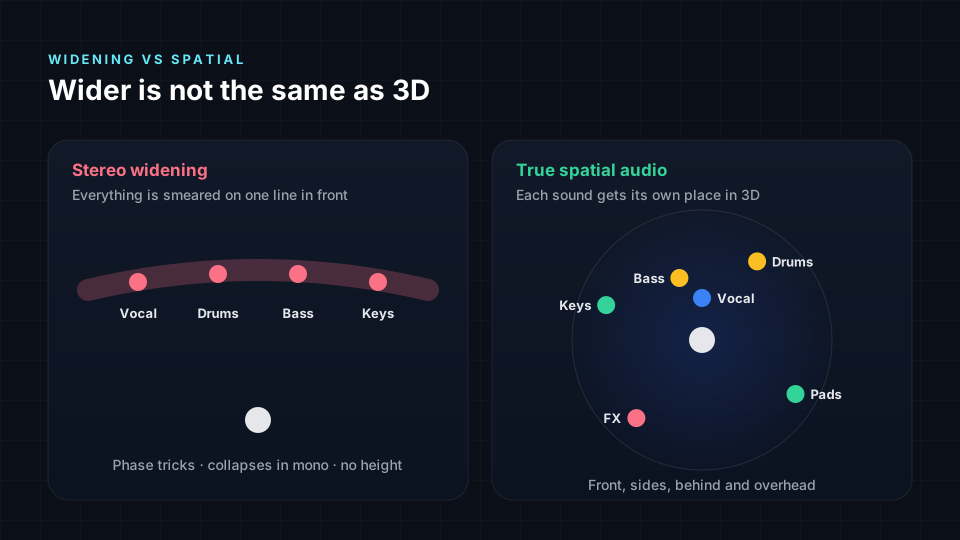
Stoner Rock styles: desert rock, heavy psych and fuzz rock
The core placement holds for every stoner rock style: kick, snare and bass in the centre, fuzz guitars wide, and lead and effects behind. What changes is the tempo, how much the music jams and how much psychedelic space it needs.
Desert Rock
Desert rock is the Californian sound that grew out of the generator parties around Palm Desert in the early 1990s, with dry, hypnotic riffs, grooving drums and a loose, open feel. The music evokes wide, empty landscapes, so give the guitars plenty of width but keep the reverb short and dry, like playing outdoors. Keep the bass and kick heavy and centred. Let the vocal sit close and slightly off centre. Long riffs can repeat for minutes, so introduce small changes in width or a lead guitar drifting behind to keep the space evolving.
Heavy Psych
Heavy psych blends stoner weight with the long jams, wah pedals, phasers and space echoes of late 1960s and early 1970s psychedelic rock. It needs the most space and movement of the three. Keep the rhythm section solid in the centre, then let lead guitars, organs and echo effects wander around the sides, behind and overhead. Raise phaser swirls and tape echo trails above the listener. During long instrumental passages, slowly open the room, then bring it back in when the main riff returns.
Fuzz Rock
Fuzz rock focuses on tone above everything: saturated fuzz pedals, driving mid to fast tempos, catchy riffs and a punchier, more song-based structure. Here the wall of guitars is the star, so double-track the riff hard left and right and keep it still. Fuzz bass and kick stay centred and mono, with the vocal close and up front. Cymbals can be raised slightly to clear the top end. Use little movement and moderate room, so the riffs hit with full force rather than floating.
Related styles such as doom metal, sludge and classic heavy blues rock follow the same idea: lock the low end, widen the riff and give the effects their own space.
How to make immersive stoner rock from stereo
Spatial9 can create spatial audio from a stereo track in a few steps:
- Upload your stereo master or your stems.
- Spatial9's AI separates and places each part, locking the kick, snare and fuzz bass in the centre and spreading the guitars, solos and effects around you.
- Preview it in binaural on headphones.
- Export Eclipsa Audio, ADM, binaural or Ambisonics.
- Publish a video. Create a YouTube-ready video with your immersive audio and publish it directly.
For related guides, read spatial audio for doom metal and spatial audio for psychedelic rock. Every guide is listed in spatial audio and immersive music by genre.
Frequently asked questions
Does this guide cover desert rock, heavy psych and fuzz rock?
Yes. Desert rock spreads the guitars wide in a short, dry space. Heavy psych lets leads, organs and echoes wander around and above the listener during long jams. Fuzz rock keeps a still, double-tracked wall of guitars and a punchy, centred low end.
Can I make a stoner rock mix in Dolby Atmos or Eclipsa Audio?
Yes. The placements in this guide work for both. Spatial9 exports ADM, the standard file used by Dolby Atmos studios, as well as Eclipsa Audio for YouTube, so one immersive stoner rock mix covers both. If you plan to release the Atmos version on Apple Music, build it from your original stems or multitracks, because Apple does not accept Atmos made from a finished stereo master. See where to publish spatial audio. You may also hear this called a 3D stoner rock mix or stoner rock in spatial audio.
Is spatial audio good for stoner rock?
Yes. Stoner rock is built on heavy, thick tone that crowds the low mids in stereo. Spatial audio keeps the bass solid in the centre and spreads the fuzz around the listener, so the riff feels bigger and the vocal stays clear.
How is stoner rock different from doom metal in spatial audio?
Doom metal is usually slower, darker and more reverberant, with a heavier focus on space and gloom. Stoner rock grooves harder, with a looser, bluesier feel and more jamming, so its mix keeps a drier room and uses movement mainly for solos and psychedelic effects.
Should fuzz bass ever be spread in an immersive stoner rock mix?
Only the upper harmonics, and only slightly. Keep the low part of the bass centred and mono so the weight stays intact. If you want more size, add width with the guitars, not the bass.
Can I convert a finished stoner rock track to spatial audio?
Yes. Spatial9 uses AI to generate an immersive mix from a stereo master and exports it as Eclipsa Audio, ADM, binaural or Ambisonics.
Does immersive stoner rock work on normal headphones?
Yes. The mix is rendered binaurally, so the fuzz wall, roaming solos and heavy, centred bass work on any regular headphones.
Dolby and Dolby Atmos are trademarks of Dolby Laboratories. Spatial9 is not affiliated with or endorsed by Dolby Laboratories.
Sources
- Blauert, J. (1997). Spatial Hearing: The Psychophysics of Human Sound Localization, revised edition. MIT Press. Low-frequency, elevation, distance and motion cues.
- Mills, A. W. (1958). On the minimum audible angle. Journal of the Acoustical Society of America, 30(4), 237-246.
- Hebrank, J. and Wright, D. (1974). Spectral cues used in the localization of sound sources on the median plane. Journal of the Acoustical Society of America, 56(6), 1829-1834.
- Bronkhorst, A. W. (2000). The cocktail party phenomenon: a review of research on speech intelligibility in multiple-talker conditions. Acta Acustica united with Acustica, 86, 117-128.
- Litovsky, R. Y., Colburn, H. S., Yost, W. A. and Guzman, S. J. (1999). The precedence effect. Journal of the Acoustical Society of America, 106(4), 1633-1654.
- Barron, M. and Marshall, A. H. (1981). Spatial impression due to early lateral reflections in concert halls. Journal of Sound and Vibration, 77(2), 211-232.
- Neuhoff, J. G. (1998). Perceptual bias for rising tones. Nature, 395, 123-124.
- Bregman, A. S. (1990). Auditory Scene Analysis: The Perceptual Organization of Sound. MIT Press.
Turn up the fuzz
Upload a track to Spatial9 and hear your riffs wrap around a heavy, centred low end in minutes. Then export it or publish it straight to YouTube.