Spatial Audio & Immersive Music for Emo: Midwest Emo, Screamo & Emo Pop
Spatial9 Team · · 10 min read
Part of the series Spatial audio and immersive music by genre.
Key takeaways
- In a spatial emo mix the lead vocal stays close in the centre with the kick and bass underneath, while the twinkly guitar, drums, distorted guitar walls, cymbals and gang vocals spread around the listener.
- Giving the clean, twinkly guitar its own place in front of the distorted wall helps the brain follow both, an effect known as auditory stream segregation.
- Spreading the distorted guitars wide reduces masking of the vocal, so the words stay clear even in the loudest chorus, an effect known as spatial release from masking.
- The emo immersion profile scores width 4, height 2, movement 2, low-end focus 3 and space 3 out of 5.
Emo began in Washington, D.C. in the mid 1980s, when hardcore punk bands such as Rites of Spring and Embrace turned the scene's energy inward, around the 1985 period known as Revolution Summer. The name came from "emotional hardcore". Through the 1990s the sound spread across American basements and college towns, especially in the Midwest, where bands such as Cap'n Jazz and American Football added clean, interlocking guitars, open tunings and odd time signatures. In the 2000s emo pop took the style to the charts. Across all of it, emo works on contrast: soft, confessional verses with clean guitar against loud, distorted choruses with shouted or sung vocals, often at 130 to 180 BPM. That contrast makes emo a strong fit for spatial audio, because an immersive mix can move the listener from a small, close room to a full wall of sound around them. This guide covers how spatial audio for emo works, where to place each element and how to make an immersive emo mix. For the basics, see what spatial audio is.
Why emo works in spatial audio
Emo is personal music played loud. The voice is the centre of every song, but it competes with two or three guitars, busy drums and, in the loud parts, a wall of distortion. In stereo that wall pushes the vocal down or squeezes the guitars into a narrow strip. In an immersive mix the voice stays close and clear in front, while the guitars spread around the sides and the cymbals rise above, so the chorus can grow without burying the words.
The rule: a close voice, the guitars around you. The vocal, kick and bass stay centred, the twinkly guitar sits in front and the distorted wall opens up to both sides when the chorus hits.
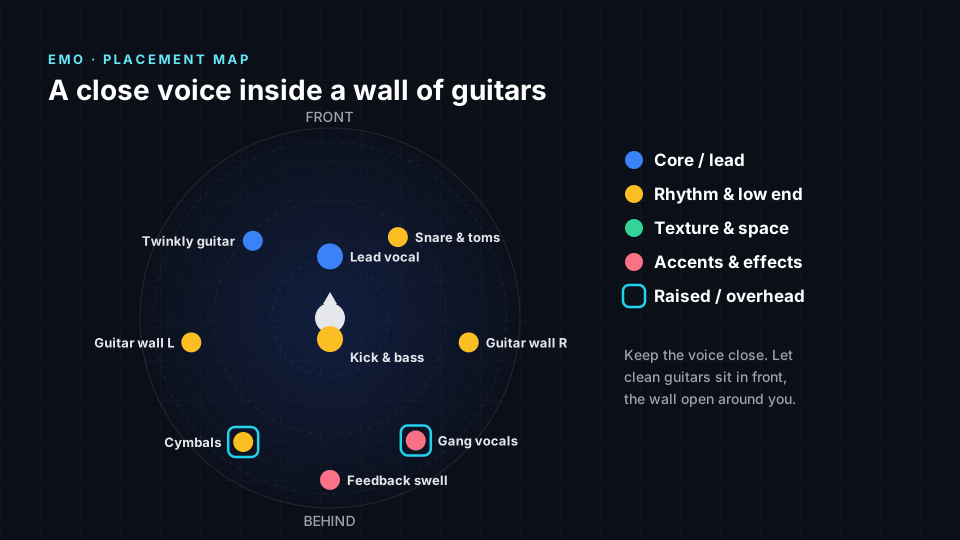
Immersive music for emo: what listeners hear
- A singer right beside you. The vocal sits close and centred, so every confessional line is clear.
- Guitars you can pick apart. The clean, twinkly lead stays in front of the distorted wall.
- A chorus that surrounds you. Distorted guitars open to both sides when the song gets loud.
- A crowd behind you. Gang vocals and cymbals rise from behind, like a basement show.
Where to place each element in an emo mix
| Element | Position | Height | Why it works |
|---|---|---|---|
| Lead vocal | Front centre, close | Ear level | The confessional focus of every song |
| Kick & bass | Centre | Ear level | A solid low end under quiet and loud parts |
| Twinkly guitar | Front left | Ear level | Clean, interlocking lines that need clarity |
| Snare & toms | Front right | Ear level | Busy fills beside the vocal, not on top of it |
| Guitar wall L | Wide left | Ear level | One half of the distorted chorus wall |
| Guitar wall R | Wide right | Ear level | The other half, clear of the vocal |
| Cymbals | Behind left | Raised | Crashes and rides above the guitars |
| Gang vocals | Behind right | Raised | A shouting crowd behind the singer |
| Feedback swell | Behind, moving | Ear level | Noise that rises between sections |
The psychoacoustics behind emo placement
Every position in the table above follows how the ear and brain locate sound. Here is the reason behind the main choices for emo.
- Kick and bass stay centred. The ear finds almost no direction in frequencies below roughly 80 to 100 Hz, so the kick and bass guitar gain nothing from being spread. Keeping them centred gives the loud choruses a stable floor on any system.
- Twinkly guitar apart from the distorted wall. The brain groups notes into streams by pitch, timbre and direction. This is auditory stream segregation (Bregman). Giving the clean guitar its own place in front lets the ear follow its tapped, interlocking lines even when the distorted guitars come in.
- Distorted guitars wide, vocal in the middle. The voice and the distorted guitars share the same midrange. Pulling them apart by direction gives spatial release from masking, so the words stay audible in the loudest chorus.
- Feedback swell moving behind. The ear is especially alert to sounds that rise in level or seem to approach, a bias known as looming (Neuhoff). A feedback swell that grows and moves behind the listener builds tension before the chorus lands.
The immersion profile for emo
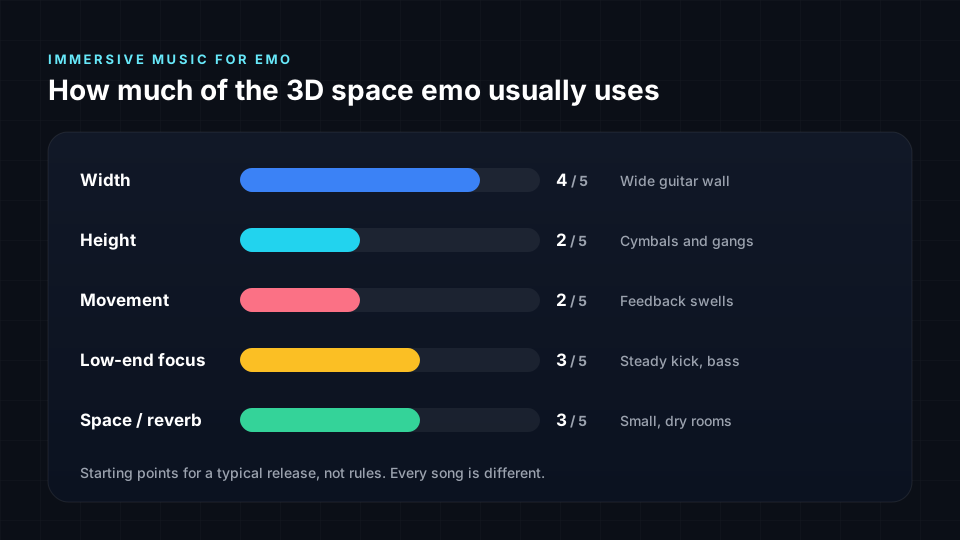
Width is high because the distorted guitar wall and the interlocking clean parts need room on both sides. Height is low: only cymbals and gang vocals go up, since emo is a band playing at ear level. Movement is low too, with only feedback and the odd guitar swell moving. Low-end focus and space are moderate, because the kick and bass support the songs rather than lead them, and the rooms are usually small and fairly dry.
Tips for an immersive emo mix
- Keep the vocal close and dry. The words matter most, so do not push the singer back into the room.
- Use the quiet to loud contrast. Keep the verses narrow and intimate, then open the guitar wall wide for the chorus.
- Give the clean guitar its own spot. Twinkly lines lose their detail if they share a direction with the distortion.
- Put the crowd behind. Gang vocals and shouted backing parts feel like a live show when raised behind the listener.
- Keep the drums in front. Busy fills should stay beside the vocal, with only the cymbals lifted.
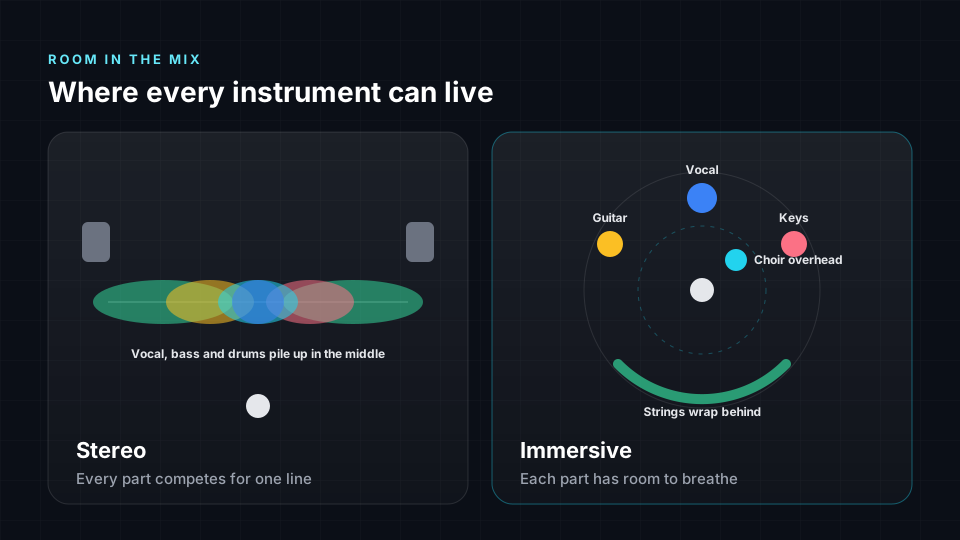
Emo styles: Midwest emo, screamo and emo pop
The core placement holds for every emo style: vocal, kick and bass in the middle, guitars around the listener. What changes is how clean, how heavy and how polished the track is.
Midwest Emo
Midwest emo grew in the 1990s around Chicago, Illinois and nearby states, with bands that favoured clean, tapped and interlocking guitars, open tunings, odd time signatures and occasional trumpet. It is the most detailed emo style, so separation matters most. Put the two clean guitars on opposite front sides so their lines stay distinct, keep the vocal close and centred, and let the drums sit just right of centre. Trumpet or other extra instruments can sit raised behind. Keep the room small and natural, like a house show, with distortion arriving wide only at the peaks.
Screamo
Screamo developed in the early 1990s, with the San Diego scene a key early centre, pushing emotional hardcore into screamed vocals, chaotic structures and sudden quiet passages. The mix is dense and raw. Keep the screamed vocal centred and close, with the kick and bass locked underneath. Spread distorted guitars wide and slightly behind the listener, so the vocal cuts through the noise. Use feedback and noise as moving elements between sections, and keep blast beats or fast snare dry and centred so they do not smear.
Emo Pop
Emo pop took the style mainstream in the late 1990s and 2000s, with catchy hooks, sung choruses, tight production and layered vocals. It is the most polished form of emo. Keep the lead vocal close and bright in the centre, and spread doubled vocals and harmonies slightly wider at the front. Guitars form a wide, even wall on both sides, and the drums stay punchy and centred. Raise cymbals and backing shouts, and keep reverb short so the hooks stay clear.
Related styles such as pop punk, post-hardcore and math rock follow the same idea: keep the voice and low end centred, then give each guitar layer its own place.
How to make immersive emo from stereo
Spatial9 can create spatial audio from a stereo track in a few steps:
- Upload your stereo master or your stems.
- Spatial9's AI separates and places each part, keeping the vocal, kick and bass centred, separating clean guitars from the distorted wall and lifting cymbals and gang vocals behind you.
- Preview it in binaural on headphones.
- Export Eclipsa Audio, ADM, binaural or Ambisonics.
- Publish a video. Create a YouTube-ready video with your immersive audio and publish it directly.
For related guides, read spatial audio for punk and spatial audio for math rock. Every guide is listed in spatial audio and immersive music by genre.
Frequently asked questions
Does this guide cover Midwest emo, screamo and emo pop?
Yes. Midwest emo splits clean, interlocking guitars on opposite front sides in a small room. Screamo keeps a screamed vocal centred and spreads a raw guitar wall wide and slightly behind. Emo pop places a bright, close vocal over an even guitar wall with harmonies spread at the front.
Can I make an emo mix in Dolby Atmos or Eclipsa Audio?
Yes. The placements in this guide work for both. Spatial9 exports ADM, the standard file used by Dolby Atmos studios, as well as Eclipsa Audio for YouTube, so one immersive emo mix covers both. If you plan to release the Atmos version on Apple Music, build it from your original stems or multitracks, because Apple does not accept Atmos made from a finished stereo master. See where to publish spatial audio. You may also hear this called a 3D emo mix or emo in spatial audio.
Is spatial audio good for emo?
Yes. Emo depends on contrast between quiet, intimate verses and loud, full choruses. Spatial audio can make that contrast physical, keeping the voice close while the guitars open up around you.
How is emo different from punk in spatial audio?
Punk is usually fast, steady and loud all the way through, with one wall of guitars around a shouted vocal. Emo has more dynamic range and more detailed guitar parts, so its mix needs clean lines kept separate in front and a guitar wall that grows and shrinks with the song.
Should the twinkly guitar be centred in an immersive emo mix?
No. Keep the vocal in the centre and put the clean guitar slightly to one side in front. That way the two melodic parts stay separate, and the guitar keeps its detail when the distortion arrives.
Can I convert a finished emo track to spatial audio?
Yes. Spatial9 uses AI to generate an immersive mix from a stereo master and exports it as Eclipsa Audio, ADM, binaural or Ambisonics.
Does immersive emo work on normal headphones?
Yes. The mix is rendered binaurally, so the close vocal, twinkly guitars and wide chorus wall work on any regular headphones.
Dolby and Dolby Atmos are trademarks of Dolby Laboratories. Spatial9 is not affiliated with or endorsed by Dolby Laboratories.
Sources
- Blauert, J. (1997). Spatial Hearing: The Psychophysics of Human Sound Localization, revised edition. MIT Press. Low-frequency, elevation, distance and motion cues.
- Mills, A. W. (1958). On the minimum audible angle. Journal of the Acoustical Society of America, 30(4), 237-246.
- Hebrank, J. and Wright, D. (1974). Spectral cues used in the localization of sound sources on the median plane. Journal of the Acoustical Society of America, 56(6), 1829-1834.
- Bronkhorst, A. W. (2000). The cocktail party phenomenon: a review of research on speech intelligibility in multiple-talker conditions. Acta Acustica united with Acustica, 86, 117-128.
- Litovsky, R. Y., Colburn, H. S., Yost, W. A. and Guzman, S. J. (1999). The precedence effect. Journal of the Acoustical Society of America, 106(4), 1633-1654.
- Barron, M. and Marshall, A. H. (1981). Spatial impression due to early lateral reflections in concert halls. Journal of Sound and Vibration, 77(2), 211-232.
- Neuhoff, J. G. (1998). Perceptual bias for rising tones. Nature, 395, 123-124.
- Bregman, A. S. (1990). Auditory Scene Analysis: The Perceptual Organization of Sound. MIT Press.
Let the chorus surround you
Upload a track to Spatial9 and hear your vocal stay close while the guitars open up all around you in minutes. Then export it or publish it straight to YouTube.