Spatial Audio & Immersive Music for Folk Metal: Viking Metal, Pagan Metal & Celtic Metal
Spatial9 Team · · 10 min read
Part of the series Spatial audio and immersive music by genre.
Key takeaways
- In a spatial folk metal mix the lead vocal, kick, snare and bass stay locked in the centre, while the fiddle, whistle and pipes, guitar walls, drones, gang chants and cymbals spread around the listener.
- Placing fiddles and whistles in front of the guitar wall helps the brain hear the tune and the riff as separate layers, an effect known as auditory stream segregation.
- Drones and chants spread behind and to the sides create a sense of envelopment, so the mix feels like a large hall full of people singing along.
- The folk metal immersion profile scores width 5, height 3, movement 2, low-end focus 4 and space 4 out of 5.
Folk metal grew out of the early 1990s, when metal bands began weaving traditional melodies and instruments into heavy music. In England, Skyclad added fiddle and folk tunes to thrash on its 1991 debut, while in Sweden, Bathory turned towards slower, epic Norse themes around 1990 and laid the ground for Viking metal. Through the late 1990s and 2000s the style spread across Europe: Finnish bands such as Finntroll, Korpiklaani and Ensiferum mixed metal with polka, humppa and folk song, Cruachan brought Irish tunes to metal and Eluveitie built a Celtic sound around bagpipes, tin whistle and hurdy-gurdy. The music swings between fast gallops, jigs in 6/8 and slow, chanted marches, often with harsh and clean vocals side by side. Acoustic instruments, distorted guitars and chants at once give folk metal more voices than stereo can hold, which makes it a strong fit for spatial audio. This guide covers how spatial audio for folk metal works, where to place each element and how to make an immersive folk metal mix. For the basics, see what spatial audio is.
Why folk metal works in spatial audio
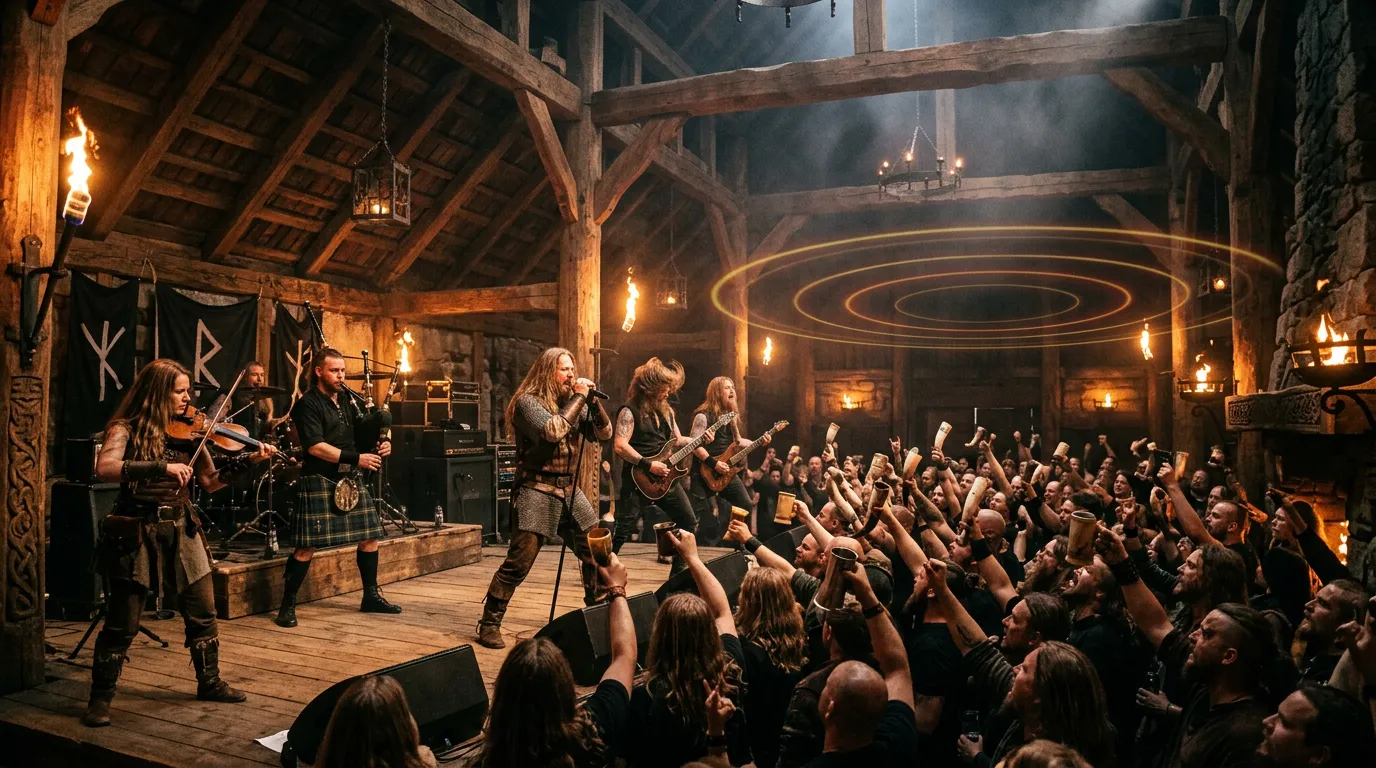
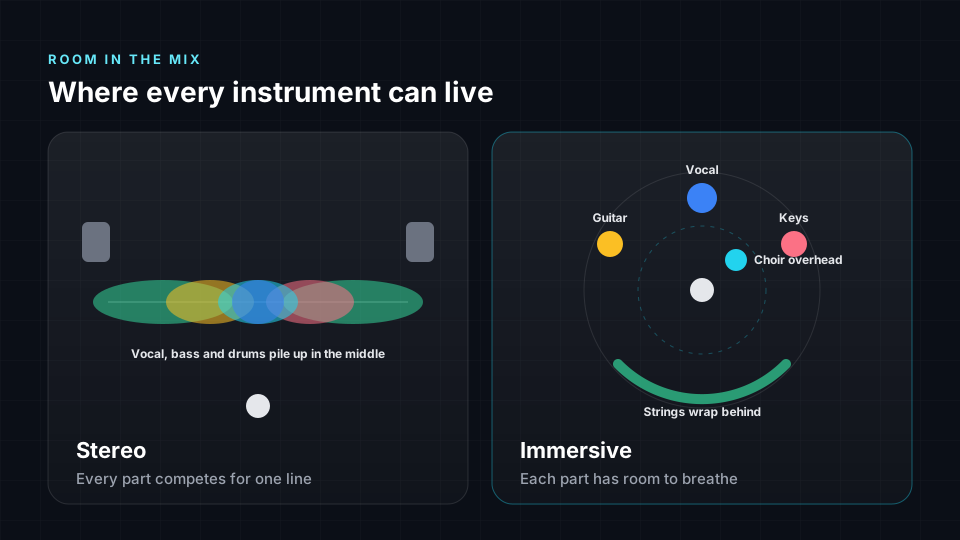
Folk metal has a balance problem. Fiddles, whistles and bagpipes are easily buried by distorted guitars, so stereo mixers often choose between a heavy riff and an audible melody. In an immersive mix the guitars can stay huge at the sides while the folk instruments get their own clear places in front, just like a band playing in a tavern full of people singing along.
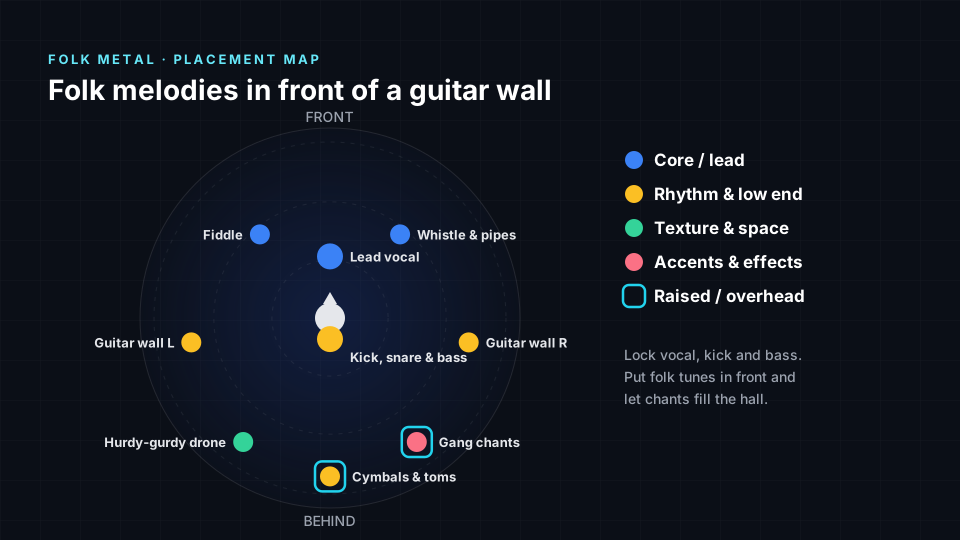
The rule: guitars wide, folk melodies in front, voices all around. The vocal and rhythm section hold the centre, the folk instruments carry the tune at the front and the chants fill the room.
Immersive music for folk metal: what listeners hear
- Folk melodies you can actually follow. The fiddle and whistle sit clear in front of the riff instead of under it.
- A guitar wall on both sides. Heavy rhythm guitars surround the listener without hiding the tune.
- A drone that fills the room. Hurdy-gurdy and bagpipe drones hum from behind like an old hall.
- A crowd singing with you. Gang chants and shouts rise above and around the listener.
Where to place each element in a folk metal mix
| Element | Position | Height | Why it works |
|---|---|---|---|
| Lead vocal | Front centre | Ear level | Harsh or clean, the voice leads the song |
| Kick, snare & bass | Centre | Ear level | The march, gallop or jig as one engine |
| Fiddle | Front left | Ear level | The main folk melody, clear of the riff |
| Whistle & pipes | Front right, moving | Ear level | Bright tunes that dance across the front |
| Guitar wall L | Left | Ear level | One half of the heavy rhythm |
| Guitar wall R | Right | Ear level | The other half, away from the melodies |
| Hurdy-gurdy drone | Behind left | Ear level | A steady drone that fills the room |
| Gang chants | Behind right | Raised | Massed voices like a crowd around you |
| Cymbals & toms | Behind | Raised | Crashes and tom rolls above the guitars |
The psychoacoustics behind folk metal placement
Every position in the table above follows how the ear and brain locate sound. Here is the reason behind the main choices for folk metal.
- Kick, snare and bass stay centred. The ear finds almost no direction in frequencies below roughly 80 to 100 Hz, so the kick and bass gain nothing from being spread. A fixed centre keeps fast gallops tight.
- Fiddle and whistle split from the guitars. The brain sorts sounds into separate streams by pitch, timbre and direction, which is auditory stream segregation (Bregman). Placing the folk instruments in front of the guitar wall, rather than inside it, lets the ear follow the tune and the riff at once.
- Guitars wide, melodies in the middle. Distorted guitars cover the same midrange as fiddle, accordion and voice. Sounds from different directions mask each other far less, an effect known as spatial release from masking, so the wide guitars leave the folk melodies audible.
- A drone behind and chants around. Early reflections and sound arriving from the sides create a sense of width and envelopment (Barron and Marshall). Spreading a steady drone and massed chants behind and to the sides makes the mix feel like a large hall full of people.
The immersion profile for folk metal
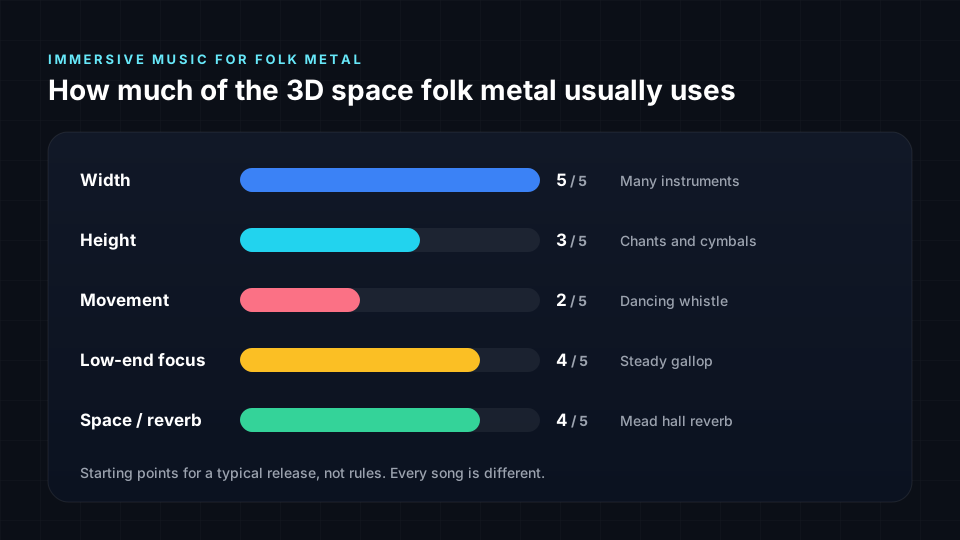
Width scores at maximum because folk metal adds fiddles, whistles, pipes and chants to a full band, and each needs a place. Low-end focus and space are high, because the gallop must stay tight while the drones and chants call for a large, hall-like room. Height is moderate, used for chants and cymbals, and movement stays low: the folk instruments carry the tune from fixed places, with only the whistle dancing.
Tips for an immersive folk metal mix
- Put folk instruments in front of the wall. Place fiddle, whistle and accordion closer to the listener than the guitars, not inside them.
- Keep acoustic instruments natural. Leave fiddles and pipes fairly dry, with a short room, so they sound real next to the distortion.
- Use the back for drones. Hurdy-gurdy and bagpipe drones work as a bed behind the listener.
- Make the chants feel like a crowd. Spread gang vocals wide and raised so the chorus sounds like a village singing along.
- Open the room for slow passages. Let the hall grow during ballads and marches, then tighten it when the gallop returns.
Folk Metal styles: Viking metal, pagan metal and Celtic metal
The core placement holds for every folk metal style: vocal, kick, snare and bass in the centre, guitars wide and folk instruments in front. What changes is which instruments lead, how fast the music runs and how much space it needs.
Viking Metal
Viking metal grew from Bathory's epic albums around 1990 and was carried on by Scandinavian bands, with Norse themes, slow marching rhythms, choirs and fewer folk instruments than other styles. The choir is the centrepiece. Raise massed clean vocals above and behind the listener, so they sound like a crew singing in a vast hall. Keep the guitars wide and the drums steady in the centre. Horns, mouth harp or a single folk melody can sit at the front sides. Use long, cold reverb on the choir while the band stays tighter and drier.
Pagan Metal
Pagan metal leans towards black metal, with harsh vocals, tremolo riffs and long songs about nature and pre-Christian belief, often from Finland, the Baltic states and Ireland. It needs the most space. Spread the tremolo guitars wide, and let ambient sounds such as wind, rain or fire sit behind the listener. Place folk instruments such as kantele or flute at the front sides, and raise clean chants above. Keep the harsh vocal close and centred, and the kick and bass mono, so the dense riffs never smear.
Celtic Metal
Celtic metal brings Irish, Scottish and Gaulish tradition into metal, with tin whistle, uilleann pipes, bagpipes, fiddle, bodhrán and hurdy-gurdy, as heard from Cruachan and Eluveitie. It has the most melody instruments, so position matters most. Keep the fiddle at the front left and the whistle or pipes at the front right, moving lightly on fast jigs. Place the hurdy-gurdy drone behind, and the bodhrán at the front sides away from the snare. Keep the room warm and lively rather than cold.
Related styles such as medieval metal and symphonic folk metal follow the same idea: keep the band anchored, then give every traditional instrument and voice its own place.
How to make immersive folk metal from stereo
Spatial9 can create spatial audio from a stereo track in a few steps:
- Upload your stereo master or your stems.
- Spatial9's AI separates and places each part, locking the vocal, kick and bass, spreading the guitar wall and giving fiddles, whistles, drones and chants their own positions.
- Preview it in binaural on headphones.
- Export Eclipsa Audio, ADM, binaural or Ambisonics.
- Publish a video. Create a YouTube-ready video with your immersive audio and publish it directly.
For related guides, read spatial audio for metal and spatial audio for folk. Every guide is listed in spatial audio and immersive music by genre.
Frequently asked questions
Does this guide cover Viking metal, pagan metal and Celtic metal?
Yes. Viking metal raises a large choir above the band with slow, marching drums. Pagan metal spreads tremolo guitars and nature sounds around the listener with a close, harsh vocal. Celtic metal gives fiddles, whistles, pipes and drones their own places around a heavy core.
Can I make a folk metal mix in Dolby Atmos or Eclipsa Audio?
Yes. The placements in this guide work for both. Spatial9 exports ADM, the standard file used by Dolby Atmos studios, as well as Eclipsa Audio for YouTube, so one immersive folk metal mix covers both. If you plan to release the Atmos version on Apple Music, build it from your original stems or multitracks, because Apple does not accept Atmos made from a finished stereo master. See where to publish spatial audio. You may also hear this called a 3D folk metal mix or folk metal in spatial audio.
Is spatial audio good for folk metal?
Yes. Folk metal layers distorted guitars, acoustic folk instruments, drones and chanted vocals. Spatial audio keeps the riff heavy while giving every melody instrument a clear place of its own.
How is folk metal different from folk rock in spatial audio?
Folk metal adds a dense wall of distorted guitars and double kick, so folk instruments must sit in front of it to stay audible. Folk rock is lighter, so its instruments share the front stage more easily.
Where should the bagpipes go in an immersive folk metal mix?
Put the melody at the front right, opposite the fiddle, and keep it fairly dry. If the pipes also play a drone, send that part behind the listener so it fills the room without masking the tune.
Can I convert a finished folk metal track to spatial audio?
Yes. Spatial9 uses AI to generate an immersive mix from a stereo master and exports it as Eclipsa Audio, ADM, binaural or Ambisonics.
Does immersive folk metal work on normal headphones?
Yes. The mix is rendered binaurally, so the fiddles, guitar walls and chanting voices work on any regular headphones.
Dolby and Dolby Atmos are trademarks of Dolby Laboratories. Spatial9 is not affiliated with or endorsed by Dolby Laboratories.
Sources
- Blauert, J. (1997). Spatial Hearing: The Psychophysics of Human Sound Localization, revised edition. MIT Press. Low-frequency, elevation, distance and motion cues.
- Mills, A. W. (1958). On the minimum audible angle. Journal of the Acoustical Society of America, 30(4), 237-246.
- Hebrank, J. and Wright, D. (1974). Spectral cues used in the localization of sound sources on the median plane. Journal of the Acoustical Society of America, 56(6), 1829-1834.
- Bronkhorst, A. W. (2000). The cocktail party phenomenon: a review of research on speech intelligibility in multiple-talker conditions. Acta Acustica united with Acustica, 86, 117-128.
- Litovsky, R. Y., Colburn, H. S., Yost, W. A. and Guzman, S. J. (1999). The precedence effect. Journal of the Acoustical Society of America, 106(4), 1633-1654.
- Barron, M. and Marshall, A. H. (1981). Spatial impression due to early lateral reflections in concert halls. Journal of Sound and Vibration, 77(2), 211-232.
- Neuhoff, J. G. (1998). Perceptual bias for rising tones. Nature, 395, 123-124.
- Bregman, A. S. (1990). Auditory Scene Analysis: The Perceptual Organization of Sound. MIT Press.
Bring the whole village
Upload a track to Spatial9 and hear your fiddles and pipes ring out in front of a heavy guitar wall in minutes. Then export it or publish it straight to YouTube.