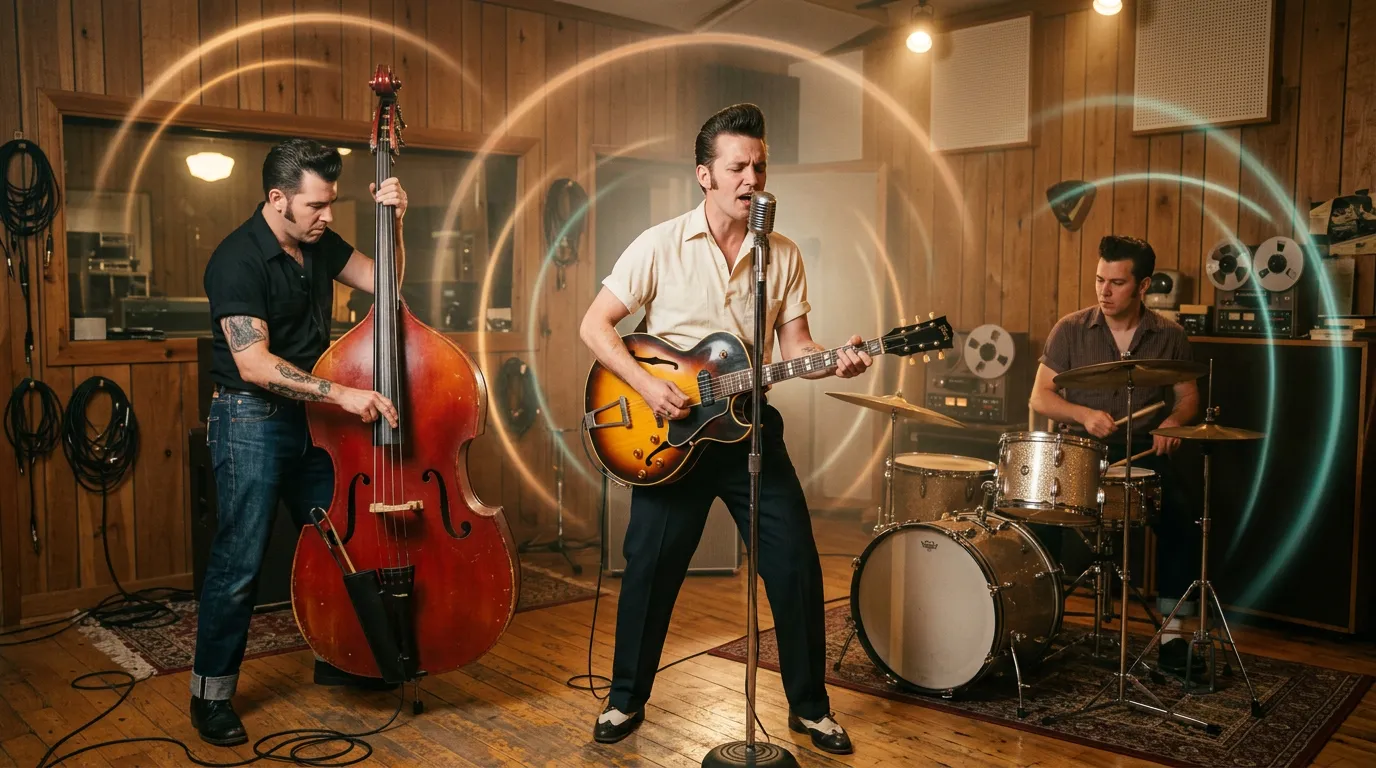
Spatial Audio & Immersive Music for Rockabilly: Rock and Roll, Psychobilly & Neo-Rockabilly
Spatial9 Team · · 10 min read
Part of the series Spatial audio and immersive music by genre.
Key takeaways
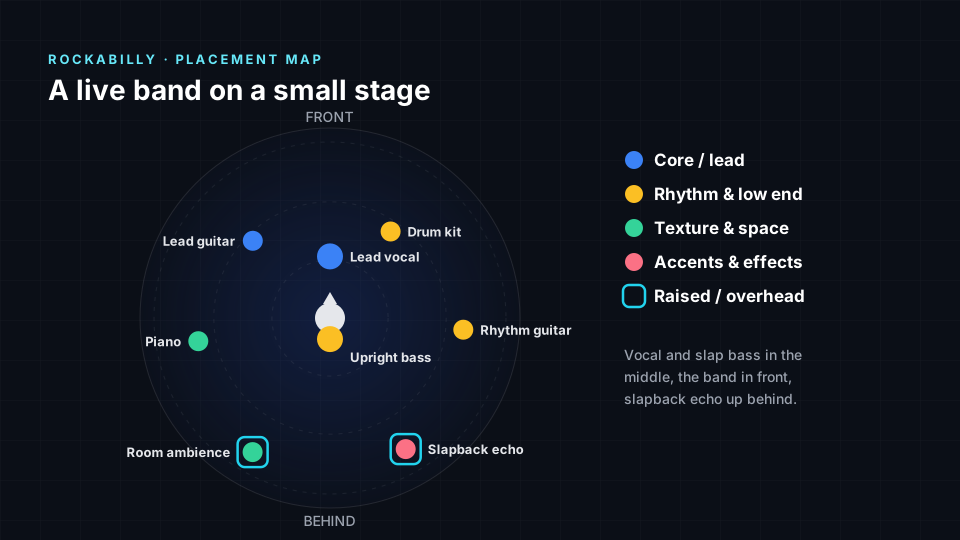
- In a spatial rockabilly mix the lead vocal and slapped upright bass stay in the centre, while the drum kit, lead guitar, rhythm guitar and piano spread across the front like a band on a small stage.
- Slapback echo works best raised behind the listener, because the brain locates a sound by its first arrival, so the dry vocal stays in front while the repeat bounces from the back of the room.
- Rockabilly was recorded live and mostly in mono, so an immersive mix should keep every player still and the band fairly narrow rather than flying parts around the room.
- The rockabilly immersion profile scores width 3, height 2, movement 1, low-end focus 3 and space 3 out of 5.
Rockabilly took shape in the American South in the mid 1950s, when young musicians mixed country and hillbilly music with rhythm and blues. Memphis was the centre of it: at Sun Records, Sam Phillips recorded Elvis Presley, Carl Perkins and Jerry Lee Lewis in one small room, often live. The sound is lean and fast, usually somewhere between 150 and 200 BPM, built on a slapped upright bass that clicks like a snare, a twangy hollow-body electric guitar, a simple kit played with brushes or sticks, and a hiccuping, excited vocal. Over it all sits slapback echo, a single short repeat made by running the signal through a second tape machine. Most of these records were mixed in mono, which is exactly why rockabilly suits spatial audio: the band was always playing in a real room, and an immersive mix can put that room back around the listener. This guide covers how spatial audio for rockabilly works, where to place each element and how to make an immersive rockabilly mix. For the basics, see what spatial audio is.
Why rockabilly works in spatial audio
Rockabilly is small band music: three or four players, one voice and one echo. In mono the slap bass, snare and guitar land on one point, with the slapback right on top of the vocal. In an immersive mix the band spreads out like it did in the studio, while the echo moves behind the listener where it can be heard as a separate repeat instead of a blur.
The rule: a tight band in front, the echo behind. The vocal and slap bass stay centred, the players spread across the front and only the slapback and the room go above and behind.
Immersive music for rockabilly: what listeners hear
- A singer standing right in front of you. The vocal sits close and centred, with every hiccup and growl intact.
- A bass you can hear slapping. The upright bass stays in the middle, its click and thump locked to the snare.
- A band on a small stage. Guitars, drums and piano each have their own spot across the front.
- That echo behind you. Slapback repeats from behind and above, like the walls of an old studio.
Where to place each element in a rockabilly mix
| Element | Position | Height | Why it works |
|---|---|---|---|
| Lead vocal | Front centre, close | Ear level | The focus of every rockabilly song |
| Upright bass | Centre | Ear level | Slap rhythm and low notes stay solid |
| Drum kit | Front right | Ear level | A small kit beside the singer |
| Lead guitar | Front left | Ear level | Twangy fills and solos with room to breathe |
| Rhythm guitar | Right | Ear level | Acoustic or electric chop that drives the beat |
| Piano | Left | Ear level | Boogie piano balanced against the rhythm guitar |
| Slapback echo | Behind right | Raised | A single repeat clear of the dry vocal |
| Room ambience | Behind left | Raised | The sound of a small, lively studio |
The psychoacoustics behind rockabilly placement
Every position in the table above follows how the ear and brain locate sound. Here is the reason behind the main choices for rockabilly.
- Upright bass stays centred. The ear finds almost no direction in frequencies below roughly 80 to 100 Hz, so the fundamental of the bass gains nothing from being moved. Keeping it centred holds the low end steady and keeps the slap click tied to the same point.
- Slapback echo behind the vocal. When a sound and its repeat arrive close together, the brain fixes its position by the first arrival. This is the precedence effect. A slapback of around 100 milliseconds is long enough to be heard as a separate repeat, so placing it behind keeps the voice firmly in front while the echo adds bounce from the back of the room.
- Lead guitar and piano on opposite sides. Twangy guitar and boogie piano both sit in the upper mids, so they mask each other when they share a direction. Separating them gives spatial release from masking, and each fill stays clear when the two trade licks.
- Room ambience raised and lateral. Early reflections arriving from the sides make a space feel wider and more enveloping. This is the link between lateral reflections and spaciousness (Barron and Marshall). Raising the room sound to the sides and behind recreates the feel of a live tracking room without washing out the band.
The immersion profile for rockabilly
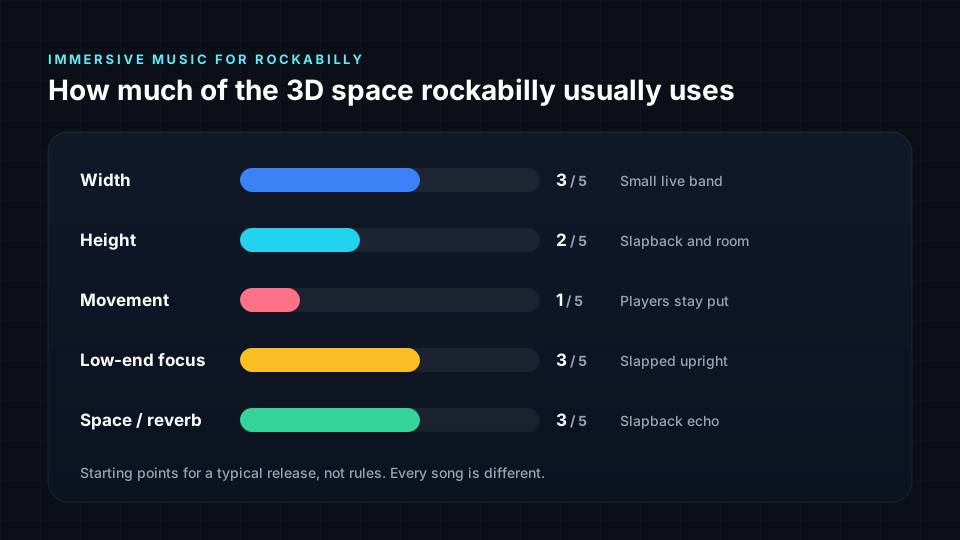
Width is moderate because the band should sound like it fits on one small stage. Height is low: only the slapback and the room sound go up. Movement is the lowest possible score, because these are live performances and every player stays in place. Low-end focus is moderate, since the slapped bass is felt as rhythm more than as deep weight. Space scores a 3 because slapback and room sound are part of the style but never turn into a big wash.
Tips for an immersive rockabilly mix
- Keep the vocal dry and close. Let the slapback carry the effect, not long reverb on the voice itself.
- Treat the slapback as its own source. Give the echo a position behind, so it bounces back rather than sitting on the vocal.
- Keep the band still. Rockabilly is a live performance, so nothing needs to fly around the room.
- Respect the mono originals. Spread the band gently across the front instead of throwing parts hard to the sides.
- Let the slap bass and snare lock. Keep them close in position so the rhythm hits as one.
Rockabilly styles: rock and roll, psychobilly and neo-rockabilly
The core placement holds for every rockabilly style: vocal and bass in the middle, the band across the front and the echo behind. What changes is the tempo, the attitude and how much space the track needs.
Rock and Roll
Rock and roll is the wider family rockabilly belongs to, with roots in rhythm and blues, boogie woogie piano and jump blues saxophone in the early to mid 1950s. Its records add pounding piano, saxophone and backing vocals to the basic rockabilly line up. Keep the lead vocal close and centred, put the piano front left and a saxophone front right so the two answer each other. Backing vocals belong a little wider and further back. Raise a short plate reverb behind.
Psychobilly
Psychobilly emerged in the late 1970s and early 1980s, when bands in the US and the UK fused rockabilly with punk speed, horror film imagery and wild, distorted vocals. The slapped double bass becomes even more aggressive, often clicking like a second snare. Keep it centred and punchy. Place screams, howls and horror samples raised behind or to the sides, where they feel menacing. Guitars can be louder and wider than in classic rockabilly, but the band should still sound like one gang in front of the listener.
Neo-Rockabilly
Neo-rockabilly is the revival that began in the late 1970s and broke through in the early 1980s, with bands such as the Stray Cats bringing quiffs, slap bass and Gretsch twang to the charts. Production is cleaner and louder, with bigger drums and more reverb. Spread the guitar and the drums a little wider across the front, keep the slap bass centred and the vocal close. Slapback and plate reverb can go higher and wider than for classic rockabilly, giving the revival sound its polish.
Related styles such as western swing, honky tonk and surf follow the same idea: keep the band on one stage and give the echo and room their own place.
How to make immersive rockabilly from stereo
Spatial9 can create spatial audio from a stereo track in a few steps:
- Upload your stereo master or your stems.
- Spatial9's AI separates and places each part, keeping the vocal and slap bass centred, spreading the band across the front and lifting the slapback echo behind you.
- Preview it in binaural on headphones.
- Export Eclipsa Audio, ADM, binaural or Ambisonics.
- Publish a video. Create a YouTube-ready video with your immersive audio and publish it directly.
For related guides, read spatial audio for rock and spatial audio for surf rock. Every guide is listed in spatial audio and immersive music by genre.
Frequently asked questions
Does this guide cover rock and roll, psychobilly and neo-rockabilly?
Yes. Rock and roll adds piano, saxophone and backing vocals around a centred singer. Psychobilly keeps an aggressive slap bass centred with screams and horror effects raised behind. Neo-rockabilly spreads a cleaner, louder band a little wider with more reverb above.
Can I make a rockabilly mix in Dolby Atmos or Eclipsa Audio?
Yes. The placements in this guide work for both. Spatial9 exports ADM, the standard file used by Dolby Atmos studios, as well as Eclipsa Audio for YouTube, so one immersive rockabilly mix covers both. If you plan to release the Atmos version on Apple Music, build it from your original stems or multitracks, because Apple does not accept Atmos made from a finished stereo master. See where to publish spatial audio. You may also hear this called a 3D rockabilly mix or rockabilly in spatial audio.
Is spatial audio good for rockabilly?
Yes. Rockabilly was recorded live by small bands in real rooms, and spatial audio can give back the sense of players standing together on a stage, with the slapback echo clear of the voice.
How is rockabilly different from rock in spatial audio?
Rockabilly is a small acoustic and electric combo with a slapped upright bass, so its mix stays narrower, drier and more live, with slapback as the main effect. Modern rock usually has layered, distorted guitars that form a wide wall and bigger drums with more height.
Can I turn an old mono rockabilly recording into spatial audio?
Yes, with care. AI separation can pull the vocal, bass, guitar and drums apart, but keep the placements gentle and close to the front so the record still sounds like the original session.
Can I convert a finished rockabilly track to spatial audio?
Yes. Spatial9 uses AI to generate an immersive mix from a stereo master and exports it as Eclipsa Audio, ADM, binaural or Ambisonics.
Does immersive rockabilly work on normal headphones?
Yes. The mix is rendered binaurally, so the slap bass, twangy guitar and slapback echo work on any regular headphones.
Dolby and Dolby Atmos are trademarks of Dolby Laboratories. Spatial9 is not affiliated with or endorsed by Dolby Laboratories.
Sources
- Blauert, J. (1997). Spatial Hearing: The Psychophysics of Human Sound Localization, revised edition. MIT Press. Low-frequency, elevation, distance and motion cues.
- Mills, A. W. (1958). On the minimum audible angle. Journal of the Acoustical Society of America, 30(4), 237-246.
- Hebrank, J. and Wright, D. (1974). Spectral cues used in the localization of sound sources on the median plane. Journal of the Acoustical Society of America, 56(6), 1829-1834.
- Bronkhorst, A. W. (2000). The cocktail party phenomenon: a review of research on speech intelligibility in multiple-talker conditions. Acta Acustica united with Acustica, 86, 117-128.
- Litovsky, R. Y., Colburn, H. S., Yost, W. A. and Guzman, S. J. (1999). The precedence effect. Journal of the Acoustical Society of America, 106(4), 1633-1654.
- Barron, M. and Marshall, A. H. (1981). Spatial impression due to early lateral reflections in concert halls. Journal of Sound and Vibration, 77(2), 211-232.
- Neuhoff, J. G. (1998). Perceptual bias for rising tones. Nature, 395, 123-124.
- Bregman, A. S. (1990). Auditory Scene Analysis: The Perceptual Organization of Sound. MIT Press.
Put the band back in the room
Upload a track to Spatial9 and hear your slap bass, twang and slapback echo come alive around you in minutes. Then export it or publish it straight to YouTube.