Spatial Audio & Immersive Music for Death Metal: Technical, Melodic & Brutal Death Metal
Spatial9 Team · · 9 min read
Part of the series Spatial audio and immersive music by genre.
Key takeaways
- In a spatial death metal mix the blast beat kick and snare, bass guitar and growled vocal stay locked in the centre, while quad-tracked tremolo-picked guitars spread wide at the front left and right.
- Ride and china cymbals work best raised above the kit, because their almost pure treble reads clearly as height and lifting them stops their wash from masking the down-tuned riffs.
- Sound below roughly 80 to 100 Hz carries very little directional information for the ear, so keeping the double kick and bass guitar centred loses no immersion and keeps blast beats tight.
- The death metal immersion profile scores width 5, height 3, movement 2, low-end focus 5 and space 2 out of 5.
Death metal grew out of thrash in the late 1980s, with early scenes around Tampa in Florida and Stockholm in Sweden. It is built on down-tuned, tremolo-picked guitars, blast beats, double kick and deep growled vocals. Styles range from old-school Swedish chainsaw tone to technical, brutal, melodic and death-doom. Our metal guide covers the general wall-of-guitars approach. This guide covers what changes when tempo and tuning go to extremes: where to place each element, why it works and how to make an immersive death metal mix. For the basics, see what spatial audio is.
Why death metal is ideal for spatial audio
Death metal has a clarity problem, not a size problem. Tremolo picking turns riffs into a stream of notes, blast beats fill every gap, and low tunings push the guitars into the range of the bass and vocal. Stereo answers this with editing and compression. Spatial audio adds direction: parts that cannot be separated by frequency can still be separated by position.
The rule: lock the centre, widen the riffs, lift the metal. Drums, bass and vocal form one spine, the guitars spread wide and the cymbal wash rises out of the way.
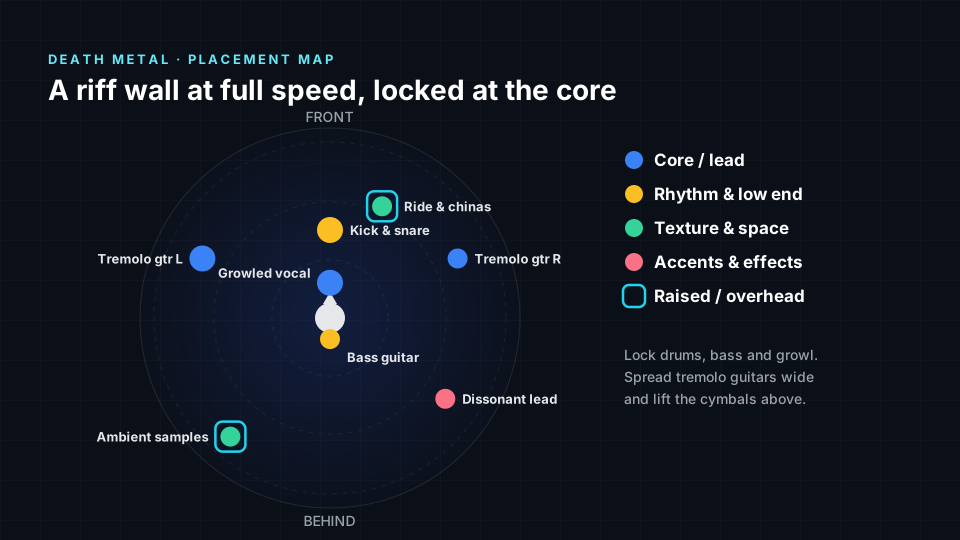
Immersive music for death metal: what listeners hear
- Riffs you can actually follow. Wide tremolo guitars keep each note audible, even at full speed.
- Blast beats that stay sharp. The kick and snare hit from one fixed point, so fast patterns never smear.
- A growl right in front of you. The vocal sits close and centred.
- Darkness behind you. Leads, drones and samples fill the rear without crowding the riff.
Where to place each element in a death metal mix
| Element | Position | Height | Why it works |
|---|---|---|---|
| Growled vocal | Front centre, close | Ear level | Direct and intimate over the riffs |
| Kick & snare | Front centre | Ear level | Blast beats stay tight and readable |
| Bass guitar | Centre | Ear level | Glues kick and low guitars together |
| Tremolo gtr L | Wide front left | Ear level | One half of the riff wall |
| Tremolo gtr R | Wide front right | Ear level | The other half, separate from the vocal |
| Ride & chinas | Front, right of centre | Raised | Clears the guitar midrange |
| Dissonant lead | Behind right, slow move | Ear level | A second line the ear can track |
| Ambient samples | Behind left | Raised | Dark atmosphere without masking |
The psychoacoustics behind Death Metal placement
Every position in the table above follows how the ear and brain locate sound. Here is the reason behind the main choices for death metal.
- Kick, snare and bass guitar locked in the centre. Below roughly 80 to 100 Hz, the ear gets almost no reliable direction from a sound, which is why one subwoofer can support an entire speaker array. Moving the double kick adds nothing, and at blast beat tempos a fixed low end keeps each hit distinct.
- Tremolo guitars wide, growl in the middle. Low tunings put the guitars, bass and growl in the same frequency range. Pulling sounds apart in direction lets the brain hear each one more clearly, an effect known as spatial release from masking. Wide guitars leave a clear channel down the middle for the vocal.
- Ride and china cymbals raised. The ear judges height mostly from high frequencies: the shape of the outer ear filters content above roughly 4 kHz differently for each elevation. Cymbals are almost all treble, so they convincingly sound overhead, and lifting them takes their wash off the riff.
- Dissonant lead behind, moving slowly. The brain groups notes into streams by pitch, timbre and location. A lead shares its tone with the rhythm guitars, so its own direction helps the ear hear two lines instead of one tangle.
The immersion profile for death metal
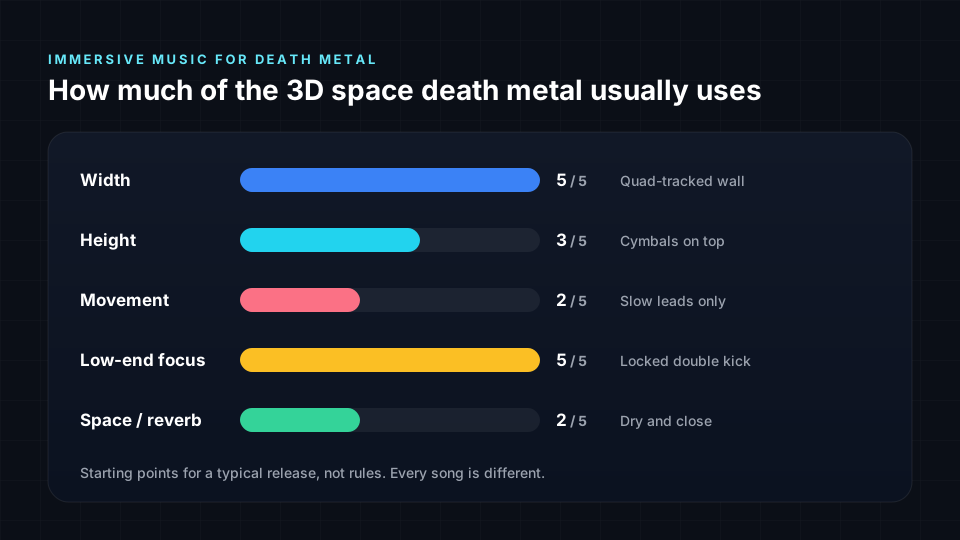
Width and low-end focus score at maximum: the riffs need the full front stage and the low end must never drift. Height comes from cymbals and atmosphere. Movement and space stay low, with longer reverbs saved for death-doom passages and intros.
Tips for an immersive death metal mix
- Split quad-tracked guitars by width. Put one pair wide and one pair slightly inside it, so the wall feels thick rather than hollow.
- Never pan the blast beat. Kick and snare stay in one fixed place.
- Lift the cymbals, not the guitars. Raised rides and chinas are the quickest way to clear space in a dense riff.
- Keep the growl close and dry. A short room on the vocal keeps it in front of the wall instead of inside it.
- Save the back for contrast. Use the rear for leads, drones and intro samples, so the returning riff hits like a wall in front of you.
Death metal styles: technical, melodic and brutal death metal
The core placement from this guide still applies to every style: blast beats, bass and growled vocal locked in the centre, tremolo guitars wide at the front and ride and chinas raised. Here is what changes from one style to the next.
Technical death metal
Technical death metal is built on complex, fast riffs, sudden changes of time signature, sweep-picked leads and a busy, clearly audible bass guitar. Clarity matters most, so keep the room very short and dry. The bass stays centred but should be easy to hear between the kick and the guitars. Put lead runs in the dissonant lead position behind right with only slow movement, so every note can still be followed.
Melodic death metal
Melodic death metal adds harmonised guitar leads, more tuneful riffs and sometimes keyboards to the growls and fast drums. Give the harmony leads their own places, one in the lead position behind right and one mirrored on the left, so the melodies read clearly. Lift keyboards behind left, where the ambient samples sit. Allow a little more space than in other death metal styles, but keep the rhythm guitars wide and still.
Brutal death metal
Brutal death metal pushes everything lower and heavier, with deep guttural vocals, extremely down-tuned guitars, relentless blast beats and slow, crushing slam sections. Keep the growled vocal, kick, snare and bass tightly centred and the guitars wide at front left and right. Use almost no ambience behind, so the low end stays dense and focused. Raise the ride and chinas to stop their wash masking the riffs.
The same approach works for grindcore, with its very short songs, blast beats and extreme distortion. Keep the room even drier, the low end centred and the guitars wide, and skip ambient samples unless they open or close a track.
How to make immersive death metal from stereo
Spatial9 can create spatial audio from a stereo track in a few steps:
- Upload your stereo master or your stems.
- Spatial9's AI separates and places each part, keeping the drums and growl centred while widening the tremolo guitars.
- Preview it in binaural on headphones.
- Export Eclipsa Audio, ADM, binaural or Ambisonics.
- Publish a video. Create a YouTube-ready video with your immersive audio and publish it directly.
For related guides, read spatial audio for metal and spatial audio for punk. Every guide is listed in spatial audio and immersive music by genre.
Frequently asked questions
Does this guide cover technical, melodic and brutal death metal?
Yes. All three keep the kick, snare, bass and growled vocal centred, the tremolo guitars wide and the ride and chinas raised. Technical death metal uses the driest room so complex riffs and the bass stay clear. Melodic death metal gives harmony leads their own places and lifts keyboards behind. Brutal death metal uses almost no ambience so the low end stays dense.
Can I make a death metal mix in Dolby Atmos or Eclipsa Audio?
Yes. The placements in this guide work for both. Spatial9 exports ADM, the standard file used by Dolby Atmos studios, as well as Eclipsa Audio for YouTube, so one immersive death metal mix covers both. If you plan to release the Atmos version on Apple Music, build it from your original stems or multitracks, because Apple does not accept Atmos made from a finished stereo master. See where to publish spatial audio. You may also hear this called a 3D death metal mix or death metal in spatial audio.
Is spatial audio good for death metal?
Yes. Separating parts by direction makes tremolo riffs, blast beats and growls easier to hear without losing weight.
Should blast beats be spread around the listener?
No. Keep the kick and snare centred and still. Only the cymbals should rise.
How do I keep growled vocals clear in an immersive mix?
Keep the growl close, dry and front centre, and push the tremolo guitars wide so the middle stays free for the voice.
Can I convert a finished death metal track to spatial audio?
Yes. Spatial9 uses AI to generate an immersive mix from a stereo master and exports it as Eclipsa Audio, ADM, binaural or Ambisonics.
Does immersive death metal work on normal headphones?
Yes. The mix is rendered binaurally, so the riff wall works on any regular headphones.
Dolby and Dolby Atmos are trademarks of Dolby Laboratories. Spatial9 is not affiliated with or endorsed by Dolby Laboratories.
Sources
- Blauert, J. (1997). Spatial Hearing: The Psychophysics of Human Sound Localization, revised edition. MIT Press. Low-frequency, elevation, distance and motion cues.
- Mills, A. W. (1958). On the minimum audible angle. Journal of the Acoustical Society of America, 30(4), 237-246.
- Hebrank, J. and Wright, D. (1974). Spectral cues used in the localization of sound sources on the median plane. Journal of the Acoustical Society of America, 56(6), 1829-1834.
- Bronkhorst, A. W. (2000). The cocktail party phenomenon: a review of research on speech intelligibility in multiple-talker conditions. Acta Acustica united with Acustica, 86, 117-128.
- Litovsky, R. Y., Colburn, H. S., Yost, W. A. and Guzman, S. J. (1999). The precedence effect. Journal of the Acoustical Society of America, 106(4), 1633-1654.
- Barron, M. and Marshall, A. H. (1981). Spatial impression due to early lateral reflections in concert halls. Journal of Sound and Vibration, 77(2), 211-232.
- Bregman, A. S. (1990). Auditory Scene Analysis: The Perceptual Organization of Sound. MIT Press.
Put your listeners in front of the riff wall
Upload a track to Spatial9 and hear your riffs surround you in minutes. Then export it or publish it straight to YouTube.