Spatial Audio & Immersive Music for Symphonic Rock: Complete Guide
Spatial9 Team · · Updated
Part of the series Spatial audio and immersive music by genre.
Symphonic rock combines a rock band with an orchestra and often a choir. Think of distorted guitars and pounding drums alongside soaring strings, heavy brass, timpani rolls and huge choral passages. Some songs are rock songs with orchestral arrangements, others are long, cinematic pieces that move between quiet and enormous. A rock mix captures a band. An orchestral mix captures a hall. A symphonic rock mix needs to hold both without either one burying the other. This guide covers how spatial audio for symphonic rock works, where to place each element and how to make an immersive symphonic rock mix. For the basics, see what spatial audio is.
Why symphonic rock is perfect for spatial audio
Symphonic rock is one of the densest styles in music. A loud passage can include a full drum kit, layered guitars, bass, keys, dozens of string players, a brass section, timpani and a choir, all at once. In stereo, that much sound fights for the same two speakers. Engineers often have to choose between a powerful band and a grand orchestra, and the vocal can disappear in the middle.
Spatial audio removes that trade-off. The band can stay in front, the orchestra can surround the listener, and the choir can rise above. Every section gets its own space, and the big moments feel truly huge instead of just loud.
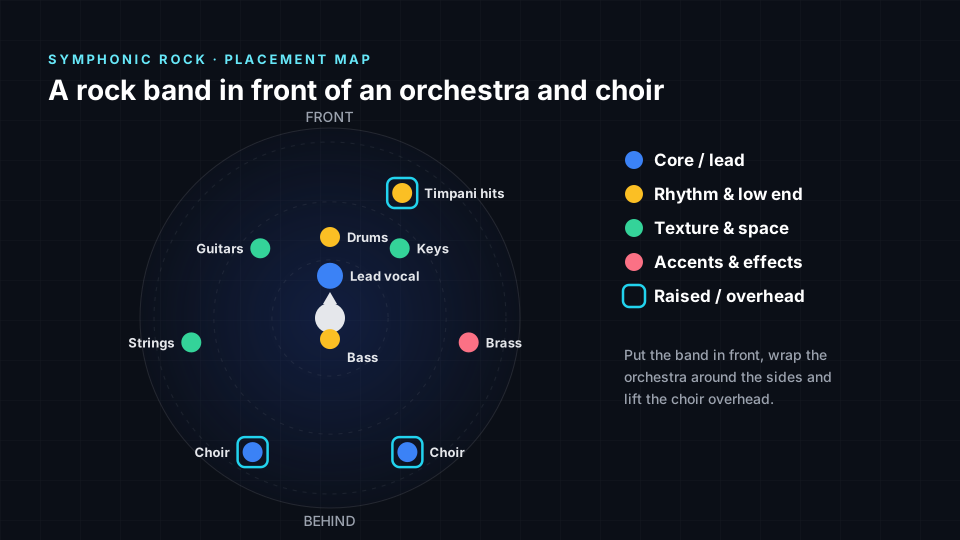
The rule: put the band in front, wrap the orchestra around the sides and lift the choir overhead.
Immersive music for symphonic rock: what listeners hear
- A band with power. Drums and guitars hit hard from the stage in front.
- An orchestra around you. Strings and brass fill the sides instead of hiding behind the guitars.
- A choir from above. Voices rise over the listener in the biggest moments.
- Real scale. Quiet passages feel close, and the climaxes feel like a concert hall.
Where to place each element in a symphonic rock mix
| Element | Position | Height | Why it works |
|---|---|---|---|
| Lead vocal | Front centre | Ear level | Stays clear above the whole ensemble |
| Guitars | Front left | Ear level | Rock power sits on the stage |
| Keys | Front right | Ear level | Balances the guitars |
| Drums | Front centre, behind vocal | Ear level | Drives the band from the stage |
| Bass | Centre | Ear level | Low notes are hard to place, so centre is cleanest |
| Strings | Left side, wide | Ear level to slightly raised | Wraps the listener without masking the guitars |
| Brass | Right side, wide | Ear level | Big hits get their own direction |
| Choir | Behind left and right | Raised | Creates the feeling of a choir loft above you |
| Timpani hits | Front right, far | Raised | Big accents land like a hall percussion section |
The psychoacoustics behind symphonic rock placement
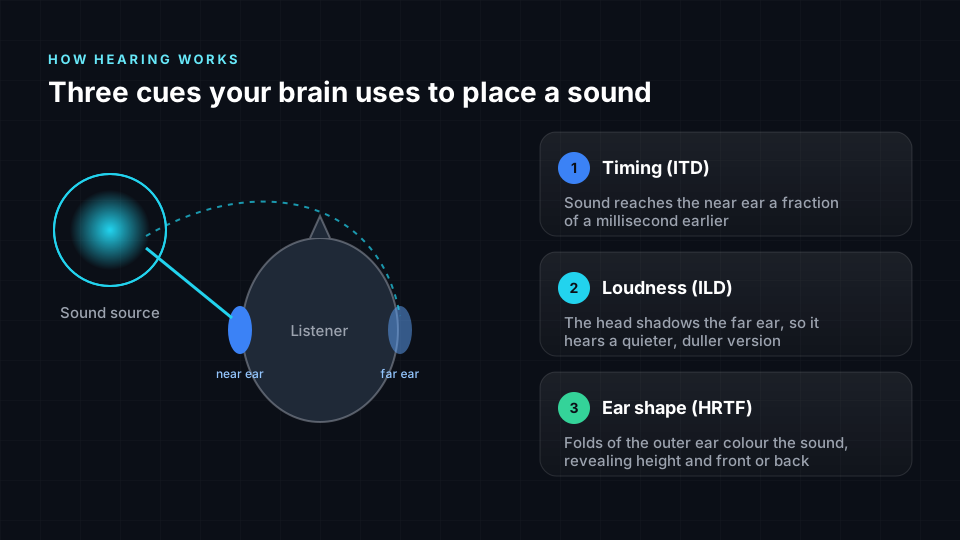
- Spatial release from masking. Sounds from different directions are easier to hear together. Separating the orchestra from the band keeps both clear (Bronkhorst, 2000).
- Grouping by location. The brain groups sounds that come from the same place. Keeping all the strings on one side helps them sound like one section (Bregman, 1990).
- Front and back spectral cues. Our ears shape sound differently depending on where it comes from, which lets the choir behind and above sound distinct from the band in front (Hebrank and Wright, 1974).
- Envelopment. Sound from the sides and behind creates the feeling of being inside a large space (Barron and Marshall, 1981).
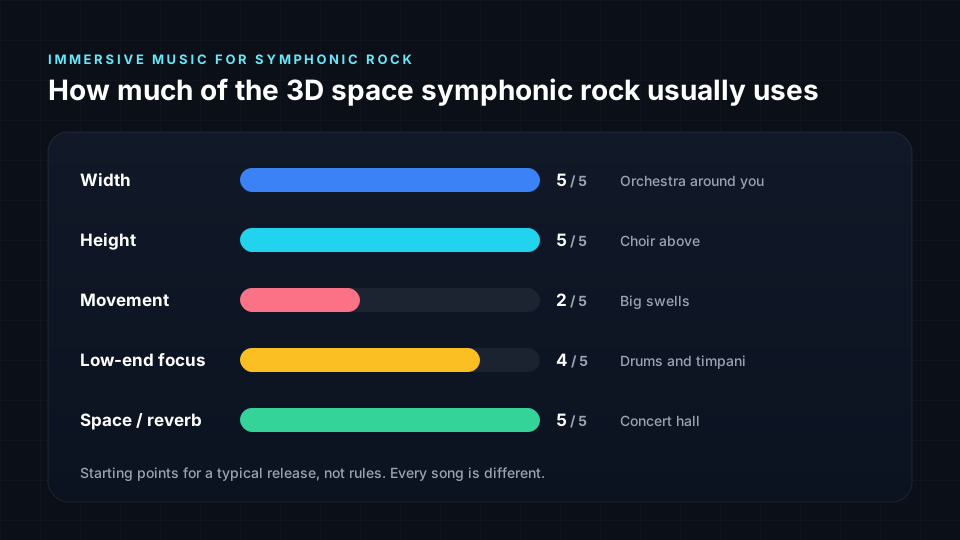
The immersion profile for symphonic rock
Tips for an immersive symphonic rock mix
- Give the band the front, the orchestra the sides. This keeps each world clear without fighting.
- Save the height for the big moments. Bring the choir and upper strings overhead in the climaxes, not the whole song.
- Keep the vocal dry and close. Everything else can be large. The singer still needs to feel near.
- Centre the low end. Bass guitar, kick and low strings should share the middle so the mix stays solid.
- Build with space, not volume. Let the mix grow wider and taller as the song builds instead of just louder.
How to make immersive symphonic rock from stereo
Spatial9 can create spatial audio from a stereo track in a few steps:
- Upload your stereo master or your stems.
- Spatial9's AI separates and places each part, from the vocal and guitars to the strings and choir.
- Preview it in binaural on headphones.
- Export Eclipsa Audio, ADM, binaural or Ambisonics.
- Publish a video. Create a YouTube-ready video with your immersive audio and publish it directly.
For related guides, read spatial audio for rock, spatial audio for metal and spatial audio for classical music. Every guide is listed in spatial audio and immersive music by genre.
Frequently asked questions
Can I make a symphonic rock mix in Dolby Atmos or Eclipsa Audio?
Yes. The placements in this guide work for both. Spatial9 exports ADM, the standard file used by Dolby Atmos studios, as well as Eclipsa Audio for YouTube, so one immersive symphonic rock mix covers both. You may also hear this called a 3D symphonic rock mix or symphonic rock in spatial audio.
How is a symphonic rock mix different from a classical mix in spatial audio?
A classical mix recreates an orchestra in a hall from the audience's seat. A symphonic rock mix puts a loud rock band at the front and uses the orchestra and choir to surround and lift the listener.
Where should the choir go?
Behind and above the listener, split to the left and right. This feels like a choir loft and keeps the voices away from the lead vocal.
Should the orchestra be in front with the band?
Not entirely. If both sit in front, they mask each other. Moving the strings and brass to the sides gives each one room.
Can I convert a released symphonic rock song to spatial audio?
Yes. Spatial9 uses AI to separate a stereo master into its parts and export an immersive mix as Eclipsa Audio, ADM, binaural or Ambisonics.
Does immersive symphonic rock work on normal headphones?
Yes. The mix is rendered binaurally, so the band sounds in front of you and the orchestra and choir surround you on any regular headphones.
Dolby and Dolby Atmos are trademarks of Dolby Laboratories. Spatial9 is not affiliated with or endorsed by Dolby Laboratories.
Sources
- Barron, M. and Marshall, A. H. (1981). Spatial impression due to early lateral reflections in concert halls. Journal of Sound and Vibration, 77(2), 211-232.
- Blauert, J. (1997). Spatial Hearing: The Psychophysics of Human Sound Localization, revised edition. MIT Press.
- Bregman, A. S. (1990). Auditory Scene Analysis: The Perceptual Organization of Sound. MIT Press.
- Bronkhorst, A. W. (2000). The cocktail party phenomenon: a review of research on speech intelligibility in multiple-talker conditions. Acta Acustica united with Acustica, 86, 117-128.
- Hebrank, J. and Wright, D. (1974). Spectral cues used in the localization of sound sources on the median plane. Journal of the Acoustical Society of America, 56(6), 1829-1834.
Put the orchestra all around you
Upload a symphonic rock track to Spatial9 and hear the band, orchestra and choir take their places in minutes. Then export it or publish it straight to YouTube.