Spatial Audio & Immersive Music for Black Metal: Atmospheric Black Metal, Symphonic Black Metal & Raw Black Metal
Spatial9 Team · · 10 min read
Part of the series Spatial audio and immersive music by genre.
Key takeaways
- In a spatial black metal mix the blast beats and bass stay in the centre, while tremolo guitar walls fill the sides and cymbal wash, synths, choirs and wind rise above and behind.
- Two separate tremolo guitar takes placed far left and far right create a true surrounding wall, because lateral energy makes a sound feel wide and enveloping.
- Bright sounds such as cymbal hiss and cold synths lift convincingly overhead, because the outer ear uses high-frequency cues to judge height.
- The black metal immersion profile scores width 5, height 4, movement 3, low-end focus 2 and space 5 out of 5.
Black metal takes its name from the 1982 album by the English band Venom, and its first wave also included Bathory in Sweden and Hellhammer and Celtic Frost in Switzerland. The second wave arrived in Norway in the early 1990s, where bands such as Mayhem, Darkthrone and Emperor defined the sound that most people know today. It is fast and cold: tremolo-picked guitars in minor keys, blast beats often well above 180 BPM, shrieked vocals and deliberately raw, trebly production with little bass. Later scenes added keyboards, orchestras and long atmospheric passages. Black metal is less about low end than about a wall of high, buzzing texture and a sense of vast, empty space, which makes it a natural fit for spatial audio. This guide covers how spatial audio for black metal works, where to place each element and how to make an immersive black metal mix. For the basics, see what spatial audio is.
Why black metal works in spatial audio
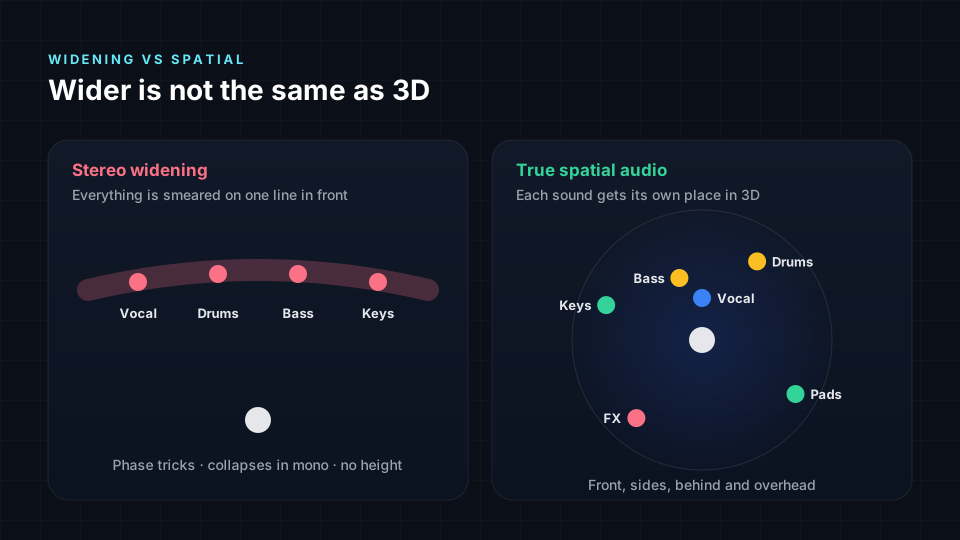
Black metal is a wall of sound. In stereo the tremolo guitars, blast beats, cymbal hiss and vocals all crowd into the same high frequencies, and the result can feel flat and harsh. In an immersive mix the drums and bass stay in the middle, the guitar takes spread wide around the sides, and cymbals, keyboards and ambience rise above and behind. The wall stops being a flat surface and becomes a storm surrounding the listener.
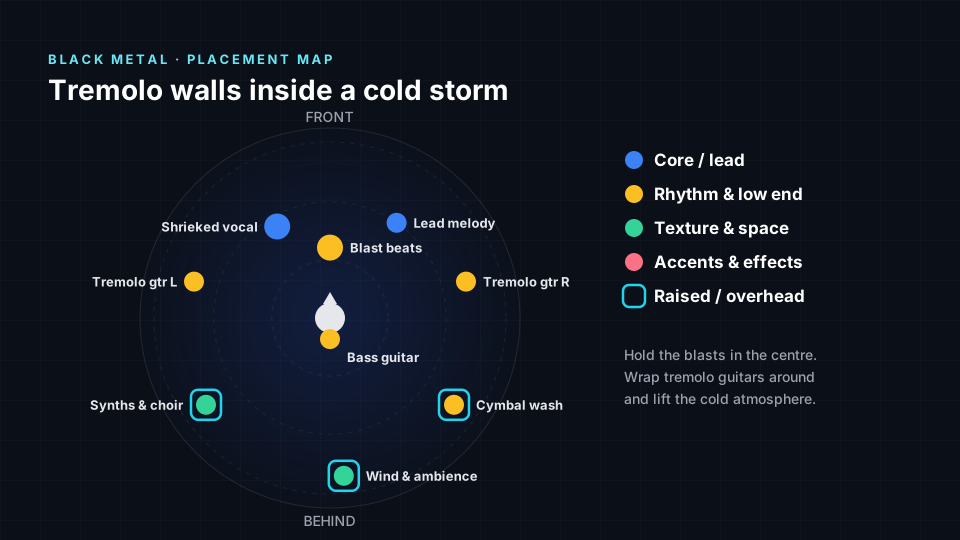
The rule: a fast, centred pulse inside a cold, wide storm. The drums never move, while guitars wrap the sides and atmosphere fills the height and the space behind.
Immersive music for black metal: what listeners hear
- A storm on every side. Tremolo guitars buzz from the left and right at once.
- A pulse that never stops. Blast beats drive straight at the listener from the front.
- A voice in the wind. The shriek sits close, just off centre, cutting through the noise.
- Cold air overhead. Cymbal wash, synths and wind swirl above and behind.
Where to place each element in a black metal mix
| Element | Position | Height | Why it works |
|---|---|---|---|
| Blast beats | Front centre | Ear level | The relentless pulse under the storm |
| Shrieked vocal | Front left | Ear level | A harsh voice cutting through the wall |
| Bass guitar | Centre | Ear level | Thin but steady support for the riff |
| Tremolo gtr L | Left | Ear level | One take of the tremolo-picked riff |
| Tremolo gtr R | Right | Ear level | A second take for a wide wall |
| Lead melody | Front right, moving | Ear level | Melodic lines that drift across the wall |
| Cymbal wash | Behind right | Raised | Constant ride and crash hiss above |
| Synths & choir | Behind left | Raised | Cold keyboards and choirs overhead |
| Wind & ambience | Behind, moving | Raised | Field sounds that sweep around the room |
The psychoacoustics behind black metal placement
Every position in the table above follows how the ear and brain locate sound. Here is the reason behind the main choices for black metal.
- Two tremolo takes on opposite sides. When two similar sounds reach the ears from the sides with slightly different timing, the brain hears width and envelopment. Early lateral reflections and energy are what make a sound feel spacious (Barron and Marshall), so separate guitar takes far left and right turn a buzzing riff into a surrounding wall.
- Cymbals and synths overhead. The outer ear shapes high frequencies differently depending on height, and these elevation spectral cues (Hebrank and Wright) are strongest on bright sounds. Black metal's constant cymbal hiss and cold synths are full of treble, so they lift above the listener convincingly.
- Vocal apart from the guitars. A shriek and a distorted tremolo riff share the same upper midrange. Two sounds mask each other far less when they come from different directions, which is spatial release from masking, so a vocal just off centre stays audible inside the wall.
- Lead melody split from the riff. The brain groups sounds into streams by pitch, timing and direction, an effect called auditory stream segregation (Bregman). Giving the melodic lead its own position lets the ear follow the tune above the tremolo blur instead of losing it.
The immersion profile for black metal
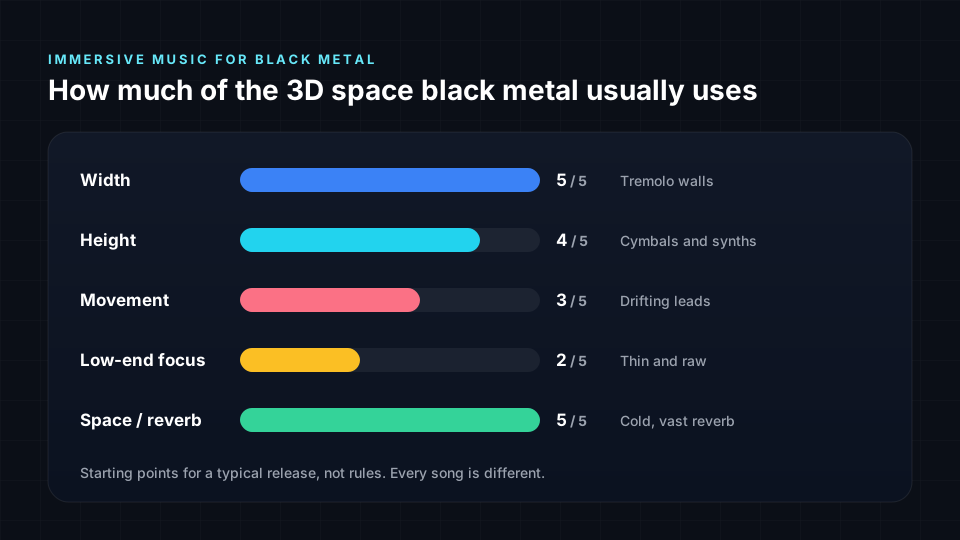
Width and space are at maximum because black metal is built from walls of tremolo guitar and long, cold reverbs. Height is high because cymbal wash, keyboards and choirs belong above the band. Movement is moderate: the drums and guitars stay fixed, while lead melodies and ambience drift. Low-end focus is low on purpose, because the genre favours trebly, raw tones over heavy bass.
Tips for an immersive black metal mix
- Keep the drums centred. Blast beats are the pulse, so hold the kick and snare in front and steady.
- Use real double takes. Two separate tremolo takes make true width. Copying one take only makes it louder.
- Do not add bass the track never had. Keep the low end light and mono so the cold, raw tone survives.
- Lift the treble, not the riff. Cymbals, synths and choirs can go overhead, while the main guitars stay at ear level.
- Let the ambience move. Wind, rain and field sounds can sweep slowly around the room during quiet passages.
Black Metal styles: atmospheric black metal, symphonic black metal and raw black metal
The core placement holds for every black metal style: drums in the middle, tremolo guitars on the sides, cymbals and atmosphere above and behind. What changes is how much of the track is orchestra, ambience or pure noise.
Atmospheric Black Metal
Atmospheric black metal stretches the genre into long, slow-building songs with ambient synths, nature sounds and repetitive, hypnotic riffs, and it later grew strong scenes in the Pacific Northwest of the United States and across Europe. It needs the most space. Spread the guitar layers in a wide arc around the listener and wrap synth pads above. Wind, rain and forest recordings can move slowly behind. Keep the vocal distant and soaked in reverb, almost part of the landscape, while the blast beats stay centred.
Symphonic Black Metal
Symphonic black metal adds keyboards, orchestral strings, brass and choirs, a style shaped by Emperor in the mid 1990s. The orchestra is the second band, so give it its own space. Place strings wide at the sides and slightly raised, brass and choirs higher and behind, and keep the guitars just inside them so the two walls do not mask each other. Hold the drums and the vocal at front centre. Use a large hall reverb on the orchestra but a tighter room on the band.
Raw Black Metal
Raw black metal keeps the lo-fi, hissing sound of early 1990s demos and records, such as Darkthrone's Transilvanian Hunger and the French Les Légions Noires scene. The noise is the point, so do not polish it. Keep the placement simple: a buzzing guitar wall wide on both sides, drums and vocal close at the front, and the hiss and room noise spread gently around. Use little height and no added bass, so the result stays cold, harsh and intimate.
Related styles such as melodic black metal and blackgaze follow the same idea: hold the pulse in the centre, widen the tremolo wall, then lift the atmosphere into the height.
How to make immersive black metal from stereo
Spatial9 can create spatial audio from a stereo track in a few steps:
- Upload your stereo master or your stems.
- Spatial9's AI separates and places each part, keeping the blast beats and bass centred, spreading the tremolo guitars wide and lifting cymbals, synths and ambience overhead.
- Preview it in binaural on headphones.
- Export Eclipsa Audio, ADM, binaural or Ambisonics.
- Publish a video. Create a YouTube-ready video with your immersive audio and publish it directly.
For related guides, read spatial audio for doom metal and spatial audio for dark ambient. Every guide is listed in spatial audio and immersive music by genre.
Frequently asked questions
Does this guide cover atmospheric black metal, symphonic black metal and raw black metal?
Yes. Atmospheric black metal spreads guitars in a wide arc with synths and nature sounds above. Symphonic black metal gives the orchestra and choirs their own raised space around the band. Raw black metal keeps a simple, close wall of buzzing guitars with little height.
Can I make a black metal mix in Dolby Atmos or Eclipsa Audio?
Yes. The placements in this guide work for both. Spatial9 exports ADM, the standard file used by Dolby Atmos studios, as well as Eclipsa Audio for YouTube, so one immersive black metal mix covers both. If you plan to release the Atmos version on Apple Music, build it from your original stems or multitracks, because Apple does not accept Atmos made from a finished stereo master. See where to publish spatial audio. You may also hear this called a 3D black metal mix or black metal in spatial audio.
Is spatial audio good for black metal?
Yes. Black metal is a dense wall of high, buzzing texture that can sound flat and harsh in stereo. Spatial audio wraps that wall around the listener and gives cymbals, keyboards and ambience their own height.
How is black metal different from death metal in spatial audio?
Death metal relies on a heavy, tight low end with downtuned riffs and a punchy, centred kick. Black metal favours trebly tremolo guitars, a lighter bass and a lot more reverb, so its mix is wider and more open, with more atmosphere placed overhead.
Should I add bass to a raw black metal recording?
No. The thin, trebly tone is part of the sound. Keep the existing low end centred and mono, and use width and height to make the track feel bigger rather than adding weight it never had.
Can I convert a finished black metal track to spatial audio?
Yes. Spatial9 uses AI to generate an immersive mix from a stereo master and exports it as Eclipsa Audio, ADM, binaural or Ambisonics.
Does immersive black metal work on normal headphones?
Yes. The mix is rendered binaurally, so the tremolo walls and overhead atmosphere work on any regular headphones.
Dolby and Dolby Atmos are trademarks of Dolby Laboratories. Spatial9 is not affiliated with or endorsed by Dolby Laboratories.
Sources
- Blauert, J. (1997). Spatial Hearing: The Psychophysics of Human Sound Localization, revised edition. MIT Press. Low-frequency, elevation, distance and motion cues.
- Mills, A. W. (1958). On the minimum audible angle. Journal of the Acoustical Society of America, 30(4), 237-246.
- Hebrank, J. and Wright, D. (1974). Spectral cues used in the localization of sound sources on the median plane. Journal of the Acoustical Society of America, 56(6), 1829-1834.
- Bronkhorst, A. W. (2000). The cocktail party phenomenon: a review of research on speech intelligibility in multiple-talker conditions. Acta Acustica united with Acustica, 86, 117-128.
- Litovsky, R. Y., Colburn, H. S., Yost, W. A. and Guzman, S. J. (1999). The precedence effect. Journal of the Acoustical Society of America, 106(4), 1633-1654.
- Barron, M. and Marshall, A. H. (1981). Spatial impression due to early lateral reflections in concert halls. Journal of Sound and Vibration, 77(2), 211-232.
- Neuhoff, J. G. (1998). Perceptual bias for rising tones. Nature, 395, 123-124.
- Bregman, A. S. (1990). Auditory Scene Analysis: The Perceptual Organization of Sound. MIT Press.
Step into the storm
Upload a track to Spatial9 and hear your tremolo guitars and cold atmosphere surround you. Then export it or publish it straight to YouTube.