Spatial Audio & Immersive Music for Garage Rock: Proto-Punk, Garage Punk & Garage Rock Revival
Spatial9 Team · · 10 min read
Part of the series Spatial audio and immersive music by genre.
Key takeaways
- In a spatial garage rock mix the drums, bass and snarled lead vocal stay close and central, while the fuzz guitar, rhythm guitar, organ and tambourine form a tight circle around the listener.
- Putting the fuzz guitar and rhythm guitar on opposite sides lets both be heard at full distortion, an effect known as spatial release from masking.
- Short reflections from the sides recreate a small room, because early lateral reflections give the sense of being inside a space without the wash of a big hall.
- The garage rock immersion profile scores width 3, height 2, movement 2, low-end focus 3 and space 3 out of 5.
Garage rock began in the United States in the mid 1960s, when teenage bands inspired by the British Invasion and by frat rock hits such as "Louie Louie" started playing in garages and school halls. Scenes grew in the Pacific Northwest, Texas and the Midwest, and countless bands cut a single or two in cheap local studios. The sound is simple and urgent: three chords, fuzz guitar from pedals like the Maestro Fuzz-Tone, a cheap combo organ such as a Farfisa or Vox Continental, pounding drums, tambourine and a sneering vocal, usually somewhere between 120 and 160 BPM. The 1972 compilation Nuggets brought the music back to a new audience and helped inspire punk. Most of these records were made live in one room, often in mono, so spatial audio suits them: it can rebuild the room the band played in. This guide covers how spatial audio for garage rock works, where to place each element and how to make an immersive garage rock mix. For the basics, see what spatial audio is.
Why garage rock works in spatial audio
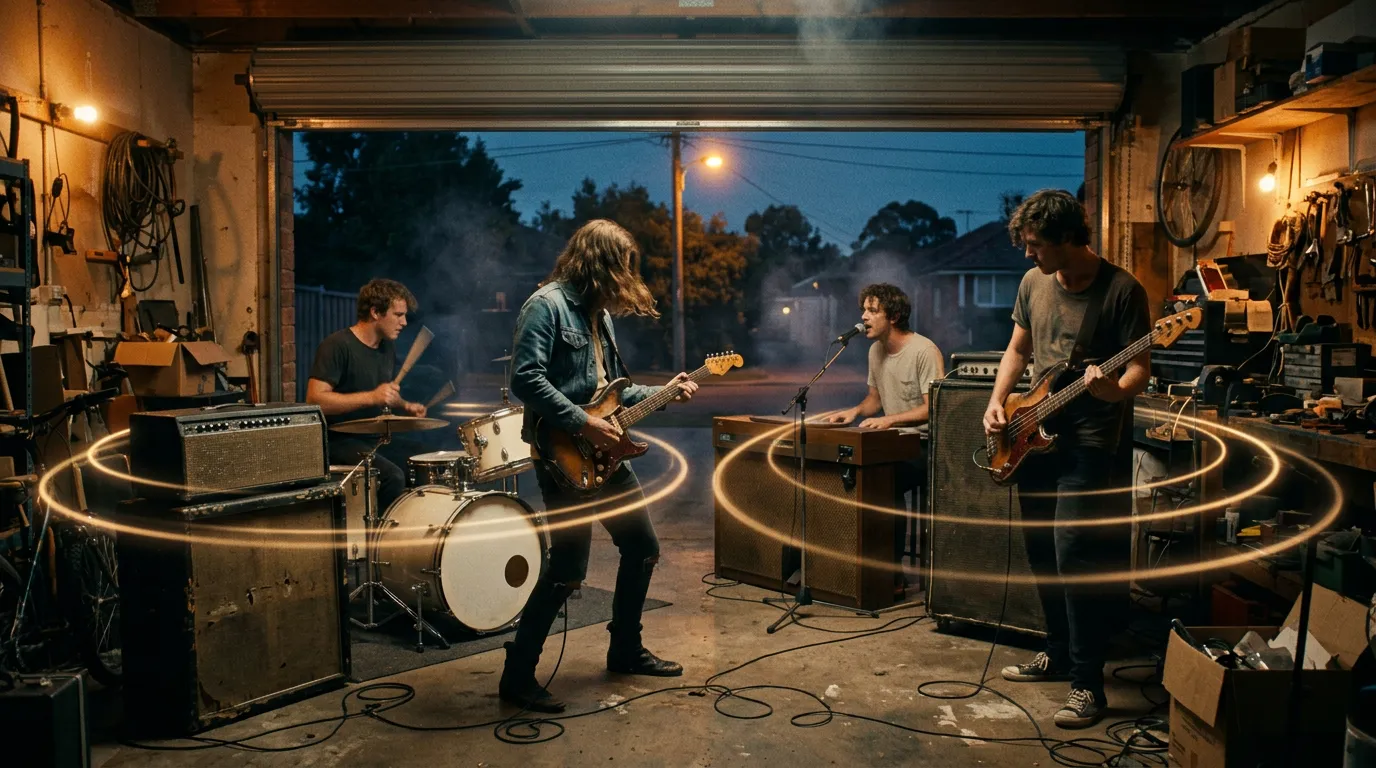
Garage rock is about energy in a small space. In stereo, the fuzz guitar, organ, cymbals and vocal all pile into the same midrange. In an immersive mix, the band can stand in a close circle around the listener, so each instrument keeps its own spot. The aim is not an arena but the feeling of standing in the garage with the amps pointed at you.
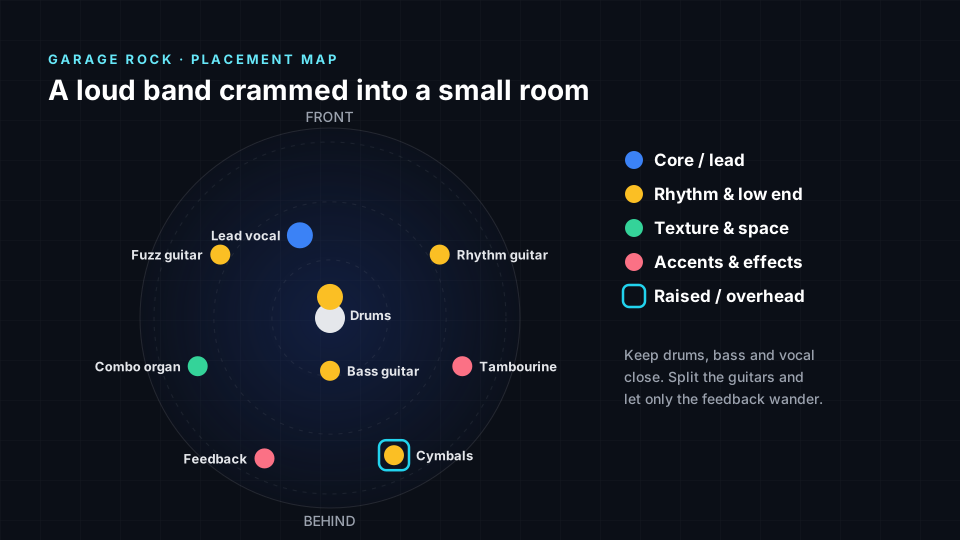
The rule: a tight, centred band in a small room. Drums, bass and vocal stay close and central, guitars split left and right, and only the feedback is allowed to wander.
Immersive music for garage rock: what listeners hear
- A band in the room with you. Drums, bass and voice feel close, as if the band is a few steps away.
- Guitars on either shoulder. The fuzz riff and the chords come from opposite sides instead of one blur.
- Organ and tambourine just behind. The cheap, buzzy keyboard and shaken accents wrap round the back.
- Feedback that circles. Amp howl drifts around the room between verses and at the end of a song.
Where to place each element in a garage rock mix
| Element | Position | Height | Why it works |
|---|---|---|---|
| Lead vocal | Front left | Ear level | A snarled, close vocal just off centre |
| Drums | Centre | Ear level | One tight kit, like a single room mic |
| Bass guitar | Centre | Ear level | Root notes that lock with the kick |
| Fuzz guitar | Left | Ear level | The raw, buzzing riff on one side |
| Rhythm guitar | Right | Ear level | Chords that answer the fuzz riff |
| Combo organ | Behind left | Ear level | Farfisa or Vox swirl beside the band |
| Tambourine | Behind right | Ear level | Shaken accents on every backbeat |
| Cymbals | Behind right | Raised | Crash and ride above the kit |
| Feedback | Behind left, moving | Ear level | Amp howl that drifts round the room |
The psychoacoustics behind garage rock placement
Every position in the table above follows how the ear and brain locate sound. Here is the reason behind the main choices for garage rock.
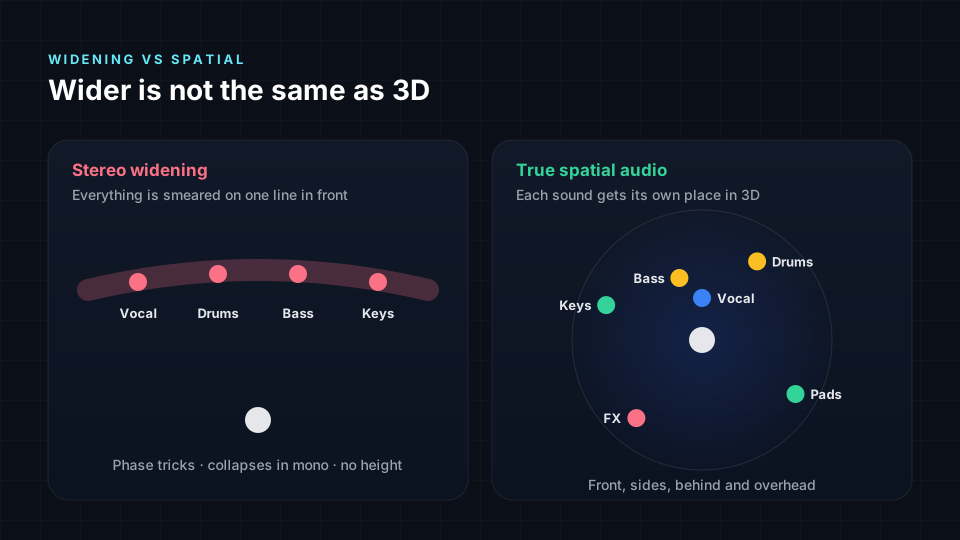
- Bass and kick stay centred. The ear finds almost no direction in frequencies below roughly 80 to 100 Hz, so spreading the bass guitar and kick drum adds nothing. Keeping them central and mono keeps the low end solid on any system.
- Fuzz and rhythm guitar on opposite sides. Two distorted guitars share the same midrange, and they mask each other far less when they arrive from different directions. This is spatial release from masking. Splitting them keeps both the riff and the chords audible without turning the fuzz down.
- A small, lateral room. A sense of being inside a space comes largely from early reflections arriving from the sides (Barron and Marshall). Short, side-weighted room reflections give a garage feel without the long tails of a big hall.
- Feedback moving behind. The brain groups sounds into separate streams by pitch, timing and direction. This is auditory stream segregation (Bregman). Letting feedback drift behind keeps it a separate event rather than noise smeared over the vocal.
The immersion profile for garage rock
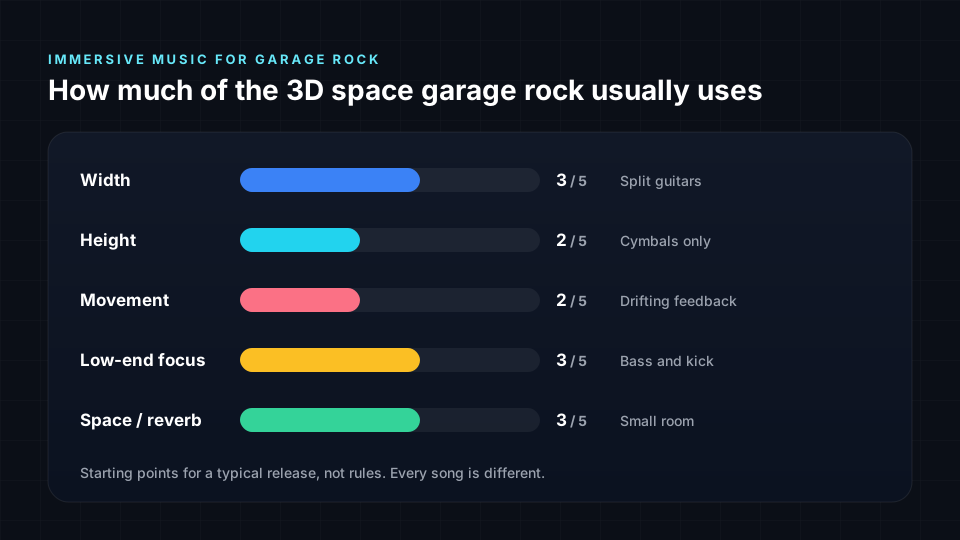
Width and space are moderate because garage rock should sound like a small room, not a stadium. Low-end focus is middling: the bass and kick matter, but the music was never built on deep sub. Height and movement are low on purpose. Only the cymbals rise, and only the feedback moves, because the power of the genre comes from a band hitting hard in one place.
Tips for an immersive garage rock mix
- Keep the room small. Use short, early reflections from the sides rather than long reverb tails.
- Split the guitars, not the drums. Put fuzz and rhythm guitar on opposite sides, but keep the kit as one tight, central source.
- Leave the vocal a little rough. A close, slightly distorted vocal just off centre sounds more honest than a polished one.
- Respect mono originals. When a 1960s master is mono, spread the parts gently and keep the core band near the centre.
- Save movement for the noise. Let feedback and amp howl drift at the end of a song, and keep everything else still.
Garage Rock styles: proto-punk, garage punk and garage rock revival
The core placement holds for every garage rock style: drums, bass and vocal close in the middle, guitars on the sides. What changes is the volume, the noise and the polish.
Proto-Punk
Proto-punk covers the late 1960s and early 1970s bands that took garage rock louder and darker, especially in Detroit and New York, and laid the ground for punk. The guitars are heavier and more distorted, the drums more brutal and the vocals more confrontational. Keep the kit and bass fully centred and close, and push the two guitars hard left and right so they feel like amps on either side of you. Feedback, noise and drones can sit behind and move slowly. Use short, dirty room reflections rather than smooth reverb, so the mix feels physical and uncomfortable in a good way.
Garage Punk
Garage punk is the fastest and rawest branch, mixing the 1960s garage sound with punk speed and lo-fi recording, and it has been revived by underground labels again and again since the 1980s. Mixes are often deliberately cheap and saturated. Do not try to clean them up: keep the whole band close, with the vocal almost on top of the listener and slightly to one side. Split the guitars, keep the bass centred under the kick, and let the tambourine or organ sit just behind. Keep space tight and dry, because a big room would take the edge off the speed.
Garage Rock Revival
The garage rock revival of the early 2000s brought the sound back into the charts, with bands such as The White Stripes, The Strokes and The Hives. Recordings are cleaner and punchier than the 1960s originals, but still built on simple riffs and a live feel. You can use a little more width here: guitars spread wider at the front sides, the vocal close and centred, and the drums slightly roomier. Keep the bass and kick locked in the centre. A short slapback echo on the vocal can sit just behind, which suits the retro production of the era.
Related styles such as freakbeat and frat rock follow the same idea: keep the band close and central, split the guitars and let only the noise move.
How to make immersive garage rock from stereo
Spatial9 can create spatial audio from a stereo track in a few steps:
- Upload your stereo master or your stems.
- Spatial9's AI separates and places each part, keeping the drums, bass and vocal close in the centre and splitting the fuzz guitar, rhythm guitar and organ around a small room.
- Preview it in binaural on headphones.
- Export Eclipsa Audio, ADM, binaural or Ambisonics.
- Publish a video. Create a YouTube-ready video with your immersive audio and publish it directly.
For related guides, read spatial audio for punk and spatial audio for psychedelic rock. Every guide is listed in spatial audio and immersive music by genre.
Frequently asked questions
Does this guide cover proto-punk, garage punk and garage rock revival?
Yes. Proto-punk pushes heavy guitars hard left and right with noise moving behind. Garage punk keeps the whole band close, dry and raw. Garage rock revival allows a little more width and a cleaner, punchier room.
Can I make a garage rock mix in Dolby Atmos or Eclipsa Audio?
Yes. The placements in this guide work for both. Spatial9 exports ADM, the standard file used by Dolby Atmos studios, as well as Eclipsa Audio for YouTube, so one immersive garage rock mix covers both. If you plan to release the Atmos version on Apple Music, build it from your original stems or multitracks, because Apple does not accept Atmos made from a finished stereo master. See where to publish spatial audio. You may also hear this called a 3D garage rock mix or garage rock in spatial audio.
Is spatial audio good for garage rock?
Yes, as long as it keeps the band close. Spatial audio separates the fuzz guitar, organ and vocal that crowd a stereo or mono mix, while keeping the feel of one small room.
How is garage rock different from punk in spatial audio?
Garage rock usually has more 1960s colour, with combo organ, tambourine, fuzz and a looser, roomier sound. Punk tends to be faster, with a denser wall of guitars, so its mix is tighter and wider at the front.
Can I turn an old mono garage single into spatial audio?
Yes, but be gentle. Keep drums, bass and vocal near the centre and spread the guitars and organ only slightly, so it still sounds like one band in one room.
Can I convert a finished garage rock track to spatial audio?
Yes. Spatial9 uses AI to generate an immersive mix from a stereo master and exports it as Eclipsa Audio, ADM, binaural or Ambisonics.
Does immersive garage rock work on normal headphones?
Yes. The mix is rendered binaurally, so the split guitars, close vocal and drifting feedback work on any regular headphones.
Dolby and Dolby Atmos are trademarks of Dolby Laboratories. Spatial9 is not affiliated with or endorsed by Dolby Laboratories.
Sources
- Blauert, J. (1997). Spatial Hearing: The Psychophysics of Human Sound Localization, revised edition. MIT Press. Low-frequency, elevation, distance and motion cues.
- Mills, A. W. (1958). On the minimum audible angle. Journal of the Acoustical Society of America, 30(4), 237-246.
- Hebrank, J. and Wright, D. (1974). Spectral cues used in the localization of sound sources on the median plane. Journal of the Acoustical Society of America, 56(6), 1829-1834.
- Bronkhorst, A. W. (2000). The cocktail party phenomenon: a review of research on speech intelligibility in multiple-talker conditions. Acta Acustica united with Acustica, 86, 117-128.
- Litovsky, R. Y., Colburn, H. S., Yost, W. A. and Guzman, S. J. (1999). The precedence effect. Journal of the Acoustical Society of America, 106(4), 1633-1654.
- Barron, M. and Marshall, A. H. (1981). Spatial impression due to early lateral reflections in concert halls. Journal of Sound and Vibration, 77(2), 211-232.
- Neuhoff, J. G. (1998). Perceptual bias for rising tones. Nature, 395, 123-124.
- Bregman, A. S. (1990). Auditory Scene Analysis: The Perceptual Organization of Sound. MIT Press.
Put the band in the garage with you
Upload a track to Spatial9 and hear your fuzz guitars, organ and drums crowd round you in a small, loud room. Then export it or publish it straight to YouTube.