Spatial Audio & Immersive Music for Surf Rock: Instrumental Surf, Surf Punk & Surf Pop
Spatial9 Team · · 9 min read
Part of the series Spatial audio and immersive music by genre.
Key takeaways
- In a spatial surf rock mix the lead guitar, drums and bass stay tight in the centre, while the rhythm guitar, saxophone, harmonies, tom fills, cymbals and spring reverb spread around the listener.
- Placing the spring reverb behind the dry guitar keeps the melody sharp, because the brain locates a sound by its first arrival, which is known as the precedence effect.
- Side-weighted reverb makes surf rock feel open and airy, since early reflections from the sides create the sense of spaciousness.
- The surf rock immersion profile scores width 4, height 2, movement 2, low-end focus 3 and space 4 out of 5.
Surf rock was born in Southern California in the early 1960s, as young bands soundtracked the local surfing craze. Dick Dale is usually credited with defining the sound, with fast, staccato tremolo picking on heavy-gauge strings, loud amplifiers and melodies borrowed from Middle Eastern scales, as on "Misirlou". Fender's standalone spring reverb unit, introduced in the early 1960s, gave surf guitar its famous wet, dripping tone. Instrumental hits such as "Pipeline" and "Wipe Out" followed, and vocal groups turned the theme into harmony-led pop. Tempos are usually quick, around 140 to 180 BPM, with a driving beat, walking bass and plenty of tom fills. The British Invasion ended the first wave, but surf has returned again and again, from punk bands to film soundtracks in the 1990s. Because so much of the sound lives in the reverb, surf rock is a natural fit for spatial audio. This guide covers how spatial audio for surf rock works, where to place each element and how to make an immersive surf rock mix. For the basics, see what spatial audio is.
Why surf rock works in spatial audio
Surf rock is a dry band playing into a very wet reverb. In stereo, that splash of spring reverb sits on top of the guitar, and the two blur together. In an immersive mix the guitar can stay sharp and close in front while its reverb opens up behind and above, so the listener hears both the bite of the pick and the wash of the wave.
The rule: a sharp guitar in front, the reverb behind. The lead guitar, drums and bass stay tight in the centre, while the spring reverb, cymbals and harmonies fill the space around them.
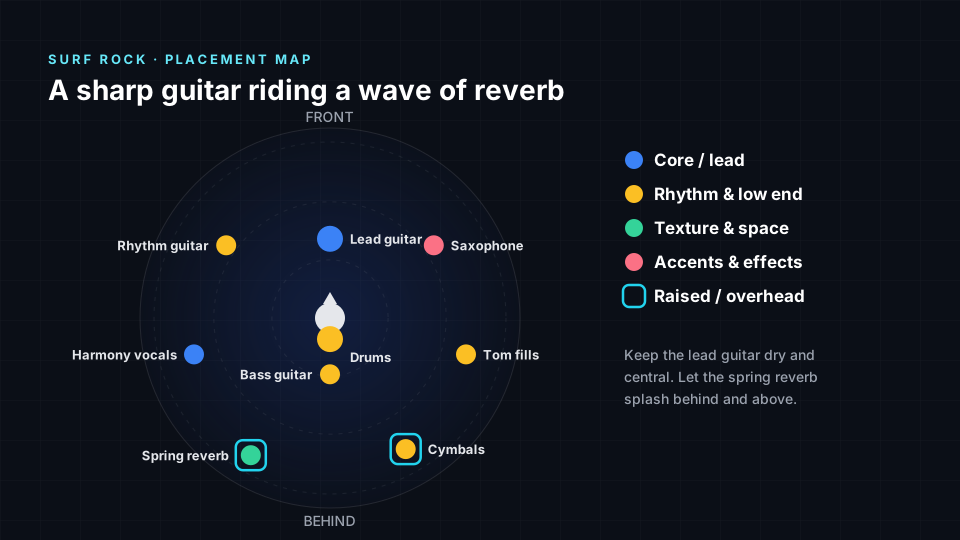
Immersive music for surf rock: what listeners hear
- A guitar that cuts. The picked lead stays sharp and close, right in front of you.
- Reverb like a wave behind you. The spring splash rises up and around instead of smearing the melody.
- A band spread along the beach. Rhythm guitar, sax and harmonies stand on either side.
- Drum fills that roll past. Tom runs sweep across the side like surf breaking.
Where to place each element in a surf rock mix
| Element | Position | Height | Why it works |
|---|---|---|---|
| Lead guitar | Front centre | Ear level | The twangy, picked melody carries the tune |
| Drums | Centre | Ear level | A driving beat under the guitar |
| Bass guitar | Centre | Ear level | Walking lines locked to the kick |
| Rhythm guitar | Left | Ear level | Chugging chords on one side |
| Saxophone | Right | Ear level | Honking riffs that answer the guitar |
| Harmony vocals | Left | Ear level | Stacked voices wrapping one side |
| Tom fills | Right, moving | Ear level | Rolling toms that sweep like a wave |
| Cymbals | Behind right | Raised | Splashy crash and ride above the kit |
| Spring reverb | Behind left | Raised | The drip and splash of the reverb tank |
The psychoacoustics behind surf rock placement
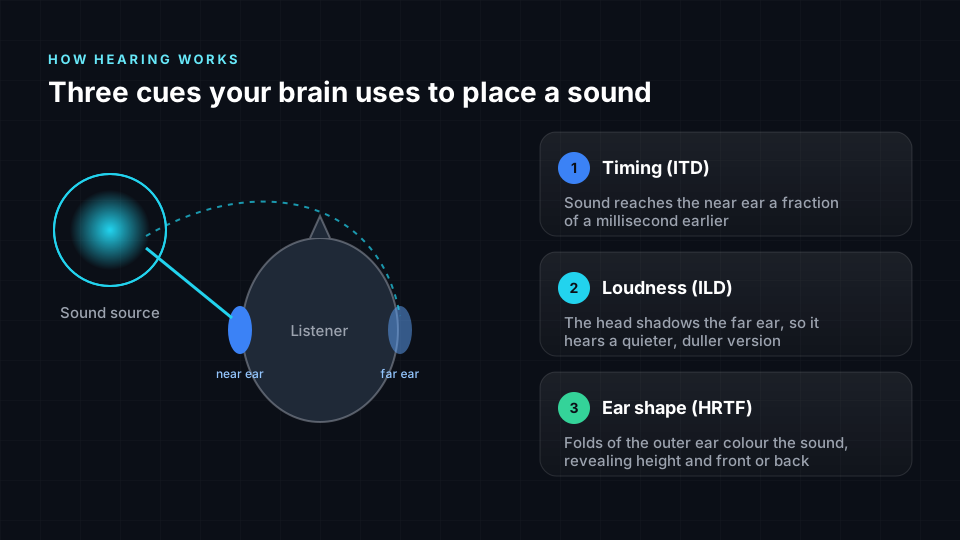
Every position in the table above follows how the ear and brain locate sound. Here is the reason behind the main choices for surf rock.
- Bass and kick stay centred. The ear finds almost no direction in frequencies below roughly 80 to 100 Hz, so the walking bass and kick drum gain nothing from being spread. Keeping them central keeps the drive steady on any system.
- Reverb behind the dry guitar. When a sound and its reflections arrive close together, the brain fixes its position by the first arrival. This is the precedence effect. The picked guitar stays sharp in front, while its spring reverb can bloom behind without pulling the melody back.
- Wide, lateral space. A sense of spaciousness comes mostly from early reflections arriving from the sides (Barron and Marshall). Side-weighted reverb makes surf rock feel open and airy, like a band playing outdoors.
- Sax and rhythm guitar on opposite sides. Two midrange parts mask each other far less when they come from different directions. This is spatial release from masking. Splitting the chords and the honking sax keeps both clear under the lead.
The immersion profile for surf rock
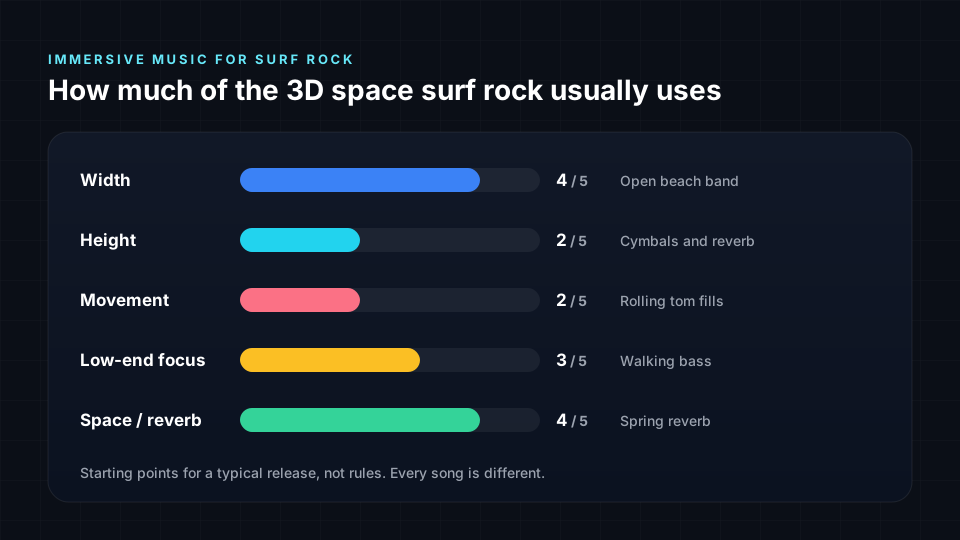
Width and space are high because the sound depends on spring reverb and a wide, open band. Low-end focus is moderate: the walking bass and kick drive the music, but there is no heavy sub. Height and movement are low, since the guitar melody must stay sharp and in front, with only the cymbals and reverb rising and only the tom fills moving.
Tips for an immersive surf rock mix
- Keep the lead guitar dry and close. Put the direct sound in front and send the reverb elsewhere.
- Spread the reverb, not the guitar. Let the spring splash fill the back and sides while the melody stays put.
- Lock the bass and kick. The walking bass is the engine, so keep it centred and mono.
- Give the toms a little motion. Let tom fills roll across one side, but keep the main beat still.
- Use the open space for breaks. Widen the reverb on stops and glissandos, then pull it back for the melody.
Surf Rock styles: instrumental surf, surf punk and surf pop
The core placement holds for every surf rock style: guitar or voice in front, drums and bass centred, reverb behind. What changes is the speed, the role of vocals and how much polish the band brings.
Instrumental Surf
Instrumental surf is the original sound of the early 1960s, built on a lead guitar playing the melody through heavy spring reverb, with fast tremolo picking, dramatic glissandos down the neck and sometimes a saxophone or organ. Keep the lead guitar dead centre and close, because it is the singer of the band. Put rhythm guitar to one side and the sax or organ to the other. Send the reverb return wide and behind, slightly raised. Tom fills can roll across one side, but the main beat should stay fixed and tight.
Surf Punk
Surf punk mixes surf guitar with punk speed and attitude, from late 1970s Californian bands to the many revival groups since. The guitar is more distorted and the drums harder, but the reverb remains. Keep the whole band close and punchy, with the lead guitar and vocal front and centre, bass and kick locked underneath. Spread two guitars wide at the front sides. Use less reverb than classic instrumental surf, keeping it shorter and behind, so the speed stays clear and the mix keeps its punk edge.
Surf Pop
Surf pop is the vocal side of the genre, with stacked harmonies, bright guitars and songs about beaches, cars and summer, made famous by Californian harmony groups in the early 1960s. The lead vocal belongs front and centre, close and clear. Wrap backing harmonies around the front sides and slightly behind, so the listener sits inside the choir. Keep the guitars, bass and drums tight in the middle, with handclaps and percussion off to the sides. Add a gentle, raised reverb for a sunny, airy space.
Related styles such as hot rod rock and modern surf revival follow the same idea: keep the core tight and let the reverb make the space.
How to make immersive surf rock from stereo
Spatial9 can create spatial audio from a stereo track in a few steps:
- Upload your stereo master or your stems.
- Spatial9's AI separates and places each part, keeping the lead guitar, drums and bass tight in the centre and spreading the spring reverb, harmonies and sax around you.
- Preview it in binaural on headphones.
- Export Eclipsa Audio, ADM, binaural or Ambisonics.
- Publish a video. Create a YouTube-ready video with your immersive audio and publish it directly.
For related guides, read spatial audio for rockabilly and spatial audio for garage rock. Every guide is listed in spatial audio and immersive music by genre.
Frequently asked questions
Does this guide cover instrumental surf, surf punk and surf pop?
Yes. Instrumental surf keeps the lead guitar centred with wide reverb behind. Surf punk keeps the band close and punchy with shorter reverb. Surf pop puts the lead vocal in front and wraps stacked harmonies around the listener.
Can I make a surf rock mix in Dolby Atmos or Eclipsa Audio?
Yes. The placements in this guide work for both. Spatial9 exports ADM, the standard file used by Dolby Atmos studios, as well as Eclipsa Audio for YouTube, so one immersive surf rock mix covers both. If you plan to release the Atmos version on Apple Music, build it from your original stems or multitracks, because Apple does not accept Atmos made from a finished stereo master. See where to publish spatial audio. You may also hear this called a 3D surf rock mix or surf rock in spatial audio.
Is spatial audio good for surf rock?
Yes. Surf rock gets much of its character from spring reverb, and spatial audio lets that reverb fill the space around the listener while the guitar stays sharp and clear in front.
How is surf rock different from rockabilly in spatial audio?
Surf rock is usually instrumental and drenched in spring reverb, so it needs more width and space. Rockabilly is drier and tighter, with slapback echo, a slapped upright bass and a vocal in front, so its mix stays closer and more central.
Should the spring reverb be raised in a surf rock mix?
Slightly, yes. Raising the reverb return a little and placing it behind keeps it apart from the dry guitar, which helps the melody stay sharp while the splash feels big.
Can I convert a finished surf rock track to spatial audio?
Yes. Spatial9 uses AI to generate an immersive mix from a stereo master and exports it as Eclipsa Audio, ADM, binaural or Ambisonics.
Does immersive surf rock work on normal headphones?
Yes. The mix is rendered binaurally, so the twangy guitar, rolling toms and splashing reverb work on any regular headphones.
Dolby and Dolby Atmos are trademarks of Dolby Laboratories. Spatial9 is not affiliated with or endorsed by Dolby Laboratories.
Sources
- Blauert, J. (1997). Spatial Hearing: The Psychophysics of Human Sound Localization, revised edition. MIT Press. Low-frequency, elevation, distance and motion cues.
- Mills, A. W. (1958). On the minimum audible angle. Journal of the Acoustical Society of America, 30(4), 237-246.
- Hebrank, J. and Wright, D. (1974). Spectral cues used in the localization of sound sources on the median plane. Journal of the Acoustical Society of America, 56(6), 1829-1834.
- Bronkhorst, A. W. (2000). The cocktail party phenomenon: a review of research on speech intelligibility in multiple-talker conditions. Acta Acustica united with Acustica, 86, 117-128.
- Litovsky, R. Y., Colburn, H. S., Yost, W. A. and Guzman, S. J. (1999). The precedence effect. Journal of the Acoustical Society of America, 106(4), 1633-1654.
- Barron, M. and Marshall, A. H. (1981). Spatial impression due to early lateral reflections in concert halls. Journal of Sound and Vibration, 77(2), 211-232.
- Neuhoff, J. G. (1998). Perceptual bias for rising tones. Nature, 395, 123-124.
- Bregman, A. S. (1990). Auditory Scene Analysis: The Perceptual Organization of Sound. MIT Press.
Catch the wave in 3D
Upload a track to Spatial9 and hear your surf guitar cut through a spring reverb that splashes all around you. Then export it or publish it straight to YouTube.