
Spatial Audio & Immersive Music for Jazz Fusion: Jazz Rock, Jazz Funk & Electric Jazz
Spatial9 Team · · 9 min read
Part of the series Spatial audio and immersive music by genre.
Key takeaways
- In a spatial jazz fusion mix the lead soloist and the electric bass stay centred, while drums, guitar, electric piano, synths and percussion spread around the listener and solos are allowed to move.
- Placing guitar and keyboards on opposite sides helps the brain follow two fast interlocking lines as separate parts, an effect known as auditory stream segregation.
- Synth leads can travel across the sides and overhead, but the motion has to be wide to register, because the ear is far less precise at the sides than in front.
- The jazz fusion immersion profile scores width 4, height 3, movement 4, low-end focus 4 and space 3 out of 5.
Jazz fusion appeared in the late 1960s, when jazz musicians picked up electric instruments and the volume, riffs and grooves of rock and funk. Miles Davis's In a Silent Way (1969) and Bitches Brew (1970) opened the door, and through the 1970s bands built a style on electric guitar, electric piano, analogue synthesisers, electric bass and drummers playing complex patterns in odd time signatures. Tempos range from slow, spacious grooves to very fast unison runs, and pieces often stretch into long solos. Fusion was a multitrack studio music from the start, and many records hard-panned whole instruments left or right, layered several keyboards and edited tape heavily. With so many busy, bright parts playing at once, jazz fusion is a strong fit for spatial audio. This guide covers how spatial audio for jazz fusion works, where to place each element and how to make an immersive jazz fusion mix. For the basics, see what spatial audio is.
Why jazz fusion works in spatial audio
Jazz fusion packs virtuoso players into the same register at the same time: guitar riffs, keyboard comping, synth solos, busy drums and a bass that often plays melody. In stereo these parts collide and the interplay turns into a loud blur. In an immersive mix the lead and the bass stay anchored, the rhythm instruments take their own sides, and the solos get room to fly around the listener.
The rule: an anchored lead and bass, solos that travel. The soloist in focus and the bass never move, while synths and percussion carry the motion.
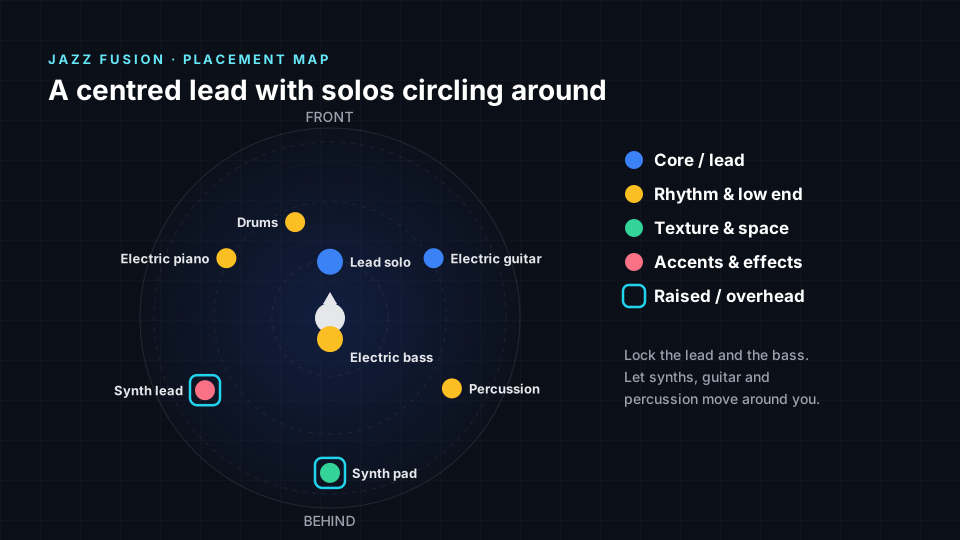
Immersive music for jazz fusion: what listeners hear
- A bass you can follow. Fast electric bass lines stay solid and centred.
- Guitar and keys in conversation. Riffs and chords answer each other across the front.
- Solos that fly past. Synth leads swoop around the sides and overhead.
- Grooves that surround you. Percussion moves behind while the drums drive from the front.
Where to place each element in a jazz fusion mix
| Element | Position | Height | Why it works |
|---|---|---|---|
| Lead solo | Front centre | Ear level | The horn or main soloist the listener follows |
| Electric bass | Centre | Ear level | Driving lines and riffs under the band |
| Drums | Front, just left | Ear level | Complex grooves close behind the lead |
| Electric guitar | Front right | Ear level | Riffs, chords and unison lines |
| Electric piano | Front left | Ear level | Chords and comping opposite the guitar |
| Synth lead | Behind left, moving | Raised | Solos and swoops that travel |
| Percussion | Behind right, moving | Ear level | Congas and shakers that add motion |
| Synth pad | Behind | Raised | Washes and drones that fill the room |
The psychoacoustics behind jazz fusion placement
Every position in the table above follows how the ear and brain locate sound. Here is the reason behind the main choices for jazz fusion.
- Electric bass stays centred. The ear finds almost no direction in frequencies below roughly 80 to 100 Hz, so the low end of the electric bass gains nothing from being spread. Keeping it centred keeps busy fusion bass lines tight and heavy on any system.
- Guitar and keys split apart. The brain groups sounds into streams by pitch, timing and direction. This is auditory stream segregation (Bregman). Placing guitar and electric piano on opposite sides lets the ear follow two fast, interlocking parts instead of one tangle.
- Synth moves made wide. The smallest change in direction we can detect is about one degree in front but much larger at the sides. This is the minimum audible angle (Mills). A synth lead moving behind or beside the listener needs a broad sweep to be heard as motion.
- Rising synth swells. Sounds that grow louder seem to approach faster than they really do. This is the looming bias for rising sounds (Neuhoff). A synth swell that rises in level and moves forward feels dramatic, so save it for the build into a solo.
The immersion profile for jazz fusion
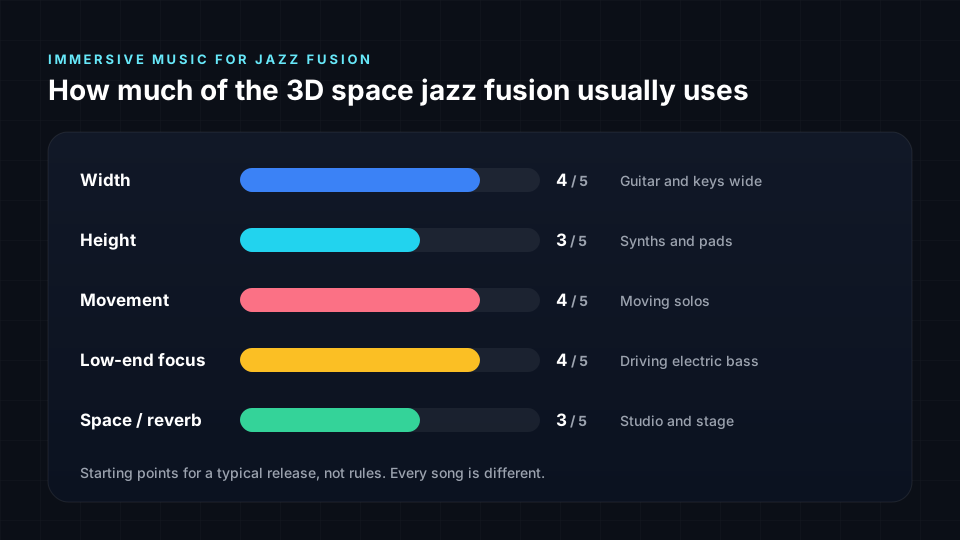
Movement is high because synth solos, percussion and studio effects suit motion around the listener. Low-end focus is high because the electric bass drives the music. Width is high with guitar and keys spread across the front. Height and space stay moderate: pads and synths can lift, but too much reverb smears fast lines.
Tips for an immersive jazz fusion mix
- Lock the bass and kick. Keep both centred and mono so the groove survives odd meters and busy fills.
- Give guitar and keys their own sides. Separate them so the interplay stays readable.
- Move solos, not the rhythm section. Synth leads and percussion can travel; drums and bass stay put.
- Keep reverb short. Fast unison runs need a tight room, with longer tails only on pads.
- Bring the lead back to centre. When a solo ends, return the next soloist to the front centre spot.
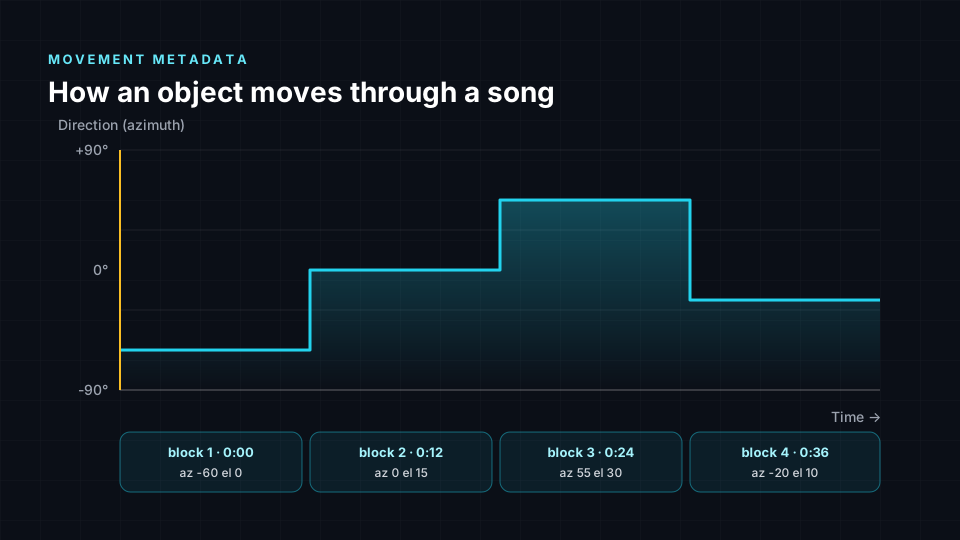
Jazz Fusion styles: jazz rock, jazz funk and electric jazz
The core placement holds for every jazz fusion style: lead and bass in the middle, rhythm instruments wide, solos free to move. What changes is how loud the band plays, how funky the groove is and how much space surrounds it.
Jazz Rock
Jazz rock leans on loud electric guitar, rock drums and fast unison lines, a sound that took off in the early 1970s. Treat it like a powerful live band. Keep the drums broad across the front with the kick centred, and put the guitar on one side with keyboards or violin opposite. When guitar and keys play a unison run, bring them closer together at the front so the line sounds like one huge instrument. Keep reverb short and the room tight. Solos can move a little, but the riffs should stay planted to keep the weight.
Jazz Funk
Jazz funk puts the groove first, with syncopated bass, clavinet, wah guitar, electric piano and lots of percussion. Herbie Hancock's Head Hunters (1973) is the landmark record. The bass and kick deserve the most focus here, so keep them centred, dry and strong. Place clavinet and guitar on opposite sides of the front so their rhythmic patterns interlock without clashing. Congas, shakers and cowbell can sit behind the listener with gentle motion. Synth leads can swoop overhead, but the groove underneath must never move.
Electric Jazz
Electric jazz covers the open, exploratory side of fusion, closest to the electric Miles Davis period, with long jams, several keyboard players, more than one drummer and echo on the trumpet. Spread the two keyboards wide left and right and set the drummers on either side of the front, as the records already suggest. Keep the trumpet or lead centred with its echo trailing behind and above. Let atmospheric keyboards and percussion drift around the sides. This style can take more space and slower movement than jazz rock or jazz funk.
Related styles such as progressive fusion and modern instrumental fusion follow the same idea: anchor the lead and bass, spread the rhythm instruments and let the solos travel.
How to make immersive jazz fusion from stereo
Spatial9 can create spatial audio from a stereo track in a few steps:
- Upload your stereo master or your stems.
- Spatial9's AI separates and places each part, locking the lead and electric bass and spreading guitar, keys, synths and percussion around you.
- Preview it in binaural on headphones.
- Export Eclipsa Audio, ADM, binaural or Ambisonics.
- Publish a video. Create a YouTube-ready video with your immersive audio and publish it directly.
For related guides, read spatial audio for jazz and spatial audio for funk. Every guide is listed in spatial audio and immersive music by genre.
Frequently asked questions
Does this guide cover jazz rock, jazz funk and electric jazz?
Yes. Jazz rock keeps loud guitar and keys planted on opposite sides with a tight room. Jazz funk centres a strong bass and kick with interlocking clavinet and guitar. Electric jazz spreads several keyboards and drummers wide, with a centred trumpet and echoes trailing behind.
Can I make a jazz fusion mix in Dolby Atmos or Eclipsa Audio?
Yes. The placements in this guide work for both. Spatial9 exports ADM, the standard file used by Dolby Atmos studios, as well as Eclipsa Audio for YouTube, so one immersive jazz fusion mix covers both. If you plan to release the Atmos version on Apple Music, build it from your original stems or multitracks, because Apple does not accept Atmos made from a finished stereo master. See where to publish spatial audio. You may also hear this called a 3D jazz fusion mix or jazz fusion in spatial audio.
Is spatial audio good for jazz fusion?
Yes. Jazz fusion layers fast, bright electric parts on top of each other. Spatial audio keeps the lead and bass solid while giving guitar, keys and solos their own space, so the interplay becomes easier to hear.
How is jazz fusion different from acoustic jazz in spatial audio?
Acoustic jazz is usually a small band in one room, so its mix stays natural and almost still. Jazz fusion is an electric studio music, so it can take a stronger low end, wider keys and guitar, and moving synths and percussion.
Should guitar solos move in an immersive jazz fusion mix?
Mostly no. Bring a guitar solo forward or towards the centre so the listener can follow it, and keep it there. Save real movement for synth leads, effects and percussion, which do not carry the main line.
Can I convert a finished jazz fusion record to spatial audio?
Yes. Spatial9 uses AI to separate a stereo master and generate an immersive mix. Many 1970s fusion records already hard-pan instruments left and right, which helps separation, but keep the drums and bass natural so the live band feel survives.
Does immersive jazz fusion work on normal headphones?
Yes. The mix is rendered binaurally, so the moving solos, wide keys and driving bass work on any regular headphones.
Dolby and Dolby Atmos are trademarks of Dolby Laboratories. Spatial9 is not affiliated with or endorsed by Dolby Laboratories.
Sources
- Blauert, J. (1997). Spatial Hearing: The Psychophysics of Human Sound Localization, revised edition. MIT Press. Low-frequency, elevation, distance and motion cues.
- Mills, A. W. (1958). On the minimum audible angle. Journal of the Acoustical Society of America, 30(4), 237-246.
- Hebrank, J. and Wright, D. (1974). Spectral cues used in the localization of sound sources on the median plane. Journal of the Acoustical Society of America, 56(6), 1829-1834.
- Bronkhorst, A. W. (2000). The cocktail party phenomenon: a review of research on speech intelligibility in multiple-talker conditions. Acta Acustica united with Acustica, 86, 117-128.
- Litovsky, R. Y., Colburn, H. S., Yost, W. A. and Guzman, S. J. (1999). The precedence effect. Journal of the Acoustical Society of America, 106(4), 1633-1654.
- Barron, M. and Marshall, A. H. (1981). Spatial impression due to early lateral reflections in concert halls. Journal of Sound and Vibration, 77(2), 211-232.
- Neuhoff, J. G. (1998). Perceptual bias for rising tones. Nature, 395, 123-124.
- Bregman, A. S. (1990). Auditory Scene Analysis: The Perceptual Organization of Sound. MIT Press.
Let the solos fly
Upload a track to Spatial9 and hear your synths and percussion circle around a locked lead and bass in minutes. Then export it or publish it straight to YouTube.