Spatial Audio & Immersive Music for Delta Blues: Country Blues, Piedmont Blues & Acoustic Blues
Spatial9 Team · · 10 min read
Part of the series Spatial audio and immersive music by genre.
Key takeaways
- In a spatial Delta blues mix the voice and the guitar stay centred and close, while the slide lines, foot stomp, harmonica and the sound of a small wooden room sit gently around them.
- Most classic Delta blues was recorded in mono by one performer, so a good immersive mix keeps the singer in one place and adds space around them rather than spreading the performance apart.
- Reflections from the sides make a small room feel real and enveloping, an effect studied by Barron and Marshall, which is why the room matters more than width in this genre.
- The Delta blues immersion profile scores width 2, height 2, movement 1, low-end focus 2 and space 3 out of 5.
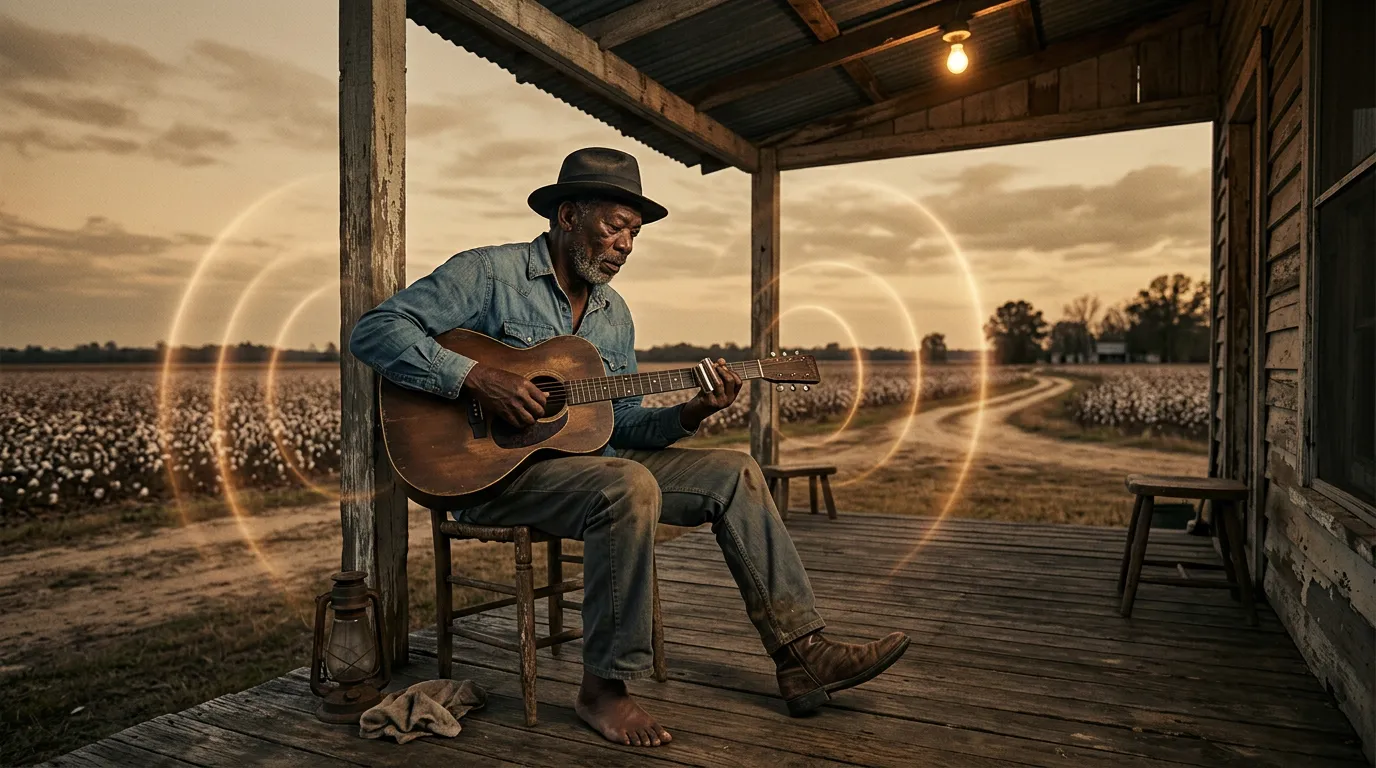
Delta blues comes from the Mississippi Delta, the flat cotton country between the Mississippi and Yazoo rivers, where Black musicians in the early 20th century played for juke joints, house parties and plantation workers. Commercial recordings began in the late 1920s, and players such as Charley Patton, Son House and Robert Johnson, who recorded in hotel and office rooms in San Antonio and Dallas in 1936 and 1937, set the sound: one voice, one acoustic guitar, often played with a bottleneck slide, and a foot keeping time. The tempo moves with the singer rather than a click, from slow, free laments to driving dance rhythms. Almost all of it was recorded in mono on a single microphone. That makes it a delicate fit for spatial audio: the goal is not to spread one player across the room, but to put the listener in the room with them. This guide covers how spatial audio for Delta blues works, where to place each element and how to make an immersive Delta blues mix. For the basics, see what spatial audio is.
Why Delta blues works in spatial audio
Delta blues is one person playing two parts at once: a voice telling the story and a guitar that keeps the bass, the rhythm and the answers to every line. In mono, all of that comes from one point, which is honest but flat. In an immersive mix the voice and guitar stay together and close in the middle, the slide and the foot stomp sit just beside them, and the room itself wraps around the listener.
The rule: one performer, close and still, inside a real room. Keep the voice and guitar together in the middle, add space around them and never move the musician.
Immersive music for Delta blues: what listeners hear
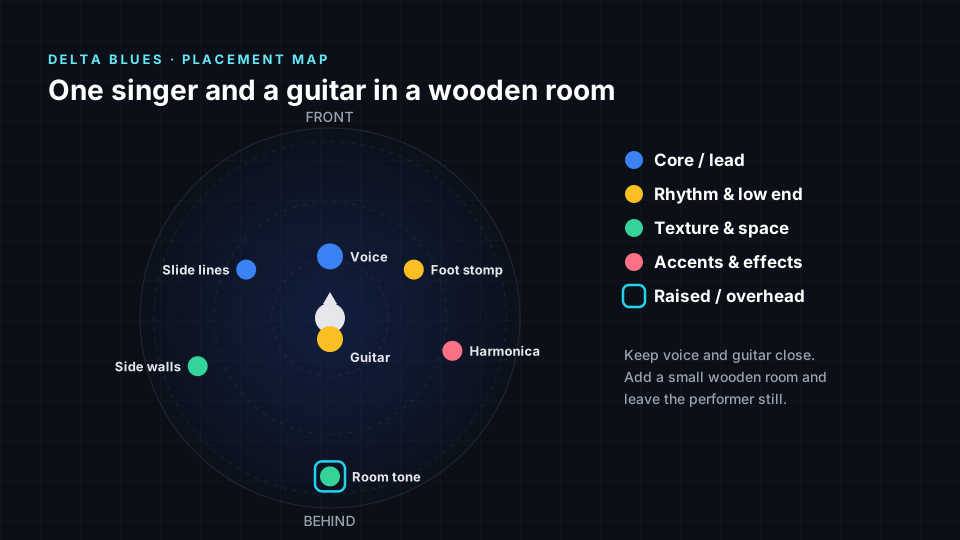
- A singer an arm's length away. The voice is close, centred and dry enough to hear every breath.
- A guitar you can almost touch. Bass notes and rhythm stay with the singer in the middle.
- Slide and stomp beside you. Bottleneck answers and the foot on the boards sit just off centre.
- A real room around you. Wooden walls and a low ceiling replace the flatness of mono.
Where to place each element in a Delta blues mix
| Element | Position | Height | Why it works |
|---|---|---|---|
| Voice | Front centre | Ear level | The singer and the story, close to the listener |
| Guitar | Centre | Ear level | Thumbed bass and rhythm from the same player |
| Slide lines | Front left, close | Ear level | Bottleneck answers just beside the voice |
| Foot stomp | Front right, close | Ear level | The beat tapped on wooden boards |
| Harmonica | Right | Ear level | A second player answering the vocal |
| Side walls | Left | Ear level | Early reflections from a small room |
| Room tone | Behind | Raised | The air of a porch, juke joint or hotel room |
The psychoacoustics behind Delta blues placement
Every position in the table above follows how the ear and brain locate sound. Here is the reason behind the main choices for Delta blues.
- Voice and guitar stay together. The smallest change in direction the ear can detect at the front is about one degree. This is the minimum audible angle (Mills). Because the ear is so precise in front, even a small gap between voice and guitar would split one performer in two, so keep them close together.
- Thumbed bass notes stay centred. The ear finds almost no direction in frequencies below roughly 80 to 100 Hz, so the low guitar strings gain nothing from being spread. Keeping them in the middle keeps the performer whole.
- Slide answers just off centre. Two sounds that share a frequency range mask each other far less when they arrive from slightly different directions. This is spatial release from masking. A small offset lets the slide answer the voice without covering it.
- Room reflections from the sides. Early reflections arriving from the sides make a space feel wide and enveloping. This is the lateral reflection effect studied by Barron and Marshall. Side reflections create the room without moving the singer.
The immersion profile for Delta blues
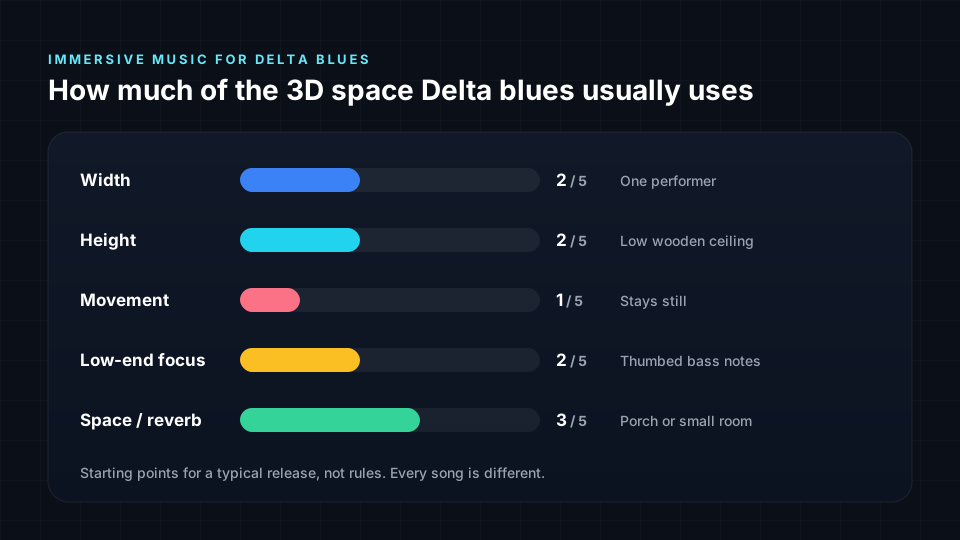
Space scores 3 because the sound of a small wooden room is what turns a mono recording into an experience. Width scores 2: one performer should stay in one place. Low-end focus scores 2, coming from the thumbed bass strings rather than a bass player. Height is low, with only room tone raised, and movement scores 1 because nothing should move.
Tips for an immersive Delta blues mix
- Keep the performer whole. Voice and guitar come from one person, so keep them together and centred.
- Add space, not width. A small room around the listener matters more than spreading parts.
- Keep it close. The intimacy of a single microphone is the point, so do not push the singer back.
- Respect the noise. Some surface noise and tape hiss belong to the record; reduce it gently and keep it centred.
- Never move anything. Motion would break the illusion of one person in one room.
Delta Blues styles: country blues, Piedmont blues and acoustic blues
The core placement holds for every acoustic blues style: voice and guitar close in the middle, a real room around them. What changes is the playing style, the number of players and how clean the recording is.
Country Blues
Country blues is the umbrella term for the rural, mostly acoustic blues recorded in the American South in the 1920s and 1930s, from the Mississippi Delta to Texas, where players such as Blind Lemon Jefferson cut some of the earliest hits. Recordings are almost all mono, made on location or in makeshift studios, so separation has limits. Keep the singer and guitar centred and close, set any second guitar or fiddle slightly to one side, and add a modest room. Do not chase width: the honesty of the original performance matters more than any effect.
Piedmont Blues
Piedmont blues comes from the southeastern states, from Virginia and the Carolinas to Georgia, and uses a fingerpicked style where the thumb plays an alternating bass while the fingers pick ragtime-flavoured melodies. Blind Willie McTell and Blind Blake are well-known early players. Because the bass and melody are so clearly separate, you can open the guitar very slightly, keeping the thumbed bass centred and the treble just off centre. Duos with harmonica or washboard are common: set the second player to the right. Use a bright, small room.
Acoustic Blues
Acoustic blues covers the modern and revival side of the tradition, from the 1960s folk revival to players recording today, often in stereo with several microphones and sometimes with a small band. With clean multitracks you have more freedom. Keep the voice and main guitar centred and close, place a second guitar, harmonica or upright bass on either side, and use a natural room or a real wooden space rather than artificial reverb. Height can stay low. Keep everything still, like a front-row seat at a small acoustic show.
Related styles such as Texas blues and hill country blues follow the same idea: keep the performer close and whole, then add the room around them.
How to make immersive Delta blues from stereo
Spatial9 can create spatial audio from a stereo track in a few steps:
- Upload your stereo master or your stems.
- Spatial9's AI separates and places each part, separating the voice, guitar and foot stomp even from old mono recordings and keeping them close and centred inside a small wooden room.
- Preview it in binaural on headphones.
- Export Eclipsa Audio, ADM, binaural or Ambisonics.
- Publish a video. Create a YouTube-ready video with your immersive audio and publish it directly.
For related guides, read spatial audio for blues and spatial audio for folk. Every guide is listed in spatial audio and immersive music by genre.
Frequently asked questions
Does this guide cover country blues, Piedmont blues and acoustic blues?
Yes. Country blues keeps a mono voice and guitar close and centred with a modest room. Piedmont blues can open the fingerpicked guitar very slightly, with a duo partner to the right. Acoustic blues uses cleaner stereo or multitrack recordings for a small, natural stage.
Can I make a Delta blues mix in Dolby Atmos or Eclipsa Audio?
Yes. The placements in this guide work for both. Spatial9 exports ADM, the standard file used by Dolby Atmos studios, as well as Eclipsa Audio for YouTube, so one immersive Delta blues mix covers both. If you plan to release the Atmos version on Apple Music, build it from your original stems or multitracks, because Apple does not accept Atmos made from a finished stereo master. See where to publish spatial audio. You may also hear this called a 3D Delta blues mix or Delta blues in spatial audio.
Is spatial audio good for Delta blues?
Yes, if it is used gently. Delta blues is one voice and one guitar, so spatial audio should not spread the performer. Its value is the room: it places the listener close to the musician in a small, real space instead of at one flat point.
How is Delta blues different from Chicago blues in spatial audio?
Chicago blues is an electric band with amplified guitar, harmonica, piano, bass and drums, so the mix spreads several players across a club stage. Delta blues is usually one acoustic performer, so the mix keeps everything close and centred and uses the room for depth instead of width.
Should the slide guitar be separated from the voice?
Only slightly. The slide and the voice come from the same person, so pulling them far apart sounds false. A small offset just to the front left helps the slide answer each line without covering the singer.
Can I convert an old mono Delta blues recording to spatial audio?
Yes. Spatial9 uses AI to separate the voice, guitar and foot stomp from a mono or stereo master and place them in an immersive mix. On 1920s and 1930s recordings separation is never perfect, so keep the performer centred and add only a small room.
Does immersive Delta blues work on normal headphones?
Yes. The mix is rendered binaurally, so the close voice, guitar and wooden room work on any regular headphones.
Dolby and Dolby Atmos are trademarks of Dolby Laboratories. Spatial9 is not affiliated with or endorsed by Dolby Laboratories.
Sources
- Blauert, J. (1997). Spatial Hearing: The Psychophysics of Human Sound Localization, revised edition. MIT Press. Low-frequency, elevation, distance and motion cues.
- Mills, A. W. (1958). On the minimum audible angle. Journal of the Acoustical Society of America, 30(4), 237-246.
- Hebrank, J. and Wright, D. (1974). Spectral cues used in the localization of sound sources on the median plane. Journal of the Acoustical Society of America, 56(6), 1829-1834.
- Bronkhorst, A. W. (2000). The cocktail party phenomenon: a review of research on speech intelligibility in multiple-talker conditions. Acta Acustica united with Acustica, 86, 117-128.
- Litovsky, R. Y., Colburn, H. S., Yost, W. A. and Guzman, S. J. (1999). The precedence effect. Journal of the Acoustical Society of America, 106(4), 1633-1654.
- Barron, M. and Marshall, A. H. (1981). Spatial impression due to early lateral reflections in concert halls. Journal of Sound and Vibration, 77(2), 211-232.
- Neuhoff, J. G. (1998). Perceptual bias for rising tones. Nature, 395, 123-124.
- Bregman, A. S. (1990). Auditory Scene Analysis: The Perceptual Organization of Sound. MIT Press.
Pull up a chair on the porch
Upload a track to Spatial9 and hear one voice and one guitar come alive in a small wooden room around you in minutes. Then export it or publish it straight to YouTube.