
Spatial Audio & Immersive Music for Smooth Jazz: Contemporary Jazz, Jazz Pop & Crossover Jazz
Spatial9 Team · · 10 min read
Part of the series Spatial audio and immersive music by genre.
Key takeaways
- In a spatial smooth jazz mix the lead saxophone and the bass and kick stay centred, while electric piano, guitar, pads, percussion and backing vocals form a soft, wide space around them.
- Placing the electric piano and the clean guitar on opposite sides of the front stops two busy midrange parts masking each other, an effect known as spatial release from masking.
- Lifting pads slightly and keeping movement to one gentle percussion part preserves the relaxed, polished feel that defines smooth jazz.
- The smooth jazz immersion profile scores width 4, height 3, movement 2, low-end focus 3 and space 3 out of 5.
Smooth jazz grew out of the crossover and jazz funk records of the 1970s, when jazz players began mixing melody-led instrumentals with R&B grooves, soft rock and pop production. George Benson's Breezin' (1976) became one of the first jazz albums to go platinum, and by the late 1980s smooth jazz had its own radio format in the United States. The sound is polished and relaxed: a singing soprano or alto saxophone, guitar or electric piano on top, a round electric bass, tight drums or drum machine, synth pads and light percussion, usually at a gentle 80 to 110 BPM. It is a studio genre, recorded on multitrack with careful overdubs, so it already has many clean layers that stereo has to stack between two speakers. That makes smooth jazz a natural fit for spatial audio. This guide covers how spatial audio for smooth jazz works, where to place each element and how to make an immersive smooth jazz mix. For the basics, see what spatial audio is.
Why smooth jazz works in spatial audio
Smooth jazz depends on clarity and comfort. A lead melody floats over a bed of keys, guitar, pads and percussion, and every part is meant to be heard without anything feeling busy. In stereo the chords, licks and pads all share the space behind the sax. In an immersive mix the groove stays solid in the middle while the harmony and texture open out into a wide, soft room.
The rule: a centred lead and groove, a soft wide bed around them. The sax and rhythm stay put, while keys, guitar and pads give the mix its width and calm.
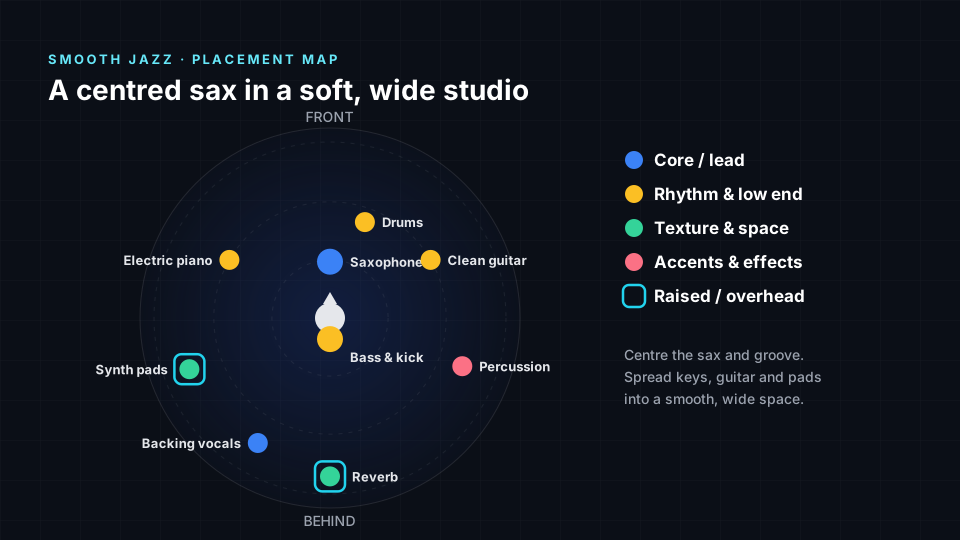
Immersive music for smooth jazz: what listeners hear
- A sax that sings right in front. The melody stays close, clear and centred.
- Keys and guitar on either side. Chords and licks answer each other across the front.
- A soft cushion of pads. Harmony floats slightly above and around the listener.
- Space without clutter. Percussion and reverb add air without crowding the groove.
Where to place each element in a smooth jazz mix
| Element | Position | Height | Why it works |
|---|---|---|---|
| Saxophone | Front centre | Ear level | The singing lead melody |
| Bass & kick | Centre | Ear level | A round, steady groove under everything |
| Drums | Front, just right | Ear level | Snare and hats tight behind the lead |
| Electric piano | Front left | Ear level | Warm chords and fills |
| Clean guitar | Front right | Ear level | Rhythm licks that answer the keys |
| Synth pads | Left side | Raised | A soft harmonic bed above the band |
| Percussion | Right side, moving gently | Ear level | Shakers and chimes that drift |
| Backing vocals | Behind left | Ear level | Hooks and oohs that surround the lead |
| Reverb | Behind | Raised | The polished studio space |
The psychoacoustics behind smooth jazz placement
Every position in the table above follows how the ear and brain locate sound. Here is the reason behind the main choices for smooth jazz.
- Bass and kick stay centred. The ear finds almost no direction in frequencies below roughly 80 to 100 Hz, so the round smooth jazz bass gains nothing from being spread. Keeping it centred keeps the groove steady on every speaker and headphone.
- Keys and guitar on opposite sides. Two sounds that share a frequency range mask each other far less when they arrive from different directions. This is spatial release from masking. Electric piano and clean guitar both fill the mids, so splitting them keeps each part clear.
- Pads lifted slightly. The outer ear filters high frequencies differently depending on height, and the brain reads this as elevation. These are the spectral cues described by Hebrank and Wright. Bright, airy pads carry enough top end to sit just above the band.
- Sax reverb behind the lead. When a sound and its reflections arrive close together, the brain places the sound by the first arrival. This is the precedence effect. The dry sax stays fixed in front, while its reverb and delay spread behind without blurring its position.
The immersion profile for smooth jazz
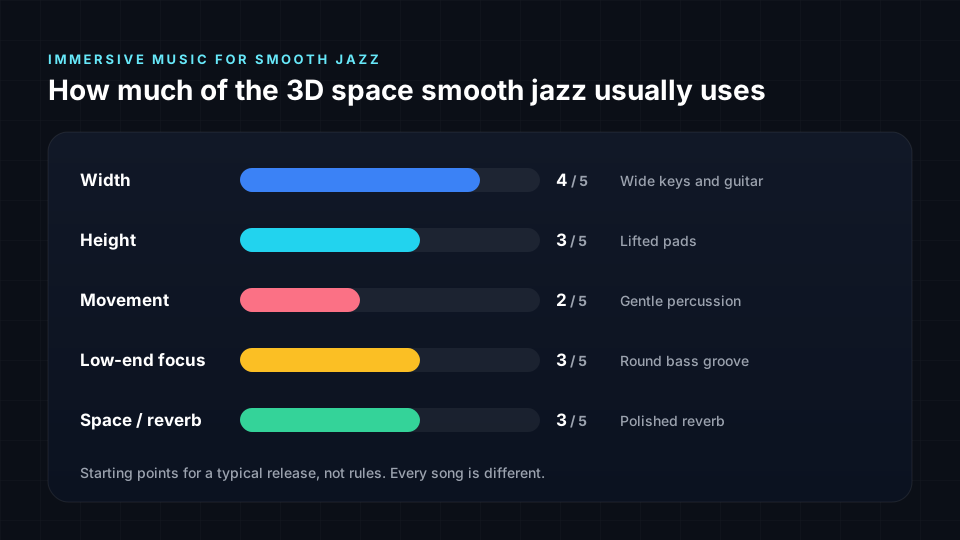
Width is high because keys, guitar, pads and backing vocals all need room around the lead. Height and space are moderate: a little lift and a polished reverb add luxury, but too much air makes the mix vague. Low-end focus sits in the middle with a round bass. Movement is low because the style is built to relax the listener, not to surprise them.
Tips for an immersive smooth jazz mix
- Keep the lead dry and close. The sax or guitar melody should sit right in front with its reverb behind it.
- Split keys and guitar. Put them on opposite sides so the comping never clashes.
- Lift pads, not drums. Pads can float a little higher, but keep the rhythm at ear level.
- Move one thing at most. A gentle shaker or chime is enough motion for the whole track.
- Keep the bass round and centred. A smooth, mono low end keeps the mix calm on every device.
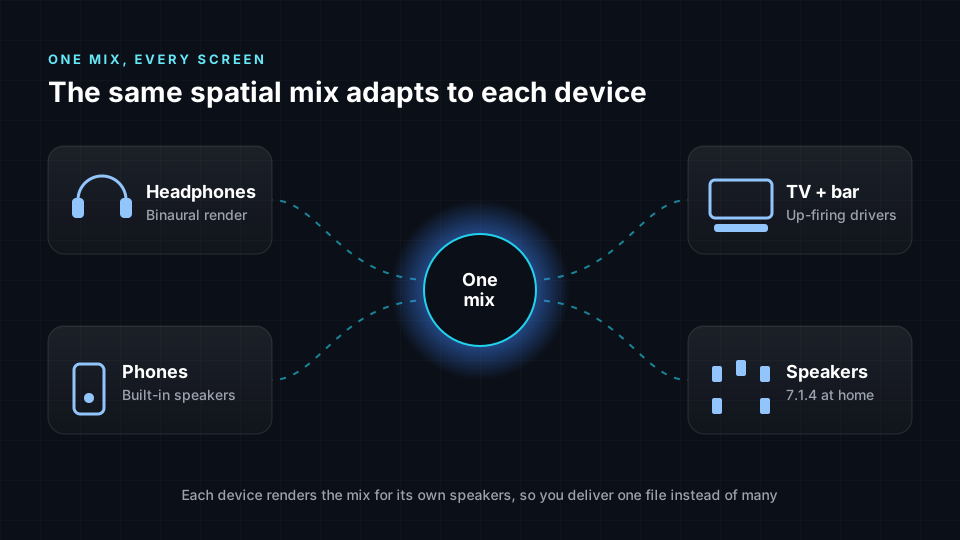
Smooth Jazz styles: contemporary jazz, jazz pop and crossover jazz
The core placement holds for every smooth jazz style: lead and groove in the middle, harmony and texture spread around. What changes is whether the lead is a horn, a guitar or a voice, and how much orchestral colour surrounds it.
Contemporary Jazz
Contemporary jazz is the radio and industry term for polished, groove-based instrumental jazz from the 1980s onwards, often led by saxophone, guitar or piano. Keep the lead instrument centred and close, with the drums tight behind it and the bass and kick firmly in the middle. Spread electric piano, rhythm guitar and synths across the front left and right so the arrangement feels wide but stable. Pads can sit slightly raised at the sides. Use one medium, smooth reverb for the whole band so the record sounds like one polished studio rather than a collection of separate effects.
Jazz Pop
Jazz pop puts a singer and a song form in front, with jazz harmony, horn solos and pop production. Here the vocal is the anchor, so it takes the front centre spot with the bass and kick underneath. Move the sax to one side of the front, where it can answer the vocal between lines. Backing vocals work well behind and to the sides, wrapping gently around the lead. Keep keys and guitar wide and the drums simple. Avoid lifting the vocal or moving it, because listeners follow the words.
Crossover Jazz
Crossover jazz describes jazz players reaching into pop, R&B, Latin and classical music, often with string sections, guest singers and big production. Records such as Grover Washington Jr.'s Winelight (1980) showed how far the style could cross into the pop charts. Give string sections a wide, slightly raised arc across the front and sides, with the lead horn or voice in the centre. Latin percussion can sit at the sides with a little gentle movement. Use a larger, warmer reverb than in contemporary jazz to carry the orchestral colour.
Related styles such as quiet storm and instrumental R&B follow the same idea: centre the lead and the groove, then give keys, pads and strings a soft, wide space.
How to make immersive smooth jazz from stereo
Spatial9 can create spatial audio from a stereo track in a few steps:
- Upload your stereo master or your stems.
- Spatial9's AI separates and places each part, keeping the lead sax and groove centred and spreading keys, guitar and pads into a soft, wide room.
- Preview it in binaural on headphones.
- Export Eclipsa Audio, ADM, binaural or Ambisonics.
- Publish a video. Create a YouTube-ready video with your immersive audio and publish it directly.
For related guides, read spatial audio for jazz fusion and spatial audio for R&B. Every guide is listed in spatial audio and immersive music by genre.
Frequently asked questions
Does this guide cover contemporary jazz, jazz pop and crossover jazz?
Yes. Contemporary jazz keeps the lead instrument centred with keys and guitar spread wide. Jazz pop centres the singer and moves the sax to one side to answer the vocal. Crossover jazz adds a wide, slightly raised string arc and a warmer reverb around the lead.
Can I make a smooth jazz mix in Dolby Atmos or Eclipsa Audio?
Yes. The placements in this guide work for both. Spatial9 exports ADM, the standard file used by Dolby Atmos studios, as well as Eclipsa Audio for YouTube, so one immersive smooth jazz mix covers both. If you plan to release the Atmos version on Apple Music, build it from your original stems or multitracks, because Apple does not accept Atmos made from a finished stereo master. See where to publish spatial audio. You may also hear this called a 3D smooth jazz mix or smooth jazz in spatial audio.
Is spatial audio good for smooth jazz?
Yes. Smooth jazz is a polished studio genre with many clean layers. Spatial audio gives keys, guitar and pads their own space, so the lead stays clear and the whole mix feels more relaxed.
How is smooth jazz different from jazz fusion in spatial audio?
Jazz fusion is louder, busier and more virtuosic, with solos, fast unison lines and more movement around the listener. Smooth jazz keeps the energy low, the lead melodic and the movement minimal, so its space feels soft and stable rather than dramatic.
Should the saxophone move in an immersive smooth jazz mix?
No. Keep the sax still and centred, because the listener follows the melody. Let its reverb and delay spread behind it instead, so the lead sounds big without drifting.
Can I convert a finished smooth jazz track to spatial audio?
Yes. Spatial9 uses AI to separate a stereo master and generate an immersive mix. Many 1980s and 1990s records have chorus and reverb printed into the stereo, so the AI separates the main parts while some of that shine stays attached, which usually sounds natural.
Does immersive smooth jazz work on normal headphones?
Yes. The mix is rendered binaurally, so the centred sax, wide keys and soft pads work on any regular headphones.
Dolby and Dolby Atmos are trademarks of Dolby Laboratories. Spatial9 is not affiliated with or endorsed by Dolby Laboratories.
Sources
- Blauert, J. (1997). Spatial Hearing: The Psychophysics of Human Sound Localization, revised edition. MIT Press. Low-frequency, elevation, distance and motion cues.
- Mills, A. W. (1958). On the minimum audible angle. Journal of the Acoustical Society of America, 30(4), 237-246.
- Hebrank, J. and Wright, D. (1974). Spectral cues used in the localization of sound sources on the median plane. Journal of the Acoustical Society of America, 56(6), 1829-1834.
- Bronkhorst, A. W. (2000). The cocktail party phenomenon: a review of research on speech intelligibility in multiple-talker conditions. Acta Acustica united with Acustica, 86, 117-128.
- Litovsky, R. Y., Colburn, H. S., Yost, W. A. and Guzman, S. J. (1999). The precedence effect. Journal of the Acoustical Society of America, 106(4), 1633-1654.
- Barron, M. and Marshall, A. H. (1981). Spatial impression due to early lateral reflections in concert halls. Journal of Sound and Vibration, 77(2), 211-232.
- Neuhoff, J. G. (1998). Perceptual bias for rising tones. Nature, 395, 123-124.
- Bregman, A. S. (1990). Auditory Scene Analysis: The Perceptual Organization of Sound. MIT Press.
Make it smoother in 3D
Upload a track to Spatial9 and hear your sax float in front of a soft, wide band in minutes. Then export it or publish it straight to YouTube.