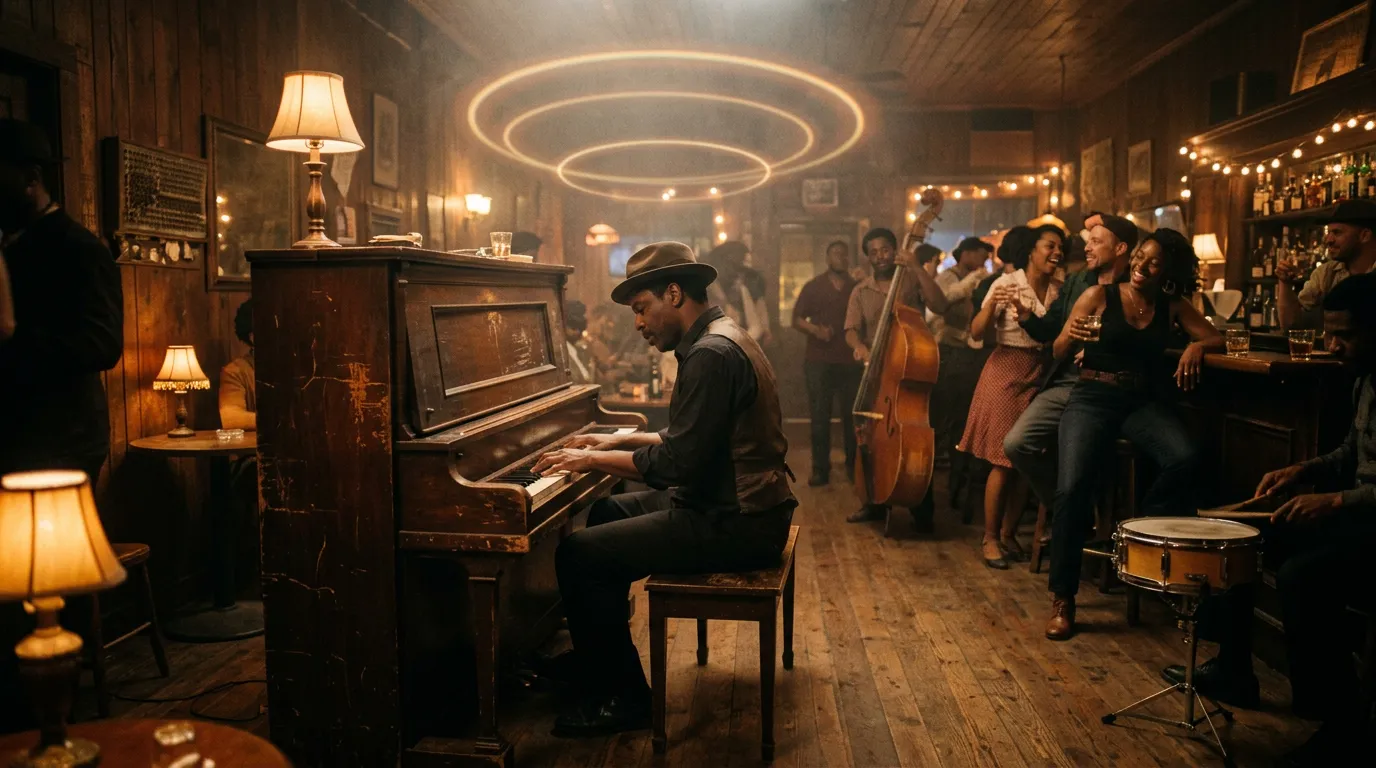
Spatial Audio & Immersive Music for Boogie-Woogie: Barrelhouse, Stride Piano & Piano Blues
Spatial9 Team · · 10 min read
Part of the series Spatial audio and immersive music by genre.
Key takeaways
- In a spatial boogie-woogie mix the piano stays one still instrument in front, with the rolling left-hand bass slightly left and the right-hand treble slightly right, while any bass, drums and guitar sit around it.
- Opening the piano a little so the left-hand bass figure and the right-hand riffs come from slightly different directions helps the ear follow both lines at once, an effect known as auditory stream segregation.
- Most classic boogie-woogie is mono, so AI separation should rebuild one piano in one room with a small, warm space, not split the instrument across the listener or set it moving.
- The boogie-woogie immersion profile scores width 3, height 2, movement 1, low-end focus 3 and space 3 out of 5.
Boogie-woogie is a piano blues style that grew up in the barrelhouses, juke joints and lumber and turpentine camps of Texas and the South around the start of the 20th century, then travelled north to Chicago and Kansas City with the Great Migration. Its sound is a driving left hand playing a repeating bass figure, usually eight notes to the bar, under right-hand riffs, trills and crushed blue notes, mostly over a 12-bar blues at around 120 to 190 BPM. Pine Top Smith's 1928 recording named the style, and the 1938 From Spirituals to Swing concert at Carnegie Hall, with Albert Ammons, Meade Lux Lewis and Pete Johnson, started a craze that fed swing, jump blues and early rock and roll. Almost every classic boogie-woogie record is mono, often one piano and one microphone. Boogie-woogie suits spatial audio in a quiet way: it is really two players in one pair of hands, and a little separation lets the listener hear both. This guide covers how spatial audio for boogie-woogie works, where to place each element and how to make an immersive boogie-woogie mix. For the basics, see what spatial audio is.
Why boogie-woogie works in spatial audio
A boogie-woogie pianist plays two parts at once: a relentless bass pattern in the left hand and a free, riffing melody in the right. In mono the two hands fuse into one block of sound. In an immersive mix the piano stays one instrument in one place, but the bass end and the treble end open slightly, so the cross-rhythms between the hands are easy to hear.
The rule: one still piano in front, its two hands gently apart. Never split the piano across the room; open it just enough for the left and right hands to read as separate lines.
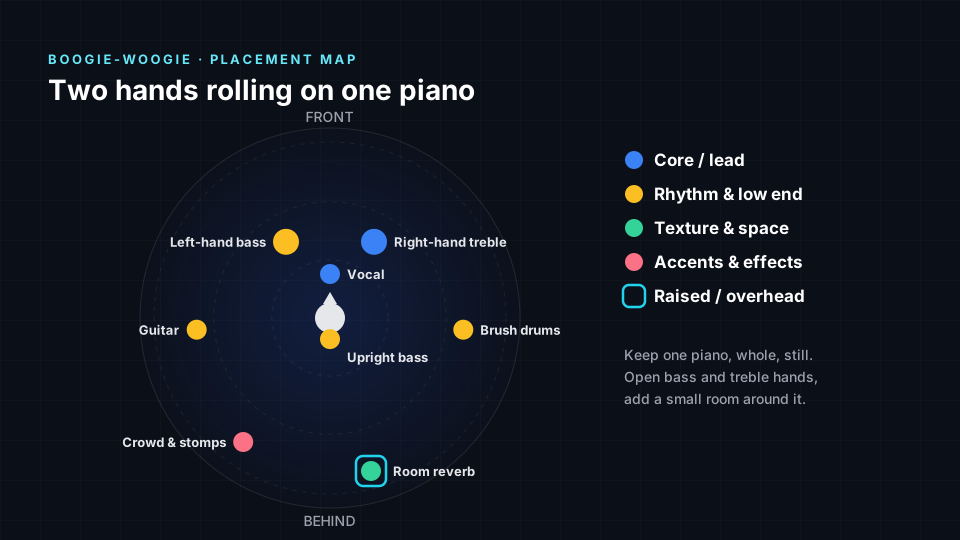
Immersive music for boogie-woogie: what listeners hear
- Two hands you can tell apart. The rolling bass and the right-hand riffs come from slightly different places.
- A piano that stays put. The instrument sits solid in front, as if you were standing beside it.
- A singer close to you. The vocal sits centred and near, just above the keys.
- A party around you. Stomps, shouts and a warm small room fill the space behind.
Where to place each element in a boogie-woogie mix
| Element | Position | Height | Why it works |
|---|---|---|---|
| Vocal | Front centre | Ear level | A shouted or sung blues line close to you |
| Left-hand bass | Front left of centre | Ear level | The rolling eight-to-the-bar bass figure |
| Right-hand treble | Front right of centre | Ear level | Riffs, trills and crushed blue notes |
| Upright bass | Centre | Ear level | Doubles the left hand in band recordings |
| Guitar | Left | Ear level | Chords and fills in small group sides |
| Brush drums | Right | Ear level | Brushed snare and hi-hat behind the shuffle |
| Crowd & stomps | Behind left | Ear level | Foot stomps, shouts and the party around you |
| Room reverb | Behind | Raised | The juke joint or club around the piano |
The psychoacoustics behind boogie-woogie placement
Every position in the table above follows how the ear and brain locate sound. Here is the reason behind the main choices for boogie-woogie.
- Bass doubling stays centred. The ear finds almost no direction in frequencies below roughly 80 to 100 Hz, so the deepest notes of the left hand and any upright bass gain nothing from being spread.
- Left and right hands slightly apart. The brain groups sounds into separate streams by pitch, timing and direction. This is auditory stream segregation (Bregman). A small angle between the bass figure and the treble riffs helps the ear hold both lines and their cross-rhythms.
- Only a small angle is needed. Listeners can detect a change in direction of only one or two degrees straight ahead. This is the minimum audible angle (Mills). That is why the piano can open slightly in front and still sound like one instrument.
- A small room, not a big hall. When a sound and its reflections arrive close together, the brain places it by the first arrival. This is the precedence effect. Short reflections add warmth without pulling the piano from the front.
The immersion profile for boogie-woogie
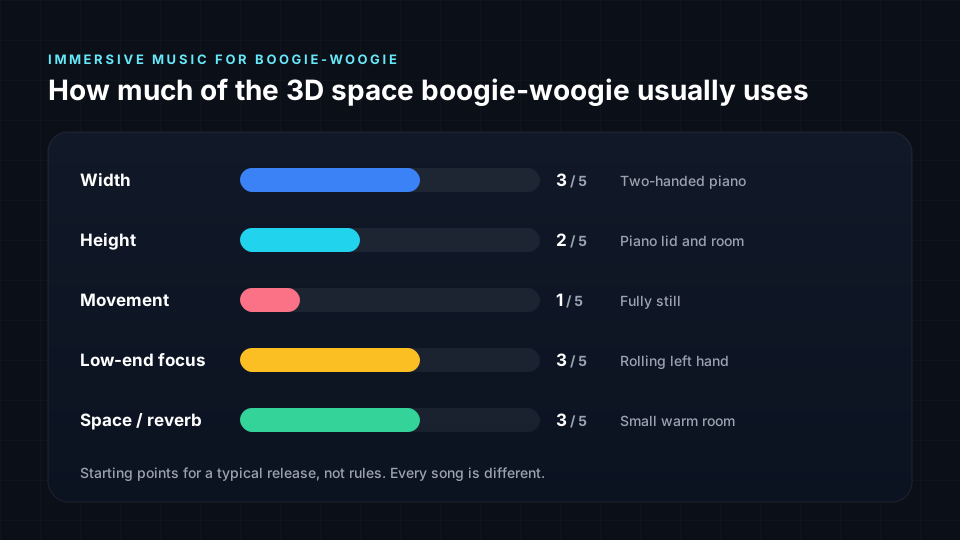
Width scores 3 because the piano opens across the front and a small band can sit at the sides. Low-end focus scores 3 because the left-hand bass figure drives everything. Space scores 3: a juke joint or club adds warmth, but the piano should stay close. Height is low, coming only from the room. Movement is at the minimum because a piano does not move.
Tips for an immersive boogie-woogie mix
- Keep the piano one instrument. Open the hands slightly, but never put bass and treble on opposite sides of the room.
- Protect the left hand. Keep the lowest notes centred and clean so the drive never thins out.
- Bring the right hand forward. The riffs and trills carry the excitement, so keep them clear and close.
- Use a small, warm room. Short reflections suit the style better than a long concert hall tail.
- Leave the crowd in the back. Stomps and shouts add life, but keep them behind and quiet.
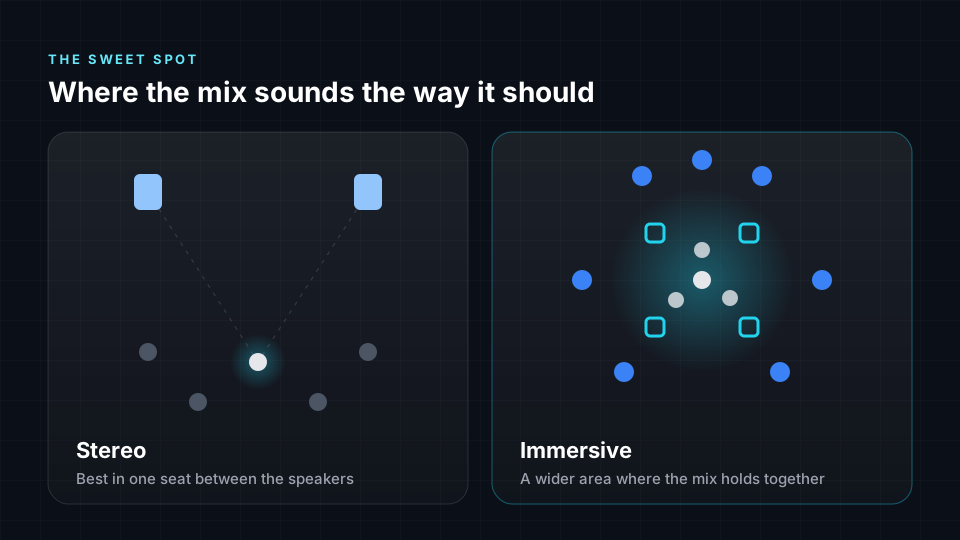
Boogie-Woogie styles: barrelhouse, stride piano and piano blues
The core placement holds for every boogie-woogie style: one still piano in front, hands gently apart, a small room around it. What changes is the left-hand pattern, the size of the band and the role of the voice.
Barrelhouse
Barrelhouse is the rough, early piano blues of the barrelhouses and camps of the South, played on worn uprights for drinking and dancing, with heavy rolling bass figures and a lot of crowd noise. Keep the piano close, centred and fairly narrow, with the bass hand a little left and the treble a little right. Put foot stomps, shouts and glasses behind the listener at a low level, and use a short, boxy room rather than smooth reverb. Do not clean it up too far: the worn upright is part of the character.
Stride Piano
Stride piano came from Harlem in the 1910s and 1920s, where players such as James P. Johnson and Fats Waller made the left hand leap between a low bass note and a mid-range chord on every beat. That leaping left hand covers a wide range, so open the piano a little more than for boogie-woogie, keeping the bass notes left of centre and the chords and right-hand melody further right. Keep it still and in front. A small, lively rent party room works well.
Piano Blues
Piano blues covers slower, more vocal styles, from the urban piano and guitar duets of the late 1920s and 1930s to the Chicago band pianists of the 1950s. The singer matters as much as the piano. Keep the voice centred and close, and set the piano just behind it, opened slightly. In duets put the guitar to one side, opposite the right hand, so the two never mask each other. Use a warm, intimate room, and keep the slow tempos spacious rather than adding long reverb.
Related styles such as jump blues piano and early rock and roll piano follow the same idea: keep the piano whole and still, open the hands slightly and place any band around it.
How to make immersive boogie-woogie from stereo
Spatial9 can create spatial audio from a stereo track in a few steps:
- Upload your stereo master or your stems.
- Spatial9's AI separates and places each part, pulling the piano, voice and any band apart even from old mono recordings, keeping the piano whole in front and opening its bass and treble slightly.
- Preview it in binaural on headphones.
- Export Eclipsa Audio, ADM, binaural or Ambisonics.
- Publish a video. Create a YouTube-ready video with your immersive audio and publish it directly.
For related guides, read spatial audio for blues and spatial audio for rhythm and blues. Every guide is listed in spatial audio and immersive music by genre.
Frequently asked questions
Does this guide cover barrelhouse, stride piano and piano blues?
Yes. Barrelhouse keeps a raw, close piano with crowd noise behind and a boxy room. Stride piano opens the leaping left hand a little wider in a lively small room. Piano blues puts a close, centred voice in front of the piano with any guitar or band at the sides.
Can I make a boogie-woogie mix in Dolby Atmos or Eclipsa Audio?
Yes. The placements in this guide work for both. Spatial9 exports ADM, the standard file used by Dolby Atmos studios, as well as Eclipsa Audio for YouTube, so one immersive boogie-woogie mix covers both. If you plan to release the Atmos version on Apple Music, build it from your original stems or multitracks, because Apple does not accept Atmos made from a finished stereo master. See where to publish spatial audio. You may also hear this called a 3D boogie-woogie mix or boogie-woogie in spatial audio.
Is spatial audio good for boogie-woogie?
Yes, used gently. Spatial audio opens the bass and treble just enough to hear both, while keeping the piano whole and still.
How is boogie-woogie different from blues in spatial audio?
Band blues spreads guitars, harmonica, bass and drums across a stage. Boogie-woogie is built around one piano, so the mix stays narrower and centred on the keyboard, with any band as support at the sides.
Should I split the piano across left and right?
No. Hard-splitting the bass and treble to opposite sides makes one piano sound like two. Open the hands only slightly in front, and keep the lowest notes near the centre.
Can I convert an old mono boogie-woogie recording to spatial audio?
Yes. Spatial9 uses AI to separate the piano, voice and any band from a mono or early stereo master. With 1920s to 1940s recordings separation is never perfect, so keep the layout simple and still, like one piano in one room.
Does immersive boogie-woogie work on normal headphones?
Yes. The mix is rendered binaurally, so the rolling piano and the small room work on any regular headphones.
Dolby and Dolby Atmos are trademarks of Dolby Laboratories. Spatial9 is not affiliated with or endorsed by Dolby Laboratories.
Sources
- Blauert, J. (1997). Spatial Hearing: The Psychophysics of Human Sound Localization, revised edition. MIT Press. Low-frequency, elevation, distance and motion cues.
- Mills, A. W. (1958). On the minimum audible angle. Journal of the Acoustical Society of America, 30(4), 237-246.
- Hebrank, J. and Wright, D. (1974). Spectral cues used in the localization of sound sources on the median plane. Journal of the Acoustical Society of America, 56(6), 1829-1834.
- Bronkhorst, A. W. (2000). The cocktail party phenomenon: a review of research on speech intelligibility in multiple-talker conditions. Acta Acustica united with Acustica, 86, 117-128.
- Litovsky, R. Y., Colburn, H. S., Yost, W. A. and Guzman, S. J. (1999). The precedence effect. Journal of the Acoustical Society of America, 106(4), 1633-1654.
- Barron, M. and Marshall, A. H. (1981). Spatial impression due to early lateral reflections in concert halls. Journal of Sound and Vibration, 77(2), 211-232.
- Neuhoff, J. G. (1998). Perceptual bias for rising tones. Nature, 395, 123-124.
- Bregman, A. S. (1990). Auditory Scene Analysis: The Perceptual Organization of Sound. MIT Press.
Pull up a chair by the piano
Upload a track to Spatial9 and hear the rolling left hand and the right-hand riffs open up in front of you in minutes. Then export it or publish it straight to YouTube.