Spatial Audio & Immersive Music for Free Jazz: Avant-Garde Jazz, Spiritual Jazz & Free Improvisation
Spatial9 Team · · 10 min read
Part of the series Spatial audio and immersive music by genre.
Key takeaways
- In a spatial free jazz mix each player keeps a fixed place in a wide circle, with the main horn at the front and the double bass centred, while bells, gongs and small percussion move around and above the listener.
- Spreading the players widely helps the brain follow several improvised lines at once instead of hearing one wall of sound, an effect known as auditory stream segregation.
- Side reflections from a real room make free jazz feel like sitting among the players, which is why space scores high and the reverb should sound like a room, not an effect.
- The free jazz immersion profile scores width 5, height 3, movement 4, low-end focus 2 and space 4 out of 5.
Free jazz broke away from fixed chord changes, steady swing and set song forms in the late 1950s and 1960s. Ornette Coleman's The Shape of Jazz to Come (1959) and his album Free Jazz (1961) gave the movement its name, and John Coltrane's Ascension (1965) pushed collective improvisation into a roaring group sound. Players treat pitch, rhythm and timbre as open material: saxophones overblow and scream, pianists play clusters, bassists bow and slap, and drummers play free time, often with no steady tempo at all. Most landmark records were made live in the studio or on stage, with the whole group in one room, and Free Jazz itself was recorded as a double quartet with one group in each stereo channel. Several lines at once, flattened by stereo into a wall, make free jazz a natural fit for spatial audio. This guide covers how spatial audio for free jazz works, where to place each element and how to make an immersive free jazz mix. For the basics, see what spatial audio is.
Why free jazz works in spatial audio
Free jazz is a conversation in which everyone talks at once. In stereo the horns, piano and drums overlap and the listener loses track of the voices. In an immersive mix each player gets a fixed home around the circle, so the ear can follow every line while the whole group still sounds like one room.
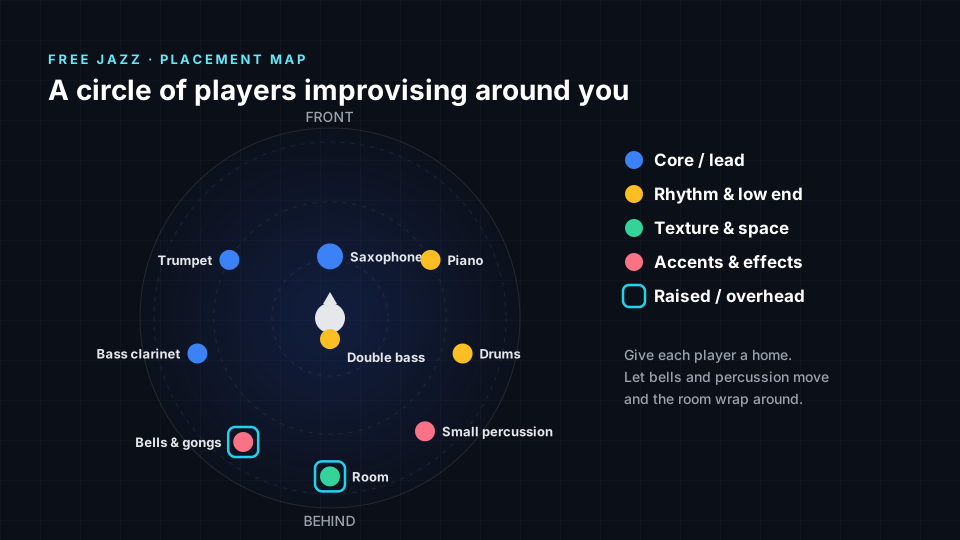
The rule: a fixed home for every player, motion only in the small sounds. The horns, piano, bass and drums stay where they stand, while bells and percussion carry the movement.
Immersive music for free jazz: what listeners hear
- Every voice in its own place. Horns, piano and drums can be followed one by one.
- A group all around you. The players form a circle instead of a flat line.
- Metal that rings overhead. Bells and gongs shimmer and drift above the listener.
- A room you can feel. The loft or hall wraps around the noise and the silence.
Where to place each element in a free jazz mix
| Element | Position | Height | Why it works |
|---|---|---|---|
| Saxophone | Front centre | Ear level | The main voice that often leads the energy |
| Double bass | Centre | Ear level | Pizzicato and bowed lines at the heart |
| Trumpet | Front left | Ear level | A second voice that answers or collides |
| Piano | Front right | Ear level | Clusters and runs opposite the horns |
| Drums | Right | Ear level | Free time played as colour and energy |
| Bass clarinet | Left | Ear level | Dark reed sounds beside the listener |
| Bells & gongs | Behind left, moving | Raised | Ringing metal that drifts overhead |
| Small percussion | Behind right, moving | Ear level | Shakers, whistles and rattles that wander |
| Room | Behind | Raised | The loft, club or hall around the players |
The psychoacoustics behind free jazz placement
Every position in the table above follows how the ear and brain locate sound. Here is the reason behind the main choices for free jazz.
- Double bass stays centred. The ear finds almost no direction in frequencies below roughly 80 to 100 Hz, so the low end of the double bass gains little from being spread. Keeping it centred gives a free performance a steady anchor, even when there is no steady pulse.
- Players spread wide. The brain groups sounds into streams by pitch, timing and direction. This is auditory stream segregation (Bregman). When saxophone, trumpet and bass clarinet improvise at once, separate directions let the ear follow each line instead of hearing one blur.
- Bells and gongs raised. The outer ear filters high frequencies differently depending on height, and the brain reads this as elevation. These are the spectral cues described by Hebrank and Wright. Bright metal percussion carries plenty of high frequencies, so it reads clearly as overhead.
- A room from the sides. Early reflections from the sides make a space feel wide and enveloping. This is the lateral reflection effect studied by Barron and Marshall. Natural side reflections make free jazz feel like being in the room with the players.
The immersion profile for free jazz
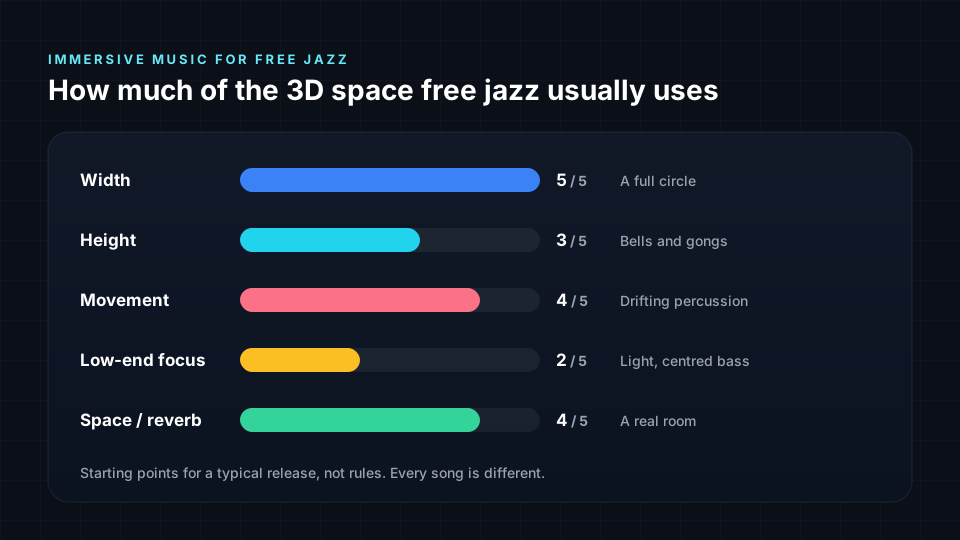
Width is at maximum because collective improvisation needs every player in a separate place. Space is high because the room is part of the sound. Movement is high, but it comes from bells, percussion and the shifting energy of the group, not from moving the main players. Height is moderate, and low-end focus is low because an acoustic bass rarely dominates.
Tips for an immersive free jazz mix
- Seat the players in a circle. Give each musician one fixed home and keep it for the whole piece.
- Keep the main voices still. Moving a horn mid-solo breaks the sense of real players in a room.
- Move the small sounds. Bells, shakers and whistles can drift without confusing the listener.
- Use a real room. Choose a natural reverb with side reflections, not a long artificial tail.
- Respect the silence. Leave quiet passages open so the room and small sounds can be heard.
Free Jazz styles: avant-garde jazz, spiritual jazz and free improvisation
The core placement holds for every free jazz style: each player has a fixed home, the bass sits in the middle and small sounds move. What changes is the size of the group, the mood and how much ritual and drone surrounds it.
Avant-Garde Jazz
Avant-garde jazz is the broad experimental side of jazz, from structured compositions to open improvisation, and it grew strongly in New York and in Chicago, where the AACM was founded in 1965. Groups often use unusual instruments: bass saxophone, bells, whistles, toy instruments and found objects. Give every unusual sound its own fixed place around the circle, with the main horns at the front. Composed sections can stay tighter at the front, while open sections spread wider. Keep the reverb natural and medium so the detail of extended techniques stays clear.
Spiritual Jazz
Spiritual jazz combines free playing with modal vamps, drones, chanting and instruments from Indian, African and Middle Eastern traditions, and John Coltrane's A Love Supreme (1965) is its touchstone. Place drones and tanpura-like sounds as a wide, slightly raised bed around the listener. Put the saxophone at the front centre and a harp or piano at the front sides, with hand percussion and bells behind. Chanting voices can sit behind and to the sides like a congregation. Use a longer, warmer reverb than in other free jazz styles, and keep movement slow.
Free Improvisation
Free improvisation moves beyond jazz itself into music with no set idiom, a scene that grew in London and across Europe from the mid 1960s. Groups are often tiny, and the sounds are close, quiet and full of extended techniques. Place each player where they would sit in the room and keep them there. A closer, drier space suits the intimate detail, though the natural room should still be heard in the silences. Small sounds can drift slightly, but keep it subtle: the listener should feel they are sitting among the players.
Related styles such as loft jazz and fire music follow the same idea: give each player a fixed home, let small sounds move and keep the room real.
How to make immersive free jazz from stereo
Spatial9 can create spatial audio from a stereo track in a few steps:
- Upload your stereo master or your stems.
- Spatial9's AI separates and places each part, pulling the horns, piano, bass and drums apart even from old stereo or mono masters and setting each player in their own place around a natural room.
- Preview it in binaural on headphones.
- Export Eclipsa Audio, ADM, binaural or Ambisonics.
- Publish a video. Create a YouTube-ready video with your immersive audio and publish it directly.
For related guides, read spatial audio for experimental music and spatial audio for jazz. Every guide is listed in spatial audio and immersive music by genre.
Frequently asked questions
Does this guide cover avant-garde jazz, spiritual jazz and free improvisation?
Yes. Avant-garde jazz gives every unusual instrument its own fixed place around the circle. Spiritual jazz wraps drones and chanting around a centred saxophone with a warmer room. Free improvisation keeps small groups close and still, with a drier space and subtle movement.
Can I make a free jazz mix in Dolby Atmos or Eclipsa Audio?
Yes. The placements in this guide work for both. Spatial9 exports ADM, the standard file used by Dolby Atmos studios, as well as Eclipsa Audio for YouTube, so one immersive free jazz mix covers both. If you plan to release the Atmos version on Apple Music, build it from your original stems or multitracks, because Apple does not accept Atmos made from a finished stereo master. See where to publish spatial audio. You may also hear this called a 3D free jazz mix or free jazz in spatial audio.
Is spatial audio good for free jazz?
Yes. Spatial audio gives each improvising player a separate direction, so the conversation is far easier to follow.
How is free jazz different from modal jazz in spatial audio?
Modal jazz keeps a clear soloist over a steady rhythm section, so its mix is a stable small band with one voice in front. Free jazz often has no fixed lead or pulse, so it needs a wider circle, more room sound and more movement in the small percussion.
How do I handle a free jazz record with two bands split left and right?
Keep the idea of the original. Place one group across the front left and side, the other across the front right and side, and keep the basses and drums close to their own group.
Can I convert an old free jazz recording to spatial audio?
Yes. Spatial9 uses AI to separate a mono or stereo master and generate an immersive mix. Loud collective passages will not separate perfectly, so keep the layout simple, the players still and the room natural.
Does immersive free jazz work on normal headphones?
Yes. The mix is rendered binaurally, so the wide circle of players, the bells overhead and the room work on any regular headphones.
Dolby and Dolby Atmos are trademarks of Dolby Laboratories. Spatial9 is not affiliated with or endorsed by Dolby Laboratories.
Sources
- Blauert, J. (1997). Spatial Hearing: The Psychophysics of Human Sound Localization, revised edition. MIT Press. Low-frequency, elevation, distance and motion cues.
- Mills, A. W. (1958). On the minimum audible angle. Journal of the Acoustical Society of America, 30(4), 237-246.
- Hebrank, J. and Wright, D. (1974). Spectral cues used in the localization of sound sources on the median plane. Journal of the Acoustical Society of America, 56(6), 1829-1834.
- Bronkhorst, A. W. (2000). The cocktail party phenomenon: a review of research on speech intelligibility in multiple-talker conditions. Acta Acustica united with Acustica, 86, 117-128.
- Litovsky, R. Y., Colburn, H. S., Yost, W. A. and Guzman, S. J. (1999). The precedence effect. Journal of the Acoustical Society of America, 106(4), 1633-1654.
- Barron, M. and Marshall, A. H. (1981). Spatial impression due to early lateral reflections in concert halls. Journal of Sound and Vibration, 77(2), 211-232.
- Neuhoff, J. G. (1998). Perceptual bias for rising tones. Nature, 395, 123-124.
- Bregman, A. S. (1990). Auditory Scene Analysis: The Perceptual Organization of Sound. MIT Press.
Sit inside the circle
Upload a track to Spatial9 and hear every improvised line take its own place around you in minutes. Then export it or publish it straight to YouTube.