Spatial Audio & Immersive Music for Western Swing: Texas Swing, Cowboy Jazz & Honky-Tonk Swing
Spatial9 Team · · 10 min read
Part of the series Spatial audio and immersive music by genre.
Key takeaways
- In a spatial Western swing mix the singer and the upright bass stay centred, while the twin fiddles, steel guitar, electric guitar, piano, drums and horns spread across a wide dance hall stage.
- Putting the fiddles and the steel guitar on opposite sides of the front reduces masking between two lead voices that share the same singing midrange, an effect known as spatial release from masking.
- Classic Western swing was recorded in mono, so AI separation should rebuild a simple, still bandstand with a warm dance hall around it rather than sounds that move.
- The Western swing immersion profile scores width 4, height 2, movement 2, low-end focus 2 and space 3 out of 5.
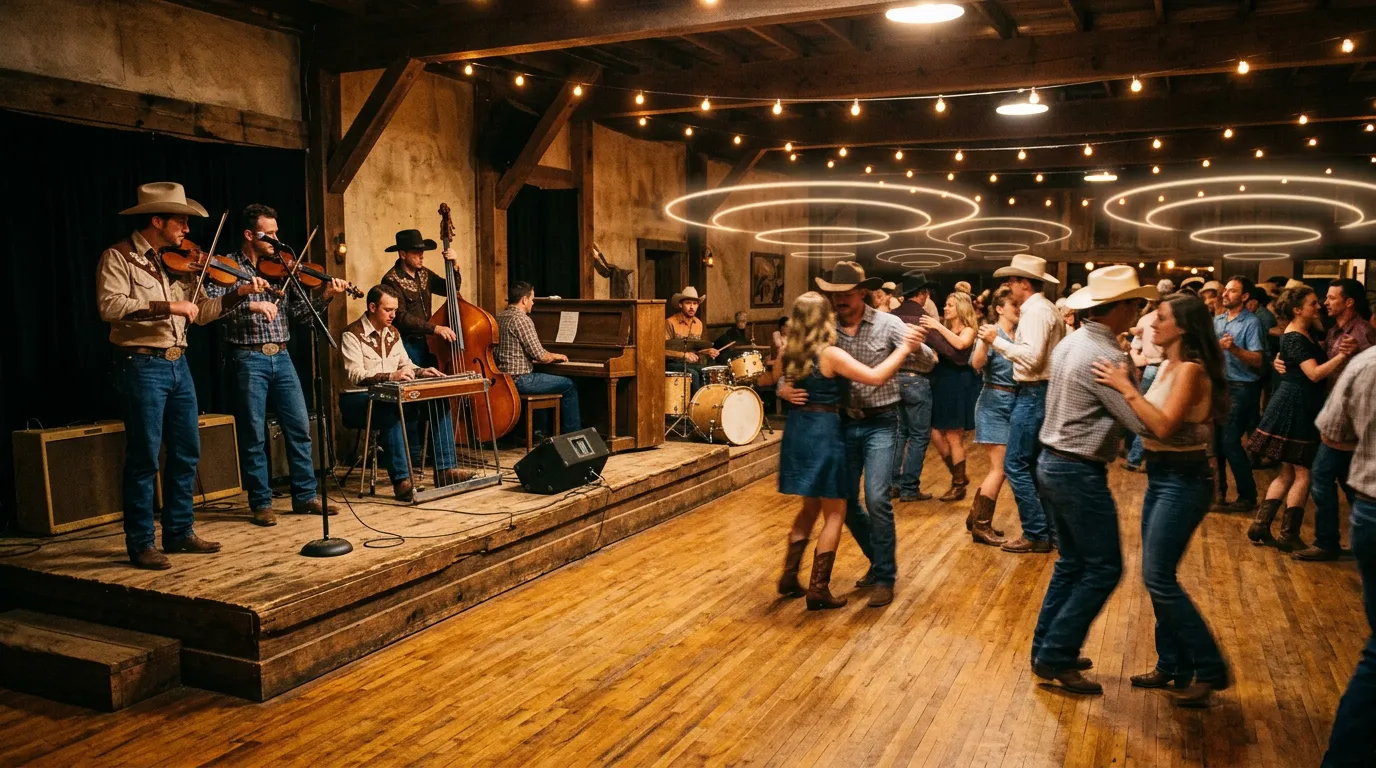
Western swing grew up in Texas and Oklahoma in the early 1930s, when string bands that played for country dances started borrowing the rhythms and soloing of jazz and the blues. Bands in Fort Worth and Tulsa added piano, drums, electric and steel guitar and sometimes horns, and played for big crowds in dance halls and on live radio, with Bob Wills and His Texas Playboys the best-known of them. The sound sits between country and swing jazz: a two-beat or four-beat dance groove of roughly 110 to 180 BPM, harmonised fiddles, sliding steel guitar and a leader calling out to the band. Almost every classic Western swing record was made in mono, often with the band gathered around one or two microphones and soloists stepping forward for their breaks. A Western swing band was always a wide line of players across a stage, and an immersive mix can rebuild that bandstand. This guide covers how spatial audio for Western swing works, where to place each element and how to make an immersive Western swing mix. For the basics, see what spatial audio is.
Why Western swing works in spatial audio
Western swing is a conversation between lead voices: fiddles play the tune, the steel answers, guitar and piano take jazzy breaks and the singer comes in over the top. In mono those lead voices share one point, and fiddles and steel blur together. In an immersive mix each lead instrument gets its own place on the bandstand and the breaks are easy to follow from one player to the next.
The rule: a centred singer and bass, lead voices spread across the bandstand. The voice and the bass hold the middle, while fiddles, steel, guitar and piano keep fixed places so the solos pass between them.
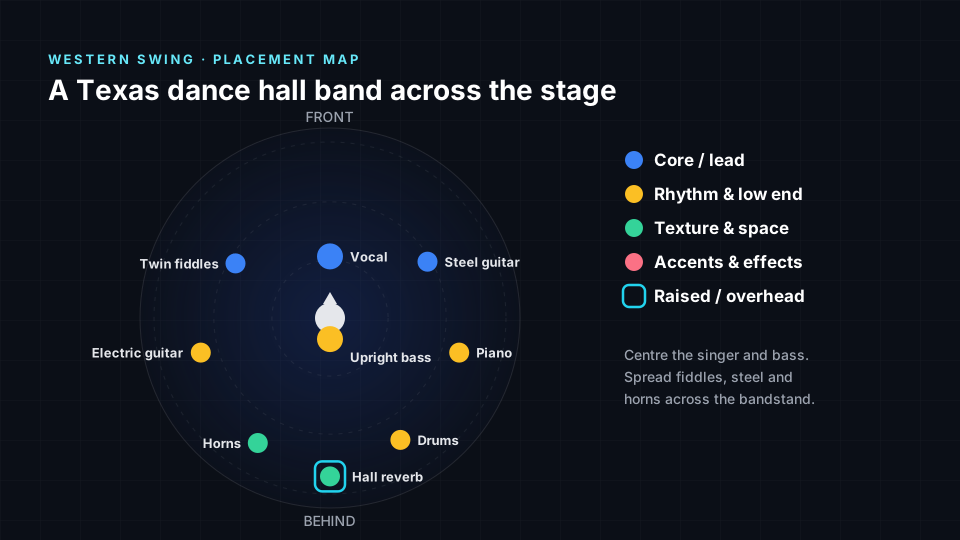
Immersive music for Western swing: what listeners hear
- Fiddles and steel side by side. The two signature lead sounds come from opposite sides of the front instead of one point.
- Solos that pass along the bandstand. Each break comes from the player who takes it, so you can follow the band.
- A singer close to you. The vocal and the spoken hollers sit centred and near, above the band.
- A dance hall around you. Wooden floor reflections and a warm room tail fill the space behind.
Where to place each element in a Western swing mix
| Element | Position | Height | Why it works |
|---|---|---|---|
| Vocal | Front centre | Ear level | The singer and the leader's hollers out front |
| Upright bass | Centre | Ear level | The slapped two-beat pulse under the dancers |
| Twin fiddles | Front left | Ear level | Harmonised fiddle lines, the heart of the band |
| Steel guitar | Front right | Ear level | Sliding, singing leads that answer the fiddles |
| Electric guitar | Left | Ear level | Jazzy single-note solos and chord stabs |
| Piano | Right | Ear level | Stride and boogie fills between the lines |
| Drums | Behind right | Ear level | Brushes and a light snare keep the swing |
| Horns | Behind left | Ear level | Trumpet and sax riffs fill out bigger bands |
| Hall reverb | Behind | Raised | The wooden dance hall around the band |
The psychoacoustics behind Western swing placement
Every position in the table above follows how the ear and brain locate sound. Here is the reason behind the main choices for Western swing.
- Upright bass stays centred. The ear finds almost no direction in frequencies below roughly 80 to 100 Hz, so the bass gains nothing from being spread. Keeping it centred keeps the pulse steady.
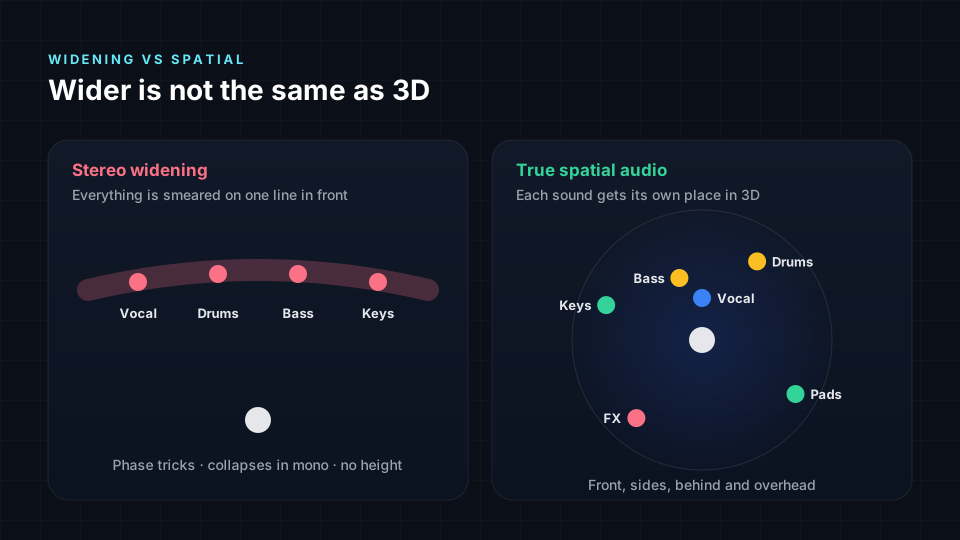
- Fiddles and steel on opposite sides. Two sounds that share a frequency range mask each other far less when they arrive from different directions. This is spatial release from masking. Fiddle and steel both sing in the upper mids, so opposite sides keep both clear.
- Solos you can follow by direction. The brain groups sounds into separate streams by pitch, timing and direction. This is auditory stream segregation (Bregman). A fixed place for every soloist lets the ear follow a break against the fiddle backing.
- Hall reflections from the sides. Early reflections arriving from the sides make a space feel wide and enveloping. This is the lateral reflection effect studied by Barron and Marshall. A little side reflection places the band in a real dance hall.
The immersion profile for Western swing
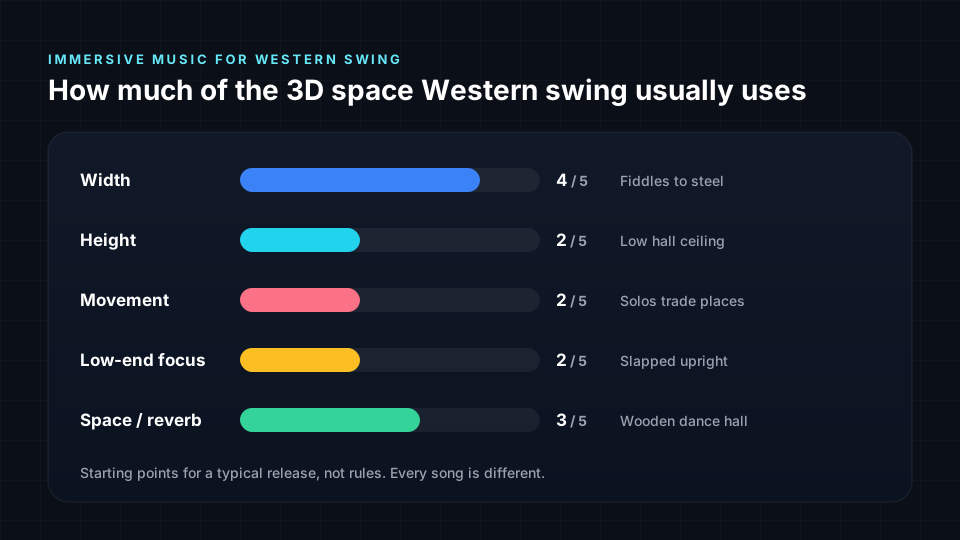
Width scores 4 because the band is a long line of lead instruments. Space scores 3: dance halls are lively, but the sound should stay close and warm. Height is low, coming only from the hall above the band. Low-end focus is modest because the upright bass carries a light pulse, not heavy bass. Movement stays low because the motion comes from solos passing between players.
Tips for an immersive Western swing mix
- Seat the band as it played. Copy a real bandstand layout, with fiddles and steel at the front on either side of the singer.
- Split the fiddles from the steel. They share a range, so opposite sides keep both lines clear.
- Let solos come from their players. Do not fly a break around the room; keep each soloist in place.
- Keep the bass light and centred. The two-beat feel needs a steady, unmoving bottom end.
- Use a warm wooden room. A short, bright dance hall reverb suits the style better than a long hall.
Western Swing styles: Texas swing, cowboy jazz and honky-tonk swing
The core placement holds for every Western swing style: singer and bass in the middle, lead instruments across the bandstand. What changes is the size of the band, the role of the horns and how loud and electric the sound becomes.
Texas Swing
Texas swing is the dance hall sound of the 1930s and 1940s, played by large bands with fiddles, steel, guitars, piano, drums and often a horn section for Saturday night crowds. Keep the twin or triple fiddles together as one section on the front left, the steel on the front right and any trumpets and saxes behind them as a second row. Keep the singer and the leader's hollers centred and close. Use a medium dance hall reverb with side reflections, and keep everything still.
Cowboy Jazz
Cowboy jazz is the name often given to the most jazz-leaning side of Western swing, where the fiddle, steel, electric guitar and piano take long improvised solos over swing rhythm, much like a small jazz combo. The band is smaller, so give each soloist a clear, separate spot in the front half and bring the current soloist slightly closer rather than moving them. Keep the rhythm guitar tight beside the bass in the centre. A smaller, drier room keeps the fast single-note lines crisp.
Honky-Tonk Swing
Honky-tonk swing blends Western swing with the harder honky-tonk country of the late 1940s and 1950s, with a louder electric band, a shuffle beat and songs about bars and heartbreak. The vocal is the focus, so keep it centred, close and fairly dry. Place steel and fiddle on opposite sides, with guitar and piano further out. Bring the drums and snare forward slightly compared with older Texas swing, and use a shorter, punchier room, like a crowded bar rather than a ballroom.
Related styles such as modern Texas dance hall country follow the same idea: centre the singer and bass, then give each lead its own place.
How to make immersive Western swing from stereo
Spatial9 can create spatial audio from a stereo track in a few steps:
- Upload your stereo master or your stems.
- Spatial9's AI separates and places each part, pulling the singer, fiddles, steel guitar, piano and rhythm section apart even from old mono recordings and setting them across a natural dance hall bandstand.
- Preview it in binaural on headphones.
- Export Eclipsa Audio, ADM, binaural or Ambisonics.
- Publish a video. Create a YouTube-ready video with your immersive audio and publish it directly.
For related guides, read spatial audio for country and spatial audio for big band. Every guide is listed in spatial audio and immersive music by genre.
Frequently asked questions
Does this guide cover Texas swing, cowboy jazz and honky-tonk swing?
Yes. Texas swing seats a large band with fiddles, steel and horns across a wide dance hall stage. Cowboy jazz uses a smaller, drier room with a clear spot for each soloist. Honky-tonk swing puts a close, dry vocal in front with steel and fiddle on either side.
Can I make a Western swing mix in Dolby Atmos or Eclipsa Audio?
Yes. The placements in this guide work for both. Spatial9 exports ADM, the standard file used by Dolby Atmos studios, as well as Eclipsa Audio for YouTube, so one immersive Western swing mix covers both. If you plan to release the Atmos version on Apple Music, build it from your original stems or multitracks, because Apple does not accept Atmos made from a finished stereo master. See where to publish spatial audio. You may also hear this called a 3D Western swing mix or Western swing in spatial audio.
Is spatial audio good for Western swing?
Yes. Western swing is built on several lead instruments taking turns and playing together. Spatial audio gives each of them its own direction, so every break is easier to follow.
How is Western swing different from big band in spatial audio?
A big band spreads whole sections of brass and reeds across a large stage with a lot of hall sound. Western swing is built around strings, so fiddles and steel take the front, the room is smaller and warmer, and any horns sit behind.
Where should the steel guitar go in an immersive Western swing mix?
Put it on the front side opposite the fiddles, at roughly the same distance, so the two lead sounds answer each other across the stage. Keep it still, even during long solos.
Can I convert an old mono Western swing recording to spatial audio?
Yes. Spatial9 uses AI to separate the singer, fiddles, steel guitar, piano and rhythm section from a mono or early stereo master and place them on a natural bandstand. With 1930s and 1940s recordings separation is never perfect, so keep the layout simple and still, like one band in one room.
Does immersive Western swing work on normal headphones?
Yes. The mix is rendered binaurally, so the wide bandstand and the dance hall work on any regular headphones.
Dolby and Dolby Atmos are trademarks of Dolby Laboratories. Spatial9 is not affiliated with or endorsed by Dolby Laboratories.
Sources
- Blauert, J. (1997). Spatial Hearing: The Psychophysics of Human Sound Localization, revised edition. MIT Press. Low-frequency, elevation, distance and motion cues.
- Mills, A. W. (1958). On the minimum audible angle. Journal of the Acoustical Society of America, 30(4), 237-246.
- Hebrank, J. and Wright, D. (1974). Spectral cues used in the localization of sound sources on the median plane. Journal of the Acoustical Society of America, 56(6), 1829-1834.
- Bronkhorst, A. W. (2000). The cocktail party phenomenon: a review of research on speech intelligibility in multiple-talker conditions. Acta Acustica united with Acustica, 86, 117-128.
- Litovsky, R. Y., Colburn, H. S., Yost, W. A. and Guzman, S. J. (1999). The precedence effect. Journal of the Acoustical Society of America, 106(4), 1633-1654.
- Barron, M. and Marshall, A. H. (1981). Spatial impression due to early lateral reflections in concert halls. Journal of Sound and Vibration, 77(2), 211-232.
- Neuhoff, J. G. (1998). Perceptual bias for rising tones. Nature, 395, 123-124.
- Bregman, A. S. (1990). Auditory Scene Analysis: The Perceptual Organization of Sound. MIT Press.
Bring the dance hall home
Upload a track to Spatial9 and hear the fiddles, steel guitar and singer spread across a Texas bandstand in minutes. Then export it or publish it straight to YouTube.