
Spatial Audio & Immersive Music for Acid Jazz: Nu Jazz, Broken Beat & Jazztronica
Spatial9 Team · · 10 min read
Part of the series Spatial audio and immersive music by genre.
Key takeaways
- In a spatial acid jazz mix the lead vocal, kick and bass stay centred, while the Rhodes, horn section, wah guitar, drum break, congas and scratches spread around a club dance floor.
- Putting the Rhodes and the horn section on opposite sides of the front keeps two busy midrange parts clear, an effect known as spatial release from masking.
- Acid jazz mixes live players with samples and breaks, so the groove stays anchored in the middle while scratches and dub delays carry the motion around the room.
- The acid jazz immersion profile scores width 4, height 2, movement 3, low-end focus 4 and space 3 out of 5.
Acid jazz came out of the London club scene in the late 1980s, when DJs such as Gilles Peterson played rare groove, jazz funk and Latin jazz records to dancers who wanted something other than house. The name became a record label and then a movement, and by the early 1990s bands such as Jamiroquai, Incognito and The Brand New Heavies were mixing live jazz and funk playing with hip-hop beats, sampled breaks and soul vocals. Grooves usually sit between about 95 and 120 BPM, built on a funky bass line, a crisp break, Rhodes or organ chords, wah guitar, a tight horn section and plenty of congas. The sound sits between a live band and a DJ set, and that mix of played and sampled layers is exactly what spatial audio can pull apart. This guide covers how spatial audio for acid jazz works, where to place each element and how to make an immersive acid jazz mix. For the basics, see what spatial audio is.
Why acid jazz works in spatial audio
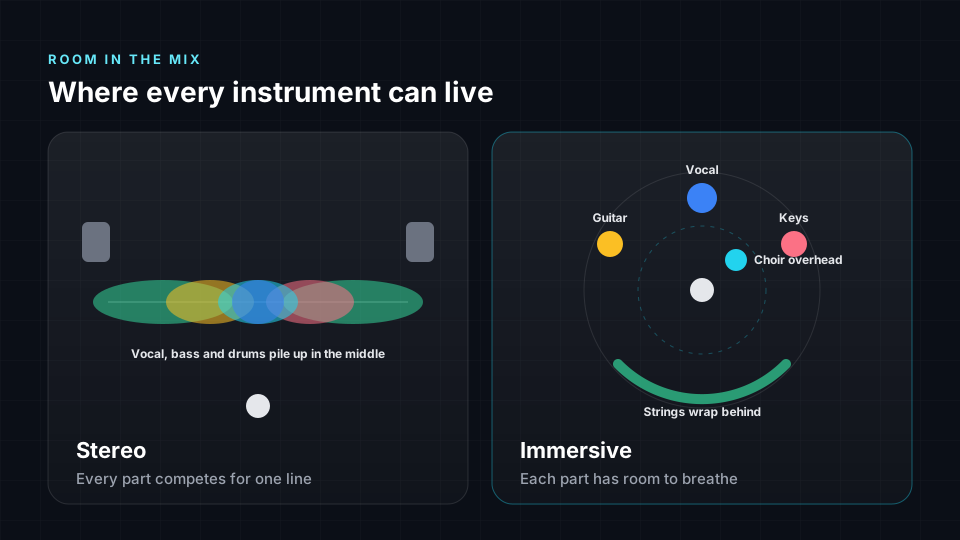
Acid jazz stacks a lot into the midrange: a singer, Rhodes chords, wah guitar, horn stabs, congas and sampled snippets, all on top of a busy break. In stereo these parts crowd the same space between the speakers, and the groove can turn into a wall. In an immersive mix the vocal, kick and bass hold the centre while the keys, horns, guitar and percussion each take their own side of the dance floor.
The rule: a centred vocal and groove, a band spread around the floor. Keep the vocal, kick and bass locked in the middle and let only the scratches and dub delays move.
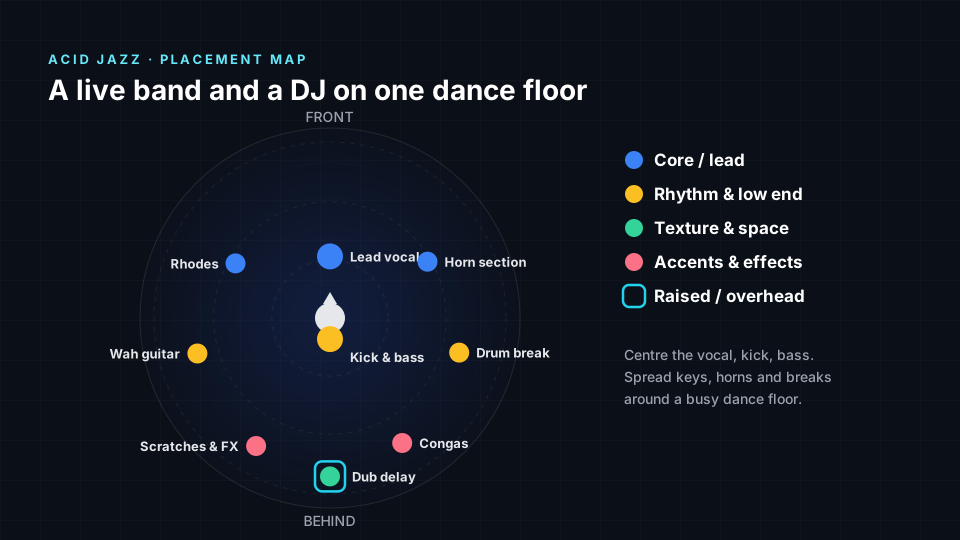
Immersive music for acid jazz: what listeners hear
- A voice right in front. The singer sits close and centred above the groove.
- A bass line you can dance to. Kick and bass stay solid in the middle on any system.
- A band on both sides. Rhodes on one side, horns on the other, guitar and break around you.
- Cuts and echoes behind. Scratches sweep across the back while dub delays float above.
Where to place each element in an acid jazz mix
| Element | Position | Height | Why it works |
|---|---|---|---|
| Lead vocal | Front centre | Ear level | The soulful hook the dance floor follows |
| Kick & bass | Centre | Ear level | The funky bass line and kick that drive the groove |
| Rhodes | Front left | Ear level | Jazz chords, comping and short solos |
| Horn section | Front right | Ear level | Unison riffs, stabs and solos |
| Drum break | Right | Ear level | Sampled or live breaks, hats and ghost notes |
| Wah guitar | Left | Ear level | Funky rhythm guitar in the gaps |
| Congas | Behind right | Ear level | Latin hand drums and shakers |
| Scratches & FX | Behind left, moving | Ear level | Turntable cuts and sampled snippets that sweep |
| Dub delay | Behind | Raised | Echoes and club space above the band |
The psychoacoustics behind acid jazz placement
Every position in the table above follows how the ear and brain locate sound. Here is the reason behind the main choices for acid jazz.
- Kick and bass stay centred. The ear finds almost no direction in frequencies below roughly 80 to 100 Hz, so the bass line and kick gain nothing from being spread. Keeping them centred and mono keeps the groove heavy on club speakers and earbuds alike.
- Rhodes and horns on opposite sides. Two sounds that share a frequency range mask each other far less when they arrive from different directions. This is spatial release from masking. Rhodes chords and horn stabs both live in the mids, so opposite sides keep each one clear.
- Break and wah guitar apart. The brain groups sounds into streams by pitch, timing and direction. This is auditory stream segregation (Bregman). With the break on one side and the guitar on the other, two busy sixteenth-note parts read as separate players.
- Dub delays above and behind. When a sound and its echoes arrive close together, the brain fixes its position by the first arrival. This is the precedence effect. A horn stab or vocal line stays in place while its delays trail away overhead.
The immersion profile for acid jazz
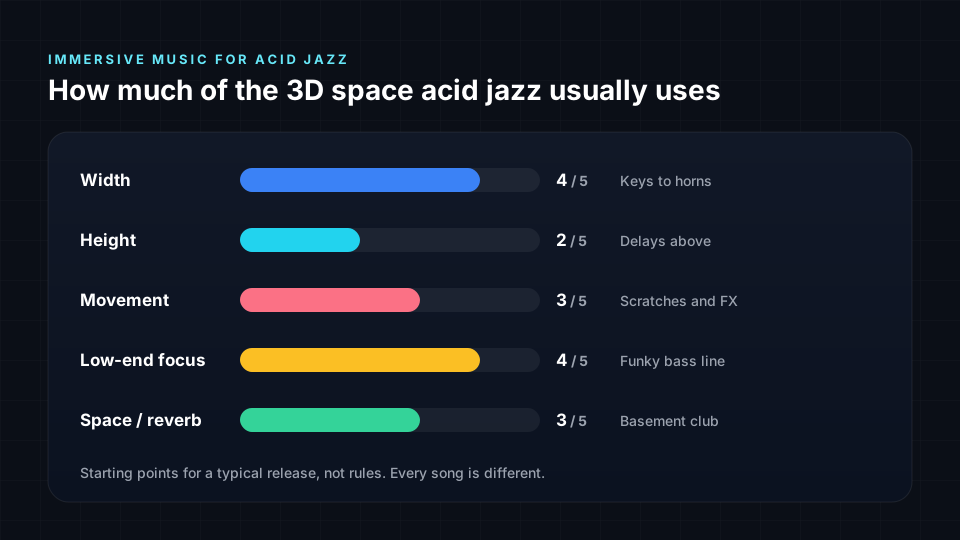
Low-end focus scores 4 because the bass line and kick carry the dance floor. Width scores 4: keys, horns, guitar and percussion all need their own side of the room. Movement scores 3, coming from scratches, sampled snippets and delays, while the players stay put. Space scores 3 for a warm basement club, and height stays low, with only the delays raised.
Tips for an immersive acid jazz mix
- Lock the groove first. Set the kick and bass centred and mono before placing anything else.
- Split the midrange players. Give Rhodes, horns and wah guitar their own directions.
- Keep the vocal close and dry. The hook has to cut through a busy band.
- Let samples do the moving. Scratches and snippets can sweep, but the live band should stand still.
- Use a club, not a hall. Short, warm reflections suit dance music better than long reverb.
Acid Jazz styles: nu jazz, broken beat and jazztronica
The core placement holds for every acid jazz style: vocal, kick and bass in the middle, players and samples around them. What changes is how electronic the production is and how complex the rhythm gets.
Nu Jazz
Nu jazz grew in the late 1990s and 2000s, when producers in Europe blended jazz harmony and live solos with electronic production, deep house and downtempo beats. Albums such as St Germain's Tourist made the sound widely known. Tracks are often built around a loop with a solo trumpet, sax or flute over the top. Keep the soloist front centre and close, the kick and bass centred, and spread pads and sampled textures wide and slightly raised. Let filtered loops and delay throws move gently, but keep the live soloist still so the listener can follow the line.
Broken Beat
Broken beat, often called bruk, came from West London in the late 1990s and early 2000s, mixing jazz chords, soul vocals and funk with complex, shuffled rhythms that skip around the bar. The drums are the star, so treat them as several parts: keep the kick centred with the bass, put snares and claps slightly to one side and spread hats, shakers and ghost notes around the front and sides. Rhodes and synth chords go wide at the front. Keep the vocal centred and dry. Avoid big reverbs, because the rhythm needs to stay crisp.
Jazztronica
Jazztronica is a name used, especially in Japan in the 2000s, for jazz played through an electronica lens: live piano and horns over programmed beats, house rhythms and glossy synths. The mix is clean and bright. Keep the piano or horn lead front centre with the bass and kick underneath, set synths and strings wide at the sides and let arpeggios or filtered effects move slowly around the back. A slightly larger, polished room suits the style better than the dusty basement of early acid jazz.
Related styles such as jazz funk, rare groove and trip-hop follow the same idea: lock the vocal and groove, then give keys, horns and samples their own places around the floor.
How to make immersive acid jazz from stereo
Spatial9 can create spatial audio from a stereo track in a few steps:
- Upload your stereo master or your stems.
- Spatial9's AI separates and places each part, locking the vocal, kick and bass in the centre and sending the Rhodes, horns, guitar, percussion and scratches around a club dance floor.
- Preview it in binaural on headphones.
- Export Eclipsa Audio, ADM, binaural or Ambisonics.
- Publish a video. Create a YouTube-ready video with your immersive audio and publish it directly.
For related guides, read spatial audio for soul jazz and spatial audio for trip-hop. Every guide is listed in spatial audio and immersive music by genre.
Frequently asked questions
Does this guide cover nu jazz, broken beat and jazztronica?
Yes. Nu jazz keeps a live soloist close over wide, slightly raised pads and loops. Broken beat splits the complex drums into several positions around the front and sides with a dry mix. Jazztronica places a clean piano or horn lead in front with synths wide and gentle movement behind.
Can I make an acid jazz mix in Dolby Atmos or Eclipsa Audio?
Yes. The placements in this guide work for both. Spatial9 exports ADM, the standard file used by Dolby Atmos studios, as well as Eclipsa Audio for YouTube, so one immersive acid jazz mix covers both. If you plan to release the Atmos version on Apple Music, build it from your original stems or multitracks, because Apple does not accept Atmos made from a finished stereo master. See where to publish spatial audio. You may also hear this called a 3D acid jazz mix or acid jazz in spatial audio.
Is spatial audio good for acid jazz?
Yes. Acid jazz layers vocals, keys, horns, guitar, percussion and samples over a funky groove. Spatial audio keeps the groove solid in the middle while giving every player and sample its own place.
How is acid jazz different from jazz fusion in spatial audio?
Jazz fusion is built around virtuoso soloists and long, complex arrangements, so the mix gives the solos room and space to move. Acid jazz is dance music first: the kick, bass and vocal hook stay locked and tight, the solos are shorter and the motion comes from samples and effects rather than the players.
Should the drum break be centred in an immersive acid jazz mix?
Keep the kick centred with the bass, but you can set the rest of the break, hats, snare and ghost notes, slightly to one side. That frees the centre for the vocal while the groove stays anchored by the kick.
Can I convert a finished acid jazz track to spatial audio?
Yes. Spatial9 uses AI to separate the vocal, bass, drums, keys and horns from a stereo master and place them in an immersive mix. Most acid jazz was made in stereo in the 1990s, so separation is usually clean, but tracks built from older jazz samples may keep some of the sample's original room.
Does immersive acid jazz work on normal headphones?
Yes. The mix is rendered binaurally, so the groove, horns and dub delays work on any regular headphones.
Dolby and Dolby Atmos are trademarks of Dolby Laboratories. Spatial9 is not affiliated with or endorsed by Dolby Laboratories.
Sources
- Blauert, J. (1997). Spatial Hearing: The Psychophysics of Human Sound Localization, revised edition. MIT Press. Low-frequency, elevation, distance and motion cues.
- Mills, A. W. (1958). On the minimum audible angle. Journal of the Acoustical Society of America, 30(4), 237-246.
- Hebrank, J. and Wright, D. (1974). Spectral cues used in the localization of sound sources on the median plane. Journal of the Acoustical Society of America, 56(6), 1829-1834.
- Bronkhorst, A. W. (2000). The cocktail party phenomenon: a review of research on speech intelligibility in multiple-talker conditions. Acta Acustica united with Acustica, 86, 117-128.
- Litovsky, R. Y., Colburn, H. S., Yost, W. A. and Guzman, S. J. (1999). The precedence effect. Journal of the Acoustical Society of America, 106(4), 1633-1654.
- Barron, M. and Marshall, A. H. (1981). Spatial impression due to early lateral reflections in concert halls. Journal of Sound and Vibration, 77(2), 211-232.
- Neuhoff, J. G. (1998). Perceptual bias for rising tones. Nature, 395, 123-124.
- Bregman, A. S. (1990). Auditory Scene Analysis: The Perceptual Organization of Sound. MIT Press.
Get the band back on the floor
Upload a track to Spatial9 and hear keys, horns and breaks spread around a deep, funky groove in minutes. Then export it or publish it straight to YouTube.