Spatial Audio & Immersive Music for Folk: Complete Guide
Spatial9 Team · · Updated
Part of the series Spatial audio and immersive music by genre.
Folk is music played by people in a room together. Acoustic instruments, close harmonies and the sound of wood and air. In stereo, a folk band often sounds like a photograph of the session. In spatial audio, you are sitting in the middle of it, with each player in their own chair. This guide covers how spatial audio for folk works, where to place each element and how to make immersive folk music from a stereo track. For the basics, see what spatial audio is.
Why folk benefits from spatial audio
Folk is natural and acoustic, and spatial audio is very good at natural sound. Instead of pushing everything to the front, you can place each musician around the listener the way real players sit in a circle.
The rule: place players, not effects. Keep it real, natural and unprocessed.
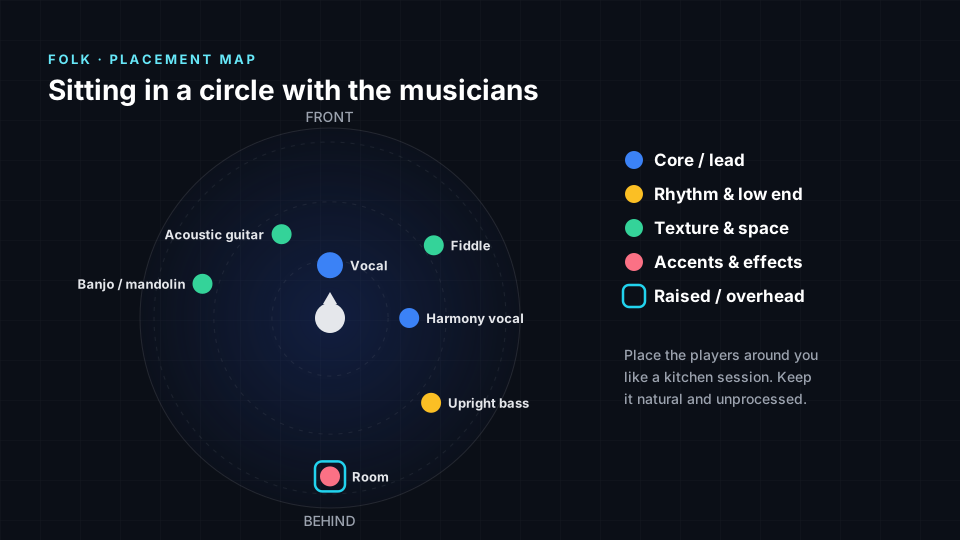
Immersive music for folk: what listeners hear
- A singer right in front of you. The lead vocal is close and honest.
- Players around you. Guitar, banjo, fiddle and bass each come from their own chair.
- Harmonies beside you. A harmony voice from the side feels like a friend singing along.
- The sound of the room. Wooden reflections surround you gently.
Where to place each element in a folk mix
| Element | Position | Height | Why it works |
|---|---|---|---|
| Vocal | Front centre | Ear level | Honest and close |
| Acoustic guitar | Front left | Ear level | The core of the song |
| Banjo or mandolin | Left side | Ear level | Bright texture |
| Fiddle | Front right | Ear level | Melodic answers |
| Harmony vocal | Right side | Ear level | Like a singer beside you |
| Upright bass | Behind right | Ear level | Warm and woody |
| Room | All around, behind | Slightly raised | Natural space |
The psychoacoustics behind folk placement
Every position in the table above follows how the ear and brain locate sound. Here is the reason behind the main choices for folk.
- Vocal in front. Hearing is sharpest straight ahead: listeners can tell apart sources about 1 degree apart in front of them, but need far larger gaps at the sides (Mills, 1958). Folk is about the words, so the voice gets the clearest position.
- Guitar and banjo left, fiddle right. Sounds that overlap in pitch mask each other less when they arrive from different directions, so spreading them keeps every part clear without extra EQ. Acoustic instruments share the same range, and direction keeps each one audible.
- Harmony vocal on the right. The brain groups sounds that come from the same place into one stream and splits sounds from different places into separate ones (Bregman, 1990). A separate position keeps the harmony a second voice instead of blending into the lead.
- Room all around. Thanks to the precedence effect, early reflections from a room do not pull a source sideways. They are heard as size and space around it. Natural reflections add the feeling of a live session without blurring the players.
The immersion profile for folk
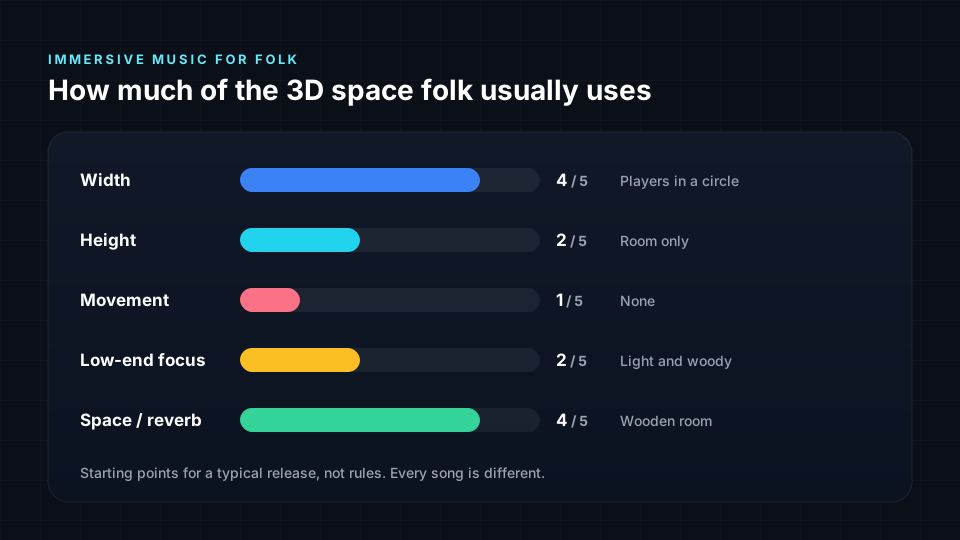
Folk scores high on width and space but low on height, movement and low end. The magic is in the natural placement of real players.
Tips for an immersive folk mix
- Picture the circle. Decide where each player sits before you place anything.
- Keep effects minimal. Natural rooms beat artificial reverbs.
- Use the sides. Folk can wrap fully around the listener without feeling strange.
- Keep the bass light. A woody upright bass should support, not dominate.
- Do not move anything. Players stay in their chairs.
How to make immersive folk music from stereo
Spatial9 can create spatial audio from a stereo track in a few steps:
- Upload your stereo master or your stems.
- Spatial9's AI separates each acoustic instrument and seats it around the listener.
- Preview it in binaural on headphones.
- Export Eclipsa Audio, ADM, binaural or Ambisonics.
- Publish a video. Create a YouTube-ready video with your immersive audio and publish it directly.
For related guides, read spatial audio for country and spatial audio for indie. Every guide is listed in spatial audio and immersive music by genre.
Frequently asked questions
Can I make a folk mix in Dolby Atmos or Eclipsa Audio?
Yes. The placements in this guide work for both. Spatial9 exports ADM, the standard file used by Dolby Atmos studios, as well as Eclipsa Audio for YouTube, so one immersive folk mix covers both. You may also hear this called a 3D folk mix or folk in spatial audio. It is the same idea.
Is spatial audio good for folk music?
Yes. Folk is acoustic and natural, and spatial audio can place each player around the listener like a live session.
Can a solo acoustic song be made immersive?
Yes. Even a voice and guitar benefit from a natural room around the listener and a little separation between the two.
Should folk use height in spatial audio?
Only a little, for the room. Instruments stay at ear level, where seated players would be.
Will spatial audio make folk sound over-produced?
Not if you keep it natural. Placing players in a circle sounds more real, not less.
Does immersive folk work on regular headphones?
Yes. Devices render the mix binaurally, so the 3D effect works on any regular headphones.
Dolby and Dolby Atmos are trademarks of Dolby Laboratories. Spatial9 is not affiliated with or endorsed by Dolby Laboratories.
Sources
- Blauert, J. (1997). Spatial Hearing: The Psychophysics of Human Sound Localization, revised edition. MIT Press. Low-frequency, elevation, distance and motion cues.
- Mills, A. W. (1958). On the minimum audible angle. Journal of the Acoustical Society of America, 30(4), 237-246.
- Hebrank, J. and Wright, D. (1974). Spectral cues used in the localization of sound sources on the median plane. Journal of the Acoustical Society of America, 56(6), 1829-1834.
- Bronkhorst, A. W. (2000). The cocktail party phenomenon: a review of research on speech intelligibility in multiple-talker conditions. Acta Acustica united with Acustica, 86, 117-128.
- Litovsky, R. Y., Colburn, H. S., Yost, W. A. and Guzman, S. J. (1999). The precedence effect. Journal of the Acoustical Society of America, 106(4), 1633-1654.
- Barron, M. and Marshall, A. H. (1981). Spatial impression due to early lateral reflections in concert halls. Journal of Sound and Vibration, 77(2), 211-232.
- Neuhoff, J. G. (1998). Perceptual bias for rising tones. Nature, 395, 123-124.
- Bregman, A. S. (1990). Auditory Scene Analysis: The Perceptual Organization of Sound. MIT Press.
Pull up a chair in 3D
Upload a song to Spatial9 and hear your players sit around you in minutes. Then export it or publish it straight to YouTube.