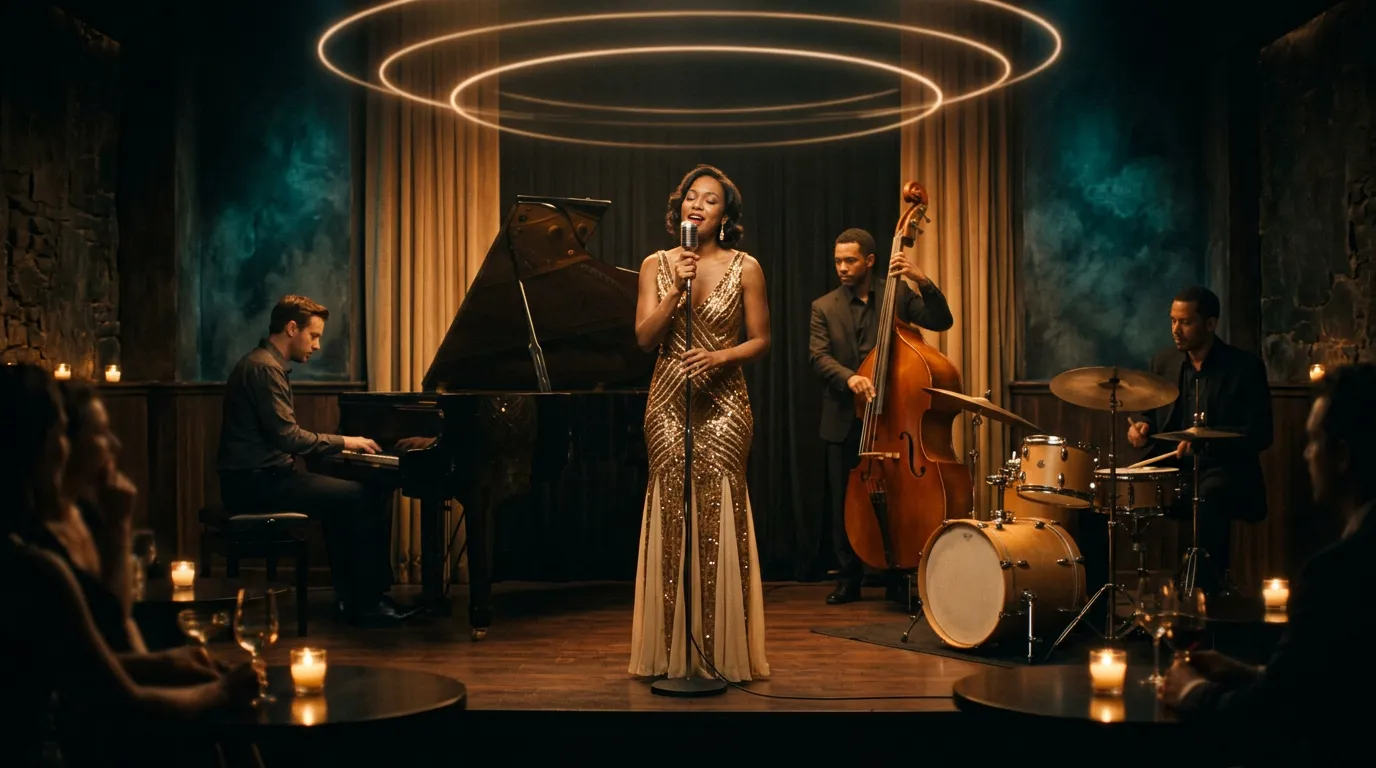
Spatial Audio & Immersive Music for Vocal Jazz: Jazz Standards, Scat & Crooner Ballads
Spatial9 Team · · 10 min read
Part of the series Spatial audio and immersive music by genre.
Key takeaways
- In a spatial vocal jazz mix the singer stays close and centred, with the upright bass anchored beneath, while piano, guitar, brushed drums and a sax obbligato sit in a calm arc around the voice and almost nothing moves.
- Placing the piano and the horn away from the voice lets the listener hear the lyric clearly even when the accompaniment plays in the same range, an effect known as spatial release from masking.
- Vocal jazz should feel like a small band in one room, so the room is the main source of immersion, not wide panning or moving objects.
- The vocal jazz immersion profile scores width 3, height 2, movement 1, low-end focus 2 and space 3 out of 5.
Vocal jazz grew up alongside the music itself. In the 1920s Louis Armstrong and Bessie Smith showed how a singer could swing and bend a melody, and the arrival of electrical microphone recording in 1925 made a softer, closer style of singing possible. From the 1930s to 1950s singers such as Billie Holiday, Ella Fitzgerald and Frank Sinatra made the Great American Songbook the core of the repertoire. The sound is a voice in front of piano, upright bass and brushed drums, sometimes with guitar, sax or strings. Tempos run from slow ballads around 60 to 80 BPM to medium and fast swing well above 160 BPM. Most classic recordings are mono, and early stereo often put the band on one side and the singer on the other. This guide covers how spatial audio for vocal jazz works, where to place each element and how to make an immersive vocal jazz mix. For the basics, see what spatial audio is.
Why vocal jazz works in spatial audio
Vocal jazz is about intimacy. The listener should feel the singer is close, phrasing each word for them, while the band breathes quietly around the voice. Hard-panned early stereo pulls the voice away from the centre. An immersive mix puts the voice right in front of you, sets the trio a little further back in a calm arc and lets a warm room surround everything, so the song feels like a live set in a small club.
The rule: a close, centred voice with a quiet trio arc behind it. Nothing needs to move: the voice, bass and trio stay fixed, and only the room gives the sense of space.
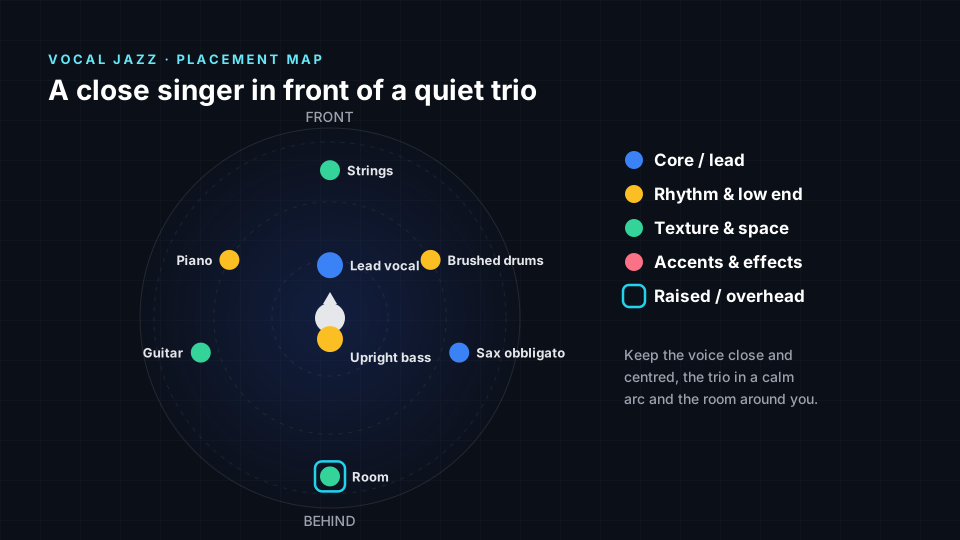
Immersive music for vocal jazz: what listeners hear
- A singer right in front of you. Every breath and consonant sits close and centred.
- A trio that never crowds the lyric. Piano and drums sit to the sides, a little further back.
- Answers from the side. The sax or guitar replies between vocal lines from its own place.
- A room you could sit in. The club or studio wraps quietly around the band.
Where to place each element in a vocal jazz mix
| Element | Position | Height | Why it works |
|---|---|---|---|
| Lead vocal | Front centre, close | Ear level | The singer and the lyric, the heart of the song |
| Upright bass | Centre | Ear level | Walking lines and ballad roots under the voice |
| Piano | Front left | Ear level | Chords, fills and the introduction |
| Brushed drums | Front right | Ear level | Brushes on the snare and a soft ride |
| Guitar | Left | Ear level | Quiet comping and chord melody |
| Sax obbligato | Right | Ear level | Answering phrases between the vocal lines |
| Strings | Front, back row | Ear level | A soft pad on orchestral ballads |
| Room | Behind | Raised | The club or studio around the band |
The psychoacoustics behind vocal jazz placement
Every position in the table above follows how the ear and brain locate sound. Here is the reason behind the main choices for vocal jazz.
- Bass stays centred. The ear finds almost no direction in frequencies below roughly 80 to 100 Hz, so the low end of the upright bass gains nothing from being spread. Keeping it centred keeps the walking line steady under the voice.
- Voice and piano kept apart. Two sounds in the same range mask each other far less when they arrive from different directions. This is spatial release from masking. Moving the piano to the side keeps every word clear during busy fills.
- A close voice in front. The smallest change in direction we can detect is about one degree in front but much larger at the sides and behind. This is the minimum audible angle (Mills). Putting the singer at the front, where hearing is sharpest, makes the voice feel precise and present.
- A warm room, not wide panning. Early reflections from the sides make a space sound wide and enveloping. This is the link between lateral reflections and spaciousness (Barron and Marshall). A natural room gives width without pulling the band apart.
The immersion profile for vocal jazz
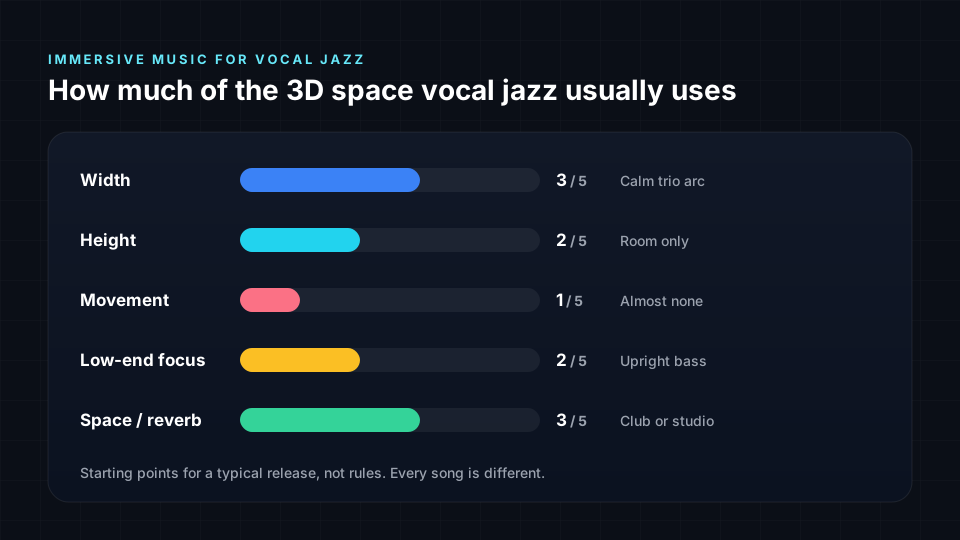
Width is moderate: the trio forms a calm arc. Height is low, with only the room rising. Movement is at the minimum, since a moving voice or piano would break the intimacy. Low-end focus is modest, with an acoustic upright bass rather than a heavy sub, and space sits in the middle to suit a small club or studio.
Tips for an immersive vocal jazz mix
- Keep the singer close. A dry, near voice at front centre is the whole point of the style.
- Do not move anything. A still band lets the listener settle into the song.
- Give the piano its own side. This keeps fills and comping clear of the lyric.
- Let the room do the work. A warm, natural reverb gives more immersion than extreme panning.
- Treat strings as a backdrop. Keep them soft and behind the band, never louder than the voice.
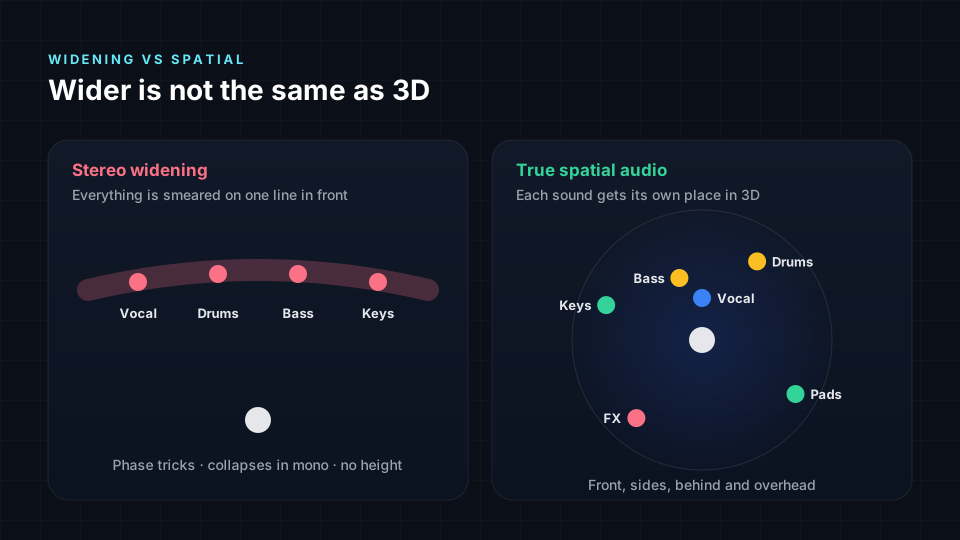
Vocal Jazz styles: jazz standards, scat and crooner ballads
The core placement holds for every vocal jazz style: voice close and centred, bass under it, trio in a calm arc. What changes is how busy the band is and how much the voice acts like an instrument.
Jazz Standards
Jazz standards are the songs of the Great American Songbook, from Gershwin, Porter and Ellington, sung in a swinging small group setting. Bring the singer back to front centre and keep the voice close and dry. Put the piano front left and the brushed drums front right, with the bass centred underneath. Keep a medium club room around the band and let nothing move during the song.
Scat
Scat singing uses wordless syllables to improvise like a horn, a technique popularised by Louis Armstrong on "Heebie Jeebies" in 1926 and taken to new heights by Ella Fitzgerald. The voice trades phrases with the band, often at fast tempos. Keep the singer at front centre but a touch further back than on a ballad, closer to the horn players. Put the trading instrument, often a trumpet or sax, on one side so the call and response is easy to follow. Keep the drums tight and the bass centred, and use a slightly livelier room for the energy of a live set.
Crooner Ballads
Crooner ballads come from singers such as Bing Crosby, Nat King Cole and Frank Sinatra, who used the microphone to sing softly and intimately, often over lush strings. Place the voice very close and centred, almost at the listener, with plenty of detail and little reverb on the voice itself. Set the strings in a soft wide band at the back of the stage and keep the piano and guitar quiet to the sides. Use a warm, slightly larger room or studio sound so the orchestra feels like a backdrop and never moves.
Related styles such as torch songs, vocalese and lounge follow the same idea: keep the voice close and centred, the band in a calm arc and the room around you.
How to make immersive vocal jazz from stereo
Spatial9 can create spatial audio from a stereo track in a few steps:
- Upload your stereo master or your stems.
- Spatial9's AI separates and places each part, keeping the singer close and centred and pulling piano, bass, drums and horns apart, even from old mono or hard-panned early stereo masters, into a calm arc behind the voice.
- Preview it in binaural on headphones.
- Export Eclipsa Audio, ADM, binaural or Ambisonics.
- Publish a video. Create a YouTube-ready video with your immersive audio and publish it directly.
For related guides, read spatial audio for jazz and spatial audio for big band. Every guide is listed in spatial audio and immersive music by genre.
Frequently asked questions
Does this guide cover jazz standards, scat and crooner ballads?
Yes. Jazz standards keep a close, centred singer over a small trio arc. Scat moves the voice slightly back towards the horns and puts the trading instrument on one side. Crooner ballads bring the voice very close and set soft strings in a wide band behind.
Can I make a vocal jazz mix in Dolby Atmos or Eclipsa Audio?
Yes. The placements in this guide work for both. Spatial9 exports ADM, the standard file used by Dolby Atmos studios, as well as Eclipsa Audio for YouTube, so one immersive vocal jazz mix covers both. If you plan to release the Atmos version on Apple Music, build it from your original stems or multitracks, because Apple does not accept Atmos made from a finished stereo master. See where to publish spatial audio. You may also hear this called a 3D vocal jazz mix or vocal jazz in spatial audio.
Is spatial audio good for vocal jazz?
Yes, when it is kept natural. Spatial audio puts the singer right in front of you with the band in its own space, so the lyric is easier to follow.
How is vocal jazz different from smooth jazz in spatial audio?
Smooth jazz is mostly instrumental and polished, with electric keys, synth pads and programmed or tight drums that can spread wider and use a little more movement. Vocal jazz keeps an acoustic band, a close voice and almost no movement, so the room matters more than width.
Should the singer have reverb in an immersive vocal jazz mix?
Only a little. Keep the voice itself close and fairly dry so it stays intimate, and let the room reverb sit mostly around the band. Too much reverb on the voice pushes the singer away from the listener.
Can I convert an old mono vocal jazz recording to spatial audio?
Yes. Spatial9 uses AI to separate a mono or early stereo master and generate an immersive mix. On 1940s and 1950s records the bleed between voice and band will not separate perfectly, so keep the layout natural, like a small band in one room, and avoid any movement.
Does immersive vocal jazz work on normal headphones?
Yes. The mix is rendered binaurally, so the close voice, the trio arc and the room work on any regular headphones.
Dolby and Dolby Atmos are trademarks of Dolby Laboratories. Spatial9 is not affiliated with or endorsed by Dolby Laboratories.
Sources
- Blauert, J. (1997). Spatial Hearing: The Psychophysics of Human Sound Localization, revised edition. MIT Press. Low-frequency, elevation, distance and motion cues.
- Mills, A. W. (1958). On the minimum audible angle. Journal of the Acoustical Society of America, 30(4), 237-246.
- Hebrank, J. and Wright, D. (1974). Spectral cues used in the localization of sound sources on the median plane. Journal of the Acoustical Society of America, 56(6), 1829-1834.
- Bronkhorst, A. W. (2000). The cocktail party phenomenon: a review of research on speech intelligibility in multiple-talker conditions. Acta Acustica united with Acustica, 86, 117-128.
- Litovsky, R. Y., Colburn, H. S., Yost, W. A. and Guzman, S. J. (1999). The precedence effect. Journal of the Acoustical Society of America, 106(4), 1633-1654.
- Barron, M. and Marshall, A. H. (1981). Spatial impression due to early lateral reflections in concert halls. Journal of Sound and Vibration, 77(2), 211-232.
- Neuhoff, J. G. (1998). Perceptual bias for rising tones. Nature, 395, 123-124.
- Bregman, A. S. (1990). Auditory Scene Analysis: The Perceptual Organization of Sound. MIT Press.
Bring the singer back to the front
Upload a track to Spatial9 and hear the voice step forward with the trio around it in minutes. Then export it or publish it straight to YouTube.