Spatial Audio & Immersive Music for Celtic Folk: Irish Trad, Scottish Folk & Celtic Rock
Spatial9 Team · · 10 min read
Part of the series Spatial audio and immersive music by genre.
Key takeaways
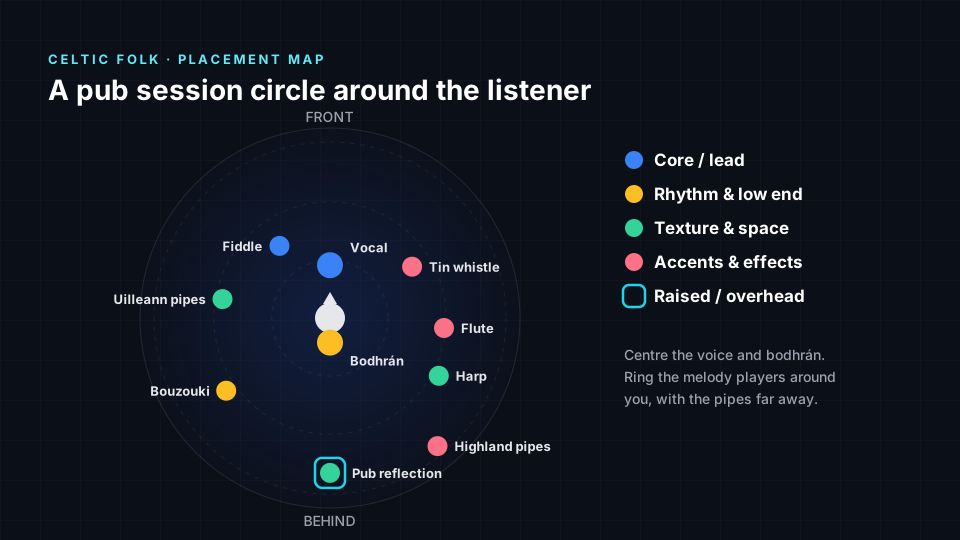
- In a spatial Celtic folk mix the voice and the bodhrán stay centred, while the fiddle, tin whistle, uilleann pipes, flute, bouzouki and harp sit in a circle around the listener like a pub session.
- Giving each melody player their own direction lets the ear follow several instruments playing the same tune with different ornaments, an effect known as auditory stream segregation.
- Celtic folk lives in lively pubs and halls, so the room should be warm and reflective, with loud Highland pipes placed far back rather than close to the listener.
- The Celtic folk immersion profile scores width 4, height 2, movement 2, low-end focus 2 and space 4 out of 5.
Celtic folk is the traditional music of Ireland and Scotland, with close cousins in Brittany, Galicia, Wales and Cape Breton. Its core is dance music: jigs in 6/8, reels in 4/4, hornpipes, polkas and, in Scotland, the strathspey, usually two-part tunes strung together in sets. Alongside sit slow airs, ballads and unaccompanied sean-nós singing in Irish. The melody instruments are fiddle, tin whistle, wooden flute, uilleann pipes (the bellows-blown pipes of Ireland), button accordion and concertina, with the harp as an old national instrument. The Great Highland bagpipe is Scotland's loud outdoor pipe. The folk revival of the 1960s and 1970s added the bodhrán, a frame drum played with a stick, and the bouzouki, adapted from Greek music as an accompanying instrument. The earliest commercial records came from Irish musicians in America in the 1920s on mono 78s. Celtic folk suits spatial audio because its natural home, the pub session, is a circle of players with the listener inside it. This guide covers how spatial audio for Celtic folk works, where to place each element and how to make an immersive Celtic folk mix. For the basics, see what spatial audio is.
Why Celtic folk works in spatial audio
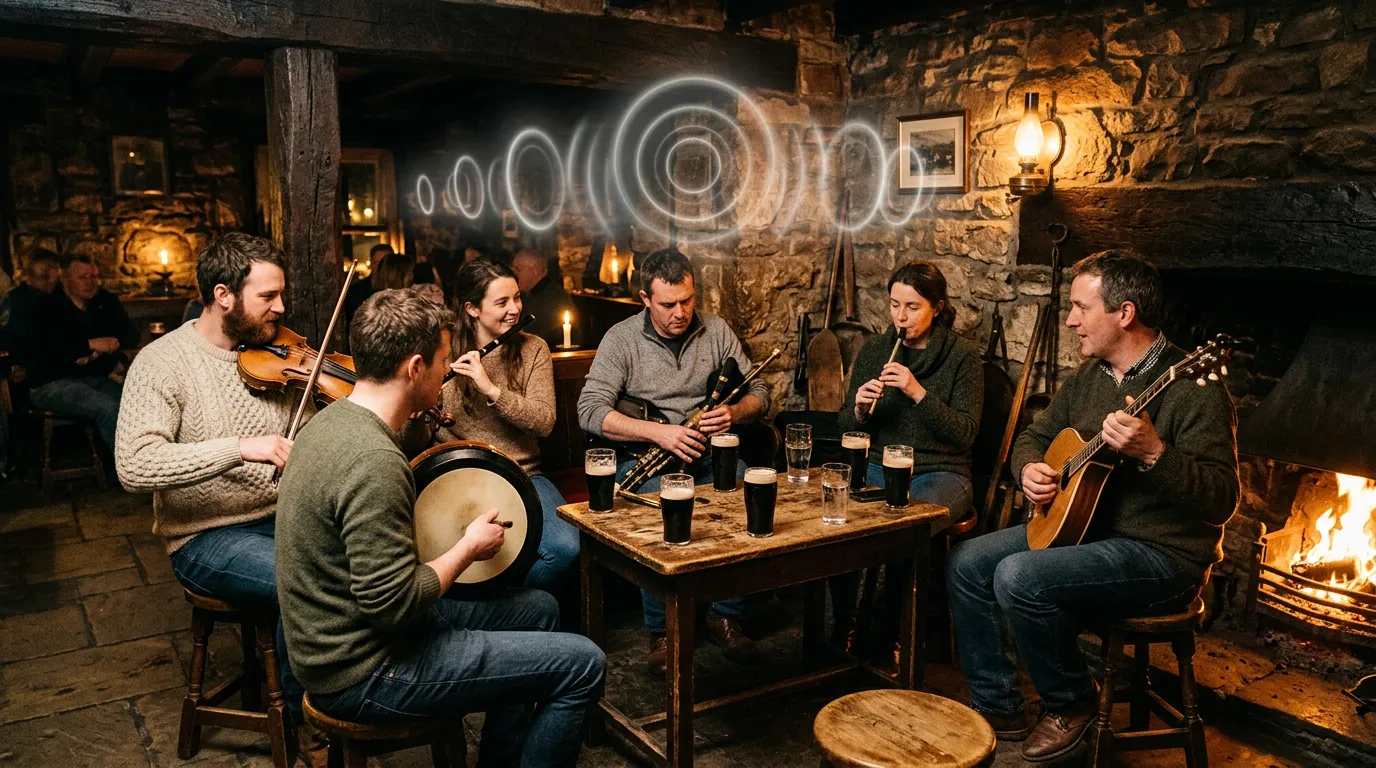
Celtic folk is played in a circle. At a session the musicians sit around a table and play the same tune together, each adding their own cuts and rolls. In mono these unison lines fuse into one thick melody. In an immersive mix the voice and bodhrán hold the centre while the melody instruments ring the listener at a similar distance, so each ornament comes from its own seat at the table.
The rule: a centred voice and bodhrán, melody players all around you. Seat the instruments in a wide circle at conversational distance, keep the pipes that need room far away, and use a lively room with plenty of side reflections.
Immersive music for Celtic folk: what listeners hear
- A seat in the session. The players surround you, each at their own place around the table.
- Every ornament in its place. Fiddle rolls, whistle cuts and pipe crans come from separate directions.
- A drum that drives the dance. The bodhrán sits close and central, pushing the jigs and reels along.
- A lively room with pipes in the distance. Warm reflections fill the pub, and the Highland pipes ring from far away.
Where to place each element in a Celtic folk mix
| Element | Position | Height | Why it works |
|---|---|---|---|
| Vocal | Front centre | Ear level | Songs, ballads and sean-nós singing up close |
| Bodhrán | Centre | Ear level | The frame drum pulse under the dance tunes |
| Fiddle | Front left | Ear level | The lead melody voice of the session |
| Tin whistle | Front right, moving slightly | Ear level | Bright ornaments above the other instruments |
| Uilleann pipes | Left | Ear level | Chanter, drones and regulators with a soft, reedy tone |
| Flute | Right | Ear level | Breathy wooden flute doubling the tune |
| Bouzouki | Behind left | Ear level | Chordal drive and open drones |
| Harp | Behind right | Ear level | Plucked arpeggios and slow airs |
| Highland pipes | Far behind right | Ear level | A loud outdoor instrument that needs distance |
| Pub reflection | Behind | Raised | A lively, low-ceilinged room around the circle |
The psychoacoustics behind Celtic folk placement
Every position in the table above follows how the ear and brain locate sound. Here is the reason behind the main choices for Celtic folk.
- Bodhrán stays centred. The ear finds almost no direction in frequencies below roughly 80 to 100 Hz, so the deep body of the bodhrán gains nothing from being spread.
- Unison players in separate seats. The brain groups sounds into streams by pitch, timing and direction. This is auditory stream segregation (Bregman). When the fiddle, flute and whistle play the same tune, giving each its own direction lets the ear hear three players with three sets of ornaments instead of one blurred line.
- Voice and fiddle slightly apart. Two sounds that share a frequency range mask each other far less when they arrive from different directions. This is spatial release from masking. The fiddle often shadows the singer, so a small angle keeps the words clear.
- A lively room with side reflections. Early reflections arriving from the sides make a sound feel wider and more enveloping. This is spatial impression from early lateral reflections (Barron and Marshall). They give the session its warm feel without smearing fast reels.
The immersion profile for Celtic folk
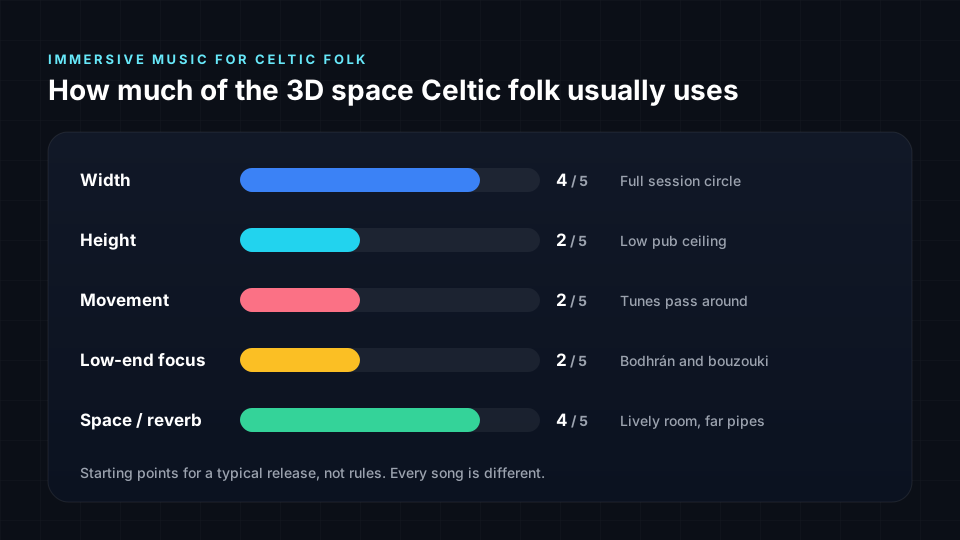
Width scores 4 because the session surrounds the listener. Space also scores 4: the music needs a lively room, and outdoor pipes need distance. Low-end focus is 2, since the bodhrán and bouzouki give pulse rather than heavy bass. Height is low, with only a light ceiling reflection. Movement scores 2, from the tune passing between players and the whistle's slight sway.
Tips for an immersive Celtic folk mix
- Keep the voice front and centre. In songs and ballads the story comes first, so the singer never moves.
- Seat the melody players around you. Give fiddle, whistle, pipes and flute their own places at a similar distance.
- Put the bodhrán in the middle. Its pulse drives the dance and works best close and central.
- Give Highland pipes distance. They are built for the open air, so place them far back and let the room soften them.
- Use a lively but short room. Side reflections add warmth; a long tail blurs fast ornaments.
Celtic folk styles: Irish trad, Scottish folk and Celtic rock
The core placement holds for every style here: voice and drum in the middle, melody instruments around the listener. What changes is the lead instrument, the size of the band and how much room sound the style needs.
Irish Trad
Irish traditional music, or trad, centres on dance tunes played in sessions and in small bands, on fiddle, flute, tin whistle, uilleann pipes, button accordion, concertina and banjo, with guitar, bouzouki and bodhrán accompanying. It also includes sean-nós singing, a solo, unaccompanied and heavily ornamented style in Irish. For sessions, seat the melody players in a circle in a lively room. For a small band, bring the lead instruments to the front arc and put guitar and bouzouki behind the sides. For sean-nós, keep one voice centred and close in a quiet room.
Scottish Folk
Scottish folk music shares many tunes and dances with Ireland, but it has its own forms such as the strathspey, with its snapped rhythm, the march and the pibroch, the classical music of the Highland bagpipe. Fiddle, accordion, smallpipes, clàrsach (the Scottish harp) and Gaelic song are central, and ceilidh bands add piano and drums. Place the very loud Highland bagpipe far back, like pipes heard across a glen, while quieter smallpipes sit in the circle. For ceilidh bands, keep accordion and fiddle in front and piano and drums centred.
Celtic Rock
Celtic rock grew up in the late 1960s and 1970s, when Irish and Scottish bands joined traditional tunes and instruments with drum kit, electric guitar and electric bass. Treat it as a rock band with a folk front line: keep kick, bass and vocal centred, spread electric guitars wide and set the fiddle, whistle or pipes on the front arc. The room can be larger than a pub, more like a concert hall.
Related styles such as Breton, Galician and Cape Breton music follow the same idea: centre the voice and drum, then seat the melody players around the listener.
How to make immersive Celtic folk from stereo
Spatial9 can create spatial audio from a stereo track in a few steps:
- Upload your stereo master or your stems.
- Spatial9's AI separates and places each part, pulling the vocal, fiddle, whistle, pipes and bodhrán apart even from old mono recordings and seating them around the listener like a pub session.
- Preview it in binaural on headphones.
- Export Eclipsa Audio, ADM, binaural or Ambisonics.
- Publish a video. Create a YouTube-ready video with your immersive audio and publish it directly.
For related guides, read spatial audio for folk and spatial audio for folk rock. Every guide is listed in spatial audio and immersive music by genre.
Frequently asked questions
Does this guide cover Irish trad, Scottish folk and Celtic rock?
Yes. Irish trad seats fiddle, flute, whistle and pipes in a session circle. Scottish folk adds strathspeys and Gaelic song, with Highland pipes far back. Celtic rock centres kick, bass and vocal with electric guitars wide.
Can I make a Celtic folk mix in Dolby Atmos or Eclipsa Audio?
Yes. The placements in this guide work for both. Spatial9 exports ADM, the standard file used by Dolby Atmos studios, as well as Eclipsa Audio for YouTube, so one immersive Celtic folk mix covers both. If you plan to release the Atmos version on Apple Music, build it from your original stems or multitracks, because Apple does not accept Atmos made from a finished stereo master. See where to publish spatial audio. You may also hear this called a 3D Celtic folk mix or Celtic folk in spatial audio.
Is spatial audio good for Celtic folk?
Yes. Celtic folk often has several instruments playing the same tune in unison. Spatial audio gives each player their own direction, so the ornaments and the character of each instrument come through more clearly.
How do I place a pub session in spatial audio?
Seat the melody players in a circle at a similar distance, with the singer in front and the bodhrán in the middle, inside a lively room with short side reflections.
Where should bagpipes go in an immersive Celtic folk mix?
Place Great Highland bagpipes far back with plenty of room sound, because they are very loud up close. Quieter uilleann pipes and smallpipes can sit in the circle.
How is Celtic folk different from bluegrass in spatial audio?
Bluegrass passes solos around one microphone, so it suits a semicircle in front with players stepping in. Celtic folk plays the tune together in a circle, so it suits a wider ring around the listener and a livelier room. See spatial audio for bluegrass.
Does immersive Celtic folk work on normal headphones?
Yes. The mix is rendered binaurally, so the session circle, the bodhrán and the distant pipes work on any regular headphones.
Dolby and Dolby Atmos are trademarks of Dolby Laboratories. Spatial9 is not affiliated with or endorsed by Dolby Laboratories.
Sources
- Blauert, J. (1997). Spatial Hearing: The Psychophysics of Human Sound Localization, revised edition. MIT Press. Low-frequency, elevation, distance and motion cues.
- Mills, A. W. (1958). On the minimum audible angle. Journal of the Acoustical Society of America, 30(4), 237-246.
- Hebrank, J. and Wright, D. (1974). Spectral cues used in the localization of sound sources on the median plane. Journal of the Acoustical Society of America, 56(6), 1829-1834.
- Bronkhorst, A. W. (2000). The cocktail party phenomenon: a review of research on speech intelligibility in multiple-talker conditions. Acta Acustica united with Acustica, 86, 117-128.
- Litovsky, R. Y., Colburn, H. S., Yost, W. A. and Guzman, S. J. (1999). The precedence effect. Journal of the Acoustical Society of America, 106(4), 1633-1654.
- Barron, M. and Marshall, A. H. (1981). Spatial impression due to early lateral reflections in concert halls. Journal of Sound and Vibration, 77(2), 211-232.
- Neuhoff, J. G. (1998). Perceptual bias for rising tones. Nature, 395, 123-124.
- Bregman, A. S. (1990). Auditory Scene Analysis: The Perceptual Organization of Sound. MIT Press.
- Vallely, F. (ed.) (1999). The Companion to Irish Traditional Music. Cork University Press.
Pull up a chair at the session
Upload a track to Spatial9 and hear the fiddle, whistle, pipes and bodhrán gather around you like a pub session in minutes. Then export it or publish it straight to YouTube.