Eclipsa Audio vs Dolby Atmos: A Deep Technical Comparison
Spatial9 Team ·
Dolby Atmos and Eclipsa Audio both promise sound from every direction, including above you. Under the hood they are very different machines. They describe space differently, compress it differently, render it differently and are licensed differently. This guide goes deep into the technology: bitstream structure, spatial models, coordinate systems, codecs, loudness, binaural rendering and what really happens when you move a mix from one format to the other.
If you are new to immersive audio, start with our complete guide to spatial audio and come back. This article assumes you know what a speaker layout like 7.1.4 is.
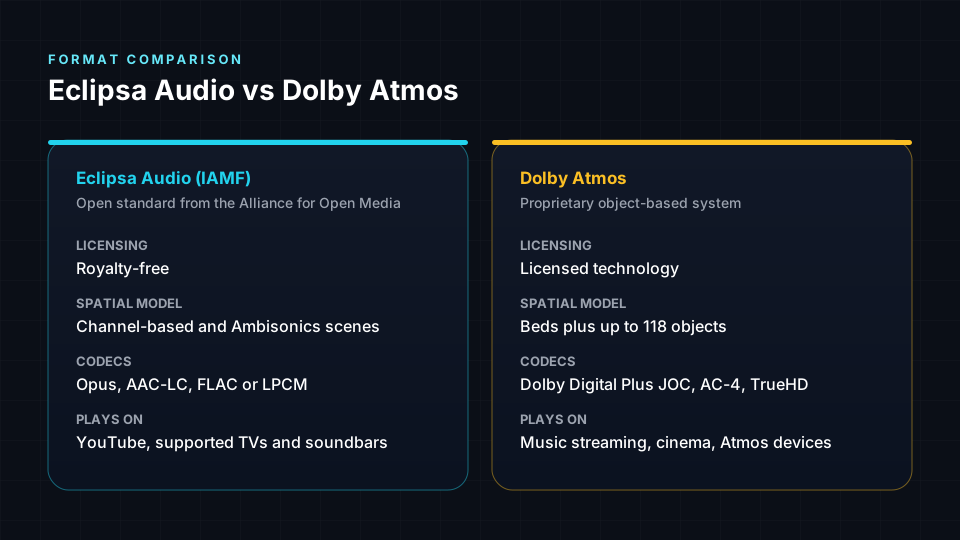
Eclipsa Audio vs Dolby Atmos at a glance
| Eclipsa Audio | Dolby Atmos | |
|---|---|---|
| Underlying technology | IAMF (Immersive Audio Model and Formats), Alliance for Open Media | Dolby's proprietary object-based audio system |
| Licensing | Open specification, royalty-free | Licensed from Dolby Laboratories |
| Spatial model | Audio elements: channel-based layers or scene-based Ambisonics | Beds (fixed channels) plus objects with position metadata |
| Channel budget | Set by profile: Simple up to 16 channels, Base up to 18, Base-Enhanced up to 28 | Up to 128 input channels in a music session |
| Coordinate system | Listener-centred directions (Ambisonics) or named speaker layouts | Room-centred positions inside a virtual room |
| Codecs | Opus, AAC-LC, FLAC, LPCM | Dolby Digital Plus with JOC, Dolby AC-4, Dolby TrueHD |
| Typical master | IAMF bitstream, usually inside an MP4 | ADM BWF or a Dolby Atmos master file set |
| Headphones | Stereo or binaural rendering flag per element | Binaural render modes per object, or the platform's own renderer |
| Main platforms | YouTube, supported Samsung TVs and soundbars, apps with an IAMF decoder | Apple Music, Tidal, Amazon Music, cinemas, Blu-ray, Atmos devices |
| Reference tools | Open-source encoder and decoder from AOMedia, open-source DAW plugin from Google | Dolby Atmos Renderer, Atmos tools built into major DAWs |
Where each format comes from
Dolby Atmos started in cinemas in 2012 and moved into homes, games and music. Its central idea is the audio object: a sound that carries its own position, so the playback system can place it correctly whether the room has 7 speakers or 64. The mix is not tied to one speaker layout. A renderer at playback time decides which speakers reproduce each object.
Eclipsa Audio is the name Google and Samsung gave to IAMF when they brought it to consumers in early 2025. Spatial9 presented the first music in Eclipsa Audio with Google and Music AI at CES 2025, and you can read the story in our CES 2025 announcement. IAMF was published by the Alliance for Open Media (AOMedia), the group behind the AV1 video codec, and it borrows AV1's design philosophy: an open specification, royalty-free use and open-source reference code anyone can build on.
The two formats were designed with different goals in mind. Atmos began as a production and theatrical system and later grew into a consumer format. IAMF was designed from the start as a delivery format: the most efficient way to get an immersive experience to a browser, a phone or a TV over the internet.
How Dolby Atmos works: beds, objects and the renderer
An Atmos music session is built from two kinds of audio. If you want the full picture of the master file itself, read What is an ADM BWF file?.
Beds
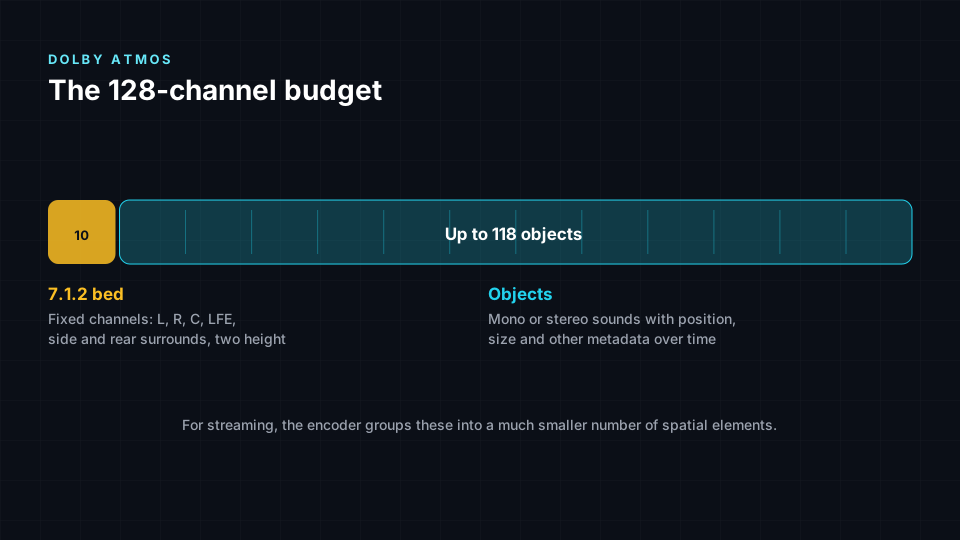
A bed is a group of channels tied to fixed speaker positions. The largest bed in Atmos music is 7.1.2: left, right, centre, LFE, two side surrounds, two rear surrounds and two overhead channels, ten channels in total. Beds are ideal for pads, room tone, reverb returns and anything that should simply fill a zone.
Objects
An object is a mono or stereo sound with metadata that changes over time:
- Position as X, Y and Z coordinates inside a virtual room.
- Size, which spreads the object over a larger area so it feels less like a point.
- Zone and snap controls, which can keep an object out of certain speakers or lock it to the nearest one.
- Binaural render mode for headphones, covered below.
With a 7.1.2 bed taking 10 of the 128 inputs, up to 118 objects remain. Most commercial music mixes use far fewer, but the budget explains why Atmos is so flexible in the studio.
The renderer
The Dolby Atmos Renderer turns beds and objects into speaker feeds for whatever layout is in the room, from 2.0 up to large 9.1.6 studio monitoring setups. Digital audio workstations such as Logic Pro, Pro Tools, Nuendo and DaVinci Resolve include Atmos tools or connect to the renderer. When the mix is done, it is exported as an ADM BWF file or as a Dolby Atmos master file set, and that master is what distributors ask for.
Room-centred positions
One detail matters a great deal later in this guide. Atmos music describes object positions in a room-centred coordinate system: a point inside a cube that represents the room, where front left corner, rear right corner and ceiling are all fixed places. The renderer then works out which real speakers are closest to that point. This is called an allocentric approach. The position is defined relative to the room, not relative to the listener's head.
How Eclipsa Audio works: inside an IAMF bitstream
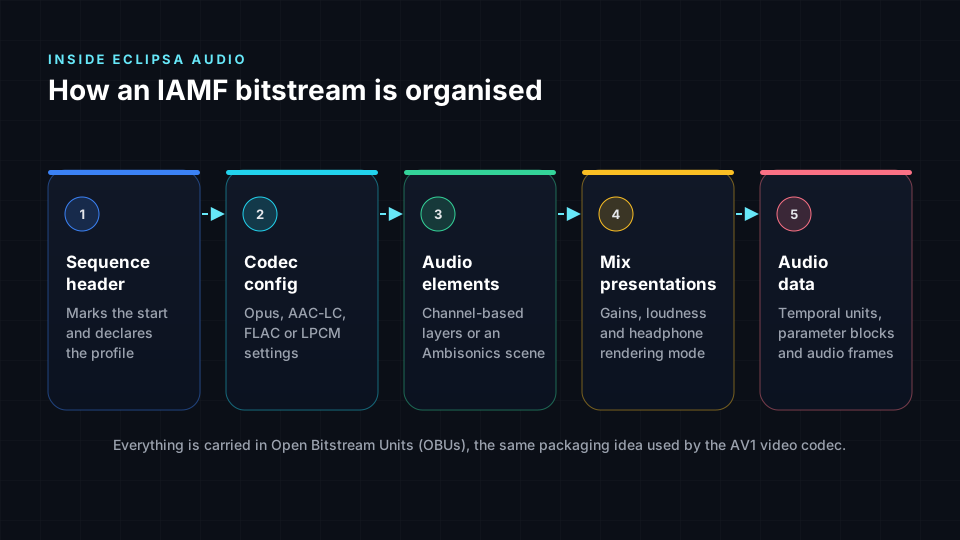
IAMF does not use objects in the Atmos sense. Instead it describes a mix as one or more audio elements, plus instructions for how to combine and render them. Everything travels inside a sequence of Open Bitstream Units (OBUs), the same packaging idea that AV1 video uses.
The OBU types
| OBU | What it carries | Why it matters |
|---|---|---|
| IA Sequence Header | The start of the stream and the profile it follows | Tells a decoder whether it can play the stream at all |
| Codec Config | Which codec is used and its settings | Lets the decoder set up Opus, AAC-LC, FLAC or LPCM |
| Audio Element | One channel-based or scene-based element and its substreams | Defines what the sound is and how its channels are arranged |
| Mix Presentation | How elements are combined, their gains, loudness and rendering settings | Defines the finished experience a listener hears |
| Parameter Block | Time-varying values such as mix gain and demixing information | Allows gains and other values to change over time |
| Temporal Delimiter | The boundary between moments in time | Keeps the stream in sync and makes seeking easier |
| Audio Frame | The coded audio itself | The actual sound |
The first four are descriptor OBUs: they set up the experience before any audio arrives. The rest are data OBUs that repeat for the length of the track.
Audio elements: channel-based and scene-based
IAMF defines two kinds of audio element.
- Channel-based elements carry audio for named loudspeaker layouts: mono, stereo, 5.1, 5.1.2, 5.1.4, 7.1, 7.1.2, 7.1.4 and 3.1.2, plus a binaural layout for headphones. They can be scalable: a stream can contain a stereo base layer and further layers that build up to 5.1 or 7.1.4. A device with two speakers decodes only what it needs. A full home theatre uses every layer and applies demixing and reconstruction gain information to rebuild the larger layout accurately.
- Scene-based elements carry an Ambisonics sound field, a description of sound arriving from every direction on a sphere around the listener. Our guide Ambisonics explained covers the basics. IAMF supports two ways to store it: mono mode, where each Ambisonics channel is coded on its own, and projection mode, where the channels are mixed through a matrix before coding, which can save bits.
Ambisonics orders and channel counts
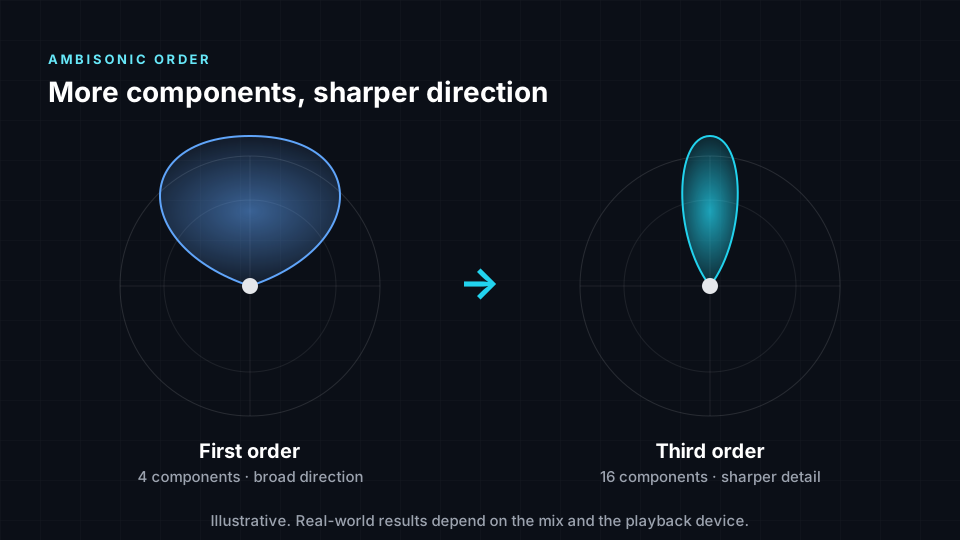
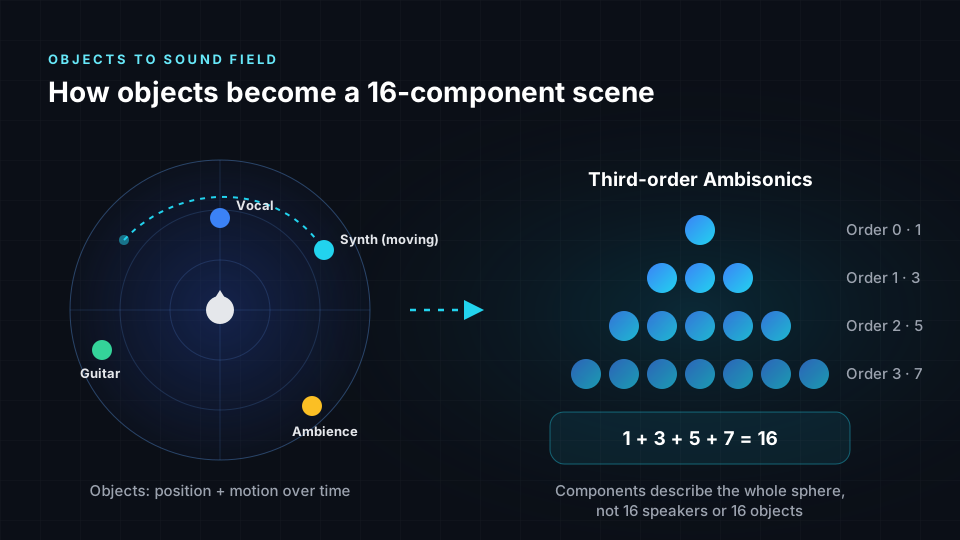
An Ambisonics scene of order N uses (N + 1)² channels. Higher orders describe direction more sharply.
| Order | Channels | Directional detail |
|---|---|---|
| First order | 4 | Broad sense of direction, soft localisation |
| Second order | 9 | Clearer placement around the listener |
| Third order | 16 | Sharp placement, the level Spatial9 uses for Eclipsa Audio conversions |
The channels follow a standard ordering, ACN, with SN3D normalisation, the same conventions used by the widely supported AmbiX format. A 16-channel third-order scene fits exactly into the 16-channel limit of IAMF's Simple profile.
Profiles
IAMF defines profiles that cap how complex a stream can be, so device makers know exactly what they must support.
| Profile | Audio elements | Channels | Typical use |
|---|---|---|---|
| Simple | 1 | Up to 16 | One immersive scene or one channel layout |
| Base | Up to 2 | Up to 18 | For example a scene plus a separate stereo element |
| Base-Enhanced | Up to 28 | Up to 28 | More complex mixes, added in a later version of the specification |
Mix presentations
A mix presentation is the recipe for what the listener hears. It lists which audio elements play, the gain applied to each, an overall output gain and loudness information measured for specific playback layouts. A stream can hold more than one mix presentation. For example, one could include a commentary element and another could leave it out, and the player picks the one the listener wants.
Gains do not have to be static. Parameter blocks can change values over time with step, linear or Bézier curves, so fades and balance changes are part of the stream rather than baked into the audio.
Objects vs sound fields: the core technical difference
This is the most important concept in the comparison.
Atmos keeps sounds separate until playback. Each object travels with its own metadata, and the renderer in the listener's device places it. A vocal object is still a discrete vocal object when it reaches your soundbar (in a compressed form, as explained below).
IAMF's scene-based mode combines sounds before delivery. All the sources are encoded into a single sound field. The vocal is no longer a separate item. It is a pattern of energy arriving from one direction within the sphere. The decoder renders that sphere to whatever speakers or headphones are present.
Each approach has trade-offs:
- Precision. An object can be rendered as a sharp point if the speakers allow it. A sound field is as sharp as its order allows. Third order is precise enough for music, but it is not a perfect point.
- Bandwidth. Atmos streams also cannot afford to send 118 separate objects, so the encoder groups them, as explained in the next section. A sound field has a fixed channel count regardless of how many sources the mix uses: a 300-track session and a 5-track session both become 16 channels at third order.
- Interactivity. Objects allow per-sound changes at playback, such as dialogue level. In IAMF, that flexibility comes from using separate audio elements and mix presentations instead.
- Rotation and head tracking. A sound field can be rotated efficiently with a single matrix operation, which suits head-tracked headphone playback and 360-degree video.
Codecs and delivery: how each format reaches the listener
Dolby Atmos delivery
A studio Atmos master is far too large to stream, so it is encoded into a consumer format.
- Dolby Digital Plus with Joint Object Coding (JOC) is the format most music streaming services use for Atmos. It carries a backward-compatible channel mix plus side information that lets a compatible decoder rebuild the objects.
- Dolby AC-4 is a newer codec used in broadcasting and on some devices and services.
- Dolby TrueHD carries Atmos losslessly on Blu-ray discs.
Before any of these, the encoder applies spatial coding: it analyses all the objects and groups them into a much smaller number of dynamic elements, each with its own position. A mix with 60 objects is therefore not streamed as 60 objects. It is a carefully chosen approximation that preserves where the important sounds are.
Eclipsa Audio delivery
IAMF wraps standard codecs instead of using its own.
| Codec | Type | Where it fits |
|---|---|---|
| Opus | Lossy, very efficient, open and royalty-free | Streaming, where bandwidth matters most |
| AAC-LC | Lossy, very widely supported | Devices and pipelines built around AAC |
| FLAC | Lossless | High-quality delivery and archiving |
| LPCM | Uncompressed | Production, testing and the highest-fidelity paths |
The IAMF bitstream normally lives inside an MP4 (ISO BMFF) file, which is how it travels with video on YouTube. Because the Ambisonics channels in a scene are highly correlated, efficient codecs keep a full third-order scene within practical streaming bitrates.
Rendering to speakers and headphones
Speakers
Both formats render at playback time, but from different starting points.
- An Atmos decoder reads object positions in the virtual room and pans them across the real speakers, using the room-centred coordinates described above.
- An IAMF decoder either plays the channel layer that best matches the speakers or decodes the Ambisonics scene to the available layout. Ambisonics decoding is a matrix operation that turns the sphere into speaker feeds for 2.0, 5.1, 7.1.4 or other layouts.
Headphones and binaural
Most people listen on headphones, so binaural rendering matters more than any speaker layout. Binaural audio uses head-related transfer functions (HRTFs): filters that copy how your head, shoulders and outer ears change a sound depending on its direction. Our guide to binaural vs spatial audio explains the idea in plain terms.
- Atmos lets the mixer choose a binaural render mode for each object or bed channel: Off, Near, Mid or Far. The mode controls how much simulated room and distance the headphone render adds. Some platforms use their own headphone renderer instead, so these settings are not honoured everywhere, and the same mix can sound noticeably different from one service to another.
- IAMF stores a headphones rendering mode for each element in a mix presentation: either plain stereo or binaural. With an Ambisonics scene, the binaural render is especially clean, because the decoder can turn the whole sphere into two ear signals with a fixed set of filters, and can rotate the sphere first when head tracking is available.
Why height is the hardest part
Height comes mostly from the high-frequency filtering of the outer ear, above roughly 4 kHz. Generic HRTFs never match every listener perfectly, so height is the least reliable cue on headphones in both formats. Our genre guides explain how this shapes placement. For example, bright hi-hats sound convincingly overhead while bass never does. See the genre-by-genre spatial audio guide.
Loudness and metadata
Both formats treat loudness as metadata, measured with the ITU-R BS.1770 method that underlies LUFS and LKFS readings.
- Atmos music deliveries usually specify an integrated loudness target and a true-peak ceiling for the binaural or speaker render. A widely used target is around -18 LKFS integrated with peaks below -1 dBTP, but always check your distributor's current specification.
- IAMF stores loudness information inside each mix presentation, measured for specific layouts such as stereo or 7.1.4. A player can normalise playback accurately without measuring the audio itself, and different layouts can carry their own measured values.
The practical lesson is the same for both: measure the render your audience will actually hear, not only the full speaker version.
Coordinate systems: why conversion is not a simple copy
Moving a mix from Atmos to Eclipsa Audio means moving between two ways of describing space.
- Atmos says where a sound is in the room: a point inside a cube.
- An Ambisonics scene says which direction a sound comes from, relative to the listener at the centre: azimuth (around) and elevation (up and down).
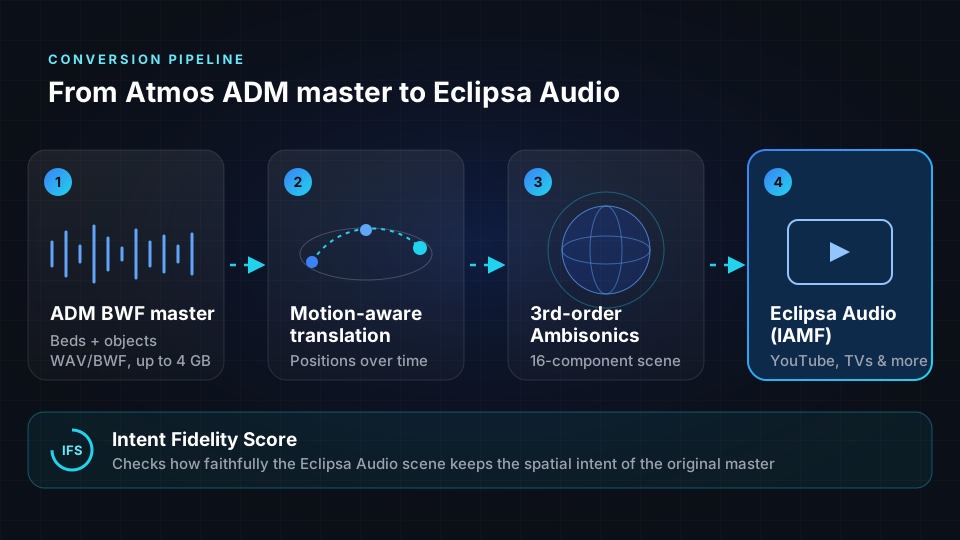
A converter therefore has to map positions in a cube onto directions on a sphere. A naive mapping distorts the mix. Sounds in the corners of the cube can be pulled to odd elevations, and sounds near the middle of the room have no clear direction at all. A good conversion has to:
- Read every bed and object, including the time blocks that record how objects move (see our ADM BWF guide).
- Map room positions to directions in a way that keeps the mixer's intent, such as front stays front, overhead stays overhead and side stays side.
- Translate object size into a matching spread in the sound field, so wide sounds stay wide.
- Follow movement over time, so a sweeping synth still sweeps instead of freezing at its first position.
- Handle the LFE. Ambisonics has no dedicated low-frequency effects channel, so the low-frequency content must be carried deliberately rather than dropped.
- Encode to third order, so the 16-channel scene keeps enough directional detail for music.
This is exactly what Spatial9's motion-aware translation does when it converts an ADM BWF master to Eclipsa Audio. Its patent-pending Intent Fidelity Score then compares the placement in the original master with the converted scene, so you can see how much of the spatial intent survived. The full walkthrough is in our Dolby Atmos to Eclipsa Audio guide.
Licensing, cost and openness
| Eclipsa Audio | Dolby Atmos | |
|---|---|---|
| Specification | Public, published by AOMedia | Proprietary |
| Royalties | None to create, distribute or play | Licensed by Dolby to device makers and services |
| Reference code | Open-source encoder (iamf-tools) and decoder (libiamf) | Licensed SDKs and tools |
| Mixing tools | Open-source DAW plugin from Google, converters such as Spatial9 | Dolby Atmos Renderer and Atmos tools inside major DAWs |
| Effect for creators | Free to experiment, build tools and distribute widely | Mature, industry-standard workflow with the widest music catalogue |
Openness matters most to platforms and device makers, because it removes a per-device licence. For creators, the bigger question is usually where your audience listens.
Platform support
| Platform or device | Eclipsa Audio | Dolby Atmos |
|---|---|---|
| YouTube | Yes, accepted as an upload and played on supported devices | Not the immersive path YouTube uses |
| Apple Music, Tidal, Amazon Music | Not currently | Yes |
| Supported Samsung TVs and soundbars | Yes, from the 2025 range | Yes, on Atmos-enabled models |
| Cinema and Blu-ray | No | Yes |
| Apps and browsers | Any app that includes an IAMF decoder | Devices and apps with a Dolby licence |
Platform support changes quickly, so check the current list before a release. For the YouTube side, our Eclipsa Audio on YouTube guide shows how to upload and verify playback.
Which one should you use?
For most professional releases the answer is both, made from one source.
- Mixing for streaming music services? Mix in Dolby Atmos and deliver the ADM BWF master to your distributor. That is what Apple Music, Tidal and Amazon Music expect.
- Releasing on YouTube or targeting TVs? Deliver Eclipsa Audio. Convert your existing Atmos master instead of remixing.
- Building an app, game or platform? IAMF's open specification and open-source decoder remove licensing barriers.
- Only have a stereo master? Spatial9 can create an immersive version from a stereo file and export ADM, Eclipsa Audio, binaural or Ambisonics. See how to create spatial audio from stereo.
Common misconceptions
- "Eclipsa Audio is just Ambisonics." Not quite. IAMF also supports channel-based layouts, scalable layers, multiple audio elements and mix presentations. Ambisonics is one of its two element types.
- "Atmos streams contain all 118 objects." Consumer streams use spatial coding, which groups objects into a smaller set of elements before encoding.
- "More channels always means better sound." Spatial quality depends on the mix, the renderer and the listener's HRTF match as much as on channel count.
- "An ADM file is a Dolby file." ADM is an open ITU standard (ITU-R BS.2076). Atmos uses it, but it is not owned by Dolby.
- "Converting Atmos to Eclipsa Audio means remixing." A motion-aware converter reads your existing master and rebuilds the scene automatically.
Frequently asked questions
Is Eclipsa Audio better than Dolby Atmos?
Neither is better in every case. Dolby Atmos is the established standard for mixing and for streaming music services. Eclipsa Audio is open, royalty-free and built for efficient delivery to YouTube, TVs and apps. Most creators benefit from offering both.
Is Eclipsa Audio the same as IAMF?
Yes, in practice. IAMF (Immersive Audio Model and Formats) is the open technical standard from the Alliance for Open Media, and Eclipsa Audio is the consumer name Google and Samsung use for it.
Does Eclipsa Audio support objects like Dolby Atmos?
Not in the same way. IAMF carries channel-based layers or a scene-based Ambisonics sound field. Moving sources from an Atmos mix are encoded into that sound field, so their positions and movement are kept even though they are no longer separate objects.
How many channels does a Dolby Atmos music mix use?
A Dolby Atmos music session has up to 128 input channels. A 7.1.2 bed uses 10 of them, which leaves up to 118 for objects.
What codecs does Eclipsa Audio use?
IAMF can carry Opus, AAC-LC, FLAC or LPCM audio. Opus is the most efficient choice for streaming, FLAC is lossless and LPCM is uncompressed.
Can I play Eclipsa Audio on headphones?
Yes. A mix presentation can flag each element for binaural rendering on headphones, and an Ambisonics scene converts cleanly into a binaural signal, including with head tracking where the device supports it.
Can I convert Dolby Atmos to Eclipsa Audio without remixing?
Yes. Export your Atmos mix as an ADM BWF master and convert it with Spatial9 for free. Motion-aware translation keeps object positions and movement, and the Intent Fidelity Score shows how closely the result matches your master.
Does YouTube support Dolby Atmos music?
YouTube's immersive audio path for uploads is Eclipsa Audio. To bring an Atmos mix to YouTube in 3D, convert it to Eclipsa Audio first.
Sources
- IAMF specification, Alliance for Open Media. OBU types, audio elements, mix presentations, codecs and profiles.
- Introducing Eclipsa Audio: immersive audio for everyone, Google Open Source Blog, January 2025. YouTube uploads and Samsung's 2025 TV lineup.
- Introducing Open Source DAW Plugin for Eclipsa Audio, Google Open Source Blog, June 2025. IAMF profiles, audio elements and channel counts.
- ITU-R BS.2076: Audio Definition Model, International Telecommunication Union. The open metadata model used in ADM BWF masters.
- ITU-R BS.1770: Algorithms to measure audio programme loudness and true-peak audio level, International Telecommunication Union.
- Dolby professional documentation, Dolby Laboratories. Dolby Atmos Renderer, beds, objects and binaural render modes.
- Spatial9 product details, including motion-aware translation and the Intent Fidelity Score, are provided by Spatial9.
Convert your Atmos masters to Eclipsa Audio
You do not have to choose between the two formats. Keep mixing in Dolby Atmos for streaming services, and turn the same master into Eclipsa Audio for YouTube, TVs and soundbars in minutes. Start a free conversion.
Dolby and Dolby Atmos are trademarks of Dolby Laboratories. Spatial9 is not affiliated with or endorsed by Dolby Laboratories.