Apple Spatial Audio vs Dolby Atmos: What Is the Difference?
Spatial9 Team · · Updated · 9 min read
Key takeaways
- Dolby Atmos is a format; Apple Spatial Audio is how Apple devices render immersive sound, including Atmos.
- Apple Music added Spatial Audio with Dolby Atmos in 2021, and Logic Pro 10.7.3 added the Apple renderer for monitoring in 2022.
- Apple says Spatial Audio tracks earn up to a 10% higher share of royalties, and it does not accept upmixes of a stereo release.
- At WWDC 2025 Apple introduced the Apple Spatial Audio Format (ASAF) for production and the APAC codec for delivery.
"Is Spatial Audio the same as Dolby Atmos?" is one of the most common questions in immersive music. The confusion is understandable. Apple Music labels its immersive catalogue "Spatial Audio", shows a Dolby Atmos badge on the same albums, and uses the word "spatial" for features that have nothing to do with Atmos at all.
This guide separates the two. It covers what each name refers to, how the signal travels from the studio to AirPods, why engineers hear differences between renderers, and what you need to deliver to appear in Spatial Audio on Apple Music. For the wider picture, start with our complete guide to spatial audio.
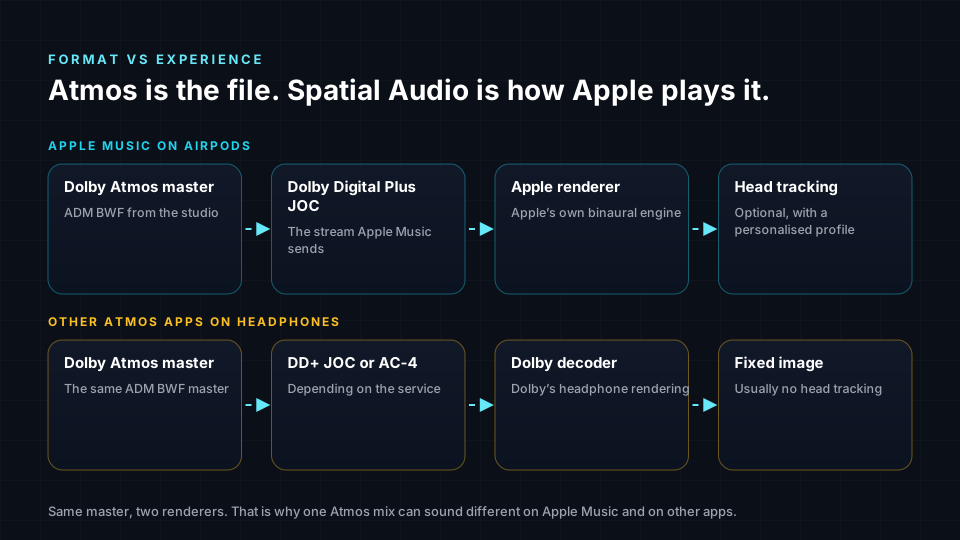
Apple Spatial Audio vs Dolby Atmos at a glance
| Apple Spatial Audio | Dolby Atmos | |
|---|---|---|
| What it is | A playback and rendering feature on Apple devices | An object-based immersive audio format and toolchain |
| Owner | Apple | Dolby Laboratories |
| What it plays | Dolby Atmos, 5.1 and 7.1 content, Apple formats | Its own masters and streams |
| Studio master | Usually a Dolby Atmos ADM BWF on Apple Music | ADM BWF, up to 128 inputs |
| Headphone rendering | Apple's binaural renderer | Dolby's binaural renderer, Near, Mid and Far modes |
| Head tracking | Yes, on supported AirPods and Beats | Depends on the device and app |
| Personalisation | Ear scan with the iPhone camera | Varies by device maker |
| Where it works | iPhone, iPad, Mac, Apple TV, Vision Pro, AirPods, Beats | Apple, Android and Windows devices, TVs, soundbars, cinemas |
Format versus experience
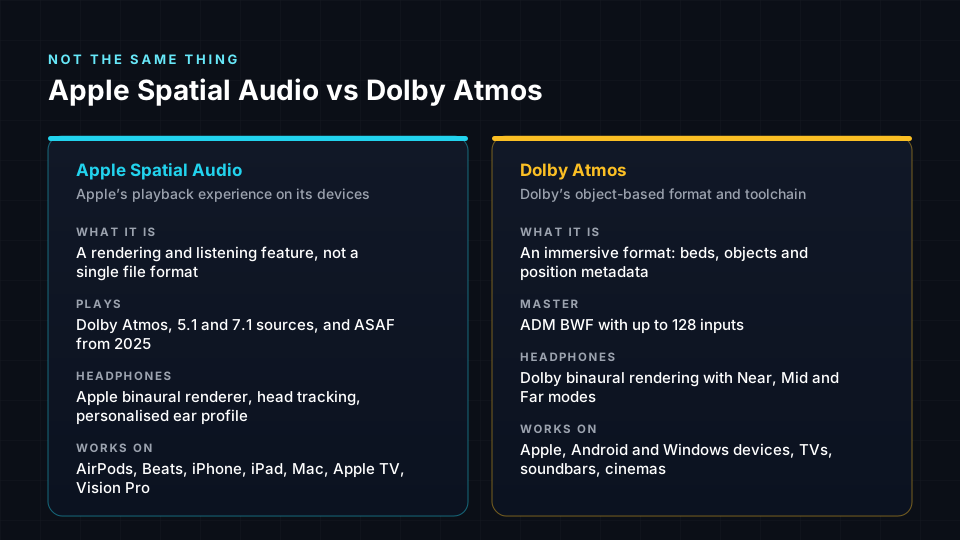
The simplest way to keep the two apart is to think of a film. Dolby Atmos is like the film file: it contains the content and instructions for how it should be presented. Apple Spatial Audio is like the cinema: it decides how that file is projected on the screen in front of you.
An Atmos master stores beds of fixed channels and up to 118 objects, each with a position that can move over time. It does not decide exactly what a pair of earbuds should play. That job belongs to a renderer, which turns the positions into two headphone signals using a model of how sound reaches human ears.
On most devices that renderer is Dolby's. On Apple devices playing Apple Music, it is Apple's. Apple's renderer also handles sources that are not Atmos, such as 5.1 film soundtracks, and it adds features Apple controls, like head tracking.
How Spatial Audio started
Apple introduced Spatial Audio in 2020 as a feature for watching video on AirPods Pro. Using the motion sensors in the earbuds and the device, it kept the soundtrack anchored to the screen as you turned your head, so dialogue still seemed to come from the iPad in front of you.
In June 2021 Apple Music launched Spatial Audio with Dolby Atmos and lossless audio. Thousands of tracks became available in Atmos at once, and the name "Spatial Audio" moved from a video feature to a music category. The same year Apple added "Spatialize Stereo", which places ordinary stereo in a virtual space around the listener.
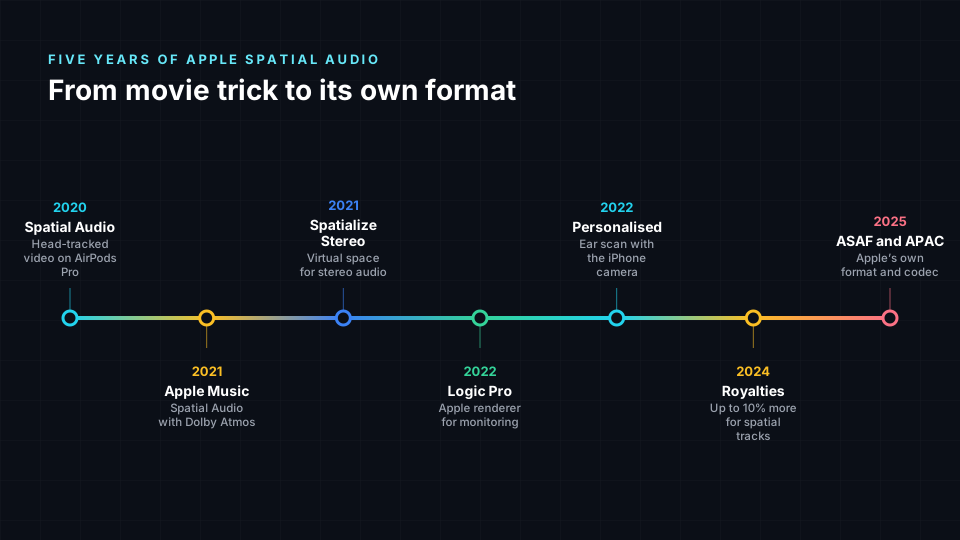
In 2022 Logic Pro 10.7.3 added the ability to monitor Atmos mixes through the Apple renderer with head tracking, and iOS 16 added Personalized Spatial Audio, which builds an ear profile from the iPhone's TrueDepth camera. In 2024 Apple said Spatial Audio tracks would earn up to a 10% higher share of royalties. At WWDC 2025 Apple introduced its own production format and codec.
How Dolby Atmos reaches Apple Music
The path from studio to AirPods looks like this:
- Mix. The engineer mixes in Dolby Atmos, with beds and objects, in a DAW such as Pro Tools, Logic Pro or Nuendo.
- Master. The session is exported as an ADM BWF file, the open master format defined by ITU-R BS.2076.
- Deliver. A label or distributor delivers the ADM BWF to Apple alongside the stereo master.
- Encode. Apple encodes it for streaming as Dolby Digital Plus with Joint Object Coding.
- Render. On an Apple device, Apple's renderer turns the stream into headphone or speaker signals. On a speaker system such as an Apple TV connected to an Atmos receiver, the receiver can decode Atmos itself.
On other services, such as TIDAL or Amazon Music on an Android phone, step five is usually handled by a Dolby decoder and Dolby's headphone virtualisation instead.
Why the same mix sounds different
Engineers have reported for years that an Atmos mix heard on Apple Music does not sound identical to the Dolby binaural render they approved in the studio. That is expected: two renderers make different choices.
Distance and binaural modes
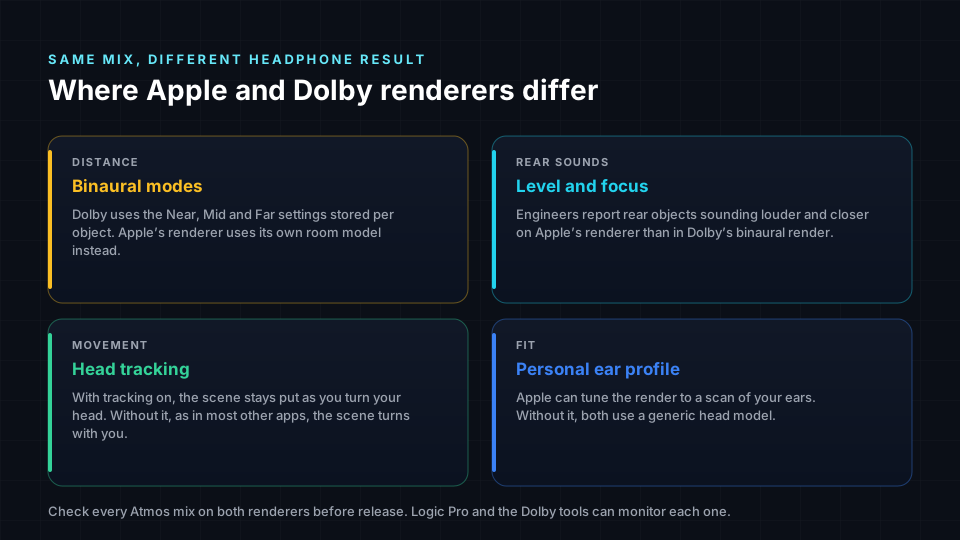
Each Atmos object carries a binaural render mode, Off, Near, Mid or Far, which tells Dolby's renderer how much room to apply on headphones. Apple's renderer uses its own room model and does not follow these settings in the same way. A vocal set to Near to keep it intimate in the Dolby render can sit differently on AirPods.
Rear sounds and overall level
Engineers working in both renderers commonly describe objects behind the listener as louder and closer in Apple's render than in Dolby's, and the Apple render as louder overall. A mix that feels balanced in one can feel crowded at the back in the other.
Head tracking
With head tracking on, the scene stays fixed in space as the listener turns their head. That improves the sense that sounds are outside the head, but it also means a centred lead vocal moves to one ear when the listener looks away. Most other apps do not track the head for music, so the scene turns with you.
Personalisation
Apple can tune its render to a scan of the listener's ears. Without that profile, both renderers use a generic head model. Because the fit of that model varies from person to person, two listeners can hear the same render differently.

For background on how headphones create a sense of direction, see binaural vs spatial audio.
ASAF and APAC: Apple's own formats
At WWDC 2025 Apple introduced two new technologies.
- Apple Spatial Audio Format (ASAF) is a production format. It combines linear PCM audio, metadata and a renderer, and it can mix higher-order Ambisonics with objects. Blackmagic Design's DaVinci Resolve 20.1 added ASAF support.
- Apple Positional Audio Codec (APAC) is a delivery codec for carrying spatial audio, including content captured on Apple devices and played on Vision Pro.
These formats matter most for video and Apple's own platforms today. For music, Apple's published delivery requirements still ask for a Dolby Atmos master. Treat ASAF as something to watch rather than something you must deliver now. We compare Apple's formats with the open alternative in Eclipsa Audio vs Apple Spatial Audio.
What creators need for Apple Music
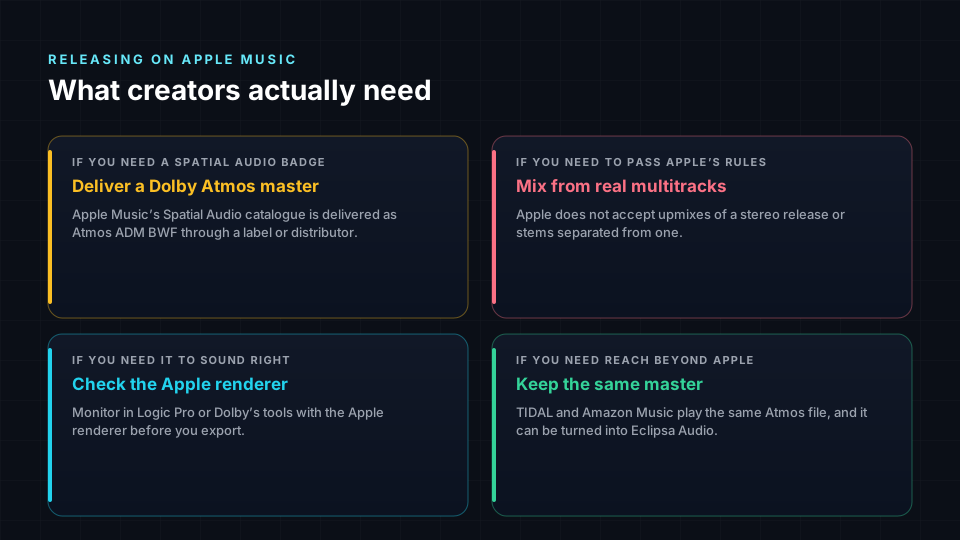
- A Dolby Atmos master. Apple's Spatial Audio catalogue is delivered as Atmos ADM BWF files through a label or a distributor that supports Atmos.
- A real immersive mix. Apple's delivery guidance says it does not accept upmixes of a stereo release, or stems separated from a stereo master. The mix has to be made from the original multitracks. We explain the difference in upmixing stereo vs mixing from stems.
- A check on the Apple renderer. Listen to your mix through the Apple renderer, for example in Logic Pro, as well as through Dolby's binaural render before you export.
- A plan for other services. The same Atmos master works for TIDAL and Amazon Music, and it can be converted to Eclipsa Audio for YouTube. Our guide on where to publish spatial audio covers every route.
Common misconceptions
- "Spatial Audio and Dolby Atmos are the same thing." Atmos is a format. Spatial Audio is Apple's playback experience, which renders Atmos and other sources.
- "Spatial Audio needs AirPods." Any wired or wireless headphones can play Spatial Audio on Apple Music. Head tracking and personalisation need supported AirPods or Beats.
- "Spatialize Stereo turns songs into Atmos." It places a stereo track in a virtual room. The track is still stereo and does not become an Atmos mix.
- "If it sounds right in the Dolby render, it will sound right on Apple Music." Apple uses its own renderer. Check both.
- "ASAF has replaced Atmos on Apple Music." Not for music delivery. Apple Music's published requirements still ask for Dolby Atmos.
Frequently asked questions
Is Apple Spatial Audio the same as Dolby Atmos?
No. Dolby Atmos is a format for immersive audio. Apple Spatial Audio is how Apple devices render immersive sound, and on Apple Music it usually plays Atmos masters with Apple's own renderer.
Why does Dolby Atmos sound different on Apple Music?
Because Apple renders Atmos with its own binaural engine. It handles distance, rear sounds and overall level differently from Dolby's renderer, and it can add head tracking and an ear profile.
Do I need AirPods for Spatial Audio?
No. Spatial Audio plays on any headphones connected to a supported Apple device. AirPods and Beats add head tracking and personalised profiles.
Can I upload a stereo upmix to Apple Music as Spatial Audio?
Apple's delivery guidance says it does not accept upmixes of a stereo release or stems separated from one. An Atmos mix for Apple Music should be made from the original multitracks.
What is ASAF?
The Apple Spatial Audio Format, introduced at WWDC 2025. It is a production format that combines PCM audio, metadata and a renderer, with support for higher-order Ambisonics and objects. Apple paired it with a delivery codec called APAC.
Do Spatial Audio tracks earn more royalties?
Apple says Spatial Audio tracks can earn up to a 10% higher share of royalties on Apple Music.
Sources
- Delivering Dolby Atmos audio, Apple Music Provider Support. Delivery routes, rules on upmixes and separated stems, and royalty share.
- Learn about Apple Spatial Audio Format and Apple Positional Audio Codec, Apple Developer, WWDC 2025. ASAF and APAC.
- Dolby professional documentation, Dolby Laboratories. Beds, objects and binaural render modes.
- ITU-R BS.2076: Audio Definition Model, International Telecommunication Union. The metadata model used in ADM BWF masters.
- How do I find Spatial Audio music?, Amazon Music Help. Dolby Atmos playback on Amazon Music.
- Audio format updates, TIDAL Support. Dolby Atmos on TIDAL.
- Engineer reports of differences between the Apple and Dolby binaural renderers, from the Dolby professional support community. Treat these as practitioner observations, not measurements.
Hear your mix beyond Apple Music
Your Atmos master can do more than one job. Keep it for Apple Music, TIDAL and Amazon, and turn the same mix into Eclipsa Audio for YouTube, TVs and soundbars. Convert an Atmos master with Spatial9.
Apple, Apple Music, AirPods, Logic Pro and Spatial Audio are trademarks of Apple Inc. Dolby and Dolby Atmos are trademarks of Dolby Laboratories. Spatial9 is not affiliated with or endorsed by Apple or Dolby Laboratories.