Eclipsa Audio vs Sony 360 Reality Audio: Open Scene or Object Sphere?
Spatial9 Team · · Updated · 8 min read
Key takeaways
- Both formats are listener-centred: they describe directions around the head rather than positions in a room.
- A third-order Ambisonics scene in Eclipsa Audio uses 16 channels however many instruments the mix contains.
- 360 Reality Audio is built on MPEG-H and plays mainly on Amazon Music Unlimited and nugs.net after TIDAL dropped it in 2024.
- Creators can upload Eclipsa Audio to YouTube themselves, while 360 Reality Audio needs a distributor that delivers it.
Most immersive formats start from a room. Dolby Atmos places sounds inside a virtual space with walls, a ceiling and a floor. Eclipsa Audio and 360 Reality Audio start from the listener instead. Both describe where a sound comes from relative to your head, in every direction including below you.
That shared starting point makes them a natural comparison. Underneath, though, they store the sphere in different ways, depend on different licensing models and reach listeners through different routes. This guide explains all three. If the concepts are new, read our complete guide to spatial audio and Ambisonics explained first.
Eclipsa Audio vs 360 Reality Audio at a glance
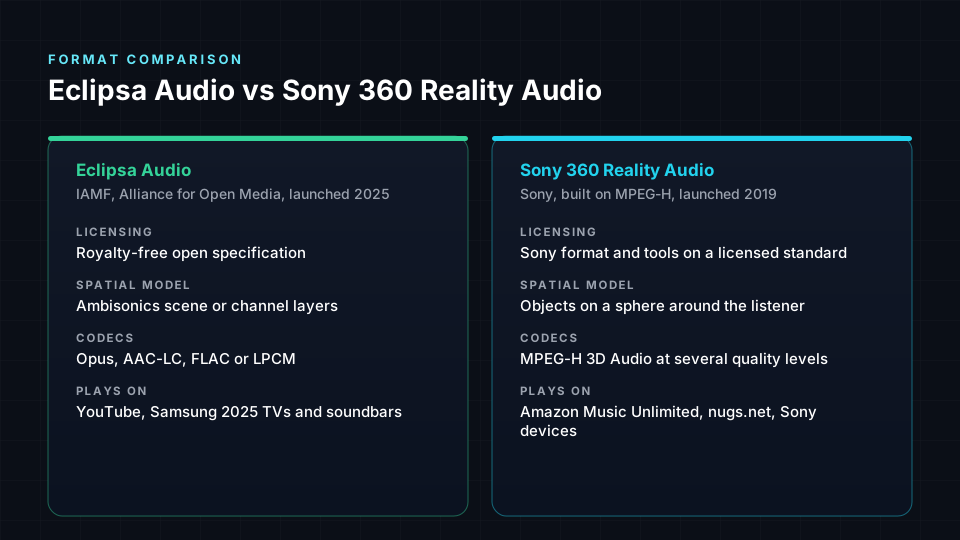
| Eclipsa Audio | Sony 360 Reality Audio | |
|---|---|---|
| Based on | IAMF, Alliance for Open Media | MPEG-H 3D Audio, ISO/IEC 23008-3 |
| Launched | 2025 | 2019 |
| Licensing | Royalty-free | Sony format and tools on a licensed standard |
| Spatial model | Ambisonics scene or channel layers | Objects with azimuth, elevation and distance |
| Codecs | Opus, AAC-LC, FLAC, LPCM | MPEG-H 3D Audio at several quality levels |
| Production tools | Open-source DAW plugin, conversion services such as Spatial9 | 360 WalkMix Creator plugin |
| How it is published | Uploaded by the creator to YouTube | Delivered by a distributor to services |
| Where it plays | YouTube, Samsung 2025 TVs and soundbars | Amazon Music Unlimited, nugs.net, Sony devices |
Two ways to store a sphere
Eclipsa Audio: one sound field
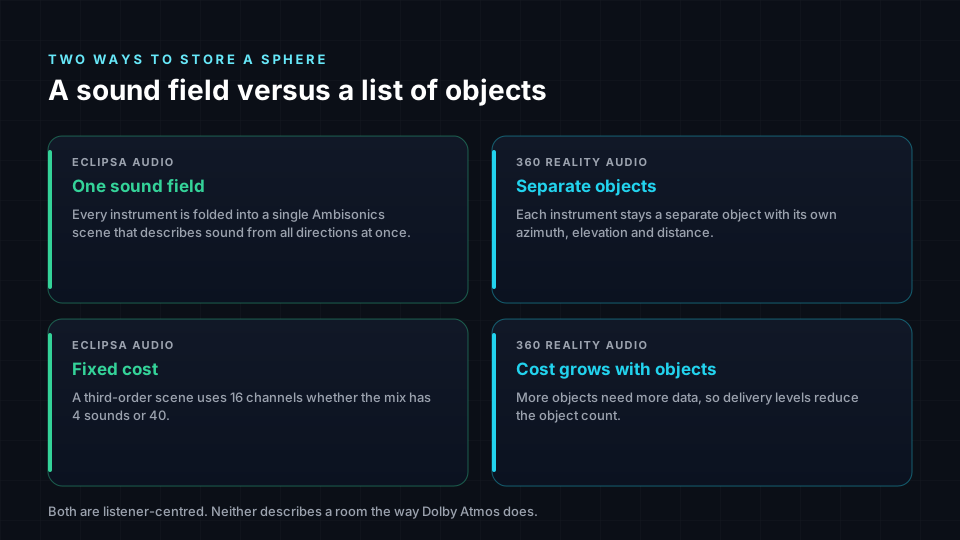
In a typical Eclipsa Audio music mix, every instrument is encoded into a single Ambisonics scene. Ambisonics describes the sound arriving from all directions at once using a set of channels called spherical harmonics. Higher orders add sharper directional detail: first order uses 4 channels, second order 9 and third order 16.
The key property is that the cost is fixed. A third-order scene is 16 channels whether the song has four instruments or forty. Movement is part of the field itself: a guitar sweeping overhead is simply sound moving through the scene.
IAMF can also carry channel-based layers, such as 5.1.2 or 7.1.4, and a stream can combine elements through mix presentations. IAMF 1.0 does not have separate objects with their own metadata.
360 Reality Audio: a list of objects
360 Reality Audio keeps each sound separate. Every instrument or group is an object with its own direction and distance, and the renderer positions each one at playback. That makes individual placements very precise and keeps instruments distinct.
The cost grows with the number of objects. To fit streaming bitrates, a 360 Reality Audio release is exported at several quality levels, each with fewer objects than the studio session. The lowest levels carry only a handful.
How each sounds in practice
Both formats are mostly heard on headphones, through binaural rendering, so the renderer and the listener's ears matter as much as the format.
Eclipsa Audio at third order gives a smooth, enveloping sound field. Because every source shares one scene, very dense mixes stay cohesive, and the bitrate stays predictable. Directional sharpness is limited by the Ambisonics order: individual sources sound slightly broader than a single object would.
360 Reality Audio can place a small number of objects with great precision, and Sony's renderer can be personalised for supported Sony headphones from photos of the listener's ears. When the delivery level reduces the object count, some instruments are merged, which can reduce that precision.
Neither is better across the board. Sparse acoustic arrangements suit discrete objects. Dense, layered productions often suit a scene. The mix itself decides more than either format.
Codecs and delivery
Eclipsa Audio codes audio with Opus or AAC-LC for streaming, or FLAC and LPCM for lossless use, and packages it in MP4 files using Open Bitstream Units. Profiles set the limits: Simple up to 16 channels, Base up to 18 and Base-Enhanced up to 28.
360 Reality Audio uses MPEG-H 3D Audio, a standard with its own core coder, in MP4 files at several quality levels. MPEG-H is also used in broadcast television in South Korea and Brazil. We compare the two standards in Eclipsa Audio vs MPEG-H 3D Audio.
Getting your music to listeners
This is where the two formats differ most for an independent artist.
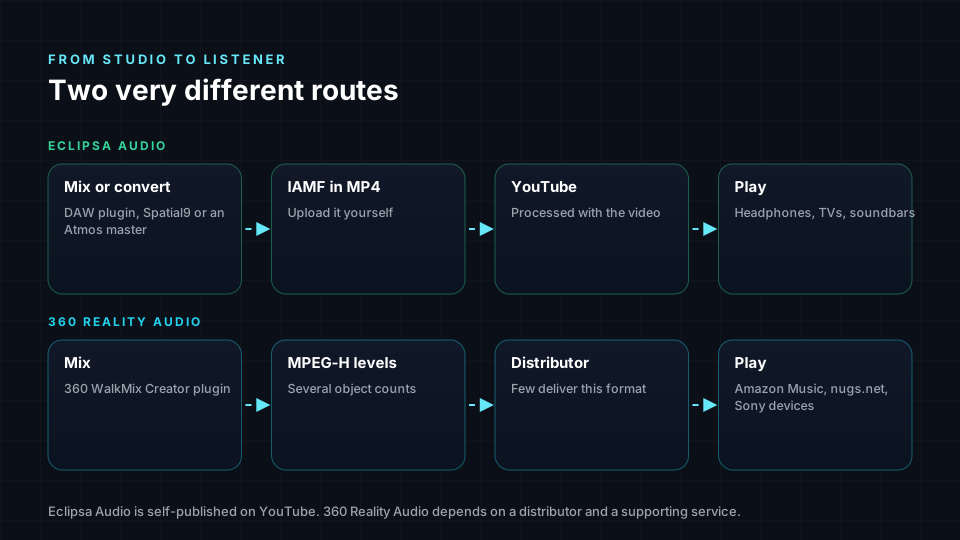
Eclipsa Audio is self-published. You upload an Eclipsa Audio MP4 to YouTube like any other video, and YouTube plays the immersive version on supported devices. There is no distributor fee for the immersive version and no approval step for the format.
360 Reality Audio goes through the music supply chain. A distributor has to accept and deliver the format, and very few do. Once delivered, it plays on Amazon Music Unlimited and nugs.net. TIDAL removed 360 Reality Audio on July 24, 2024, and the 360 by Deezer app closed on October 31, 2022, so the list of services has shrunk since launch.

Our guide on where to publish spatial audio covers every service and distributor route in detail.
Licensing and tools
IAMF is a royalty-free specification from the Alliance for Open Media, with open-source reference software and a free DAW plugin. Any service or device maker can adopt it without paying royalties. Our article on why open source matters for immersive audio explains why that matters for creators.
360 Reality Audio is a Sony brand and production toolchain. Mixes are made with the 360 WalkMix Creator plugin, and playback depends on services and devices that support the format. The underlying MPEG-H standard is licensed by its patent holders.
Converting between the two
Because both formats are listener-centred, positions translate more directly between them than between either one and Atmos. An object at a given azimuth and elevation in a 360 Reality Audio session can be encoded at the same direction in an Ambisonics scene.
The reverse is harder. An Ambisonics scene does not contain separate instruments, so turning an Eclipsa Audio file into objects would mean separating the sources again. The practical answer is the same as with every format: keep your stems and positions, and render each version from the session.
Which one should you use?
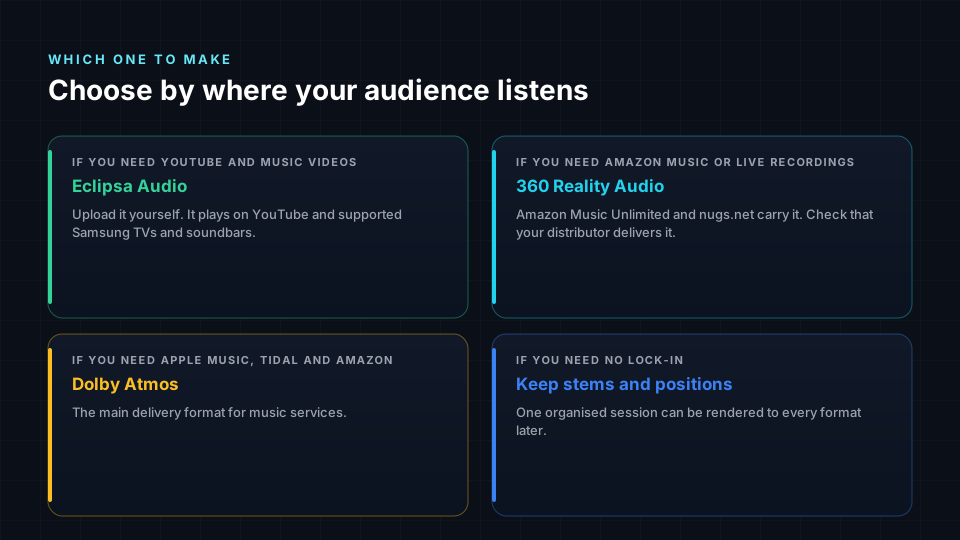
- YouTube, music videos and visualisers: make Eclipsa Audio. You can upload it yourself today.
- Fans on Amazon Music or nugs.net: 360 Reality Audio can reach them, if your distributor delivers it. Dolby Atmos reaches Amazon Music too.
- Apple Music, TIDAL and the wider music market: make Dolby Atmos, and see Dolby Atmos vs Sony 360 Reality Audio for that comparison.
- Keeping your options open: save stems and positions. Spatial9 can render an Eclipsa Audio version from stems, a stereo master or an Atmos master.
Common misconceptions
- "Both formats are the same because they use a sphere." They share a listener-centred view, but Eclipsa Audio usually stores one sound field and 360 Reality Audio stores separate objects.
- "Ambisonics is lower quality than objects." It trades a little directional sharpness for a fixed cost and a cohesive field. Third order is precise enough for most music.
- "360 Reality Audio has disappeared." It is no longer on TIDAL or Deezer, but Amazon Music Unlimited and nugs.net still play it.
- "Eclipsa Audio is only for 360 videos." It plays on regular YouTube videos and on supported TVs and soundbars, not just in VR.
- "You need special headphones." Both formats play on ordinary headphones through binaural rendering.
Frequently asked questions
Is Eclipsa Audio better than 360 Reality Audio?
It depends on where your listeners are. Eclipsa Audio is royalty-free and plays on YouTube and supported TVs. 360 Reality Audio plays on Amazon Music Unlimited and nugs.net. Sound quality depends more on the mix than on the format.
Can I upload 360 Reality Audio to YouTube?
No. YouTube plays Eclipsa Audio for immersive music and video. 360 Reality Audio is delivered to music services through distributors.
Does Eclipsa Audio use objects?
Not in IAMF 1.0. It uses Ambisonics scenes and channel-based layers, which can be combined through mix presentations.
Which streaming services play 360 Reality Audio?
Mainly Amazon Music Unlimited and nugs.net. TIDAL removed it on July 24, 2024, and the 360 by Deezer app closed on October 31, 2022.
Can I convert a 360 Reality Audio mix to Eclipsa Audio?
The positions translate well because both formats are listener-centred. The cleanest route is to render a new version from the original session or stems.
Sources
- IAMF specification, Alliance for Open Media. Audio elements, mix presentations, codecs and profiles.
- Introducing Eclipsa Audio: immersive audio for everyone, Google Open Source Blog, January 2025. YouTube and Samsung's 2025 TV lineup.
- Introducing Open Source DAW Plugin for Eclipsa Audio, Google Open Source Blog, June 2025. Profiles, channel counts and the free plugin.
- Sony launches 360 Reality Audio, Sony Group press release, October 2019. Launch services and the MPEG-H basis.
- 360 Reality Audio, Sony Electronics. Current services, devices and ear personalisation.
- Audio format updates, TIDAL Support. Removal of 360 Reality Audio on July 24, 2024.
- 360 by Deezer, Deezer Support. App closed on October 31, 2022.
- Michael A. Gerzon, "Periphony: With-Height Sound Reproduction", Journal of the Audio Engineering Society, vol. 21, no. 1, 1973. The foundation of Ambisonics.
Put your music on YouTube in Eclipsa Audio
You can have an immersive version of your song on YouTube without a distributor. Spatial9 turns a stereo song, stems or an Atmos master into an Eclipsa Audio file ready to upload. See how it works for YouTube creators.
360 Reality Audio and 360 WalkMix Creator are trademarks of Sony Group Corporation. Eclipsa Audio and all other names are trademarks of their respective owners. Spatial9 is not affiliated with or endorsed by Sony, Google or the Alliance for Open Media.