Eclipsa Audio vs Apple Spatial Audio: Open Format vs Apple's Ecosystem
Spatial9 Team · · 10 min read
Key takeaways
- Eclipsa Audio is an open, royalty-free file format (IAMF). Apple Spatial Audio is Apple's playback experience, which mostly plays Dolby Atmos masters on Apple Music.
- Apple's newer formats, ASAF for production and APAC for delivery, mix Ambisonics with objects, an idea IAMF also uses, but APAC playback is limited to Apple platforms.
- Eclipsa Audio reaches YouTube, Samsung TVs and soundbars, Android and Chrome; Apple Spatial Audio reaches iPhone, Mac, Apple TV, Vision Pro and AirPods.
- Most releases need both: keep a Dolby Atmos master for Apple Music and convert the same master to Eclipsa Audio for YouTube, free with Spatial9.
People compare these two because both promise "3D sound on headphones and in the living room". The comparison is useful, but only once you see that one is a file format and the other is a listening experience tied to one company's hardware. If you want the format-to-format view first, read our Eclipsa Audio vs Dolby Atmos comparison, because Atmos is what Apple Spatial Audio usually plays.
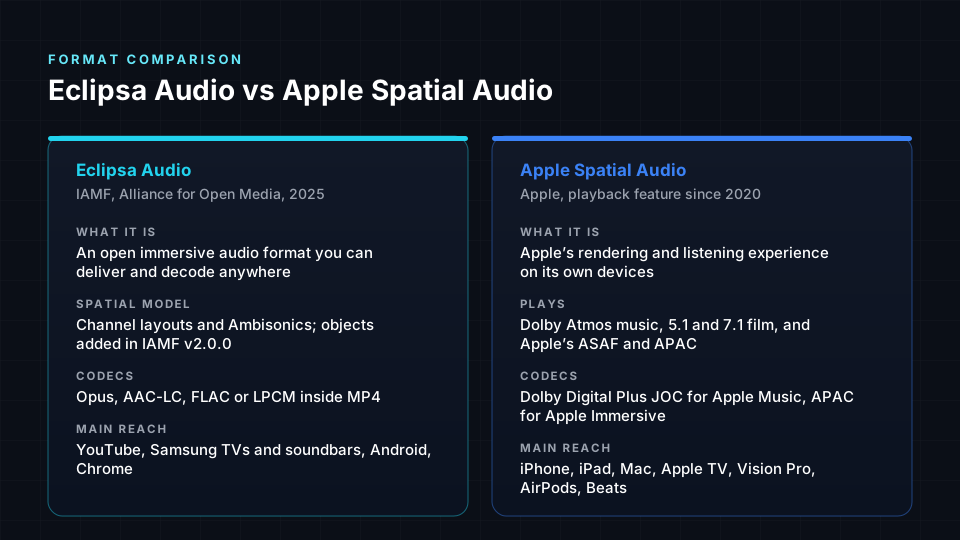
Eclipsa Audio vs Apple Spatial Audio at a glance
| Eclipsa Audio | Apple Spatial Audio | |
|---|---|---|
| What it is | An open immersive audio format | A playback and rendering feature on Apple devices |
| Owner | Alliance for Open Media (IAMF), launched by Google and Samsung | Apple |
| Licensing | Open specification, royalty-free | Apple's own technology; Apple Music content is licensed Dolby Atmos |
| Spatial model | Channel layouts and Ambisonics scenes; objects added in IAMF v2.0.0 | Renders Atmos beds and objects, 5.1 and 7.1, and Apple's ASAF |
| Codecs | Opus, AAC-LC, FLAC, LPCM | Dolby Digital Plus with JOC on Apple Music; APAC for Apple Immersive |
| Studio master | Usually made from an ADM BWF master, or authored with Google's open-source plugin | Dolby Atmos ADM BWF for music; ASAF in Broadcast Wave for Apple Immersive |
| Headphones | Binaural rendering by any IAMF decoder | Apple's binaural renderer with optional head tracking and ear profile |
| Main reach | YouTube, Samsung TVs and soundbars, Android, Chrome | iPhone, iPad, Mac, Apple TV, Vision Pro, AirPods, Beats |
| Who can build a player | Anyone, using the open-source decoder | Apple |
A format versus an experience
The cleanest way to keep them apart: Eclipsa Audio describes what is in the file. Apple Spatial Audio describes how Apple plays a file to you.
An Eclipsa Audio file carries one or more audio elements, either channel layouts such as 7.1.4 or a scene in Ambisonics, plus mix presentations that tell the player how to combine them and how loud the result should be. Any device with an IAMF decoder can turn that into speaker feeds or a headphone signal. Our IAMF technical deep dive shows these structures with code from the official repositories.
Apple Spatial Audio sits one step later. It takes a source, usually Dolby Atmos on Apple Music, and renders it with Apple's engine. That engine adds features Apple controls: head tracking that keeps the sound fixed in the room as you turn, and a personalised profile built from a scan of your ears. We explain why that changes how a mix sounds in Apple Spatial Audio vs Dolby Atmos.
Where each one comes from
Apple Spatial Audio arrived in 2020 as a feature for watching video on AirPods Pro. In June 2021 Apple Music launched Spatial Audio with Dolby Atmos, and the name became a music category. Head-tracked monitoring in Logic Pro and personalised profiles followed in 2022. In 2024 Apple said Spatial Audio tracks could earn up to a 10% higher share of royalties on Apple Music.
Eclipsa Audio was introduced by Google and Samsung in January 2025 as the consumer name for IAMF, the Immersive Audio Model and Formats standard from the Alliance for Open Media. YouTube began accepting Eclipsa Audio uploads, Samsung built it into its 2025 TVs and soundbars, Google released an open-source DAW plugin in June 2025, Android 16 added a decoder with the QPR2 update, and Chrome 153 added IAMF decoding for web players in September 2026. IAMF v2.0.0, approved in August 2026, added object-based audio elements.
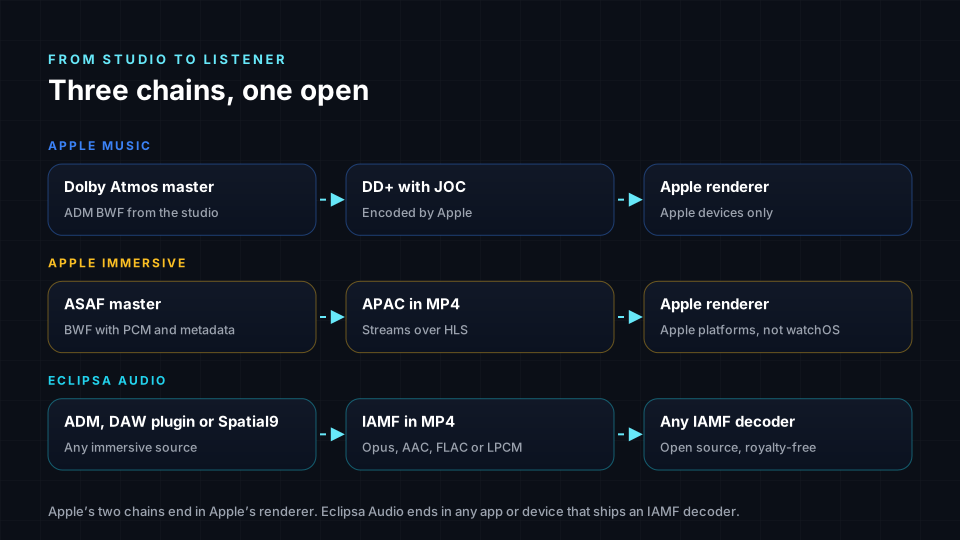
ASAF and APAC: Apple's own formats
At WWDC 2025 Apple introduced two formats of its own, and they are the closest Apple equivalent to Eclipsa Audio.
- Apple Spatial Audio Format (ASAF) is a production format. In Apple's words, it is new metadata coupled with linear PCM and a spatial renderer built into Apple platforms. It combines point sources with higher-order Ambisonics and is carried inside Broadcast Wave files.
- Apple Positional Audio Codec (APAC) is the delivery codec. Apple says it carries channels, objects, higher-order Ambisonics, dialogue, binaural audio and interactive elements, works at bitrates as low as 64 kbps, streams in MP4 over HLS, and plays on every Apple platform except watchOS. APAC is required for Apple Immersive Video on Vision Pro.
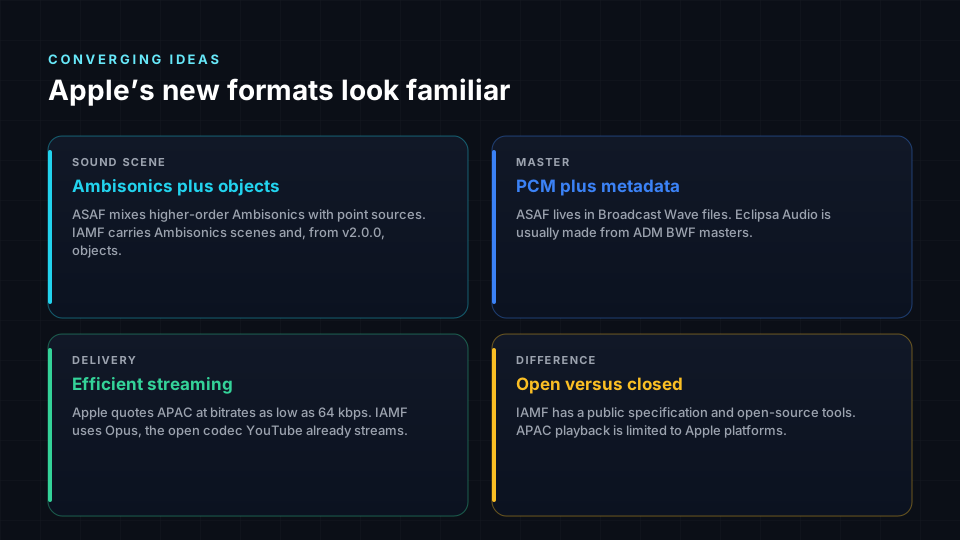
The technical direction is strikingly similar to IAMF: a sound scene in Ambisonics, extra point sources where precision matters, and metadata that lets the player adapt the result to speakers or headphones. The difference is openness. IAMF has a public specification, an open-source encoder and decoder and a royalty-free licence, so a TV maker, browser or game engine can add it without asking anyone. APAC playback, as Apple documents it, is an Apple platform feature.
For music, ASAF does not change what you deliver today. Apple Music's published delivery requirements still ask for a Dolby Atmos master.
How each sounds on headphones
Both reach most listeners on headphones, so this is where the experience is decided.
- Apple Spatial Audio renders with Apple's binaural engine. With supported AirPods or Beats it can track your head, so a voice stays "in front" even when you look away, and it can use a scan of your ears to tune the render. Engineers often report that Apple's render places rear sounds closer and plays louder overall than Dolby's own headphone render.
- Eclipsa Audio is rendered by whichever decoder plays it. IAMF lets the mix mark each element for stereo or binaural headphone rendering, and the open-source decoder includes a binaural renderer. Head tracking depends on the device, not the format. Spatial9 also delivers a ready-made binaural WAV with every render, so you can check exactly what headphone listeners will hear.
For the science behind this, see binaural vs spatial audio.
Where each one plays
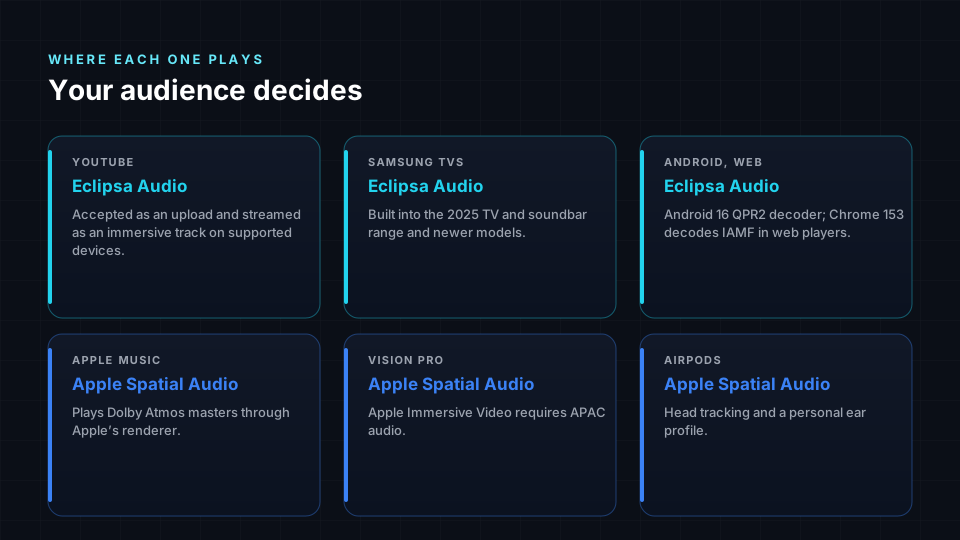
| Platform or device | Eclipsa Audio | Apple Spatial Audio |
|---|---|---|
| YouTube | Yes, as an immersive upload | Not the path YouTube uses |
| Apple Music | Not currently | Yes, from Dolby Atmos masters |
| Samsung TVs and soundbars | Yes, from the 2025 range | No |
| Android phones | Yes, Android 16 QPR2 and later, in apps that use the decoder | No |
| Chrome | Yes, from Chrome 153, including on Mac | No |
| Safari and Apple's own apps | We have not seen support announced | Yes |
| Vision Pro | Not announced | Yes, with APAC for Apple Immersive Video |
Support changes quickly, so check the current lists before a release. Our guide on where to publish spatial audio tracks every major service.
What creators need to deliver
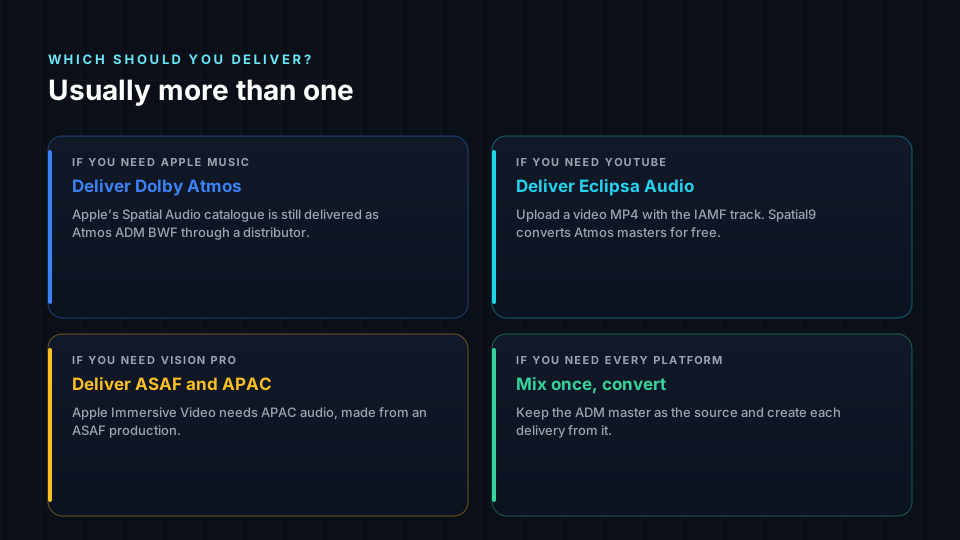
- For Apple Music: deliver a Dolby Atmos ADM BWF master through a label or distributor that supports Atmos. Apple says it does not accept upmixes of a stereo release or stems separated from one, so the mix must come from the original multitracks. Our guide on upmixing stereo vs mixing from stems explains the difference.
- For YouTube and TVs: deliver Eclipsa Audio in a video MP4. If you already have the Atmos master, you do not need to remix. Convert it free with Spatial9, or follow our free guide to Eclipsa Audio on YouTube, which also covers doing it from ChatGPT and listening on a computer.
- For Vision Pro films: produce in ASAF and deliver APAC, as Apple Immersive Video requires.
- For everything at once: keep the ADM master as your source of truth and create each delivery from it.
Common misconceptions
- "Eclipsa Audio is Google's answer to Apple Spatial Audio." It is closer to an open answer to Dolby Atmos. Apple Spatial Audio is a player; Eclipsa Audio is a format a player can play.
- "Apple Spatial Audio is a file format." For music it is a way of playing Dolby Atmos. Apple's own file formats are ASAF and APAC.
- "You need AirPods to hear spatial audio." Any headphones can play a binaural render. AirPods add Apple's head tracking and ear profiles for Apple's own playback.
- "An Eclipsa Audio mix can go straight to Apple Music." Not today. Apple Music asks for Dolby Atmos.
- "Converting Atmos to Eclipsa Audio means mixing again." No. The same ADM master converts directly, and Spatial9 scores how well the spatial intent survived.
Frequently asked questions
Is Eclipsa Audio the same as Apple Spatial Audio?
No. Eclipsa Audio is an open immersive audio format based on IAMF. Apple Spatial Audio is Apple's playback experience on its devices, which on Apple Music mostly plays Dolby Atmos masters with Apple's renderer.
Can I hear Eclipsa Audio on an iPhone or Mac?
On a Mac, Chrome 153 and later can decode Eclipsa Audio in web players. We have not seen Eclipsa Audio support announced for Safari or Apple's own apps. Any headphones, including AirPods, can play the binaural version of an Eclipsa Audio mix.
Does Apple Music support Eclipsa Audio?
Not currently. Apple Music's Spatial Audio catalogue is delivered as Dolby Atmos ADM BWF masters.
What is the Apple equivalent of Eclipsa Audio?
The closest is ASAF for production and APAC for delivery, introduced at WWDC 2025. Like IAMF, they combine Ambisonics with point sources. Unlike IAMF, APAC playback is an Apple platform feature rather than an open, royalty-free standard.
Which is better for headphones, Eclipsa Audio or Apple Spatial Audio?
They do different jobs. Apple Spatial Audio adds head tracking and ear profiles on supported AirPods and Beats. Eclipsa Audio brings a binaural render to any device with a decoder, including Android phones, TVs and Chrome. The quality you hear depends mostly on the mix and the renderer.
Can one master serve both Apple Music and YouTube?
Yes. Keep your Dolby Atmos ADM BWF master for Apple Music, and convert the same file to Eclipsa Audio for YouTube. Spatial9's ADM to Eclipsa converter does this for free.
Is Eclipsa Audio royalty-free?
Yes. IAMF is published by the Alliance for Open Media with an open specification and a royalty-free licence, and the reference encoder and decoder are open source.
Sources
- Learn about Apple Immersive Video technologies, Apple Developer, WWDC 2025. ASAF, APAC, bitrates, HLS delivery and platform support.
- Delivering Dolby Atmos audio, Apple Music Provider Support. Delivery requirements, rules on upmixes and royalty share.
- Apple Music announces Spatial Audio and Lossless Audio, Apple Newsroom, May 2021.
- IAMF specification, Alliance for Open Media. Audio elements, mix presentations, codecs and profiles.
- Introducing Eclipsa Audio: immersive audio for everyone, Google Open Source Blog, January 2025.
- Introducing Open Source DAW Plugin for Eclipsa Audio, Google Open Source Blog, June 2025.
- IAMF decoding with Media Source Extensions, Chrome Platform Status. Shipped in Chrome 153.
- Engineer reports of differences between Apple's and Dolby's headphone renderers, from the Dolby professional support community. Treat these as practitioner observations, not measurements.
Put your mix on both sides
You do not have to pick an ecosystem. Keep your Atmos master for Apple Music and turn the same file into Eclipsa Audio for YouTube, TVs and Android, free. Convert your master with Spatial9.
Apple, Apple Music, AirPods, Vision Pro, Logic Pro and Spatial Audio are trademarks of Apple Inc. Dolby and Dolby Atmos are trademarks of Dolby Laboratories. Eclipsa Audio, YouTube, Android, Chrome and all other names are trademarks of their respective owners. Spatial9 is not affiliated with or endorsed by Apple, Dolby Laboratories, Google or Samsung.