Dolby Atmos vs DTS:X: Object Audio for Cinema, Home and Music
Spatial9 Team · · Updated · 9 min read
Key takeaways
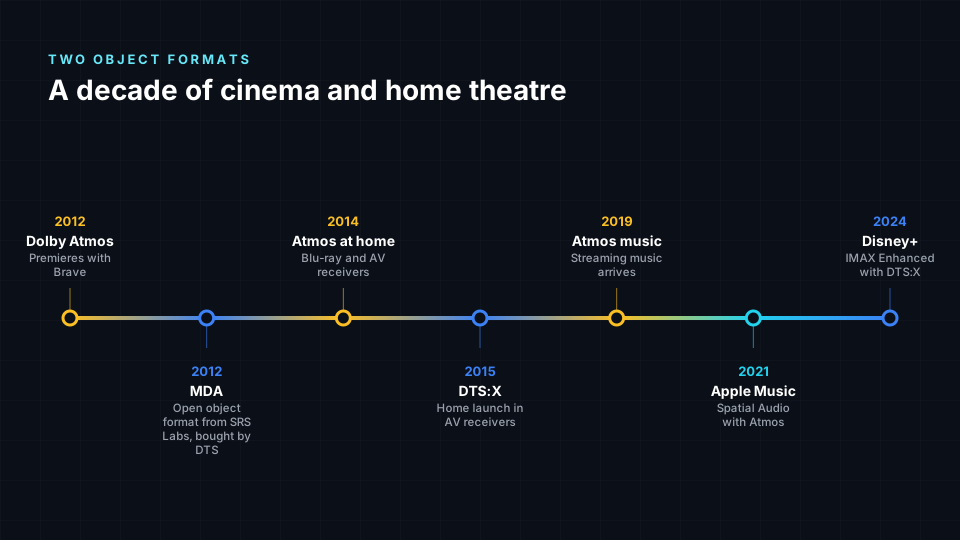
- Dolby Atmos premiered in cinemas in 2012; DTS:X reached home receivers in 2015, built on the MDA object format.
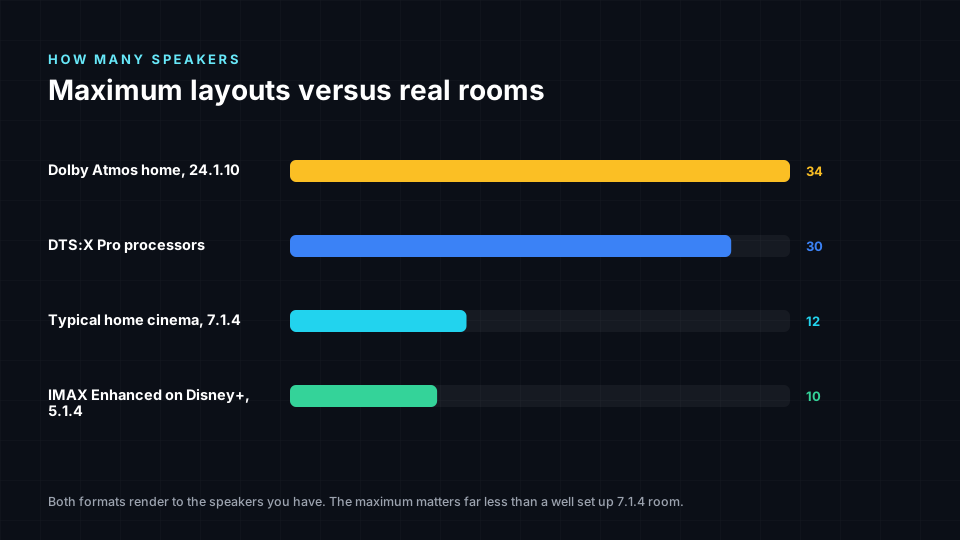
- Home Atmos supports layouts up to 24.1.10, or 34 speakers, while DTS:X Pro processors render to up to 30 speakers.
- Disney+ began offering IMAX Enhanced with DTS:X on May 15, 2024, as a fixed 5.1.4 mix on supported devices.
- Music streaming services deliver Dolby Atmos; DTS:X has no mainstream music streaming route.
If you have shopped for an AV receiver or read the back of a 4K Blu-ray case, you have seen both logos. Dolby Atmos and DTS:X arrived in home cinemas within a year of each other and promise the same thing: sound placed around and above you, adapted to the speakers in your room.
This guide explains how each format works, where they differ in practice, and why the comparison looks very different for a film fan than for a musician. If you are new to the subject, our complete guide to spatial audio covers the basics.
Dolby Atmos vs DTS:X at a glance
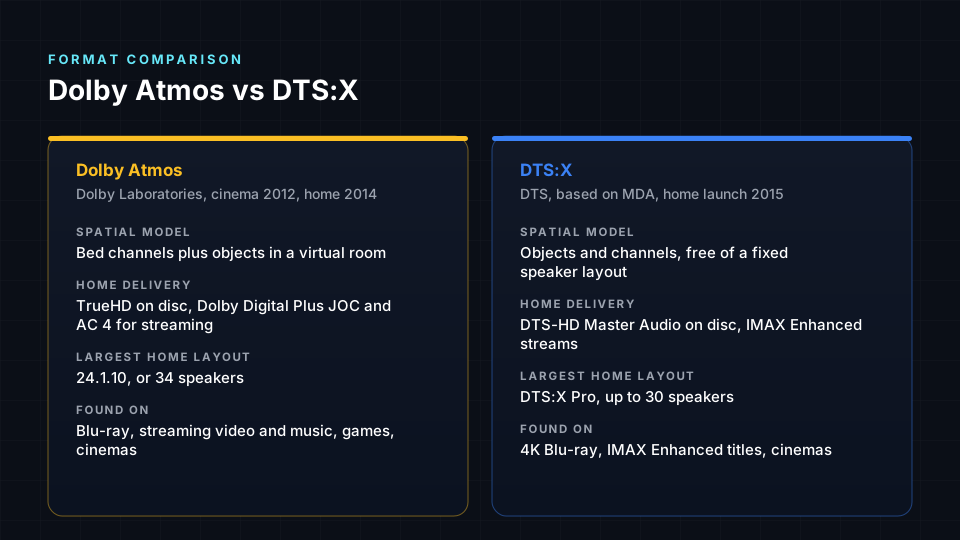
| Dolby Atmos | DTS:X | |
|---|---|---|
| Owner | Dolby Laboratories | DTS, part of Xperi |
| Cinema debut | 2012 | Cinema systems from 2015 |
| Home debut | 2014 | 2015 |
| Spatial model | Bed channels plus objects in a virtual room | Objects and channels, independent of a fixed layout |
| Disc codec | Dolby TrueHD (lossless) | DTS-HD Master Audio (lossless) |
| Streaming codec | Dolby Digital Plus JOC, AC-4 | DTS:X in IMAX Enhanced streams |
| Largest home layout | 24.1.10 (34 speakers) | DTS:X Pro, up to 30 speakers |
| Upmixer for older content | Dolby Surround | DTS Neural:X |
| Music streaming | Apple Music, Amazon Music, TIDAL | None |
| Streaming video | Most major services | IMAX Enhanced titles on Disney+ and selected devices |
Where each format comes from
Dolby Atmos
Dolby Atmos premiered with Pixar's Brave in 2012. It added overhead speakers and, more importantly, objects: individual sounds with positions that the cinema processor renders to whatever speakers that auditorium has. The home version followed in 2014 on Blu-ray and in AV receivers, then moved into streaming video, games consoles, soundbars, phones and, from 2019, music.
DTS:X and MDA
DTS:X grew out of MDA, Multi-Dimensional Audio, an object-based format developed by SRS Labs. DTS acquired SRS Labs in 2012 and positioned MDA as an open alternative to proprietary cinema formats, with early support from processor makers such as Trinnov. The MDA metadata and bitstream format was later published by ETSI as TS 103 223. DTS:X, launched for the home in 2015, is DTS's consumer brand for that object-based approach.
How Dolby Atmos works
An Atmos mix combines beds, fixed channel groups such as 7.1.2 for ambience and static elements, with objects that have positions in a virtual room. Positions are stored as x, y and z coordinates. At playback the renderer maps the room onto the speakers that exist: a cinema with dozens of speakers, a 7.1.4 living room, a soundbar or a pair of headphones.
For the home, Atmos travels in three main ways:
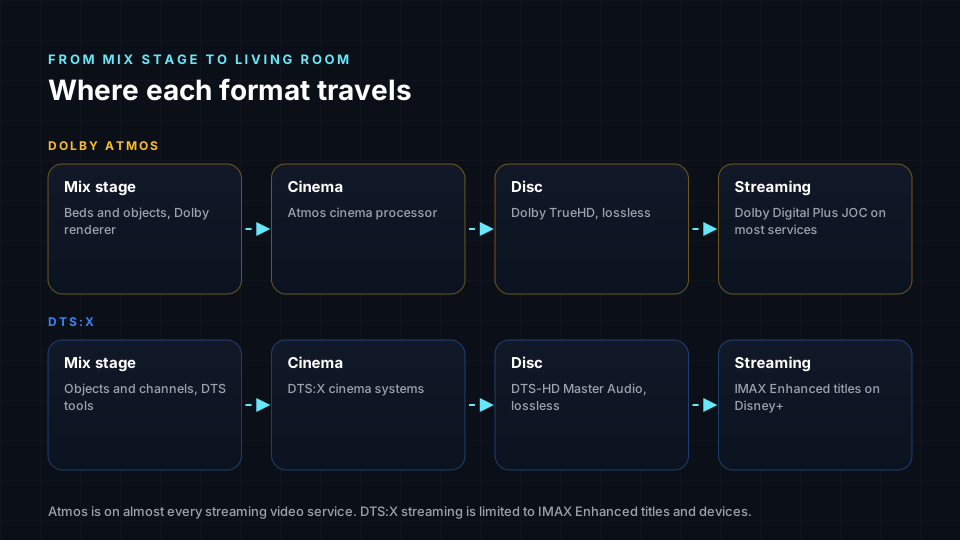
- Dolby TrueHD on Blu-ray, a lossless codec with the Atmos object data carried as an extension.
- Dolby Digital Plus with Joint Object Coding (JOC) for streaming. JOC groups objects into a smaller set of elements and sends instructions to rebuild them.
- AC-4, used in some broadcast systems and music services.
Atmos also has a headphone path. Dolby's binaural renderer turns beds and objects into a two-channel signal, which is how most people hear Atmos music.
How DTS:X works
DTS:X also combines channels and objects, but it was designed to be independent of any fixed speaker layout from the start. The renderer reads the positions in the stream and maps them to the speakers it has been told about, without requiring specific height positions. In practice receivers support the same common layouts for both formats, such as 5.1.2, 7.1.4 and 9.1.6.
On disc, DTS:X is carried inside DTS-HD Master Audio, a lossless codec with a backward-compatible core. A player or receiver that does not understand DTS:X can still play the core surround mix.
DTS:X also introduced dialogue control, which lets a viewer raise the level of dialogue relative to the rest of the soundtrack on supported content and devices. And DTS:X Pro, found in higher-end processors, renders to up to 30 speakers and can upmix older channel-based content with Neural:X.
The core difference
Technically the two formats are closer than the marketing suggests. Both use objects with position metadata. Both render to the speakers available. Both are lossless on disc. A well-mixed film sounds excellent in either.
The real difference is ecosystem:
- Streaming. Atmos is the immersive format on almost every major streaming video service. DTS:X streaming arrived much later, through IMAX Enhanced, and depends on specific devices.
- Music. Apple Music, Amazon Music and TIDAL deliver Atmos. No mainstream music service streams DTS:X.
- Headphones and phones. Atmos is built into many phones, laptops and consoles. DTS offers headphone virtualisation too, including DTS Headphone:X, but on fewer devices.
- Disc. Here they are equals. 4K Blu-ray titles ship in either format, and many studios choose DTS:X for some releases.
Speaker layouts and upmixing
Home Atmos supports layouts up to 24.1.10, which is 34 speakers. DTS:X Pro processors render to up to 30. These maximums matter to very few rooms. A well-calibrated 7.1.4 system, with four height speakers, delivers most of what either format can offer.
Both systems also include upmixers for channel-based content. Dolby Surround spreads stereo or 5.1 sources across an Atmos speaker layout. DTS Neural:X does the same for DTS systems, and DTS:X Pro can use it to fill very large layouts. Upmixers create a sense of space from existing channels. They do not create true object positions, and they cannot separate a stereo song into individually placed instruments.
Streaming: IMAX Enhanced and DTS:X
IMAX Enhanced is a certification and content programme run by IMAX and DTS. On May 15, 2024, Disney+ began offering IMAX Enhanced audio with DTS:X on selected Marvel titles and other films. The mix is a fixed 5.1.4 presentation, and it plays only on devices that support IMAX Enhanced with DTS:X, which is a much smaller list than devices that play Atmos.
That launch made DTS:X available on a major streaming service for the first time at scale. It does not change the overall picture: on most services, for most viewers, the immersive soundtrack is Atmos.
Music and DTS:X
For musicians the answer is simple. Music services deliver Dolby Atmos, and Apple Music, Amazon Music and TIDAL accept Atmos ADM BWF masters through labels and distributors. There is no mainstream route for releasing a DTS:X music mix to streaming services.
DTS:X music does exist on some concert Blu-rays and audio discs, and DTS Neural:X will upmix any stereo record on a home system. For a new release, though, Atmos is the delivery format, with an optional Eclipsa Audio version for YouTube. Our guide on where to publish spatial audio lists every route.

Licensing
Both formats are proprietary and licensed. Device makers pay to include Dolby or DTS decoding, studios use the companies' production tools, and content owners deliver to their specifications. MDA, the basis of DTS:X, was published as an ETSI specification, but the DTS:X brand, certification and consumer devices are controlled by DTS.
The royalty-free alternative is Eclipsa Audio, based on IAMF from the Alliance for Open Media. We compare it in Eclipsa Audio vs Dolby Atmos.
Which one should you use?
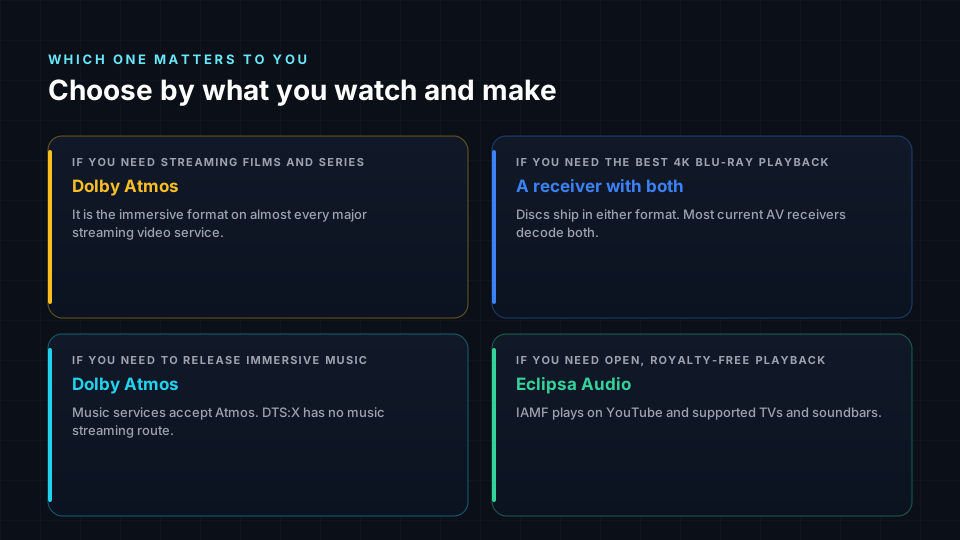
- Streaming films and series: Atmos matters most, because almost every service uses it.
- Collecting 4K Blu-rays: buy a receiver or soundbar that decodes both. Your discs will arrive in either format.
- Releasing music: make a Dolby Atmos master. It is the format music services accept.
- Reaching YouTube, TVs and soundbars without licensing fees: add an Eclipsa Audio version, which you can convert from an Atmos master.
Common misconceptions
- "DTS:X is better because DTS uses higher bitrates." That reputation comes from older lossy DTS on DVD. On 4K Blu-ray both formats are lossless, so bitrate is not the deciding factor.
- "DTS:X does not need height speakers, so it is more flexible." Both formats render to the speakers you have, with or without heights. Height speakers improve both.
- "Atmos is the only object-based format." DTS:X, MPEG-H 3D Audio and others use objects too.
- "Neural:X or Dolby Surround turns old films into Atmos or DTS:X." Upmixers spread existing channels around the room. They do not create a new object mix.
- "You can stream DTS:X music." Music services do not deliver DTS:X. They deliver Atmos.
Frequently asked questions
Is DTS:X better than Dolby Atmos?
On 4K Blu-ray they are comparable, and the quality of the mix matters more than the format. Atmos has much wider support across streaming services, music, phones and games.
Can my receiver play both Dolby Atmos and DTS:X?
Most current AV receivers from major brands decode both. Check the specifications for both logos before buying.
Does Netflix use DTS:X?
Netflix uses Dolby Atmos for its immersive soundtracks. DTS:X streaming is mainly available through IMAX Enhanced titles on Disney+ and selected devices.
What is DTS:X Pro?
The high-end version of DTS:X found in some processors and receivers. It renders to up to 30 speakers and can upmix channel-based content with Neural:X.
Can I release music in DTS:X?
Not to streaming services. Apple Music, Amazon Music and TIDAL deliver Dolby Atmos. For YouTube, an Eclipsa Audio version is the immersive option.
What is MDA?
Multi-Dimensional Audio, an object-based audio format developed by SRS Labs and acquired by DTS in 2012. It is the technical basis of DTS:X.
Sources
- IMAX Enhanced, DTS. The IMAX Enhanced programme and DTS:X audio.
- Disney+ Help Center, Disney. IMAX Enhanced titles and supported devices, including the 5.1.4 DTS:X mix available from May 15, 2024.
- Dolby Atmos for the Home Theater, Dolby Laboratories professional documentation. Home speaker layouts up to 24.1.10.
- Dolby professional documentation, Dolby Laboratories. Beds, objects, TrueHD, Dolby Digital Plus JOC and binaural rendering.
- ETSI TS 103 223, MDA: Object-Based Audio Immersive Sound Metadata and Bitstream, European Telecommunications Standards Institute. The published MDA specification.
- Delivering Dolby Atmos audio, Apple Music Provider Support. Atmos as the delivery format for Spatial Audio.
- Audio format updates, TIDAL Support. Formats supported on TIDAL.
Take your Atmos mix further
If you already work in Atmos, your master can reach more people. Keep it for streaming services and discs, and turn the same mix into Eclipsa Audio for YouTube, TVs and soundbars. Convert an Atmos master with Spatial9.
Dolby, Dolby Atmos and Dolby TrueHD are trademarks of Dolby Laboratories. DTS, DTS:X, DTS-HD Master Audio and Neural:X are trademarks of DTS, Inc. IMAX Enhanced is a trademark of IMAX Corporation. Spatial9 is not affiliated with or endorsed by Dolby Laboratories, DTS or IMAX.