Eclipsa Audio vs MPEG-H 3D Audio: Two Open Paths to Immersive Sound
Spatial9 Team · · Updated · 10 min read
Key takeaways
- MPEG-H 3D Audio was first published in 2015 as ISO/IEC 23008-3 and supports channels, objects and higher-order Ambisonics.
- MPEG-H has been on air in South Korea since 2017 and is the sole mandatory audio system for Brazil's TV 3.0.
- Eclipsa Audio is based on IAMF from the Alliance for Open Media, released in 2023 and launched on YouTube and Samsung TVs in 2025.
- IAMF is royalty-free and reuses Opus, AAC-LC, FLAC or LPCM, while MPEG-H uses its own core coder based on MPEG-D USAC.
Most comparisons in immersive audio pit one company's format against another, such as Dolby Atmos vs DTS:X in cinemas and home theatres. Eclipsa Audio and MPEG-H 3D Audio are different. Both are published specifications that anyone can implement, but they come from different organisations, solve different problems and follow different licensing models.
This guide explains how each one works, what is inside their bitstreams, where they are deployed and what the comparison means for creators. For the basics of immersive audio, start with our complete guide to spatial audio. For the Eclipsa side in more depth, see Eclipsa Audio vs Dolby Atmos.
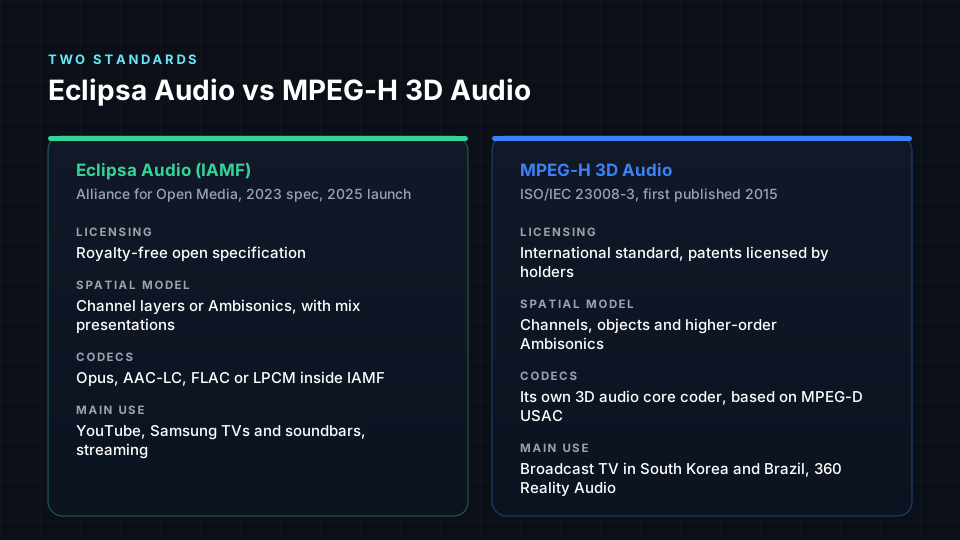
Eclipsa Audio vs MPEG-H at a glance
| Eclipsa Audio (IAMF) | MPEG-H 3D Audio | |
|---|---|---|
| Published by | Alliance for Open Media (AOMedia) | ISO/IEC, developed by MPEG |
| Specification | IAMF 1.0, 2023 | ISO/IEC 23008-3, first edition 2015 |
| Licensing | Royalty-free | Patents licensed by their holders |
| Spatial model | Channel-based layers or scene-based Ambisonics | Channels, objects and higher-order Ambisonics |
| Objects | Not in IAMF 1.0 | Yes, with position and interactivity metadata |
| Codecs | Opus, AAC-LC, FLAC, LPCM | Its own 3D audio core coder, based on MPEG-D USAC |
| Channel budget | By profile: Simple up to 16, Base up to 18, Base-Enhanced up to 28 | Set by profile and level |
| Personalisation | Multiple mix presentations | Dialogue control, languages, presets and positions |
| Main deployments | YouTube, Samsung 2025 TVs and soundbars | Broadcast TV in South Korea and Brazil, 360 Reality Audio |
Where each standard comes from
MPEG-H: next-generation broadcast audio
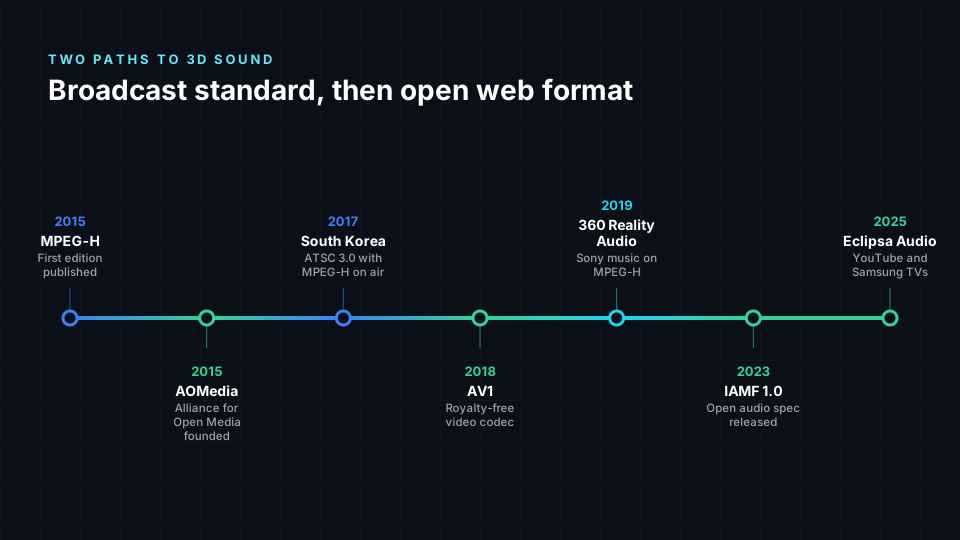
MPEG, the Moving Picture Experts Group, began work on a 3D audio standard in the early 2010s, as broadcasters prepared for ultra-high-definition television. The result, MPEG-H 3D Audio, was first published in 2015 as part 3 of the MPEG-H family, ISO/IEC 23008-3. Fraunhofer IIS, known for its work on MP3 and AAC, was a leading contributor and develops the MPEG-H Audio system used in products and broadcasts.
The design goals came straight from television. A broadcaster needed one stream that could play on a 7.1.4 system, a TV's built-in speakers or headphones; could carry several languages and commentary tracks; and would let viewers turn the dialogue up without remixing.
Eclipsa Audio: immersive audio for the open web
The Alliance for Open Media was founded in 2015 by technology and media companies to create royalty-free media formats for the web. Its first major result was the AV1 video codec in 2018. IAMF, the Immersive Audio Model and Formats specification, followed in 2023 as the audio companion. In January 2025 Google and Samsung launched it to consumers as Eclipsa Audio, with support on YouTube and on Samsung's 2025 TVs and soundbars.
IAMF's goals were different: an immersive format that any browser, phone, TV or streaming service could adopt without licensing fees, reusing codecs that devices already support.
How MPEG-H 3D Audio works
MPEG-H describes an audio scene from three kinds of content, which can be mixed in one stream:
- Channels, fixed speaker feeds in layouts up to and beyond 7.1.4.
- Objects, individual sounds with positions and metadata.
- Higher-order Ambisonics (HOA), a scene-based description of a full sound field.
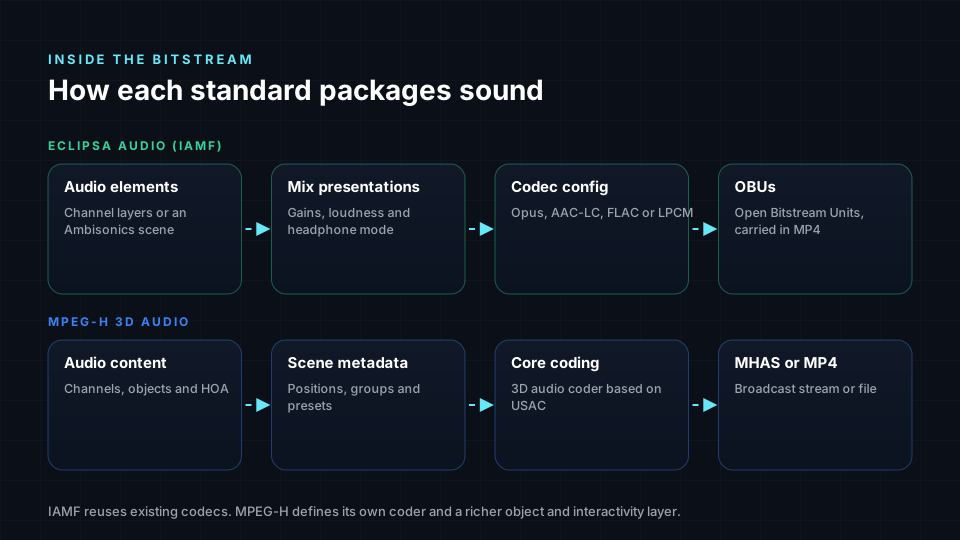
The audio is compressed with MPEG-H's own core coder, which builds on MPEG-D Unified Speech and Audio Coding (USAC). The stream is packaged in MHAS, the MPEG-H Audio Stream format, for broadcast, or in MP4 files for streaming and download.
A defining feature is interactivity. The metadata can group elements, mark which ones a viewer may adjust, set limits and define presets. A sports broadcast can offer a "commentary louder" preset, an "atmosphere only" preset and a choice of commentary languages, all in one stream. The decoder renders the result to speakers or binaurally to headphones.
How Eclipsa Audio works
IAMF organises a stream around two ideas:
- Audio elements hold the sound. Each is either channel-based, a layered set of speaker layouts that can scale from stereo up to 7.1.4, or scene-based, a first- or higher-order Ambisonics sound field.
- Mix presentations describe how to combine audio elements into finished mixes, each with its own gains, loudness information and a choice of speaker or binaural headphone rendering.
The audio itself is coded with existing codecs: Opus, AAC-LC, FLAC or uncompressed LPCM. Everything is carried in Open Bitstream Units (OBUs), the same packaging idea used by AV1, inside MP4 files. Profiles cap complexity: Simple allows up to 16 channels, Base up to 18 and Base-Enhanced up to 28.
IAMF 1.0 does not include object audio elements. Movement in an Eclipsa Audio mix is captured in the Ambisonics scene or the channel layers rather than as separate objects with metadata.
The core difference
MPEG-H is a complete, tightly specified audio system. It defines its own codec, a full object model, Ambisonics, interactivity rules, loudness control and rendering. That depth is why broadcasters chose it: a regulator can mandate one standard and know that every certified TV will behave the same way.
IAMF is a lighter container for immersive audio. It leaves compression to established codecs, keeps the scene model simple, and focuses on delivering finished mixes efficiently with clear loudness and rendering instructions. That simplicity, and the absence of royalties, is what suits it to browsers, phones and global platforms such as YouTube.
Put simply, MPEG-H gives the viewer controls over a mix. IAMF gives the platform an open, efficient way to deliver one.
Personalisation and interactivity
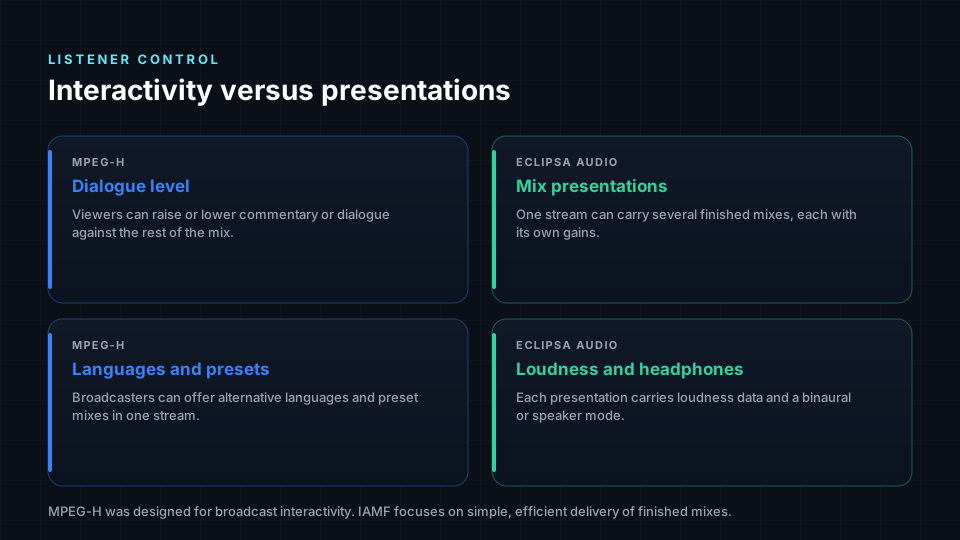
MPEG-H lets viewers change the balance of a mix within limits set by the broadcaster: dialogue level, commentary language, preset mixes and, in some cases, the position of an element. That is especially useful for accessibility, where raising dialogue helps viewers with hearing loss.
IAMF handles choice through mix presentations. A stream can carry more than one finished mix, for example a main mix and an alternative, each with its own loudness data and rendering mode. The listener or the player selects a presentation rather than adjusting individual elements.
Codecs and efficiency
MPEG-H's USAC-based coder is designed for efficient broadcast at controlled bitrates, with tools tailored to speech and music. Because the codec is part of the standard, every certified decoder implements it identically.
IAMF's choice of codecs trades some specialisation for reach. Opus is already in every major browser and in Android, AAC-LC is supported on nearly every device, and FLAC and LPCM offer lossless options. A platform can choose the codec that suits its bandwidth and device base without adopting a new one.
Where each standard plays
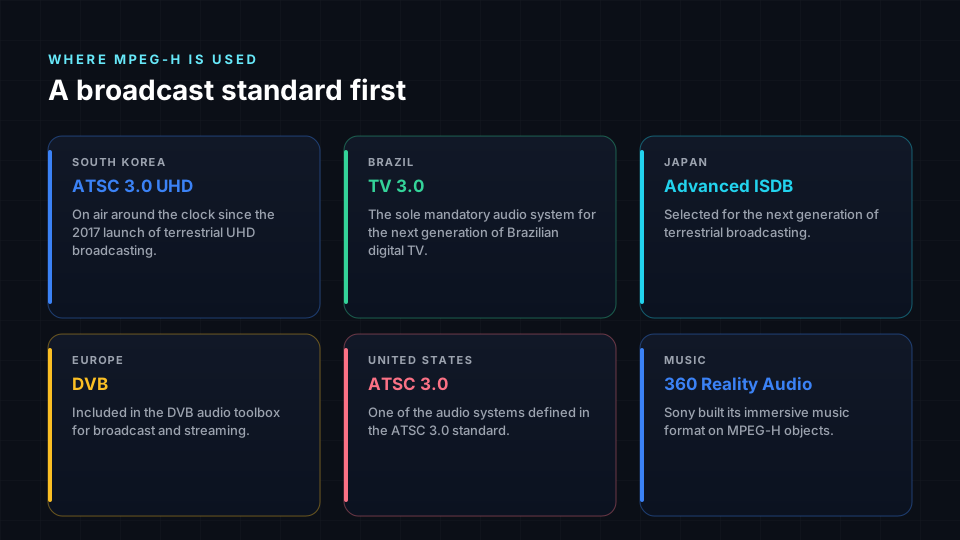
MPEG-H 3D Audio is part of the ATSC 3.0, DVB, TTA and SBTVD broadcast standards. It has been on air around the clock in South Korea since terrestrial UHD broadcasting launched in 2017, has been used in Brazil since 2019 and is the sole mandatory audio system for Brazil's TV 3.0. It has also been selected for Japan's advanced ISDB system. In music, Sony built 360 Reality Audio on MPEG-H objects; see Dolby Atmos vs Sony 360 Reality Audio.
Eclipsa Audio plays on YouTube and on Samsung's 2025 TVs and soundbars, with open-source encoders, decoders and DAW plugins available. Its reach comes from the platforms that adopt it rather than from broadcast regulation.

Licensing
IAMF is a royalty-free specification. AOMedia members commit to licensing their essential patents without royalties, as with AV1, and reference software is open source. Our article on why open source matters for immersive audio explains why that matters.
MPEG-H is an open standard in the sense that its specification is published and anyone can implement it, but patents essential to it are licensed by their holders. Broadcast receivers and other devices that implement it typically pay licensing fees.
Which one should you use?
- Broadcasting live TV in a region that mandates MPEG-H: MPEG-H is the requirement, and your broadcast tools will support it.
- Publishing music or video for YouTube and connected TVs: Eclipsa Audio is the format that plays there.
- Releasing to music services: neither is the main route. Apple Music, Amazon Music and TIDAL deliver Dolby Atmos. See where to publish spatial audio.
- Building one master for many outlets: keep stems and positions, then render the formats you need. Spatial9 exports Eclipsa Audio directly and can convert an Atmos master.
Common misconceptions
- "MPEG-H is just Sony's music format." 360 Reality Audio uses MPEG-H, but the standard's main use is broadcast television.
- "Open standard means royalty-free." MPEG-H is published openly, but its essential patents are licensed. IAMF is designed to be royalty-free.
- "Eclipsa Audio supports objects like Atmos." IAMF 1.0 uses channel layers and Ambisonics, not objects with metadata.
- "MPEG-H needs a speaker system." It renders to speakers, TV speakers and headphones.
- "The two formats compete for the same market." Today they mostly serve different ones: broadcast television for MPEG-H, the open web and connected TVs for Eclipsa Audio.
Frequently asked questions
Is Eclipsa Audio based on MPEG-H?
No. Eclipsa Audio is based on IAMF from the Alliance for Open Media. It uses codecs such as Opus and AAC rather than MPEG-H's core coder.
Is MPEG-H 3D Audio royalty-free?
No. The specification is published by ISO/IEC, but essential patents are licensed by their holders. IAMF is designed to be royalty-free.
Where is MPEG-H used?
Mainly in broadcast television, including ATSC 3.0 in South Korea and TV 3.0 in Brazil, and in Sony 360 Reality Audio for music.
Does Eclipsa Audio support object-based audio?
Not in IAMF 1.0. It supports channel-based layers and scene-based Ambisonics, combined through mix presentations.
Can MPEG-H play on headphones?
Yes. MPEG-H decoders can render the scene binaurally for headphones, as 360 Reality Audio does.
Which is better for YouTube?
Eclipsa Audio. YouTube supports Eclipsa Audio uploads, and it does not play MPEG-H.
Sources
- IAMF specification, Alliance for Open Media. Audio elements, mix presentations, OBUs, codecs and profiles.
- Introducing Eclipsa Audio: immersive audio for everyone, Google Open Source Blog, January 2025. YouTube and Samsung's 2025 TV lineup.
- Introducing Open Source DAW Plugin for Eclipsa Audio, Google Open Source Blog, June 2025. IAMF profiles and channel counts.
- MPEG-H Audio, Fraunhofer IIS. Channels, objects, Ambisonics, interactivity and rendering.
- MPEG-H adoption, Fraunhofer IIS. Deployments in ATSC 3.0, DVB, TTA and SBTVD, South Korea, Brazil and Japan.
- ISO/IEC 23008-3, Information technology: High efficiency coding and media delivery in heterogeneous environments, Part 3: 3D audio, International Organization for Standardization. The MPEG-H 3D Audio standard.
- Sony launches 360 Reality Audio, Sony Group press release, October 2019. 360 Reality Audio built on MPEG-H.
Make an Eclipsa Audio version of your music
Eclipsa Audio is the immersive format that plays on YouTube and a growing list of TVs and soundbars. Spatial9 can turn a stereo song, a set of stems or an Atmos master into an Eclipsa Audio file. See how it works for artists and producers.
360 Reality Audio is a trademark of Sony Group Corporation. MPEG-H, Eclipsa Audio and all other names are trademarks of their respective owners. Spatial9 is not affiliated with or endorsed by Fraunhofer IIS, the Alliance for Open Media, Google or Sony.