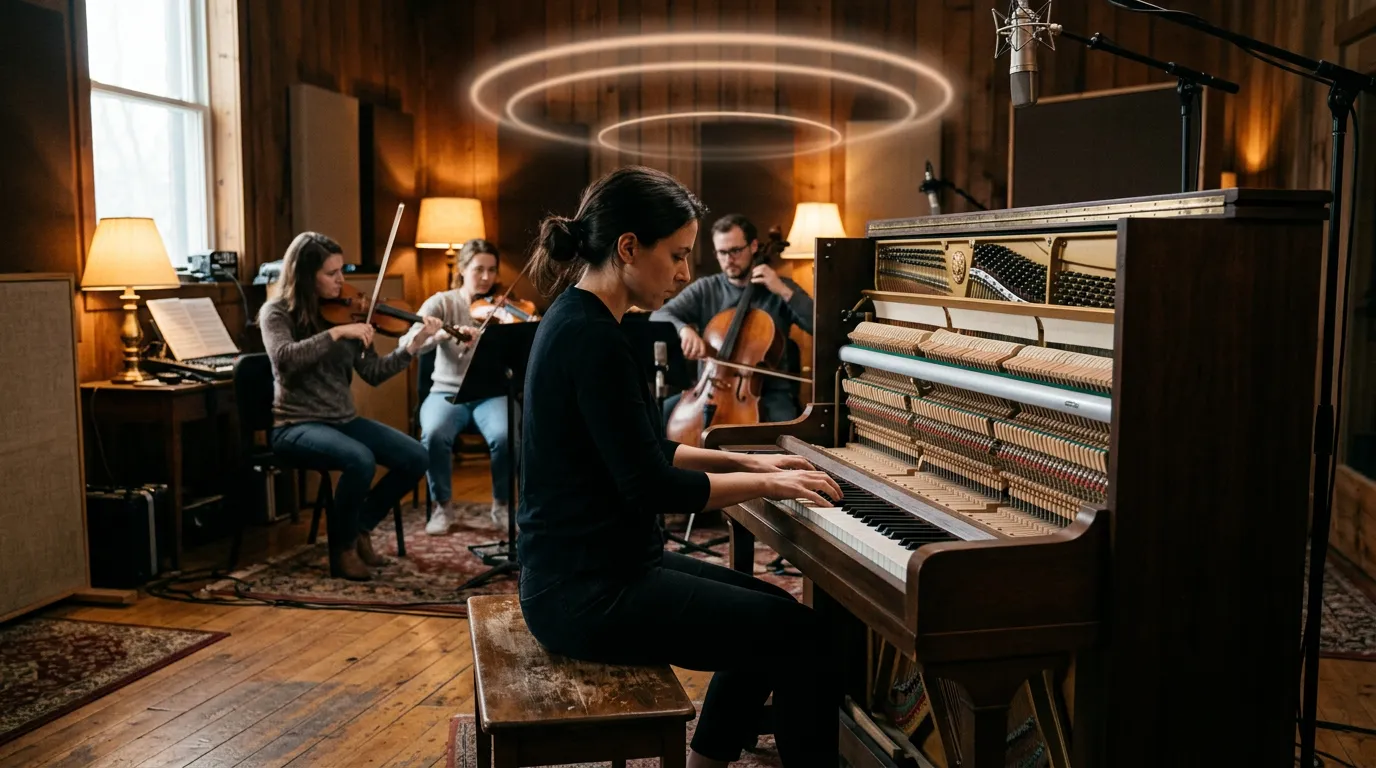
Spatial Audio & Immersive Music for Neoclassical: Modern Classical, Ambient Piano & Cinematic Strings
Spatial9 Team · · 10 min read
Part of the series Spatial audio and immersive music by genre.
Key takeaways
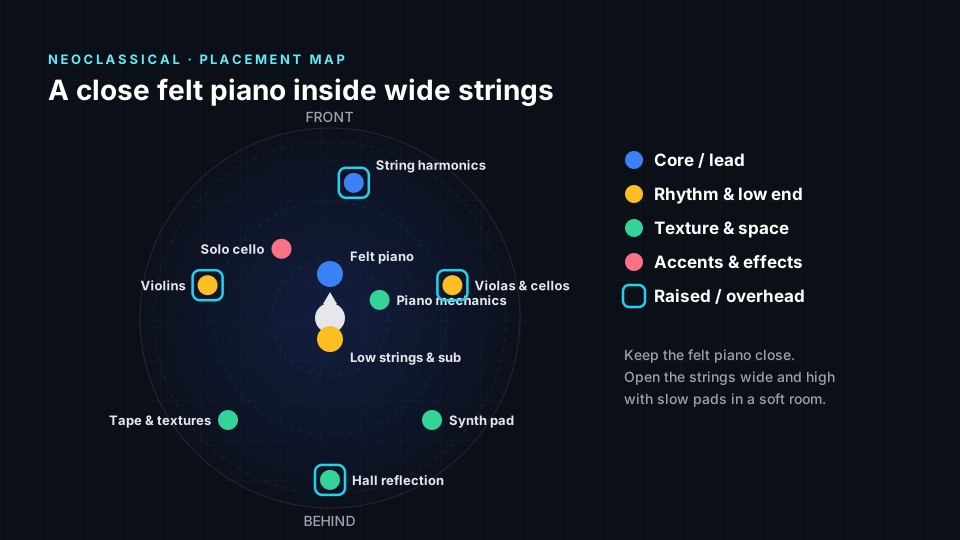
- In a spatial neoclassical mix the felt piano stays close and centred in front of the listener, while a solo cello sits beside it and the violins and lower strings open wide and slightly raised to either side.
- Setting the solo cello at an angle from the piano keeps both lines clear even though they share the same range, an effect known as spatial release from masking.
- Neoclassical depends on the contrast between a dry, intimate piano and a deep, soft room, so slow drifting pads and a raised hall tail matter more than fast movement.
- The neoclassical immersion profile scores width 3, height 3, movement 2, low-end focus 2 and space 4 out of 5.
Neoclassical, also sold as modern classical or post-classical, is the quiet, emotional instrumental music that grew from the late 1990s and 2000s out of the overlap between concert music, ambient and electronic production. Its roots run back to Erik Satie's sparse Gymnopédies of 1888, American minimalism and the ambient records of the late 1970s. Jóhann Jóhannsson and composers in Iceland, Germany, Britain and Italy shaped the sound in the 2000s and 2010s, often in small studios. The core instruments are a piano, often fitted with a strip of felt between hammers and strings for a muffled, intimate tone, a small string ensemble and subtle electronics: synth pads, tape loops and granular textures. Pieces are short, slow and repetitive, often 50 to 80 BPM, built on ostinatos, simple chord cycles and long crescendos. Almost every record is a modern digital stereo production, close-miked and layered. It suits spatial audio because it already mixes two distances, the piano beside you and the strings far away. This guide covers how spatial audio for neoclassical works, where to place each element and how to make an immersive neoclassical mix. For the basics, see what spatial audio is.
Why neoclassical works in spatial audio
Neoclassical lives on contrast between near and far. The felt piano is recorded inches from the strings, so you hear the hammers and pedal, while the string section carries room and reverb, like a film score heard from a distance. In stereo both sit on one flat line, and the strings often swamp the piano when they swell. In an immersive mix the piano stays close in front while the strings open into a wide, slightly raised arc and the electronics breathe slowly behind.
The rule: an intimate piano up close, cinematic strings wide around it. Keep the piano centred and near, give the strings and pads the width and height, and keep the low end calm and centred.
Immersive music for neoclassical: what listeners hear
- A piano right beside you. The felt piano sits close and centred, every soft hammer audible.
- Strings that open the room. Violins and lower strings spread wide and slightly above.
- A solo line you can follow. A cello stands apart from the piano instead of blending into it.
- Slow air behind you. Pads and tape textures drift gently at the back.
Where to place each element in a neoclassical mix
| Element | Position | Height | Why it works |
|---|---|---|---|
| Felt piano | Front centre, close | Ear level | The intimate lead voice |
| Piano mechanics | Front right of centre, very close | Ear level | Hammer and pedal noise that make it real |
| Low strings & sub | Centre | Ear level | Double bass and sub swells underneath |
| Solo cello | Front left | Ear level | The singing line beside the piano |
| Violins | Wide left | Slightly raised | Long cinematic lines that open the space |
| Violas & cellos | Wide right | Slightly raised | Inner harmony balancing the violins |
| String harmonics | Front, high | Raised | Airy, shimmering notes above the stage |
| Synth pad | Behind right, drifting slowly | Ear level | A slow wash of electronic colour |
| Tape & textures | Behind left, drifting slowly | Ear level | Loops, hiss and grains that add warmth |
| Hall reflection | Behind | Raised | A soft, large room tail |
The psychoacoustics behind neoclassical placement
Every position in the table above follows how the ear and brain locate sound. Here is the reason behind the main choices for neoclassical.
- Low strings and sub stay centred. The ear finds almost no direction in frequencies below roughly 80 to 100 Hz, so the double bass and sub swells gain nothing from being spread.
- Solo cello set apart from the piano. Two sounds that share a frequency range mask each other far less when they arrive from different directions. This is spatial release from masking. A modest angle keeps cello and piano clear.
- String harmonics raised. The outer ear shapes high frequencies differently depending on where a sound comes from, and the brain reads those spectral notches as height. These are elevation spectral cues (Hebrank and Wright). Bright harmonics lift naturally when placed above the front.
- Wide strings with lateral reflections. Early reflections arriving from the sides make a sound feel broad and enveloping. This is spatial impression from early lateral reflections (Barron and Marshall). Spreading the strings to the sides gives the swell its size without pushing the piano away.
The immersion profile for neoclassical
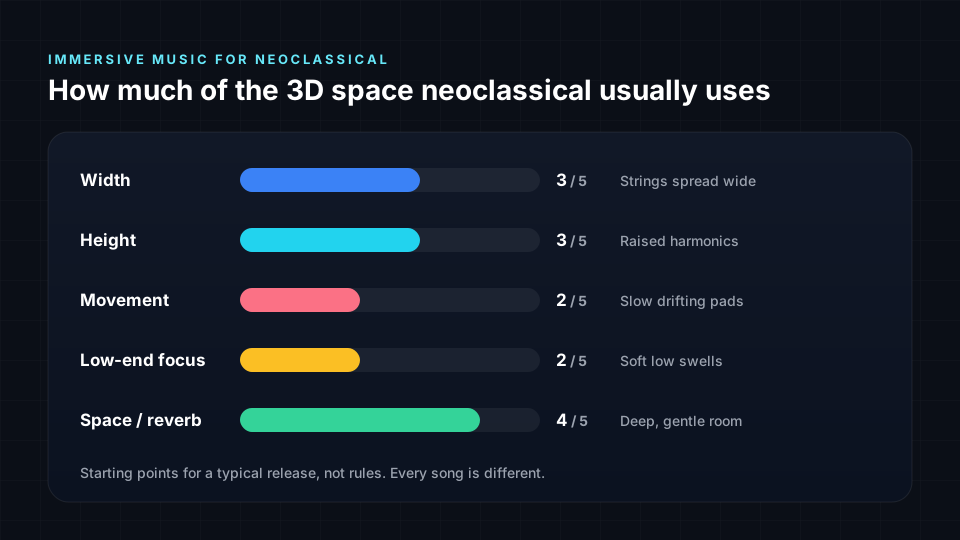
Space scores 4 because the contrast between a dry piano and a deep room is the heart of the style. Width scores 3: the strings spread wide, but the piano stays a small, close point. Height scores 3, with harmonics and the hall tail lifted gently. Movement scores 2, from slowly drifting pads. Low-end focus is 2, since soft low swells support the music without driving it.
Tips for an immersive neoclassical mix
- Keep the felt piano close and centred. Never push it back or spread it wide.
- Keep the mechanics, but quietly. Hammer and pedal noise sell the intimacy; do not exaggerate it.
- Open the strings to the sides. Spread them wide and slightly raised so their swell surrounds the piano.
- Move only the electronics, and slowly. Pads drift over many bars; piano and strings stay fixed.
- Keep the low end soft and centred. Sub swells and double bass should be felt more than heard.
Neoclassical styles: modern classical, ambient piano and cinematic strings
The core placement holds for every style here: an intimate lead close in front, a soft centred low end and a large, gentle room. What changes is the balance of piano, strings and electronics.
Modern Classical
Modern classical is the concert-leaning side of the genre, with written scores for piano, string quartet or small chamber orchestra, sometimes joined by voice, harp or celesta. Pieces are longer and more developed than ambient piano works, with slowly shifting harmonies, repeated cells and recomposed baroque or romantic material. Treat the ensemble like a small group on a stage in front of you: piano close at centre, strings in a moderate arc behind it, any voice slightly forward. Keep the width closer to a chamber group than a film orchestra, with a warm hall and a slightly raised tail. Electronics, if present, sit low and still behind the ensemble.
Ambient Piano
Ambient piano is the most intimate style: a single upright or grand, often felt-muffled or played with the una corda pedal, recorded very close at quiet tempos, sometimes over tape loops and soft drones. The piano is everything, so keep it close and centred and do not spread it across the room. Let the mechanical sounds sit just beside it. Delays and reverb returns can widen slightly behind and above, so the room grows around a piano that stays put. Pads and tape hiss belong low behind the listener, drifting very slowly.
Cinematic Strings
Cinematic strings bring the scale of a film score into neoclassical: layered sections, long legato lines, pulsing ostinatos and slow crescendos, often built from multitracked players or sample libraries blended with synths. Width and height carry the drama. Spread the violins wide left, violas and cellos wide right, and lift the upper lines slightly. Keep the double bass and low synth swells centred and soft. If a piano or soloist leads, hold it close in front so the strings surround it. The hall can be larger, with a longer raised tail, but keep movement for the pads alone.
Related styles such as post-minimalist piano music and quiet instrumental soundtrack work follow the same idea: hold the lead instrument close and centred, then open the strings and the room around it.
How to make immersive neoclassical from stereo
Spatial9 can create spatial audio from a stereo track in a few steps:
- Upload your stereo master or your stems.
- Spatial9's AI separates and places each part, pulling the felt piano, solo instruments, string sections and electronic textures apart and setting the piano close in front with the strings and pads wide and deep around it.
- Preview it in binaural on headphones.
- Export Eclipsa Audio, ADM, binaural or Ambisonics.
- Publish a video. Create a YouTube-ready video with your immersive audio and publish it directly.
For related guides, read spatial audio for ambient and spatial audio for film and game scores. Every guide is listed in spatial audio and immersive music by genre.
Frequently asked questions
Does this guide cover modern classical, ambient piano and cinematic strings?
Yes. Modern classical places a piano and small ensemble on a stage in front of you in a warm hall. Ambient piano keeps one close felt piano at the centre of a soft, distant room. Cinematic strings open wide, slightly raised string sections around a close lead instrument.
Can I make a neoclassical mix in Dolby Atmos or Eclipsa Audio?
Yes. The placements in this guide work for both. Spatial9 exports ADM, the standard file used by Dolby Atmos studios, as well as Eclipsa Audio for YouTube, so one immersive neoclassical mix covers both. If you plan to release the Atmos version on Apple Music, build it from your original stems or multitracks, because Apple does not accept Atmos made from a finished stereo master. See where to publish spatial audio. You may also hear this called a 3D neoclassical mix or neoclassical in spatial audio.
Is spatial audio good for neoclassical?
Yes. Neoclassical sets a close piano against wide strings and soft electronics. Spatial audio keeps the piano near while the strings open around it.
Is this the same as Stravinsky's neoclassicism or neoclassical metal?
No. Neoclassicism in the 1920s and 1930s saw composers such as Stravinsky revive 18th-century forms, and those works suit a concert hall layout. Neoclassical metal is a guitar style. This guide covers the modern piano, strings and electronics genre.
Where should the felt piano go in an immersive neoclassical mix?
Put it at front centre, close and at ear level, as a fairly narrow source. Keep its hammer and pedal noise right beside it so it feels like one real piano.
How much should the electronics move in a neoclassical mix?
Very little. Let pads and tape textures drift slowly behind the listener. Fast panning breaks the calm.
Does immersive neoclassical work on normal headphones?
Yes. The mix is rendered binaurally, so the close piano, wide strings and soft pads work on any regular headphones.
Dolby and Dolby Atmos are trademarks of Dolby Laboratories. Spatial9 is not affiliated with or endorsed by Dolby Laboratories.
Sources
- Blauert, J. (1997). Spatial Hearing: The Psychophysics of Human Sound Localization, revised edition. MIT Press. Low-frequency, elevation, distance and motion cues.
- Mills, A. W. (1958). On the minimum audible angle. Journal of the Acoustical Society of America, 30(4), 237-246.
- Hebrank, J. and Wright, D. (1974). Spectral cues used in the localization of sound sources on the median plane. Journal of the Acoustical Society of America, 56(6), 1829-1834.
- Bronkhorst, A. W. (2000). The cocktail party phenomenon: a review of research on speech intelligibility in multiple-talker conditions. Acta Acustica united with Acustica, 86, 117-128.
- Litovsky, R. Y., Colburn, H. S., Yost, W. A. and Guzman, S. J. (1999). The precedence effect. Journal of the Acoustical Society of America, 106(4), 1633-1654.
- Barron, M. and Marshall, A. H. (1981). Spatial impression due to early lateral reflections in concert halls. Journal of Sound and Vibration, 77(2), 211-232.
- Neuhoff, J. G. (1998). Perceptual bias for rising tones. Nature, 395, 123-124.
- Bregman, A. S. (1990). Auditory Scene Analysis: The Perceptual Organization of Sound. MIT Press.
- Ross, A. (2007). The Rest Is Noise: Listening to the Twentieth Century. Farrar, Straus and Giroux.
Bring the piano closer
Upload a track to Spatial9 and hear a felt piano beside you while the strings open into a wide, soft room in minutes. Then export it or publish it straight to YouTube.