Spatial Audio & Immersive Music for Experimental Music: Complete Guide
Spatial9 Team · · Updated
Part of the series Spatial audio and immersive music by genre.
Experimental music is a wide family of styles that break the usual rules of melody, rhythm and structure. Think of noise, drone, musique concrète built from recorded everyday sounds, granular synthesis, sound art, electroacoustic pieces and avant-garde improvisation. Many experimental composers worked with sound in space long before spatial audio reached streaming, using speaker domes and multi-speaker concerts. Spatial audio now lets anyone hear that kind of work on headphones. This guide covers how spatial audio for experimental music works, where to place each element and how to make an immersive experimental mix. For the basics, see what spatial audio is.
Why experimental music is perfect for spatial audio
In most genres, space supports the song. In experimental music, space can be the song. The direction, distance and movement of a sound can be as important as its pitch or rhythm. Stereo only offers a line between two speakers. Spatial audio offers a full sphere, including above and behind the listener, which opens up completely new ideas.
Total freedom can also be confusing. If everything moves all the time, the listener loses their bearings. A single anchor, such as a drone or a repeating motif, gives them something to hold on to while the rest of the piece explores the space.
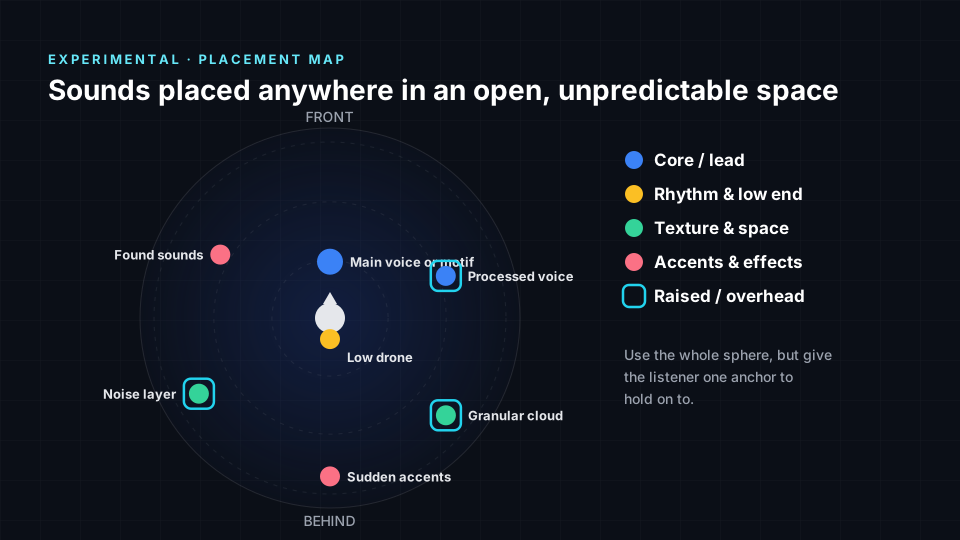
The rule: use the whole sphere, but give the listener one anchor to hold on to.
Immersive music for experimental music: what listeners hear
- Sound as a place. The piece feels like a space you are standing inside.
- Surprise from every direction. Sounds can appear above, behind or right beside you.
- Real movement. Sounds travel around the listener as part of the composition.
- A thread to follow. The anchor keeps the experience focused.
Where to place each element in an experimental mix
| Element | Position | Height | Why it works |
|---|---|---|---|
| Main voice or motif | Front centre | Ear level | Gives the listener a clear anchor |
| Low drone | Centre | Ear level | Grounds the piece without a clear direction |
| Found sounds | Front left, moving | Ear level | Real-world sounds feel alive when they travel |
| Processed voice | Front right | Raised | Floating voices feel strange and dreamlike |
| Noise layer | Behind left | Raised | Texture above creates a sense of scale |
| Granular cloud | Behind right | Raised | Tiny grains of sound surround the listener |
| Sudden accents | Behind, moving | Ear level to raised | Unexpected events keep attention sharp |
The psychoacoustics behind experimental placement
- Front and back spectral cues. Our ears shape sound differently from behind and above, which makes height and rear placement clearly audible (Hebrank and Wright, 1974).
- Looming sounds grab attention. Sounds that rise or approach feel more urgent, a powerful tool for tension (Neuhoff, 1998).
- Grouping by location. Sounds from the same place tend to be heard as one stream, so placement can join or separate ideas (Bregman, 1990).
- The precedence effect. The first-arriving sound sets where we hear it, so short delays between positions can create surprising spatial illusions (Litovsky et al., 1999).
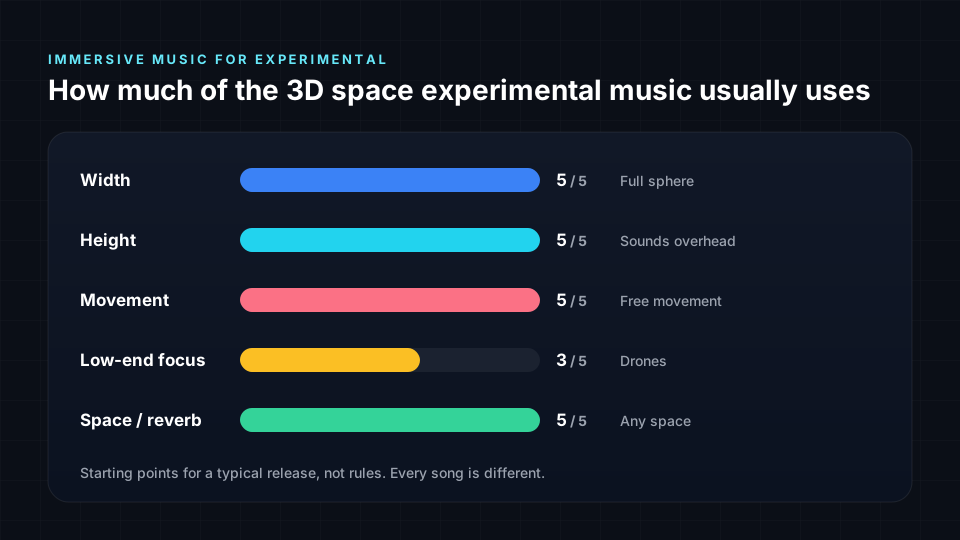
The immersion profile for experimental music
Tips for an immersive experimental mix
- Choose an anchor first. Decide what stays still before deciding what moves.
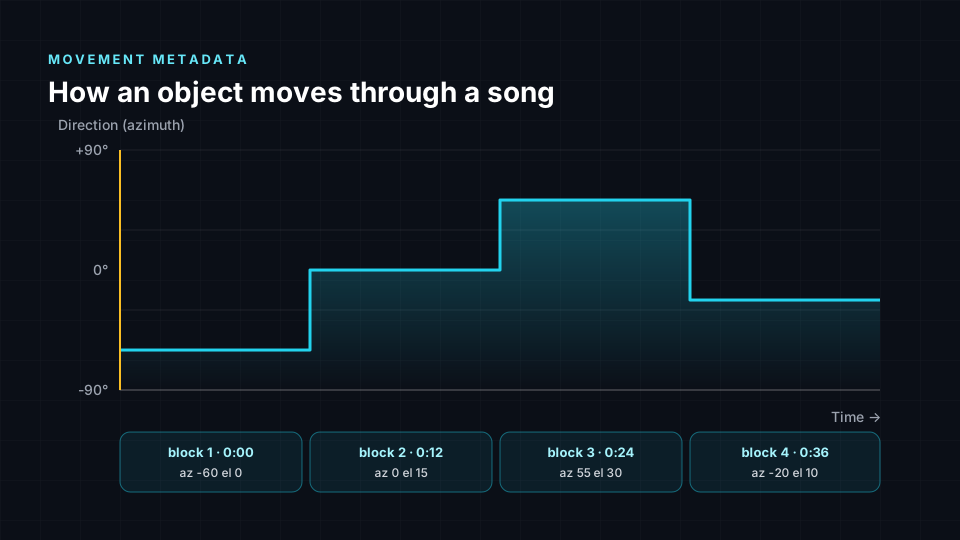
- Treat movement as a musical line. Plan where each sound travels, just like a melody.
- Use height on purpose. Sounds above the listener feel unusual, so save them for key moments.
- Leave silence around events. Empty space makes each new sound more striking.
- Check on headphones and speakers. Experimental pieces often rely on detail, so test on both.
How to make immersive experimental music from stereo
Spatial9 can create spatial audio from a stereo track in a few steps:
- Upload your stereo master or your stems.
- Spatial9's AI separates and places each part, from drones and voices to textures and found sounds.
- Preview it in binaural on headphones.
- Export Eclipsa Audio, ADM, binaural or Ambisonics.
- Publish a video. Create a YouTube-ready video with your immersive audio and publish it directly.
For related guides, read spatial audio for ambient music, spatial audio for minimal techno and spatial audio for film and game scores. Every guide is listed in spatial audio and immersive music by genre.
Frequently asked questions
Can I make an experimental mix in Dolby Atmos or Eclipsa Audio?
Yes. The placements in this guide work for both. Spatial9 exports ADM, the standard file used by Dolby Atmos studios, as well as Eclipsa Audio for YouTube, so one immersive experimental mix covers both. You may also hear this called a 3D experimental mix or experimental music in spatial audio.
Is Ambisonics a good format for experimental music?
Often, yes. Ambisonics captures a full sphere of sound and is popular for sound art and installations. Spatial9 can export Ambisonics alongside Eclipsa Audio, ADM and binaural.
Should everything move in an experimental mix?
No. Constant movement becomes tiring and hard to follow. Keep at least one element still so the movement of the others means something.
How do I use height in experimental music?
Place textures and processed sounds above the listener for moments of scale or strangeness. Height is unusual in everyday listening, so it is very noticeable.
Can I convert a released experimental piece to spatial audio?
Yes. Spatial9 uses AI to separate a stereo master into its parts and export an immersive mix as Eclipsa Audio, ADM, binaural or Ambisonics.
Does immersive experimental music work on normal headphones?
Yes. The mix is rendered binaurally, so sounds can appear around, above and behind you on any regular headphones.
Dolby and Dolby Atmos are trademarks of Dolby Laboratories. Spatial9 is not affiliated with or endorsed by Dolby Laboratories.
Sources
- Bregman, A. S. (1990). Auditory Scene Analysis: The Perceptual Organization of Sound. MIT Press.
- Hebrank, J. and Wright, D. (1974). Spectral cues used in the localization of sound sources on the median plane. Journal of the Acoustical Society of America, 56(6), 1829-1834.
- Litovsky, R. Y., Colburn, H. S., Yost, W. A. and Guzman, S. J. (1999). The precedence effect. Journal of the Acoustical Society of America, 106(4), 1633-1654.
- Neuhoff, J. G. (1998). Perceptual bias for rising tones. Nature, 395, 123-124.
- Blauert, J. (1997). Spatial Hearing: The Psychophysics of Human Sound Localization, revised edition. MIT Press.
Turn your sound into a space
Upload an experimental piece to Spatial9 and hear it unfold around you in minutes. Then export it or publish it straight to YouTube.