Spatial Audio & Immersive Music for Minimalist Music: Phase Music, Post-Minimalism & Holy Minimalism
Spatial9 Team · · 10 min read
Part of the series Spatial audio and immersive music by genre.
Key takeaways
- In a spatial minimalist music mix each pair of identical or interlocking parts sits on opposite sides of the listener, while the steady pulse holds the front centre and voices float slightly raised.
- Placing two phasing pianos on opposite sides lets the brain follow each one as a separate line as they drift apart, an effect known as auditory stream segregation.
- The movement in minimalist music comes from the phasing process itself, so the parts stay fixed in a clear, medium room while slow swells breathe behind the listener.
- The minimalist music immersion profile scores width 4, height 3, movement 3, low-end focus 1 and space 3 out of 5.
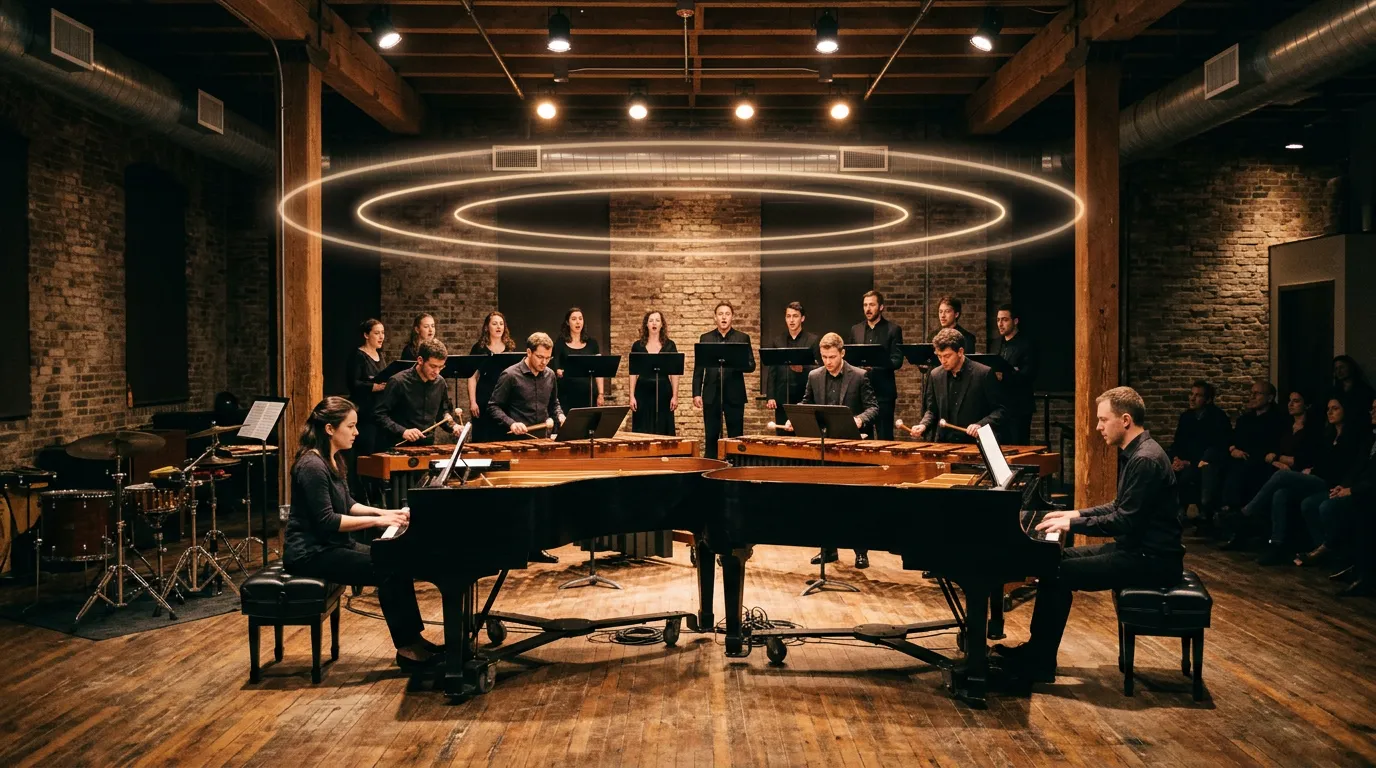
Minimalist music began in the United States in the late 1950s and 1960s as a reaction against post-war modernism. La Monte Young explored long drones, Terry Riley's In C of 1964 set 53 short phrases over a repeated high C on the piano, and Steve Reich discovered phasing with tape loops in It's Gonna Rain in 1965, then moved it to live players in Piano Phase in 1967. Philip Glass built long additive patterns for amplified organs, winds and voice, leading to the opera Einstein on the Beach in 1976. The typical sound is pulsing marimbas, pianos and electric organs, often with clarinets, strings and wordless voices, built from short cells repeated and changed very slowly over one fixed pulse. Most recordings are stereo studio productions from the 1970s onwards, while early tape works are often mono. It suits spatial audio because its meaning lies in how patterns interlock. This guide covers how spatial audio for minimalist music works, where to place each element and how to make an immersive minimalist music mix. For the basics, see what spatial audio is.
Why minimalist music works in spatial audio
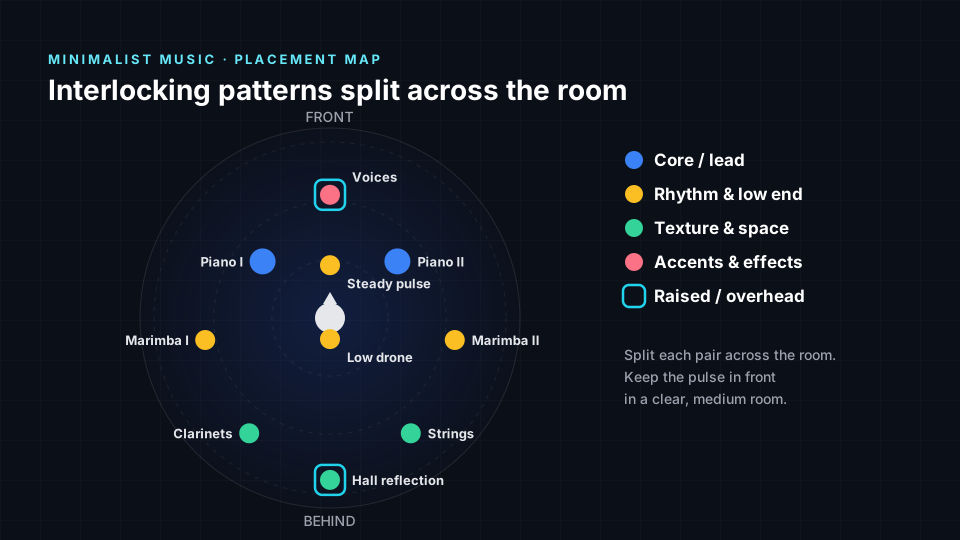
Minimalist music is built from repetition and small changes. Two players play the same pattern, one slowly moves ahead, and new melodies, called resultant patterns, appear in the gaps between them. Marimbas, pianos and voices interlock so tightly that in stereo they fuse into one shimmering block, and the process becomes hard to follow. In an immersive mix the paired parts sit on opposite sides, the pulse stays in front and sustained colours wrap around the room, so you hear both the lines and the pattern they make.
The rule: pair the patterns across the room, keep the pulse in front. Put interlocking parts on opposite sides at the same distance, hold the pulse at the centre and keep the low end light.
Immersive music for minimalist music: what listeners hear
- Two patterns you can tell apart. As the parts drift out of phase, each one stays on its own side.
- Melodies that appear between them. Resultant patterns seem to move across the space as the phase shifts.
- A pulse you can lean on. The steady beat sits in front, anchoring the whole process.
- Swells that breathe around you. Clarinets, strings and voices rise and fall slowly behind and above.
Where to place each element in a minimalist music mix
| Element | Position | Height | Why it works |
|---|---|---|---|
| Piano I | Front left | Ear level | The fixed pattern that holds its place |
| Piano II | Front right | Ear level | The same pattern drifting ahead out of phase |
| Steady pulse | Front centre | Ear level | The repeated beat that anchors every change |
| Marimba I | Wide left | Ear level | One half of an interlocking mallet pattern |
| Marimba II | Wide right | Ear level | The answering half of the pattern |
| Voices | Front centre, further back | Raised | Wordless lines floating above the ensemble |
| Clarinets | Behind left, swelling | Ear level | Breath-length pulses that rise and fade |
| Strings | Behind right, swelling | Ear level | Sustained chords that colour each section |
| Low drone | Centre | Ear level | A light bass or organ pedal underneath |
| Hall reflection | Behind | Raised | A clear, medium room around the ensemble |
The psychoacoustics behind minimalist music placement
Every position in the table above follows how the ear and brain locate sound. Here is the reason behind the main choices for minimalist music.
- Phasing parts on opposite sides. The brain groups sounds into streams by pitch, timing and direction. This is auditory stream segregation (Bregman). Two identical pianos from opposite sides can each be followed as they drift.
- Interlocking marimbas close in pitch. The ear can tell apart sources only a few degrees apart at the front, a limit measured as the minimum audible angle (Mills). Wide angles keep closely voiced mallet parts distinct.
- A clear, medium room. When a sound and its reflections arrive close together, the brain places it by the first arrival. This is the precedence effect. Moderate reflections add bloom without smearing fast repeated notes.
- Voices lifted. The outer ear shapes high frequencies by direction, and the brain reads those spectral cues as height (Hebrank and Wright). Wordless sopranos rise naturally above the mallets when slightly raised.
The immersion profile for minimalist music
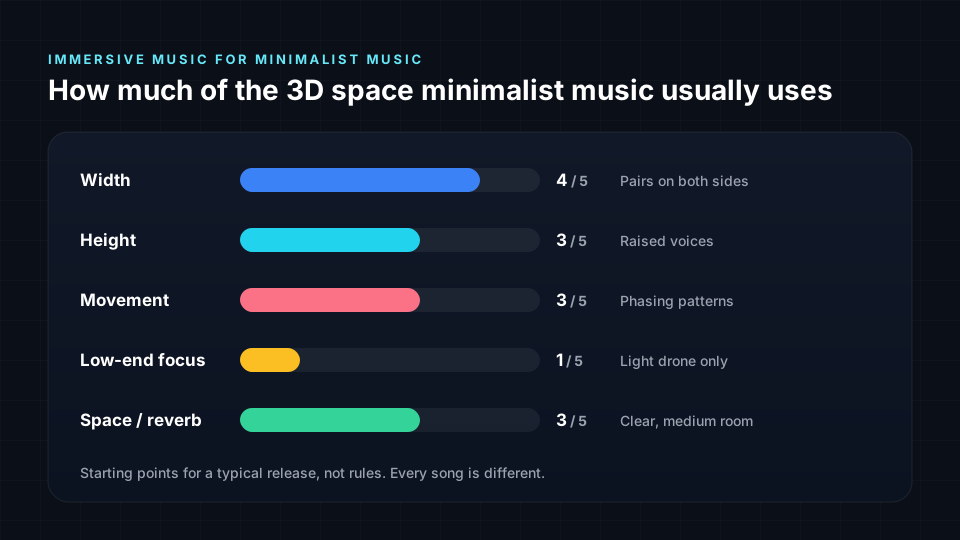
Width scores 4 because paired parts need clear, opposite positions. Movement scores 3, but it comes from the music: resultant patterns seem to travel as the phase shifts while the players stay fixed. Height scores 3, with raised voices and a lifted hall tail. Space scores 3: enough room for warmth, but not so much that repeated notes blur. Low-end focus is 1, since most scores have little bass beyond a light drone.
Tips for an immersive minimalist music mix
- Split every phasing pair. Put identical parts on opposite sides at the same distance and level.
- Hold the pulse in front. The steady beat is the reference for every change, so never move it.
- Let the process create the motion. Do not pan the patterns; the phasing already makes them seem to move.
- Keep the room clear. A long, dense reverb smears fast repeated notes into a wash.
- Lift the voices gently. Raise wordless vocal lines slightly so they float above the mallets.
Minimalist music styles: phase music, post-minimalism and holy minimalism
The core placement holds for every style here: repeating parts placed so the ear can follow each one, a steady centre and a room that suits the pace. What changes is the speed and the reverb.
Phase Music
Phase music is the strictest form of minimalism, where identical patterns played by two or more parts slowly move out of step and back into line. It began with tape loops on two machines running at slightly different speeds and moved to live players on pianos, violins, clapping and mallets. Placement follows the process. Put the two identical parts directly opposite each other, front left and front right, at exactly the same distance and level, so neither dominates. Keep the room fairly dry and the low end almost empty. For early mono tape pieces, a modest split of the separated loops is enough.
Post-Minimalism
Post-minimalism grew from the late 1970s and 1980s as composers kept the pulse and repetition but added richer harmony, orchestral colour, rock energy and drama. John Adams's Shaker Loops of 1978 and his later orchestral works are classic examples, and New York's Bang on a Can festival, founded in 1987, brought amplified ensembles into the style. Treat it like a pulsing orchestra: keep the pulse in front, spread mallets, pianos and strings wide and let brass or winds swell behind. There is more low end here, from basses or bass guitar, so centre it firmly. The room can be a little larger, but clear enough for the rhythm.
Holy Minimalism
Holy minimalism, sometimes called sacred or mystic minimalism, is the slow, spiritual branch associated with Arvo Pärt, Henryk Górecki and John Tavener from the 1970s onwards. Pärt's tintinnabuli style pairs a melody voice with a voice outlining a single triad, like bells ringing around a line. The music is slow, quiet and reverberant, written for choirs, strings, organ and piano. Place the melody voice and the triad voice on opposite sides of the front, like phase music but much slower. Raise choirs and high strings slightly and add a long stone church tail above and behind. Keep movement almost nil.
Related styles such as drone music, totalism and the pulse-based scores of later concert composers follow the same idea: give each repeating strand its own place, then let the process unfold around the listener.
How to make immersive minimalist music from stereo
Spatial9 can create spatial audio from a stereo track in a few steps:
- Upload your stereo master or your stems.
- Spatial9's AI separates and places each part, pulling the pianos, mallets, voices and sustained instruments apart even from older stereo or mono recordings and setting paired patterns on opposite sides around a steady pulse.
- Preview it in binaural on headphones.
- Export Eclipsa Audio, ADM, binaural or Ambisonics.
- Publish a video. Create a YouTube-ready video with your immersive audio and publish it directly.
For related guides, read spatial audio for electroacoustic music and spatial audio for choral music. Every guide is listed in spatial audio and immersive music by genre.
Frequently asked questions
Does this guide cover phase music, post-minimalism and holy minimalism?
Yes. Phase music sets identical drifting parts on opposite sides in a dry room. Post-minimalism spreads a pulsing orchestra wide with a firmer low end. Holy minimalism pairs a melody and a triad voice slowly in a long, raised church tail.
Can I make a minimalist music mix in Dolby Atmos or Eclipsa Audio?
Yes. The placements in this guide work for both. Spatial9 exports ADM, the standard file used by Dolby Atmos studios, as well as Eclipsa Audio for YouTube, so one immersive minimalist music mix covers both. If you plan to release the Atmos version on Apple Music, build it from your original stems or multitracks, because Apple does not accept Atmos made from a finished stereo master. See where to publish spatial audio. You may also hear this called a 3D minimalist music mix or minimalist music in spatial audio.
Is spatial audio good for minimalist music?
Yes. Minimalist music is about hearing patterns interlock and drift. Spatial audio gives each strand its own direction, so the process stays clear.
Should I pan the phasing parts to make them move?
No. Keep both parts fixed on opposite sides. The phase shift itself makes resultant patterns seem to travel, and extra panning hides the process.
Is minimalist music the same as minimal techno?
No. Minimalist music is a concert tradition of acoustic and electric ensembles from the 1960s. Minimal techno is club music from the 1990s that borrows its repetition but centres a kick drum and bass.
Where should the voices go in an immersive minimalist music mix?
Put wordless voices at front centre, a little further back than the pulse and slightly raised. In holy minimalism, raise the choir more and give it a longer tail.
Can I convert an old minimalist tape piece to spatial audio?
Yes. Spatial9 uses AI to separate parts from mono or early stereo masters. With tape loops separation is never perfect, so keep the layout simple: one loop on each side and a modest room.
Dolby and Dolby Atmos are trademarks of Dolby Laboratories. Spatial9 is not affiliated with or endorsed by Dolby Laboratories.
Sources
- Blauert, J. (1997). Spatial Hearing: The Psychophysics of Human Sound Localization, revised edition. MIT Press. Low-frequency, elevation, distance and motion cues.
- Mills, A. W. (1958). On the minimum audible angle. Journal of the Acoustical Society of America, 30(4), 237-246.
- Hebrank, J. and Wright, D. (1974). Spectral cues used in the localization of sound sources on the median plane. Journal of the Acoustical Society of America, 56(6), 1829-1834.
- Bronkhorst, A. W. (2000). The cocktail party phenomenon: a review of research on speech intelligibility in multiple-talker conditions. Acta Acustica united with Acustica, 86, 117-128.
- Litovsky, R. Y., Colburn, H. S., Yost, W. A. and Guzman, S. J. (1999). The precedence effect. Journal of the Acoustical Society of America, 106(4), 1633-1654.
- Barron, M. and Marshall, A. H. (1981). Spatial impression due to early lateral reflections in concert halls. Journal of Sound and Vibration, 77(2), 211-232.
- Neuhoff, J. G. (1998). Perceptual bias for rising tones. Nature, 395, 123-124.
- Bregman, A. S. (1990). Auditory Scene Analysis: The Perceptual Organization of Sound. MIT Press.
- Potter, K. (2000). Four Musical Minimalists: La Monte Young, Terry Riley, Steve Reich, Philip Glass. Cambridge University Press.
Step inside the pattern
Upload a track to Spatial9 and hear interlocking pianos and marimbas drift around you in minutes. Then export it or publish it straight to YouTube.