Immersive audio formats compared
Eclipsa Audio, Dolby Atmos, Sony 360 Reality Audio, MPEG-H, DTS:X and Apple Spatial Audio side by side.
This page compares the immersive audio formats you are most likely to encounter when you produce, convert or publish spatial audio: Eclipsa Audio (IAMF), Dolby Atmos, Sony 360 Reality Audio, MPEG-H 3D Audio, DTS:X and Apple Spatial Audio, including Apple's newer ASAF and APAC formats. It explains how each one describes space, which codecs carry it, where it plays and how it is licensed.
It is written for engineers, producers, platform developers and anyone deciding which deliverables a release needs. For the internals of individual formats, see Eclipsa Audio and IAMF reference, ADM BWF files and Ambisonics.
Format versus playback experience
Before you compare formats, separate two kinds of names that are often confused.
- A format defines what is stored in a file or stream: channels, objects or a sound field, plus metadata and a codec. Eclipsa Audio, Dolby Atmos, Sony 360 Reality Audio, MPEG-H 3D Audio and DTS:X are formats.
- A playback experience defines how a device renders a format for the listener. Apple Spatial Audio is a playback and rendering feature on Apple devices. On Apple Music it almost always plays a Dolby Atmos master through Apple's own renderer.
Apple also has its own formats since WWDC 2025: the Apple Spatial Audio Format (ASAF) for production and the Apple Positional Audio Codec (APAC) for delivery. For music, Apple Music's published delivery requirements still ask for a Dolby Atmos master.
Spatial models
Every immersive format uses one or more of three ways to describe space.
| Model | What is stored | Cost grows with | Used by |
|---|---|---|---|
| Channel-based | One signal per named speaker position, such as 7.1.4 | Speaker count | IAMF, Atmos beds, MPEG-H, DTS:X |
| Object-based | Individual sounds with position metadata over time | Number of objects | Atmos, DTS:X, MPEG-H, 360 Reality Audio, IAMF v2.0.0 |
| Scene-based (Ambisonics) | A full sound field around one listening point | Ambisonics order only | IAMF, MPEG-H, ASAF and APAC |
A scene-based description has a fixed channel cost. A third-order Ambisonics scene uses 16 channels whether the session has 5 tracks or 300. An object-based description keeps sounds separate until playback, so per-sound changes and very sharp placement are possible, but the stream must reduce the object count to fit streaming bitrates.
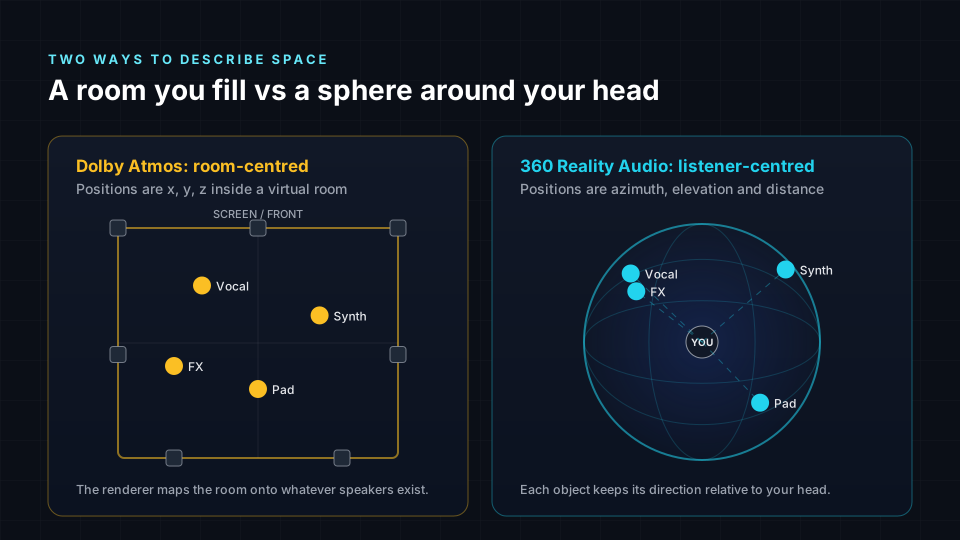
Room-centred and listener-centred coordinates
Formats also differ in where they place the listener.
| Coordinate system | Description | Formats |
|---|---|---|
| Room-centred (allocentric) | A position inside a virtual room, given as X, Y and Z | Dolby Atmos music |
| Listener-centred (egocentric) | A direction from the listener's head: azimuth, elevation and, for objects, distance | Ambisonics in IAMF, Sony 360 Reality Audio |
| Named layouts | Fixed speaker positions such as 5.1.2 or 7.1.4 | IAMF channel elements, Atmos beds |
A room model has a floor, so it does not express sounds below the listener in the way a sphere does. A listener-centred sphere suits headphones and head tracking, and can include negative elevation. Conversion between the two requires mapping positions in a cube to directions on a sphere, which is why converting Atmos to Eclipsa Audio is not a simple file copy. See ADM to Eclipsa Audio.
Master comparison table
| Eclipsa Audio | Dolby Atmos | 360 Reality Audio | MPEG-H 3D Audio | DTS:X | |
|---|---|---|---|---|---|
| Owner | AOMedia (IAMF) | Dolby Laboratories | Sony | ISO/IEC, developed by MPEG | DTS, part of Xperi |
| Specification | IAMF 1.0, 2023 | Proprietary | Built on MPEG-H | ISO/IEC 23008-3, 2015 | Based on MDA, ETSI TS 103 223 |
| Licensing | Royalty-free | Licensed | Sony tools on a licensed standard | Patents licensed by holders | Licensed |
| Spatial model | Channel layers or Ambisonics | Beds plus objects | Objects on a sphere | Channels, objects and HOA | Objects and channels |
| Codecs | Opus, AAC-LC, FLAC, LPCM | DD+ JOC, AC-4, TrueHD | MPEG-H at several levels | Own core coder based on USAC | DTS-HD Master Audio |
| Main use | YouTube, TVs, open web | Music, film, streaming, games | Music on a few services | Broadcast television | Blu-ray, IMAX Enhanced |
Channel and object budgets
| Format | Budget | Notes |
|---|---|---|
| Dolby Atmos music master | Up to 128 inputs | A 7.1.2 bed uses 10, leaving up to 118 objects |
| Dolby Atmos home playback | Up to 24.1.10 (34 speakers) | Largest home layout |
| DTS:X Pro | Up to 30 speakers | Higher-end processors |
| IAMF Simple profile | 1 audio element, up to 16 channels | Fits one third-order Ambisonics scene exactly |
| IAMF Base profile | Up to 2 audio elements, up to 18 channels | For example a scene plus a stereo element |
| IAMF Base-Enhanced profile | Up to 28 audio elements, up to 28 channels | Added in a later specification version |
| Sony 360 Reality Audio | Several quality levels | A few dozen objects at the top level, a handful at the lowest |
| MPEG-H 3D Audio | Set by profile and level | Channels, objects and HOA in one stream |
Codecs and delivery formats
| Format | Streaming codec | Lossless or disc | Container |
|---|---|---|---|
| Eclipsa Audio | Opus, AAC-LC | FLAC, LPCM | IAMF OBUs, usually in MP4 |
| Dolby Atmos | Dolby Digital Plus JOC, AC-4 | Dolby TrueHD on Blu-ray | Dolby streams; ADM BWF as master |
| 360 Reality Audio | MPEG-H 3D Audio | Not applicable | MP4 |
| MPEG-H 3D Audio | MPEG-H core coder (USAC-based) | Not applicable | MHAS for broadcast, MP4 for streaming |
| DTS:X | DTS:X in IMAX Enhanced streams | DTS-HD Master Audio | Disc and selected streams |
| Apple APAC | APAC, as low as 64 kbps | ASAF masters in Broadcast Wave | MP4 over HLS |
Dolby TrueHD and DTS-HD Master Audio are both lossless on 4K Blu-ray, so bitrate is not a deciding factor between Atmos and DTS:X on disc. DTS-HD Master Audio also carries a backward-compatible core for players that do not decode DTS:X.
Format profiles
Eclipsa Audio
Eclipsa Audio is the consumer name Google and Samsung gave to IAMF, the Immersive Audio Model and Formats specification from the Alliance for Open Media, when they launched it in January 2025. A stream contains audio elements, either channel-based layers that can scale from stereo up to 7.1.4 or a scene-based Ambisonics sound field, plus mix presentations that define gains, loudness and speaker or binaural rendering. IAMF 1.0 has no object elements; IAMF v2.0.0, approved in August 2026, adds object-based audio elements. Spatial9 converts mixes to third-order Ambisonics for Eclipsa Audio. See Eclipsa Audio and IAMF reference.
Dolby Atmos
Dolby Atmos premiered in cinemas in 2012, reached homes in 2014 and music in 2019. A session combines beds, fixed channel groups up to 7.1.2, with objects that carry position, size, zone and snap controls, and a binaural render mode (Off, Near, Mid or Far). The Dolby Atmos Renderer turns them into speaker feeds or a binaural signal. The finished master is exported as an ADM BWF file or a Dolby Atmos master file set. See ADM BWF files.
Sony 360 Reality Audio
Sony announced 360 Reality Audio at CES 2019. It is built on the object part of MPEG-H 3D Audio and places each sound by azimuth, elevation and distance on a sphere around the listener. Mixes are produced with the 360 WalkMix Creator plugin and exported as MPEG-H files at several quality levels. Supported Sony headphones can personalise playback from photos of the listener's ears.
MPEG-H 3D Audio
MPEG-H 3D Audio is an international standard, ISO/IEC 23008-3, first published in 2015. It combines channels, objects and higher-order Ambisonics with interactivity metadata: viewers can adjust dialogue level, choose a commentary language or select presets within limits set by the broadcaster. It is part of the ATSC 3.0, DVB, TTA and SBTVD broadcast standards, on air in South Korea since 2017 and the sole mandatory audio system for Brazil's TV 3.0.
DTS:X
DTS:X grew out of MDA (Multi-Dimensional Audio), an object-based format developed by SRS Labs, which DTS acquired in 2012. DTS:X launched for the home in 2015. It offers dialogue control on supported content, and DTS:X Pro renders to up to 30 speakers and upmixes channel-based content with Neural:X. Since May 15, 2024, Disney+ offers IMAX Enhanced titles with a fixed 5.1.4 DTS:X mix on supported devices. There is no mainstream music streaming route for DTS:X.
Apple Spatial Audio, ASAF and APAC
Apple Spatial Audio started in 2020 as head-tracked video playback on AirPods Pro and became a music category when Apple Music launched Spatial Audio with Dolby Atmos in June 2021. Apple's renderer does not follow Atmos binaural render modes in the same way as Dolby's, and engineers report that rear sounds are closer and the overall level is louder. ASAF combines linear PCM, metadata and a renderer, mixing point sources with higher-order Ambisonics inside Broadcast Wave files. APAC carries channels, objects, higher-order Ambisonics and binaural audio, and is required for Apple Immersive Video on Vision Pro.
Platform support
| Platform or device | Eclipsa Audio | Dolby Atmos | 360 Reality Audio | DTS:X |
|---|---|---|---|---|
| YouTube | Yes | No | No | No |
| Apple Music | No | Yes, as Spatial Audio | No | No |
| Amazon Music Unlimited | No | Yes | Yes | No |
| TIDAL | No | Yes | Removed July 24, 2024 | No |
| nugs.net | No | No | Yes | No |
| Samsung TVs and soundbars | Yes, from the 2025 range | Yes, on Atmos models | No | Check the device |
| AV receivers | No | Yes | No | Yes, most current models |
| Cinema and Blu-ray | No | Yes | No | Yes |
| Streaming video services | YouTube | Most major services | No | IMAX Enhanced titles |
Eclipsa Audio also decodes on Android 16 QPR2 and later in apps that use the decoder, and in web players in Chrome 153 and later, including on Mac. Dolby Atmos is built into many phones, laptops and consoles. The 360 by Deezer app closed on October 31, 2022. MPEG-H 3D Audio is not listed because its main deployments are broadcast television in South Korea, Brazil and Japan's advanced ISDB system rather than streaming platforms. Support changes quickly; confirm the current list before a release. See Publishing and delivery.
Licensing and tools
| Specification | Royalties | Reference tools | |
|---|---|---|---|
| Eclipsa Audio | Public, AOMedia | None to create, distribute or play | Open-source iamf-tools encoder, libiamf decoder, Google DAW plugin |
| Dolby Atmos | Proprietary | Licensed to device makers and services | Dolby Atmos Renderer, Atmos tools in major DAWs |
| 360 Reality Audio | Sony brand on MPEG-H | Licensed standard | 360 WalkMix Creator |
| MPEG-H 3D Audio | Published by ISO/IEC | Essential patents licensed by holders | Fraunhofer IIS MPEG-H Audio system |
| DTS:X | Brand controlled by DTS; MDA published by ETSI | Licensed | DTS tools and certification |
| Apple ASAF and APAC | Apple | Apple platform feature | DaVinci Resolve 20.1 supports ASAF |
Loudness
All of these formats treat loudness as metadata measured with the ITU-R BS.1770 method. A widely used Atmos music target is -18 LKFS integrated with true peaks below -1 dBTP, measured on the rendered output; always check your distributor's current specification. IAMF stores loudness inside each mix presentation, measured for specific layouts such as stereo or 7.1.4. MPEG-H carries loudness metadata as part of the standard. Measure each rendered output you deliver separately, because object counts and renderers differ between formats.
Choosing deliverables
For most music releases the answer is more than one format, created from one source.
| Goal | Deliverable |
|---|---|
| Apple Music, Amazon Music, TIDAL | Dolby Atmos ADM BWF master through a label or distributor |
| YouTube, TVs and soundbars | Eclipsa Audio in an MP4, converted from the Atmos master or created from stereo or stems |
| Amazon Music Unlimited or nugs.net only | Optional 360 Reality Audio version, if your distributor delivers it |
| Live broadcast in an MPEG-H region | MPEG-H 3D Audio through broadcast tools |
| 4K Blu-ray | Dolby Atmos (TrueHD) or DTS:X (DTS-HD Master Audio) |
| Apple Immersive Video on Vision Pro | ASAF production and APAC delivery |
| An app, game or platform | IAMF, using the open-source decoder |
Common misconceptions
- Eclipsa Audio is not only Ambisonics. IAMF also supports channel-based layouts, scalable layers, multiple audio elements and mix presentations.
- Apple Spatial Audio is not a file format. For music it is Apple's way of rendering Dolby Atmos.
- 360 Reality Audio is not its own codec. It uses MPEG-H 3D Audio.
- Upmixers such as Dolby Surround and DTS Neural:X spread existing channels around a room. They do not create a new object mix.
Next steps
- Eclipsa Audio and IAMF reference explains audio elements, mix presentations, profiles and codecs in detail.
- ADM BWF files describes the master format that Dolby Atmos deliveries use.
- ADM to Eclipsa Audio shows how to turn an existing Atmos master into an Eclipsa Audio file.
- Publishing and delivery lists what each platform expects.