Dolby Atmos vs Sony 360 Reality Audio: How They Work and Where They Play
Spatial9 Team · · Updated · 12 min read
Key takeaways
- Dolby Atmos music masters hold up to 128 inputs: a bed plus up to 118 objects, delivered as Dolby Digital Plus JOC or AC-4.
- Sony 360 Reality Audio launched in 2019 and is built on MPEG-H 3D Audio, standardised as ISO/IEC 23008-3.
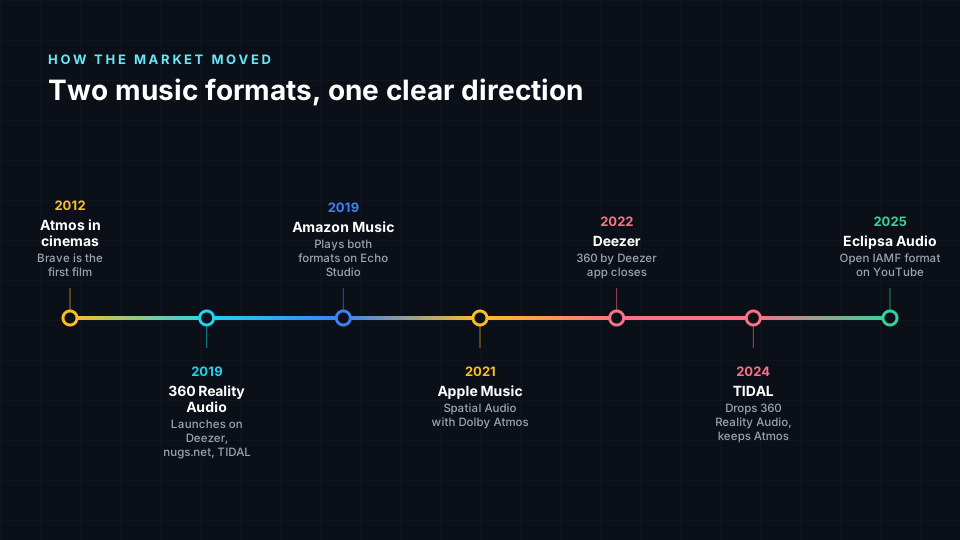
- TIDAL removed 360 Reality Audio on July 24, 2024, and the 360 by Deezer app closed on October 31, 2022.
- Today 360 Reality Audio music is mainly on Amazon Music Unlimited and nugs.net, while Atmos plays on Apple Music, Amazon Music and TIDAL.
In 2019 two immersive music formats arrived within months of each other. Dolby brought Atmos, already established in cinemas, to streaming music. Sony introduced 360 Reality Audio, a format designed for music from the start. Both promised songs that surround you instead of sitting between two speakers. Seven years later, one of them is on almost every major service and the other has retreated to a few.
This guide explains how each format works, why they sound different, how they are delivered, and what that means for a release today. If you are new to the subject, read our complete guide to spatial audio first.
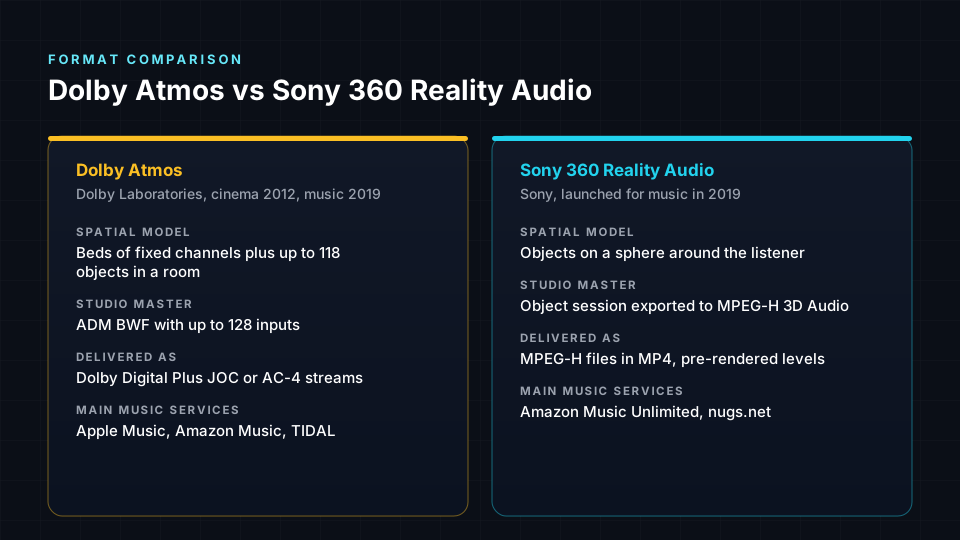
Dolby Atmos vs 360 Reality Audio at a glance
| Dolby Atmos | Sony 360 Reality Audio | |
|---|---|---|
| Owner | Dolby Laboratories | Sony |
| Underlying technology | Dolby's proprietary object-based system | MPEG-H 3D Audio (ISO/IEC 23008-3) |
| Spatial model | Bed channels plus objects in a virtual room | Objects on a sphere around the listener |
| Studio master | ADM BWF, up to 128 inputs | Object session exported to MPEG-H |
| Delivery codec | Dolby Digital Plus JOC, AC-4, TrueHD on disc | MPEG-H 3D Audio in MP4, several quality levels |
| Height | Yes, through top speakers or binaural rendering | Yes, objects can sit above and below |
| Below the listener | No, the room has a floor | Yes, the sphere includes negative elevation |
| Music services | Apple Music, Amazon Music, TIDAL and others | Amazon Music Unlimited, nugs.net |
| Film and TV | Cinema, streaming video, Blu-ray, games | Not used for film |
| Distributor support | Wide | Limited |
Where each format comes from
Dolby Atmos: from cinema to music
Dolby Atmos premiered in cinemas in 2012 with Pixar's Brave. Its idea was simple to state and hard to engineer: instead of mixing to a fixed number of speakers, describe each sound with a position and let the cinema's processor work out which of its speakers should play it. A mix made once could play in a small room or a large auditorium.
The home version followed in 2014 through Blu-ray and AV receivers. Music arrived in 2019, when Amazon Music launched Atmos tracks alongside its Echo Studio speaker. Apple Music added Spatial Audio with Dolby Atmos in June 2021, which turned Atmos into the default immersive format for music. Labels then began remixing catalogue in Atmos at scale, and distributors added Atmos delivery.
Sony 360 Reality Audio: built for music
Sony announced 360 Reality Audio at CES in 2019 and launched it that autumn with three services: Deezer, nugs.net and TIDAL. It was positioned as a music format rather than a film format. Sony built it on MPEG-H 3D Audio, an international standard developed largely by Fraunhofer IIS, and paired it with Sony headphones, speakers and an app that could personalise headphone playback from photos of the listener's ears.
Amazon Music added 360 Reality Audio in the same year, again alongside the Echo Studio. For a while Amazon was the one service that played both formats.
How Dolby Atmos works
Beds and objects
An Atmos music session has two kinds of audio. Bed channels are fixed speaker feeds, usually a 7.1.2 layout, used for sounds that do not need to move, such as reverb returns or wide pads. Objects are mono or stereo sounds with position metadata that can change over time. A music master allows up to 128 inputs in total. With a 10-channel bed, that leaves up to 118 objects.
A room-centred coordinate system
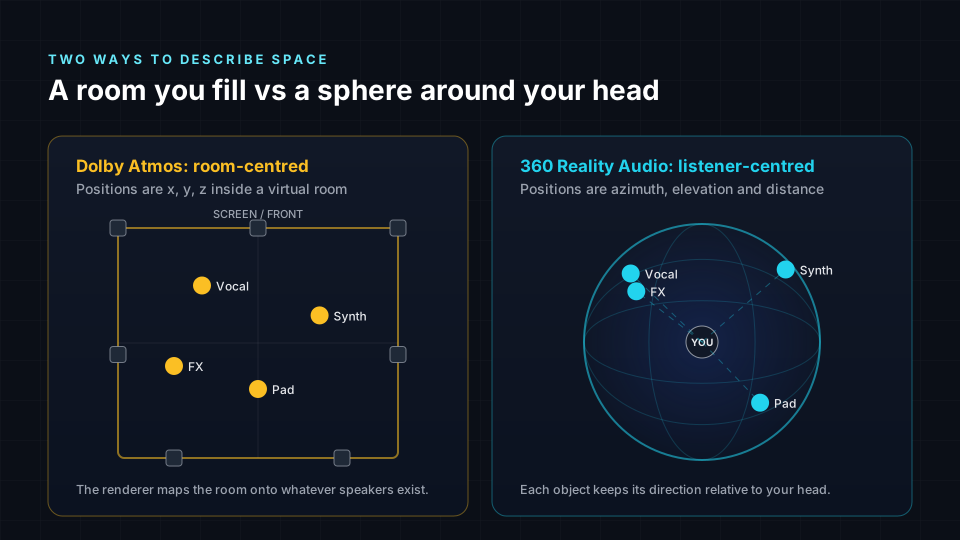
Atmos places objects inside a virtual room. Each position is an x, y and z value: left to right, front to back, floor to ceiling. The listener is assumed to sit inside that room, and the renderer maps the room onto whatever speakers exist. A sound placed in the top-right corner goes to the top-right speaker in a 7.1.4 studio, and to a virtual equivalent on headphones.
This approach comes from cinema, where many people sit in different seats. Describing the room, rather than one listener's head, keeps the mix stable for everyone.
The renderer
The Dolby Atmos Renderer turns beds and objects into speaker feeds for monitoring, and into a binaural signal for headphones. Each object carries a binaural render mode, Off, Near, Mid or Far, which tells the headphone renderer how much room to add. The master file is an ADM BWF: a broadcast WAV with an Audio Definition Model description of every channel and object, defined in ITU-R BS.2076.
How Sony 360 Reality Audio works
Objects on a sphere
360 Reality Audio describes every sound as an object with a direction and distance from the listener: azimuth, elevation and radius. The listener sits at the centre of a sphere. Because the sphere is complete, an object can sit below ear level as well as above it, which a room model with a floor does not express in the same way.
The production tools
Engineers create 360 Reality Audio mixes in a DAW with a dedicated plugin, today sold as 360 WalkMix Creator and previously known as the 360 Reality Audio Creative Suite. Each track becomes an object that can be placed and automated on the sphere. The plugin then exports the mix as MPEG-H 3D Audio files for delivery.
Delivery at several quality levels
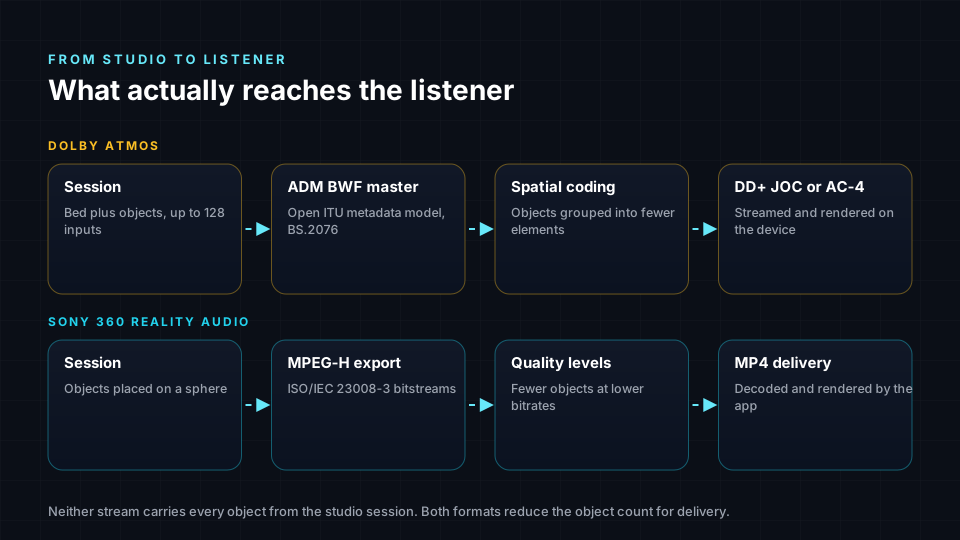
A 360 Reality Audio release is not one file. The session is exported at several levels, each with a different number of objects and a different bitrate, so a service can stream a lighter version on a slow connection. Published material on the format describes a top level carrying a few dozen objects and a lowest level carrying only a handful. In practice that means an object-rich studio mix is simplified before it reaches most listeners.
The core difference
The real difference is where the format places the listener.
Atmos describes a room and puts the listener inside it. The same mix plays on a 7.1.4 system, a soundbar or headphones because the renderer adapts the room to the device. That made Atmos a natural fit for cinema and home theatre, and it carried those strengths into music.
360 Reality Audio describes the world from the listener's head. That suits headphones, which is how most people hear streamed music, and it makes it natural to place sounds below you. It is less natural for a room full of speakers, where there is no single head at the centre.
Neither model is better in the abstract. They are answers to different questions. Atmos asks "where in the room is this sound?", 360 Reality Audio asks "which direction does this sound come from?".
Codecs and delivery
Atmos music streams as Dolby Digital Plus with Joint Object Coding (JOC) on most services, or as AC-4 on some. Both are lossy. JOC works by grouping nearby objects into a smaller number of elements, sending those along with instructions for rebuilding the original objects at playback. On Blu-ray, Atmos rides on Dolby TrueHD, which is lossless.
360 Reality Audio streams as MPEG-H 3D Audio in an MP4 container. MPEG-H is a full audio system rather than just a codec: it carries channels, objects and Ambisonics scenes, with metadata for rendering and for user interaction. Sony uses the object side of it, at the quality levels described above.
The practical consequence is the same for both: what the listener hears is a reduced version of the studio session. Mixes with many simultaneous objects in the same region tend to survive delivery better when those objects are grouped deliberately in the studio, rather than left for the encoder to merge.
Rendering to speakers and headphones
Speakers. Atmos plays on cinema systems, home theatre receivers with height speakers, soundbars with upward-firing drivers and smart speakers. 360 Reality Audio plays on a smaller set of speakers, including Sony's own models and the Amazon Echo Studio.
Headphones. Both formats are mostly heard on headphones. Atmos uses Dolby's binaural renderer, or Apple's own renderer on Apple Music, which is covered in our guide to Apple Spatial Audio vs Dolby Atmos. 360 Reality Audio uses Sony's renderer, and supported Sony headphones can be personalised by analysing photos of the listener's ears. Amazon Music Unlimited plays 360 Reality Audio on any headphones.

Headphone rendering is where the two formats differ most for the average listener, because each depends on a head-related model that never fits every head perfectly. For background on how that works, see binaural vs spatial audio.
Loudness and metadata
Dolby's guidance for Atmos music targets an integrated loudness of −18 LKFS with a true peak no higher than −1 dBTP, measured on the rendered output. That is quieter than typical stereo masters, and it leaves room for dynamics across many speakers. Apple Music applies its own loudness rules to Atmos deliveries.
MPEG-H carries loudness metadata as part of the standard, so a player can normalise playback. Sony's tools handle the measurement during export. If you master in both formats, measure each rendered output separately rather than assuming the levels match, because the object counts and renderers differ.
Licensing
Atmos is licensed from Dolby. Studios use Dolby's renderer and tools, device makers license Dolby decoders, and services pay to stream Dolby formats. The ADM BWF master format itself is based on open ITU recommendations.
360 Reality Audio is a Sony brand and toolchain built on MPEG-H, an ISO/IEC standard whose patents are licensed by their holders. Creating content requires the Sony-licensed tools, and playback depends on services and devices that support the format.
For contrast, Eclipsa Audio, the consumer name for IAMF from the Alliance for Open Media, is royalty-free. We compare it in Eclipsa Audio vs Dolby Atmos and in Eclipsa Audio vs Sony 360 Reality Audio.
Platform support in 2026
| Service | Dolby Atmos | 360 Reality Audio |
|---|---|---|
| Apple Music | Yes, as Spatial Audio | No |
| Amazon Music Unlimited | Yes | Yes |
| TIDAL | Yes | Removed July 24, 2024 |
| Deezer | No dedicated immersive app | 360 by Deezer closed October 31, 2022 |
| nugs.net | No | Yes |
| Spotify | No documented support | No |
| YouTube | No | No (YouTube plays Eclipsa Audio) |
Distribution follows the same pattern. Most distributors that offer immersive delivery accept Atmos ADM BWF files. Very few deliver 360 Reality Audio. Our guide on where to publish spatial audio lists the current routes service by service.
Which one should you use?
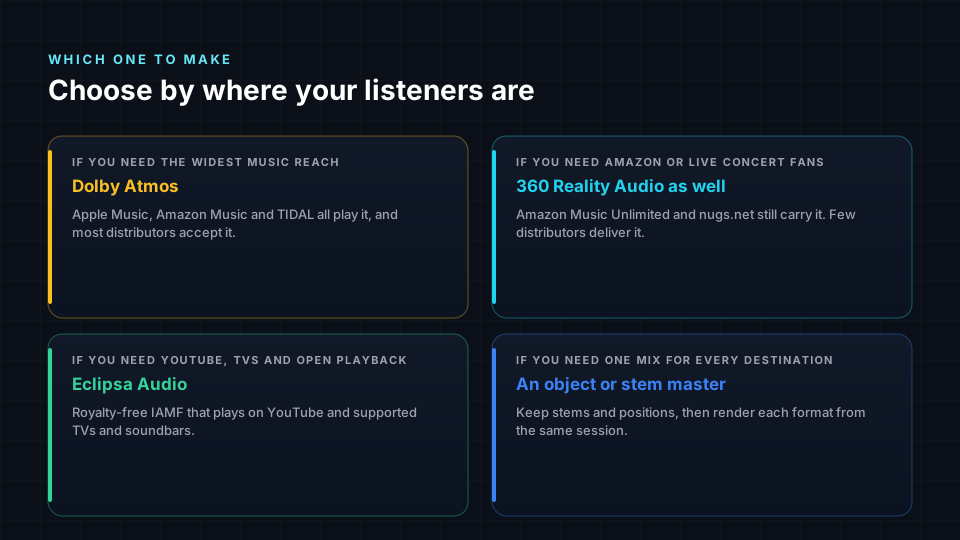
- Releasing music to the widest audience: make a Dolby Atmos master. It reaches Apple Music, Amazon Music and TIDAL, and most distributors accept it.
- Your fans are on Amazon Music or nugs.net: a 360 Reality Audio version can add to an Atmos release, but plan for the extra mix and the limited delivery routes.
- You want YouTube, TVs and open playback: add an Eclipsa Audio version. You can convert an Atmos master to Eclipsa Audio without remixing.
- You want flexibility later: keep your stems and object positions. A well-organised session can be rendered to any of these formats.
Common misconceptions
- "360 Reality Audio is dead." It is no longer on TIDAL or Deezer, but Amazon Music Unlimited and nugs.net still play it, and Sony continues to sell compatible tools and devices.
- "Atmos only works with ceiling speakers." Most Atmos music is heard on headphones through binaural rendering. Height speakers are one playback option, not a requirement.
- "360 Reality Audio is its own codec." It uses MPEG-H 3D Audio, an international standard also used in broadcast television in South Korea and Brazil.
- "The stream contains every object from the session." Neither format does this. Atmos groups objects with JOC, and 360 Reality Audio exports reduced quality levels.
- "You can convert one into the other at the click of a button." The spatial models differ, so a good conversion means re-placing objects and checking the result, not just changing the file type.
Frequently asked questions
Is Sony 360 Reality Audio better than Dolby Atmos?
Neither is better in every case. 360 Reality Audio was designed around headphones and a listener-centred sphere, which suits some music well. Atmos has a larger ecosystem, wider device support and far more services, which matters more for most releases.
Which services play 360 Reality Audio in 2026?
Amazon Music Unlimited and nugs.net are the main music services. TIDAL removed it on July 24, 2024, and the 360 by Deezer app closed on October 31, 2022.
Does Apple Music support 360 Reality Audio?
No. Apple Music's Spatial Audio catalogue is delivered in Dolby Atmos.
What is 360 Reality Audio based on?
It is based on MPEG-H 3D Audio, standardised as ISO/IEC 23008-3. Sony uses the object-based part of the standard and its own production tools and renderer.
Can I make both versions from one mix?
You can start from the same stems and creative decisions, but each format needs its own session or conversion and its own checks. Keeping stems and object positions organised makes this much easier.
Do I need special headphones?
No. Both formats play on ordinary headphones through binaural rendering. Some Sony headphones add personalisation for 360 Reality Audio, and AirPods add head tracking for Atmos on Apple Music.
Sources
- Sony launches 360 Reality Audio, Sony Group press release, October 2019. Launch services Deezer, nugs.net and TIDAL, and the MPEG-H basis.
- 360 Reality Audio, Sony Electronics. Current services, compatible devices and ear personalisation.
- MPEG-H 3D Audio adoption, Fraunhofer IIS. Broadcast and streaming deployments of MPEG-H.
- MPEG-H Audio, Fraunhofer IIS. Objects, channels, scenes and interactivity in the standard.
- Audio format updates, TIDAL Support. Removal of 360 Reality Audio on July 24, 2024.
- 360 by Deezer, Deezer Support. App closed on October 31, 2022.
- How do I find Spatial Audio music?, Amazon Music Help. Dolby Atmos and 360 Reality Audio badges and supported devices.
- Delivering Dolby Atmos audio, Apple Music Provider Support. Atmos delivery for Spatial Audio.
- ITU-R BS.2076: Audio Definition Model, International Telecommunication Union. The metadata model used in ADM BWF masters.
- Dolby professional documentation, Dolby Laboratories. Beds, objects, binaural render modes and music loudness guidance.
Make one master, reach every service
You do not have to bet on a single format. Keep your Atmos master for the music stores and turn the same mix into Eclipsa Audio for YouTube, TVs and soundbars. Convert an Atmos master with Spatial9, or start from stereo or stems and build an immersive mix from scratch.
Dolby and Dolby Atmos are trademarks of Dolby Laboratories. 360 Reality Audio and 360 WalkMix Creator are trademarks of Sony Group Corporation. Spatial9 is not affiliated with or endorsed by Dolby Laboratories or Sony.