Spatial Audio & Immersive Music for World Electronic: Complete Guide
Spatial9 Team · · Updated
Part of the series Spatial audio and immersive music by genre.
World electronic music is a broad family rather than one style. It covers organic and ethnic house, global bass, Balkan beats, Middle Eastern and North African electronica, Andean and Latin American electronic fusion, Asian electronic fusion and many hybrids. What connects them is a meeting of two worlds: the steady pulse and deep low end of electronic dance music, and the instruments, voices, scales and rhythms of a specific musical tradition. This guide covers how spatial audio for world electronic music works, where to place each element and how to make an immersive mix. For the basics, see what spatial audio is.
Why world electronic music is perfect for spatial audio
These tracks are built in layers that come from very different places. A sampled chant from one tradition, a live hand drum, a synth pad and a recording of wind or birds can all play at once. In stereo, those layers fight for the same narrow space, and the traditional sounds that give the track its identity are often the first to get buried. In spatial audio, the electronic foundation and the traditional colours can each have their own area.
The rule: a solid electronic centre, a living world around it. Keep the parts that drive the dance floor centred and steady. Use the rest of the 3D field for the sounds that tell the listener where the music comes from.
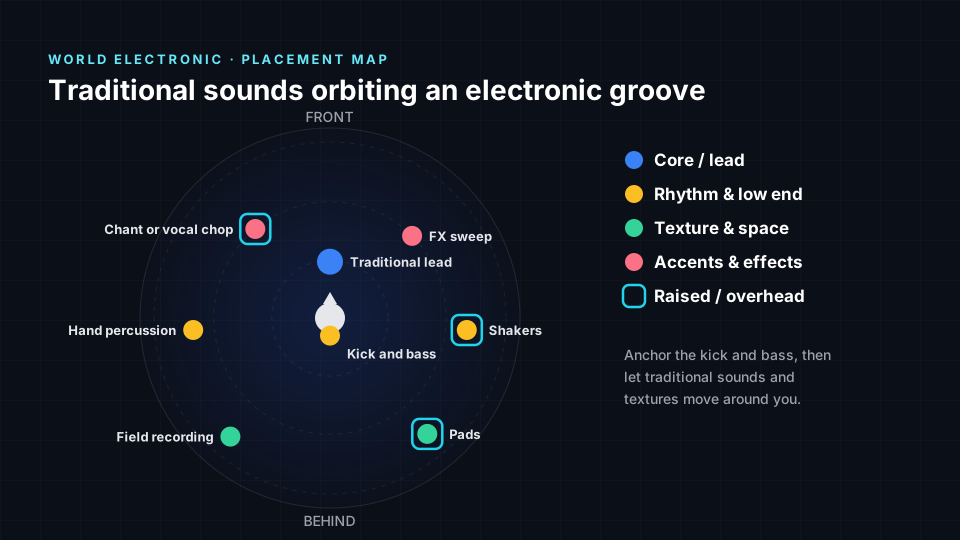
Immersive music for world electronic: what listeners hear
- A groove that never wavers. The kick and bass stay solid in the middle.
- A traditional voice in front. The oud, ney, kora, flute or singer leads the track from the front.
- Rhythm in a ring. Darbuka, djembe, tabla or frame drums play from one side, and shakers from the other.
- A sense of place. Field recordings, pads and chants open up the space behind and above.
- Gentle motion. Effects and sweeps travel slowly around the listener during build-ups.
Where to place each element in a world electronic mix
| Element | Position | Height | Why it works |
|---|---|---|---|
| Kick | Centre | Ear level | The anchor of the dance floor |
| Bass | Centre | Ear level | Solid low end on every system |
| Traditional lead | Front centre | Ear level | The identity of the track |
| Chant or vocal chop | Front left | Slightly raised | Calls out above the groove |
| Hand percussion | Left | Ear level | Organic rhythm from one side |
| Shakers | Right | Slightly raised | Bright texture from the other |
| Pads | Behind right | Raised | Warm space above the listener |
| Field recording | Behind left | Ear level | Wind, water, birds or a market |
| FX sweep | Moving | Varies | Lifts transitions and drops |
The psychoacoustics behind world electronic placement
Every position in the table above follows how the ear and brain locate sound. Here is the reason behind the main choices for world electronic music.
- Kick and bass centred. In real rooms and on most playback systems, sub-bass below roughly 80 to 100 Hz gives the brain very little usable direction. Centring it keeps the dance floor solid on everything from headphones to a festival system.
- Traditional lead separated from the pads. Location is one of the cues the brain uses to decide which sounds belong together. Giving the lead instrument its own place in front keeps it from blending into the synths behind it.
- Shakers and chants slightly raised. The outer ear shapes high frequencies differently depending on the height of a sound, and the brain reads those changes as elevation. Bright, airy sounds carry those cues well, so a small lift sounds natural.
- Sweeps that move during build-ups. The brain is especially sensitive to sounds that seem to approach. Research has shown that rising sounds are perceived as nearer and more urgent than falling ones. Movement used sparingly in transitions adds tension before the drop.
The immersion profile for world electronic
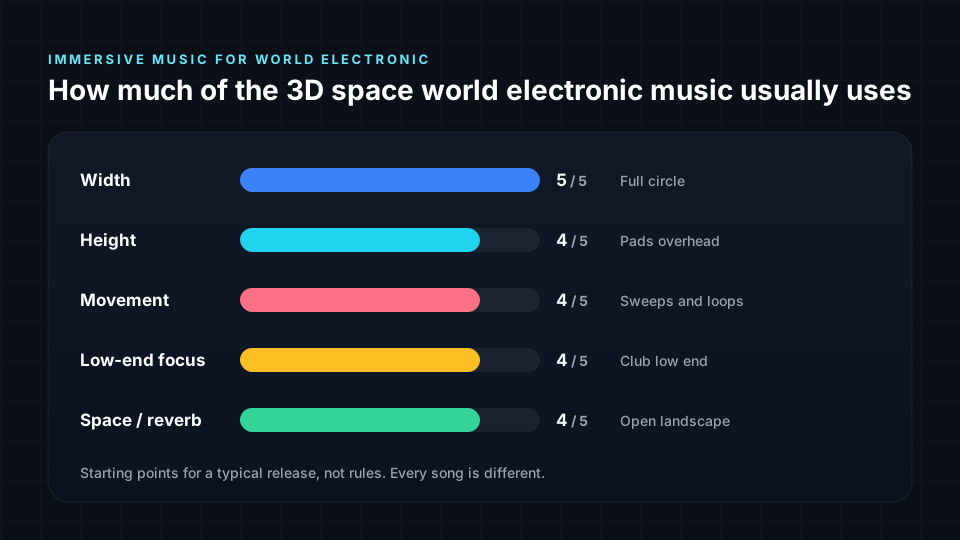
World electronic music scores high on almost every dimension. It has the low end of club music and the open, natural space of the landscapes its sounds come from.
Tips for an immersive world electronic mix
- Give the tradition the spotlight. The traditional lead should be the clearest sound in the mix, not decoration on top of the beat.
- Keep the low end simple. One kick and one bass, both centred.
- Use field recordings for place. A little nature or street sound behind the listener sets the scene instantly.
- Move effects, not instruments. Sweeps and risers can travel. Drums and the lead should stay put.
- Respect the source. If you sample traditional music, credit the musicians and make sure you have permission to use the recording.
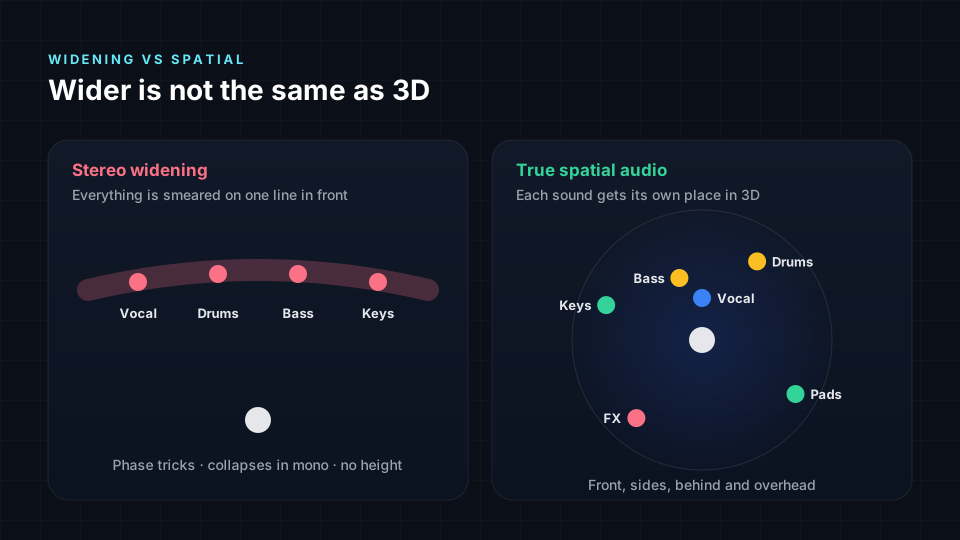
How to make immersive world electronic music from stereo
Spatial9 can create spatial audio from a stereo track in a few steps:
- Upload your stereo master or your stems.
- Spatial9's AI separates and places each part, from the kick and bass to the traditional instruments.
- Preview it in binaural on headphones.
- Export Eclipsa Audio, ADM, binaural or Ambisonics.
- Publish a video. Create a YouTube-ready video with your immersive audio and publish it directly.
For related guides, read spatial audio for Afro house, spatial audio for melodic techno and spatial audio for Indian classical music. Every guide is listed in spatial audio and immersive music by genre.
Frequently asked questions
Can I make a world electronic mix in Dolby Atmos or Eclipsa Audio?
Yes. The placements in this guide work for both. Spatial9 exports ADM, the standard file used by Dolby Atmos studios, as well as Eclipsa Audio for YouTube, so one immersive mix covers both. You may also hear this called a 3D world fusion mix or organic house in spatial audio.
What counts as world electronic music?
Any electronic track built around a specific musical tradition, such as organic house, global bass, Balkan beats, Middle Eastern electronica or Andean electronic fusion.
Where should the traditional instruments go?
The main traditional melody goes in front. Supporting percussion goes to the sides, and atmospheric sounds go behind and above.
Is it fine to move sounds around in this genre?
Yes, in moderation. Let effects and sweeps travel during transitions, but keep the kick, bass and lead instrument still.
Can I convert a world electronic track I already released?
Yes. Spatial9 uses AI to separate a stereo master into its parts and export an immersive mix as Eclipsa Audio, ADM, binaural or Ambisonics.
Does immersive world electronic music work on normal headphones?
Yes. The mix is rendered binaurally, so the landscape surrounds you on any regular headphones.
Dolby and Dolby Atmos are trademarks of Dolby Laboratories. Spatial9 is not affiliated with or endorsed by Dolby Laboratories.
Sources
- Blauert, J. (1997). Spatial Hearing: The Psychophysics of Human Sound Localization, revised edition. MIT Press. Low-frequency, elevation, distance and motion cues.
- Hebrank, J. and Wright, D. (1974). Spectral cues used in the localization of sound sources on the median plane. Journal of the Acoustical Society of America, 56(6), 1829-1834.
- Neuhoff, J. G. (1998). Perceptual bias for rising tones. Nature, 395, 123-124.
- Bregman, A. S. (1990). Auditory Scene Analysis: The Perceptual Organization of Sound. MIT Press.
- Bronkhorst, A. W. (2000). The cocktail party phenomenon: a review of research on speech intelligibility in multiple-talker conditions. Acta Acustica united with Acustica, 86, 117-128.
- Barron, M. and Marshall, A. H. (1981). Spatial impression due to early lateral reflections in concert halls. Journal of Sound and Vibration, 77(2), 211-232.
Take your listeners somewhere new
Upload a world electronic track to Spatial9 and hear the landscape surround you in minutes. Then export it or publish it straight to YouTube.