Spatial Audio & Immersive Music for Anime: Complete Guide
Spatial9 Team · · Updated
Part of the series Spatial audio and immersive music by genre.
Anime music covers the opening and ending theme songs of Japanese animated series and films, often called anisong, along with their soundtracks. Think of soaring, emotional vocals, fast rock guitars, bright synths, sweeping strings, piano breakdowns, choirs and dramatic hits that match the action on screen. A single song can move from a quiet piano intro to a full band and orchestra in a few seconds. It shares a lot with J-pop and rock, but with the scale of a film score. This guide covers how spatial audio for anime music works, where to place each element and how to make an immersive anime mix. For the basics, see what spatial audio is.
Why anime music is perfect for spatial audio
Anime songs are packed with layers and big contrasts. A chorus can combine a full rock band, synths, strings, a choir and effect hits all at once, while the vocal still needs to cut through. In stereo, this often becomes a dense, loud wall of sound. In spatial audio, the band can stay in front while strings and choir surround the listener, and the dramatic moments gain real size.
Anime music is also tied to visuals. Many fans watch openings and music videos on YouTube, where immersive audio can match the scale of the animation.
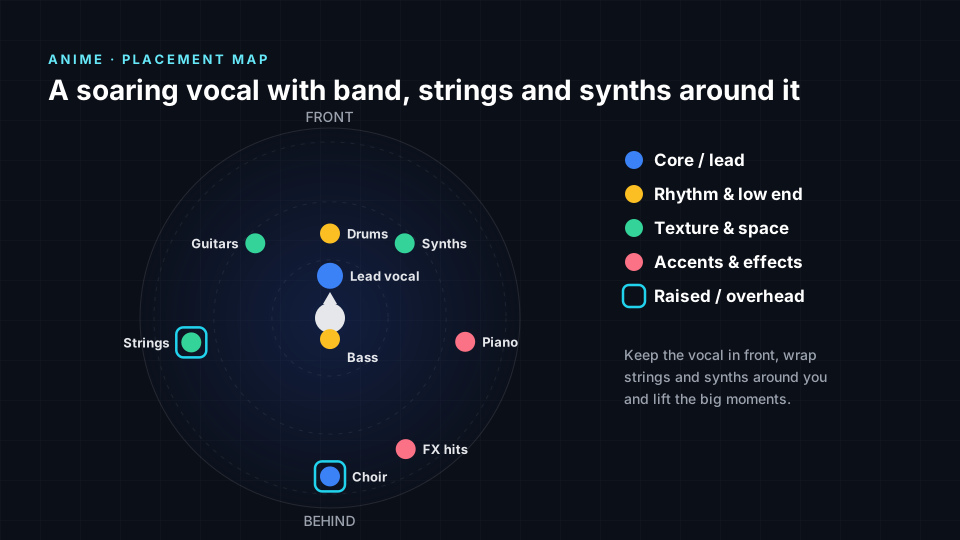
The rule: keep the vocal in front, wrap strings and synths around the listener and lift the big moments.
Immersive music for anime: what listeners hear
- A vocal that soars. The singer stays clear in front, even at full power.
- A band with energy. Guitars, synths and drums drive from the stage.
- Orchestral size. Strings and choir wrap around and above you.
- Cinematic hits. Dramatic effects sweep around like a scene change.
Where to place each element in an anime song mix
| Element | Position | Height | Why it works |
|---|---|---|---|
| Lead vocal | Front centre | Ear level | The emotional voice leads every song |
| Guitars | Front left | Ear level | Rock energy sits on the stage |
| Synths | Front right | Ear level | Balances the guitars |
| Drums | Front centre, behind vocal | Ear level | Drives the band without crowding the singer |
| Bass | Centre | Ear level | Low notes are hard to place, so centre is cleanest |
| Strings | Left side | Raised | Sweeping lines add scale around you |
| Piano | Right side | Ear level | Breakdowns and intros get their own place |
| Choir | Behind | Raised | Lifts the biggest moments above the listener |
| FX hits | Behind right, moving | Ear level | Cinematic transitions feel like a scene change |
The psychoacoustics behind anime placement
- Spatial release from masking. Moving strings and synths away from the vocal keeps the singer clear in dense choruses (Bronkhorst, 2000).
- Front and back spectral cues. Our ears shape sound differently from behind and above, so the choir sounds distinct from the band (Hebrank and Wright, 1974).
- Looming sounds grab attention. Approaching or rising sounds feel more intense, which makes effect hits dramatic (Neuhoff, 1998).
- Envelopment. Strings and choir from the sides and above create the feeling of a huge space (Barron and Marshall, 1981).
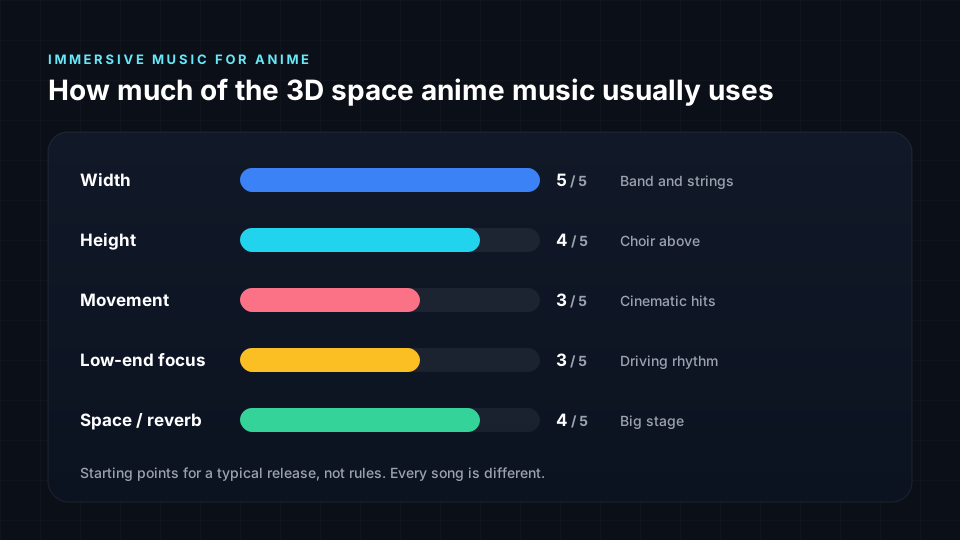
The immersion profile for anime
Tips for an immersive anime song mix
- Plan the contrast. Keep quiet intros close and narrow so the full chorus feels enormous.
- Give the band the front. Rock energy works best on a stage in front of you.
- Lift the strings and choir. Height adds scale without fighting the vocal.
- Move the hits, not the singer. Dramatic effects can travel. The voice stays put.
- Match the visuals. If you publish a video, let big sound moments line up with big moments on screen.
How to make immersive anime music from stereo
Spatial9 can create spatial audio from a stereo track in a few steps:
- Upload your stereo master or your stems.
- Spatial9's AI separates and places each part, from the vocal and guitars to the strings and choir.
- Preview it in binaural on headphones.
- Export Eclipsa Audio, ADM, binaural or Ambisonics.
- Publish a video. Create a YouTube-ready video with your immersive audio and publish it directly.
For related guides, read spatial audio for J-pop, spatial audio for film and game scores and spatial audio for rock. Every guide is listed in spatial audio and immersive music by genre.
Frequently asked questions
Can I make an anime song mix in Dolby Atmos or Eclipsa Audio?
Yes. The placements in this guide work for both. Spatial9 exports ADM, the standard file used by Dolby Atmos studios, as well as Eclipsa Audio for YouTube, so one immersive anime mix covers both. You may also hear this called a 3D anime song mix or anisong in spatial audio.
How is an anime mix different from a J-pop mix in spatial audio?
A J-pop mix is usually built around a pop song. An anime mix often adds orchestral strings, choir and cinematic effects, so it uses more height and a larger space.
Where should the choir go?
Behind and above the listener. This lifts the biggest moments without getting in the way of the lead vocal.
Should the effect hits move?
Yes, briefly. A short sweep across the back adds drama, especially at transitions. Keep the rest of the mix steady.
Can I convert a released anime song to spatial audio?
Yes, if you have the rights to the recording. Spatial9 uses AI to separate a stereo master into its parts and export an immersive mix as Eclipsa Audio, ADM, binaural or Ambisonics.
Does immersive anime music work on normal headphones?
Yes. The mix is rendered binaurally, so the singer sounds in front of you and the strings and choir surround you on any regular headphones.
Dolby and Dolby Atmos are trademarks of Dolby Laboratories. Spatial9 is not affiliated with or endorsed by Dolby Laboratories.
Sources
- Barron, M. and Marshall, A. H. (1981). Spatial impression due to early lateral reflections in concert halls. Journal of Sound and Vibration, 77(2), 211-232.
- Bronkhorst, A. W. (2000). The cocktail party phenomenon: a review of research on speech intelligibility in multiple-talker conditions. Acta Acustica united with Acustica, 86, 117-128.
- Hebrank, J. and Wright, D. (1974). Spectral cues used in the localization of sound sources on the median plane. Journal of the Acoustical Society of America, 56(6), 1829-1834.
- Neuhoff, J. G. (1998). Perceptual bias for rising tones. Nature, 395, 123-124.
- Blauert, J. (1997). Spatial Hearing: The Psychophysics of Human Sound Localization, revised edition. MIT Press.
Give your opening theme the scale it deserves
Upload an anime song to Spatial9 and hear the band, strings and choir rise around you in minutes. Then export it or publish it straight to YouTube.