Spatial Audio & Immersive Music for Dark Ambient: Drone, Isolationism & Ritual Ambient
Spatial9 Team · · 10 min read
Part of the series Spatial audio and immersive music by genre.
Key takeaways
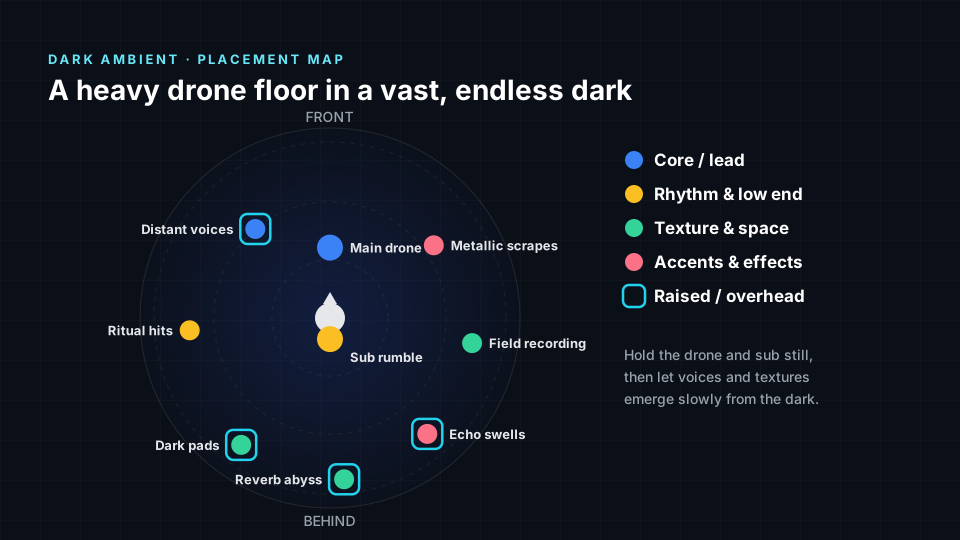
- In a spatial dark ambient mix the main drone and sub rumble form a steady floor, while distant voices, metallic textures, ritual hits and field recordings appear around the listener and pads and reverb rise above and behind.
- Sounds behind and to the sides are harder to pin down than sounds in front, which is why placing scrapes and echo swells there creates the unease dark ambient relies on.
- Movement in dark ambient should be slow and rare, because one sound shifting position is more unsettling than constant motion.
- The dark ambient immersion profile scores width 5, height 5, movement 2, low-end focus 4 and space 5 out of 5.
Dark ambient is the shadow side of ambient music. It grew in the 1980s from the overlap between industrial music and ambient, as artists from the industrial and experimental underground began making slow, beatless, unsettling soundscapes, and the name came into wide use in the 1990s. Lustmord is often credited as one of its pioneers. The sound is built from long, low drones, sub-bass rumbles, metallic scrapes and resonances, processed field recordings of caves, factories or wind, distant voices or chants, sparse percussive hits and enormous reverbs. There is usually no regular beat or clear melody. The music works through texture, scale and dread. Because dark ambient is so much about place, the sense of where sounds come from, and how far away they are, matters more than in almost any other genre. This guide covers how spatial audio for dark ambient works, where to place each element and how to make an immersive dark ambient mix. For the basics, see what spatial audio is.
Why dark ambient is ideal for spatial audio
Dark ambient is designed to make a listener feel small inside a large, uncertain space. In stereo, that space is suggested with reverb but stays in front of you. In spatial audio it can really surround you, rise above you and stretch out behind you. A sound that appears from behind, or a voice that seems to come from overhead, creates exactly the unease the genre is reaching for.
The rule: a heavy floor, an endless dark above and behind. The drone and sub rumble stay steady, while voices, textures and echoes appear slowly from every direction.
Immersive music for dark ambient: what listeners hear
- A floor that hums. The drone and sub rumble fill the body rather than the ears.
- Voices that come from nowhere. Distant chants or whispers drift slowly above and in front.
- Something moving at the edges. Metallic scrapes and echo swells appear, shift and fade.
- No walls. Reverb and pads stretch behind and above until the room seems endless.
Where to place each element in a dark ambient mix
| Element | Position | Height | Why it works |
|---|---|---|---|
| Main drone | Front centre | Ear level | A steady anchor in the dark |
| Sub rumble | Centre | Ear level | Felt more than heard, on every system |
| Distant voices | Front left, moving | Raised | Ghostly and hard to place |
| Metallic scrapes | Front right, moving | Ear level | Cold, shifting tension |
| Ritual hits | Left | Ear level | Sparse, heavy punctuation |
| Field recording | Right | Ear level | A real place beneath the music |
| Dark pads | Behind left | Raised | Slow, enveloping harmony |
| Echo swells | Behind right, moving | Raised | Sounds that rise and vanish |
| Reverb abyss | Behind | Raised | A space with no end |
The psychoacoustics behind dark ambient placement
Every position in the table above follows how the ear and brain locate sound. Here is the reason behind the main choices for dark ambient.
- Sub rumble stays centred. The ear finds almost no direction in frequencies below roughly 80 to 100 Hz, so a dark ambient sub rumble seems to come from everywhere at once. Keeping it centred and mono makes it feel like the floor of the space itself, steady on any system, rather than a source you can point at.
- Unease lives behind and to the sides. Our sense of direction is sharpest straight ahead, where the minimum audible angle is smallest, as Mills showed, and gets much vaguer at the sides and behind. Placing scrapes, swells and echoes there makes them hard to pin down, which is exactly the uncertainty dark ambient wants.
- Voices raised overhead. The ear judges elevation mostly from spectral cues shaped by the outer ear, as Hebrank and Wright described. Filtered, airy voices placed above the listener read as high and distant, which makes chants and whispers feel ghostly rather than present.
- Pads and reverb all around. Sound arriving from the sides and behind soon after the direct sound creates a strong feeling of envelopment, as Barron and Marshall showed for early lateral reflections. Wrapping pads and reverb around the listener turns a drone into a vast, enclosing space.
The immersion profile for dark ambient
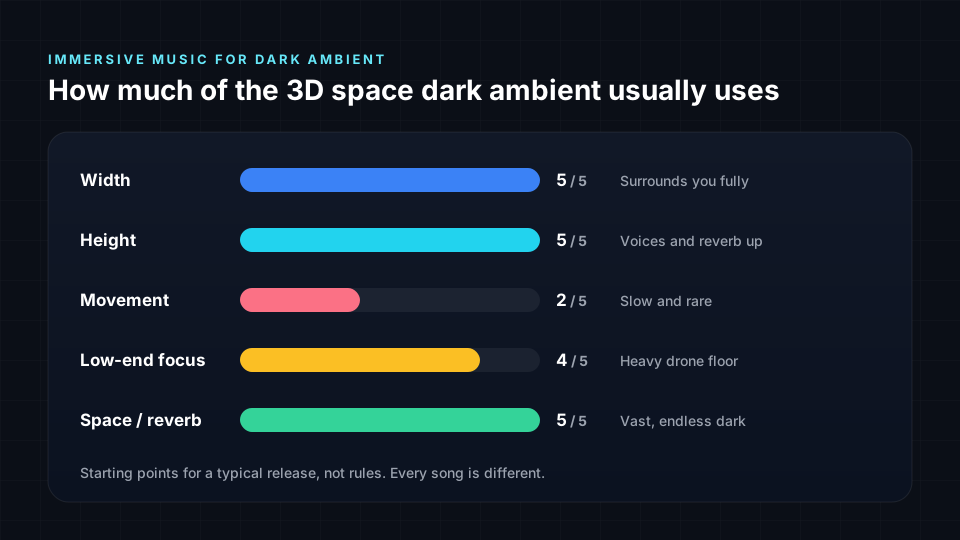
Width, height and space are all at maximum because dark ambient is about scale: the listener should feel surrounded by a vast, dark place. Low-end focus is high because drones and sub rumbles carry much of the weight and the dread. Movement is deliberately low. In dark ambient, a single sound that slowly shifts position is far more unsettling than constant motion, so most elements stay put and only a few drift.
Tips for an immersive dark ambient mix
- Build the floor first. Set the drone and sub rumble before adding anything else.
- Use distance as a tool. Keep most sounds far away, and bring one closer only when you want a moment of tension.
- Move rarely and slowly. Let one element shift over many seconds instead of moving several at once.
- Use the space behind. Sounds behind the listener are the most unsettling, so save them for key moments.
- Leave silence in places. Empty directions make the space feel larger and the next sound more striking.
Dark Ambient styles: drone, isolationism and ritual ambient
The core placement holds for every dark ambient style: a steady low floor, textures and voices around the listener, a vast space above and behind. What changes is how dense the sound is, how much is happening and whether human sounds such as chants and drums play a role.
Drone
Drone music is built from long, sustained tones that change very slowly, with roots in the minimalist and experimental music of the 1960s and in older traditions that use a constant tone. Dark ambient drone takes this into lower, heavier territory. In spatial audio, think of one drone as several layers: keep the fundamental centred and low, and spread its upper harmonics wider and higher around the listener. Let those harmonics drift very slowly so the drone seems to breathe. Use very little else.
Isolationism
Isolationism is the bleakest, sparsest side of dark ambient. The term was popularised by an influential mid 1990s compilation that gathered cold, desolate music from ambient, industrial, post-rock and metal artists. It is about emptiness rather than threat. In spatial audio, keep everything far away and leave wide empty gaps between sounds. A single tone, a hum or a distant noise can sit alone in one direction with nothing around it. Use cold, long reverb and avoid filling the space, because the emptiness is the point.
Ritual Ambient
Ritual ambient adds human and ceremonial sounds to dark ambient: frame drums, gongs, bells, horns, chanting and throat singing, often with spiritual or occult themes. It feels like a ceremony in a cave or temple. Place chanting voices in a loose circle around the listener, as if they are standing within a group. Keep drums low and to the sides, heavy but sparse. Bells and gongs can be raised so their decay fills the space above. Keep the drone and sub as the floor beneath it all.
Related styles such as black ambient and death industrial follow the same idea.
How to make immersive dark ambient from stereo
Spatial9 can create spatial audio from a stereo track in a few steps:
- Upload your stereo master or your stems.
- Spatial9's AI separates and places each part, anchoring the drone and sub rumble and spreading voices, textures and reverb around and above you.
- Preview it in binaural on headphones.
- Export Eclipsa Audio, ADM, binaural or Ambisonics.
- Publish a video. Create a YouTube-ready video with your immersive audio and publish it directly.
For related guides, read spatial audio for ambient and spatial audio for experimental. Every guide is listed in spatial audio and immersive music by genre.
Frequently asked questions
Does this guide cover drone, isolationism and ritual ambient?
Yes. Drone keeps the fundamental centred and spreads slowly drifting harmonics wider and higher. Isolationism keeps sounds sparse and far away with wide empty gaps. Ritual ambient places chants in a circle around the listener, drums low at the sides and bells raised above, over a steady drone.
Can I make a dark ambient mix in Dolby Atmos or Eclipsa Audio?
Yes. The placements in this guide work for both. Spatial9 exports ADM, the standard file used by Dolby Atmos studios, as well as Eclipsa Audio for YouTube, so one immersive dark ambient mix covers both. If you plan to release the Atmos version on Apple Music, build it from your original stems or multitracks, because Apple does not accept Atmos made from a finished stereo master. See where to publish spatial audio. You may also hear this called a 3D dark ambient mix or dark ambient in spatial audio.
Is spatial audio good for dark ambient?
Yes. Dark ambient is about space, scale and unease, and spatial audio lets sounds appear from above, behind and far away. It is one of the genres that gains the most from an immersive mix.
How is dark ambient different from ambient in spatial audio?
Both use the full room, but ambient is usually light, warm and calm, with gentle movement and open air. Dark ambient sits lower and heavier, with a stronger sub floor, less movement and more use of the space behind the listener to create tension.
Where should distant voices go in immersive dark ambient?
Raised and away from the centre, often front left or right and drifting slowly. Filtered voices above the listener feel ghostly and hard to place, which suits the genre better than a clear voice at ear level.
Can I convert a finished dark ambient track to spatial audio?
Yes. Spatial9 uses AI to generate an immersive mix from a stereo master and exports it as Eclipsa Audio, ADM, binaural or Ambisonics.
Does immersive dark ambient work on normal headphones?
Yes. The mix is rendered binaurally, so the drones, distant voices and endless reverb work on any regular headphones.
Dolby and Dolby Atmos are trademarks of Dolby Laboratories. Spatial9 is not affiliated with or endorsed by Dolby Laboratories.
Sources
- Blauert, J. (1997). Spatial Hearing: The Psychophysics of Human Sound Localization, revised edition. MIT Press. Low-frequency, elevation, distance and motion cues.
- Mills, A. W. (1958). On the minimum audible angle. Journal of the Acoustical Society of America, 30(4), 237-246.
- Hebrank, J. and Wright, D. (1974). Spectral cues used in the localization of sound sources on the median plane. Journal of the Acoustical Society of America, 56(6), 1829-1834.
- Bronkhorst, A. W. (2000). The cocktail party phenomenon: a review of research on speech intelligibility in multiple-talker conditions. Acta Acustica united with Acustica, 86, 117-128.
- Litovsky, R. Y., Colburn, H. S., Yost, W. A. and Guzman, S. J. (1999). The precedence effect. Journal of the Acoustical Society of America, 106(4), 1633-1654.
- Barron, M. and Marshall, A. H. (1981). Spatial impression due to early lateral reflections in concert halls. Journal of Sound and Vibration, 77(2), 211-232.
- Neuhoff, J. G. (1998). Perceptual bias for rising tones. Nature, 395, 123-124.
- Bregman, A. S. (1990). Auditory Scene Analysis: The Perceptual Organization of Sound. MIT Press.
Step into the dark
Upload a dark ambient track to Spatial9 and hear your drones, voices and textures fill a vast space around you in minutes. Then export it or publish it straight to YouTube.