Spatial Audio & Immersive Music for Indie Electronic: Complete Guide
Spatial9 Team · · Updated
Part of the series Spatial audio and immersive music by genre.
Indie electronic music blends the songwriting and personal feel of indie with electronic production. Think of breathy vocals, warm analog synths, guitar loops, soft drum machines, glitchy edits, chopped vocals and little everyday recorded sounds woven into the track. It is often made in bedrooms and small studios, and it values texture and mood over sheer power. A dance mix is built for the club. An indie electronic mix is built for headphones. This guide covers how spatial audio for indie electronic music works, where to place each element and how to make an immersive indie electronic mix. For the basics, see what spatial audio is.
Why indie electronic music is perfect for spatial audio
Indie electronic tracks are full of small details: a reversed guitar, a clicking hi-hat, a fragment of a voice, the sound of rain. In stereo, these details are tucked behind the vocal and many listeners never notice them. In spatial audio, each detail can live in its own place around the listener, so the whole world of the track becomes audible.
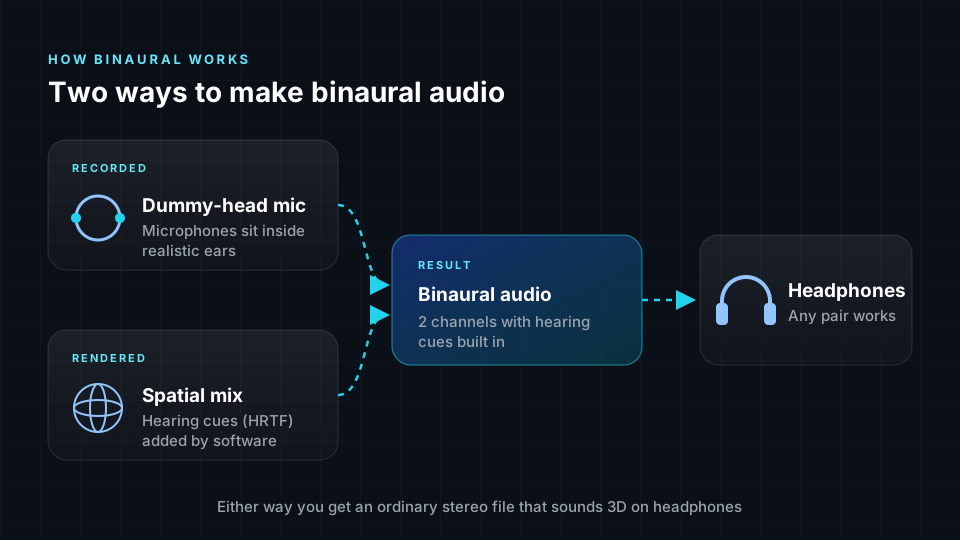
Because the music is mostly listened to on headphones, it is also a natural fit for binaural playback, where those details can appear beside and behind you.
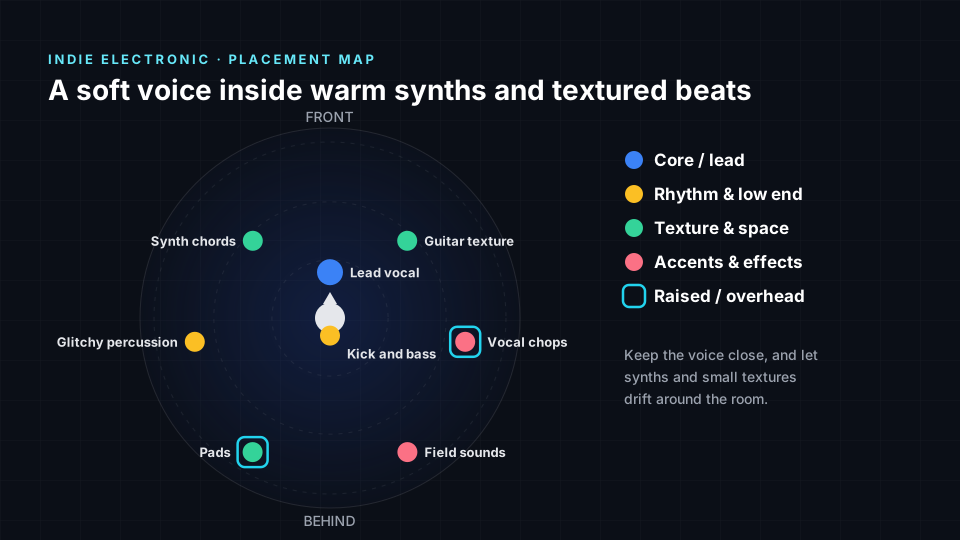
The rule: keep the voice close, and let synths and small textures drift around the room.
Immersive music for indie electronic: what listeners hear
- A voice right beside you. The vocal feels close and personal.
- Hidden details revealed. Small sounds appear around you instead of hiding.
- Warm, floating synths. Pads and chords create a soft space above.
- Gentle motion. A few textures drift slowly, like part of a dream.
Where to place each element in an indie electronic mix
| Element | Position | Height | Why it works |
|---|---|---|---|
| Lead vocal | Front centre, close | Ear level | The personal voice anchors the track |
| Synth chords | Front left | Ear level | Warm harmony sits near the singer |
| Guitar texture | Front right | Ear level | Balances the synths on the other side |
| Kick and bass | Centre | Ear level | Low notes are hard to place, so centre is cleanest |
| Glitchy percussion | Left side | Ear level | Small clicks stay clear away from the voice |
| Vocal chops | Right side | Slightly raised | Fragments feel like echoes of the lead |
| Pads | Behind left | Raised | Fill the space above the listener |
| Field sounds | Behind right, drifting | Ear level | Real-world sounds add a sense of place |
The psychoacoustics behind indie electronic placement
- Spatial release from masking. Small details are easier to hear when they come from a different direction than the vocal (Bronkhorst, 2000).
- Distance cues. A dry, close vocal and softer, more distant textures create depth (Zahorik et al., 2005).
- Front and back spectral cues. Our ears shape sound differently from behind, helping field sounds there feel distinct (Hebrank and Wright, 1974).
- Envelopment. Pads and textures from the sides and above make the listener feel surrounded (Barron and Marshall, 1981).
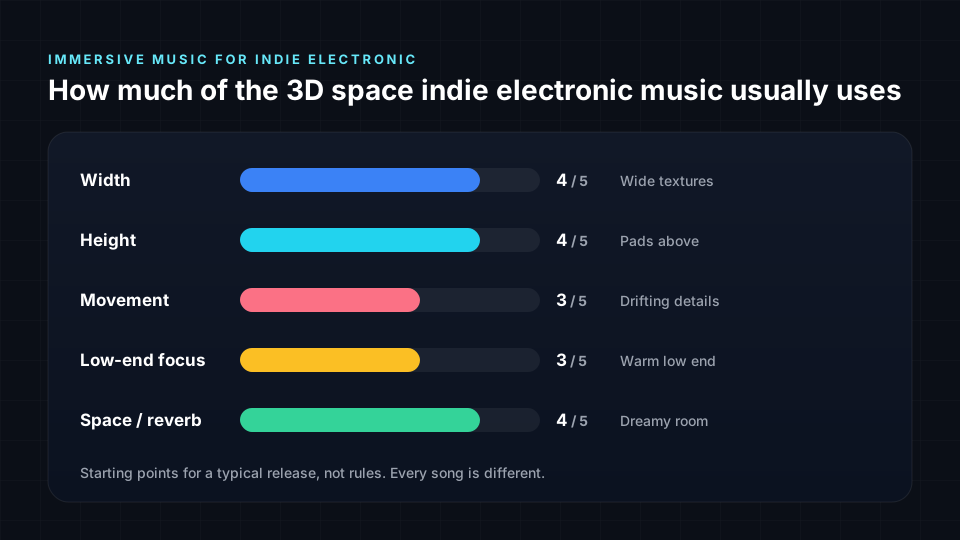
The immersion profile for indie electronic
Tips for an immersive indie electronic mix
- Keep the vocal intimate. Do not let the textures push the singer away.
- Give every small sound a home. Place each detail where it can be heard clearly.
- Move slowly. Gentle drifting suits the mood better than fast sweeps.
- Use field sounds to set the scene. Rain, birds or street noise behind you adds a sense of place.
- Lift the pads. Height makes the track feel open without adding volume.
How to make immersive indie electronic music from stereo
Spatial9 can create spatial audio from a stereo track in a few steps:
- Upload your stereo master or your stems.
- Spatial9's AI separates and places each part, from the vocal and synths to the beats and textures.
- Preview it in binaural on headphones.
- Export Eclipsa Audio, ADM, binaural or Ambisonics.
- Publish a video. Create a YouTube-ready video with your immersive audio and publish it directly.
For related guides, read spatial audio for indie, spatial audio for indie dance and spatial audio for ambient music. Every guide is listed in spatial audio and immersive music by genre.
Frequently asked questions
Can I make an indie electronic mix in Dolby Atmos or Eclipsa Audio?
Yes. The placements in this guide work for both. Spatial9 exports ADM, the standard file used by Dolby Atmos studios, as well as Eclipsa Audio for YouTube, so one immersive indie electronic mix covers both. You may also hear this called a 3D indie electronic mix or indietronica in spatial audio.
How is an indie electronic mix different from an indie dance mix in spatial audio?
An indie dance mix is built around a driving club beat. An indie electronic mix is softer and more detailed, so the space is used for textures and mood rather than energy.
Where should the vocal chops go?
To one side, slightly raised. They then sound like echoes or memories of the main vocal, instead of competing with it.
Should the textures move?
Some of them, slowly. A few drifting sounds add life. Too many moving parts become distracting.
Can I convert a released indie electronic song to spatial audio?
Yes. Spatial9 uses AI to separate a stereo master into its parts and export an immersive mix as Eclipsa Audio, ADM, binaural or Ambisonics.
Does immersive indie electronic music work on normal headphones?
Yes. The mix is rendered binaurally, so the voice sounds close and the textures surround you on any regular headphones.
Dolby and Dolby Atmos are trademarks of Dolby Laboratories. Spatial9 is not affiliated with or endorsed by Dolby Laboratories.
Sources
- Barron, M. and Marshall, A. H. (1981). Spatial impression due to early lateral reflections in concert halls. Journal of Sound and Vibration, 77(2), 211-232.
- Bronkhorst, A. W. (2000). The cocktail party phenomenon: a review of research on speech intelligibility in multiple-talker conditions. Acta Acustica united with Acustica, 86, 117-128.
- Hebrank, J. and Wright, D. (1974). Spectral cues used in the localization of sound sources on the median plane. Journal of the Acoustical Society of America, 56(6), 1829-1834.
- Zahorik, P., Brungart, D. S. and Bronkhorst, A. W. (2005). Auditory distance perception in humans: a summary of past and present research. Acta Acustica united with Acustica, 91, 409-420.
- Blauert, J. (1997). Spatial Hearing: The Psychophysics of Human Sound Localization, revised edition. MIT Press.
Let listeners step inside your track
Upload an indie electronic track to Spatial9 and hear every texture find its place in minutes. Then export it or publish it straight to YouTube.