Spatial Audio & Immersive Music for IDM: Braindance & Electronica
Spatial9 Team · · 9 min read
Part of the series Spatial audio and immersive music by genre.
Key takeaways
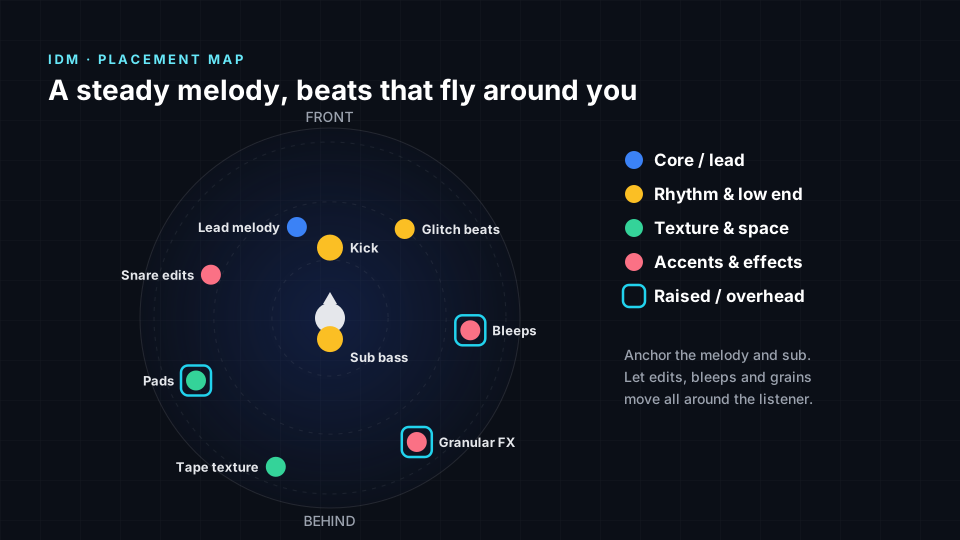
- In a spatial IDM mix the kick, sub and lead melody stay anchored, while glitch beats, snare edits, bleeps, pads, granular effects and tape texture spread and move around the listener.
- Giving each rhythmic layer its own direction uses auditory stream segregation, so the overlapping patterns and odd meters of IDM are heard as separate lines instead of one tangle.
- Short edits, stutters and bleeps make the best moving objects in IDM, while the melody should stay still in front as the listener's reference point.
- The IDM immersion profile scores width 5, height 4, movement 5, low-end focus 3 and space 4 out of 5.
IDM, short for intelligent dance music, grew out of the UK in the early 1990s, when producers coming from rave and techno started making electronic music meant as much for home listening as for the dance floor. Warp's Artificial Intelligence compilations helped define the sound, and the name spread through an online mailing list, although many of the artists have never liked it. Aphex Twin, Autechre and Boards of Canada are among its best-known names. The sound is detailed and restless: intricately programmed drums, irregular and shifting rhythms, rapid edits and stutters, warm analogue melodies, glassy bleeps, pads and worn tape textures. IDM is already a headphone music, and much of its appeal lies in tiny details that are easy to miss in stereo. That makes it one of the most natural genres for spatial audio. This guide covers how spatial audio for IDM works, where to place each element and how to make an immersive IDM mix. For the basics, see what spatial audio is.
Why IDM is ideal for spatial audio
IDM packs a lot of information into short spaces: a snare roll cut into fragments, a hi-hat pattern that changes every bar, a melody drifting over a beat in a different meter. In stereo all of that competes for the same narrow strip between two speakers. In an immersive mix each layer can live in its own direction, and the edits can literally fly around the head, which turns dense programming into something you can follow.
The rule: a still melody, a moving machine. The lead and the low end stay put, while the beats, edits and effects travel freely around them.
Immersive music for IDM: what listeners hear
- A melody you can hold on to. The lead stays steady in front while everything else shifts.
- Beats that come apart in space. Edits and stutters jump between directions.
- Bleeps that float overhead. Small, bright tones hover and drift above you.
- A worn, intimate room. Tape hiss and pads wrap around the listener.
Where to place each element in an IDM mix
| Element | Position | Height | Why it works |
|---|---|---|---|
| Kick | Front centre | Ear level | A stable anchor under the chaos |
| Sub bass | Centre | Ear level | Warm, steady low end |
| Lead melody | Front left | Ear level | The thread listeners follow |
| Glitch beats | Front right, moving | Ear level | Intricate programming in motion |
| Snare edits | Left, moving | Ear level | Stutters and rolls that jump |
| Bleeps | Right, moving | Raised | Bright detail floating above |
| Pads | Behind left | Raised | Soft harmonic bed |
| Granular FX | Behind right, moving | Raised | Grains that swirl behind |
| Tape texture | Behind left | Ear level | Warm, worn atmosphere |
The psychoacoustics behind IDM placement
Every position in the table above follows how the ear and brain locate sound. Here is the reason behind the main choices for IDM.
- Kick and sub stay centred. The ear finds almost no direction in frequencies below roughly 80 to 100 Hz, so the IDM low end gains nothing from being spread. Keeping it centred and mono gives the listener a stable floor while the rhythms above it break apart.
- Separate directions for separate rhythms. The brain sorts sound into separate streams using cues such as pitch, timing and location. This is auditory stream segregation. When glitch beats, snare edits and bleeps come from different directions, overlapping patterns and odd meters are heard as distinct lines instead of one tangled loop.
- The melody in front. The ear judges direction most precisely straight ahead, where the minimum audible angle is smallest. A lead melody placed in front stays clear and stable, which gives the listener a reference point against all the motion around it.
- Bleeps and grains raised. The outer ear shapes high frequencies differently depending on elevation, and those spectral cues are what let us hear height. Bright bleeps, clicks and granular fragments are rich in high frequencies, so they sit convincingly above the listener.
The immersion profile for IDM
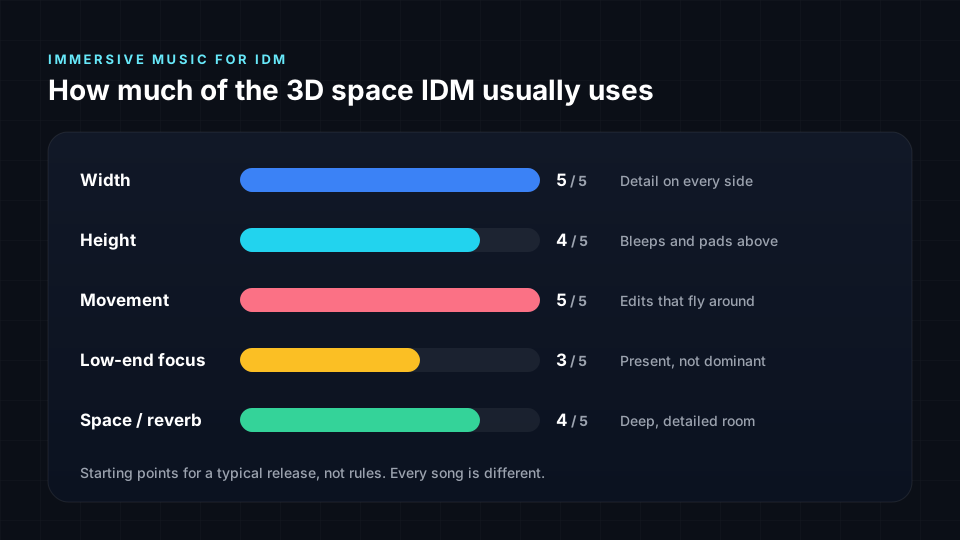
Width and movement are at maximum because IDM is built on detailed, shifting programming, and that detail is exactly what spatial audio can spread and animate. Height and space are high, as bleeps, pads and textures suit raised positions and a deep, layered room. Low-end focus is moderate: the sub and kick matter as a foundation, but unlike most club music, IDM is not driven by bass weight, so the attention goes to the detail above it.
Tips for an immersive IDM mix
- Give the ear one anchor. Keep the melody or main motif still so the listener never gets lost.
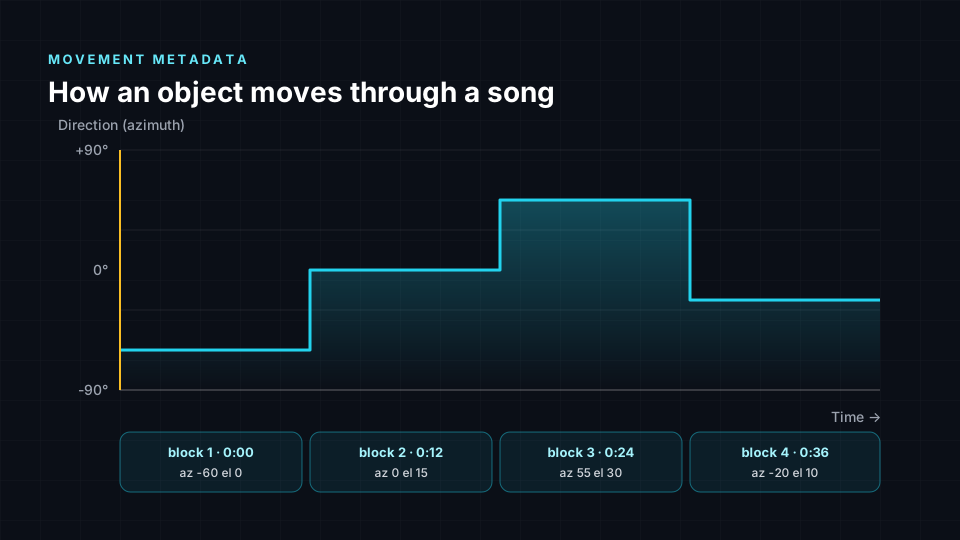
- Move edits, not loops. Short stutters and rolls make the best moving objects.
- Match motion to rhythm. Let movements follow the beat programming, not random paths.
- Separate busy layers. Put each drum pattern in its own direction rather than stacking them.
- Keep textures soft and wide. Tape hiss and pads should surround, not distract.
IDM styles: braindance and electronica
The core placement still applies across the whole family: a stable low end and melody, with rhythms and details spread and moving around the listener. What changes is how fast and chaotic the drums are and how much atmosphere the track carries.
Braindance
Braindance is the playful, hyperactive side of IDM, closely tied to acid lines, electro and breakbeat rhythms and rapid drum edits. It is the busiest style to place. Keep the kick, sub and any squelching acid bassline centred, then let the drum edits jump around the listener with fast, clear movements. Split simultaneous drum patterns into opposite directions so the chaos stays readable. Bright melodic lines can sit in front, with bleeps raised overhead. Keep the room tight, because long reverb blurs fast edits.
Electronica
Electronica is a broad term for melodic, song-like electronic music that borrows IDM's detail but often adds vocals, guitars or acoustic instruments. Treat any vocal like a lead: in front and close. Spread acoustic samples and synth layers to the sides, and keep glitchy details as moving accents around the edges. Height suits pads and bleeps. The mix should feel warmer and more structured than braindance, with moderate movement and a natural, mid-sized room.
Related branches such as drill 'n' bass and glitch push the edits further, while folktronica leans on acoustic textures. The same idea holds: anchor the core and let the detail move.
How to make immersive IDM from stereo
Spatial9 can create spatial audio from a stereo track in a few steps:
- Upload your stereo master or your stems.
- Spatial9's AI separates and places each part, anchoring the melody, kick and sub and sending beats, bleeps and textures around you.
- Preview it in binaural on headphones.
- Export Eclipsa Audio, ADM, binaural or Ambisonics.
- Publish a video. Create a YouTube-ready video with your immersive audio and publish it directly.
For related guides, read spatial audio for glitch and spatial audio for experimental music. Every guide is listed in spatial audio and immersive music by genre.
Frequently asked questions
Does this guide cover braindance and electronica?
Yes. Braindance needs fast, clear movement for its hyperactive edits and a tight room. Electronica treats vocals and acoustic parts like a song, in front and at the sides, with glitchy details moving around the edges.
Can I make an IDM mix in Dolby Atmos or Eclipsa Audio?
Yes. The placements in this guide work for both. Spatial9 exports ADM, the standard file used by Dolby Atmos studios, as well as Eclipsa Audio for YouTube, so one immersive IDM mix covers both. If you plan to release the Atmos version on Apple Music, build it from your original stems or multitracks, because Apple does not accept Atmos made from a finished stereo master. See where to publish spatial audio. You may also hear this called a 3D IDM mix or IDM in spatial audio.
Is spatial audio good for IDM?
Yes. IDM is detailed, headphone-oriented music, and spatial audio gives every edit, bleep and texture its own direction, so complex programming becomes clearer.
How is IDM different from glitch in spatial audio?
Glitch is built mainly from clicks, errors and micro-sounds, so the whole mix can be treated as moving texture. IDM usually keeps a melody and a clearer beat, so it needs a stable anchor in front while the edits move around it.
How much movement is too much in immersive IDM?
Movement becomes too much when the listener loses the melody or the pulse. Keep the lead and low end still, and move only short edits and effects, following the rhythm of the programming.
Can I convert a finished IDM track to spatial audio?
Yes. Spatial9 uses AI to generate an immersive mix from a stereo master and exports it as Eclipsa Audio, ADM, binaural or Ambisonics.
Does immersive IDM work on normal headphones?
Yes. The mix is rendered binaurally, so the moving edits, overhead bleeps and warm textures work on any regular headphones.
Dolby and Dolby Atmos are trademarks of Dolby Laboratories. Spatial9 is not affiliated with or endorsed by Dolby Laboratories.
Sources
- Blauert, J. (1997). Spatial Hearing: The Psychophysics of Human Sound Localization, revised edition. MIT Press. Low-frequency, elevation, distance and motion cues.
- Mills, A. W. (1958). On the minimum audible angle. Journal of the Acoustical Society of America, 30(4), 237-246.
- Hebrank, J. and Wright, D. (1974). Spectral cues used in the localization of sound sources on the median plane. Journal of the Acoustical Society of America, 56(6), 1829-1834.
- Bronkhorst, A. W. (2000). The cocktail party phenomenon: a review of research on speech intelligibility in multiple-talker conditions. Acta Acustica united with Acustica, 86, 117-128.
- Litovsky, R. Y., Colburn, H. S., Yost, W. A. and Guzman, S. J. (1999). The precedence effect. Journal of the Acoustical Society of America, 106(4), 1633-1654.
- Barron, M. and Marshall, A. H. (1981). Spatial impression due to early lateral reflections in concert halls. Journal of Sound and Vibration, 77(2), 211-232.
- Neuhoff, J. G. (1998). Perceptual bias for rising tones. Nature, 395, 123-124.
- Bregman, A. S. (1990). Auditory Scene Analysis: The Perceptual Organization of Sound. MIT Press.
Hear every edit in its own place
Upload a track to Spatial9 and hear your beats, bleeps and textures move around a steady melody in minutes. Then export it or publish it straight to YouTube.