Acoustic Digital Twin (ADT)
Real-time stereo-to-immersive rendering for cars, devices, streaming and broadcast, and how it is deployed.
Acoustic Digital Twin (ADT) is a real-time spatial audio engine by Spatial9. It analyzes ordinary stereo or mono audio as it plays, builds a live 3D model of the sound scene and renders it as immersive audio for headphones, speakers or immersive formats. ADT works on existing content, including decades-old stereo and mono recordings, live radio and video soundtracks, so you do not need to remix, remaster or re-upload a catalog.
ADT runs as a cloud API, in a private cloud or on premises, as native C/C++ libraries inside other software, or directly on phones, cars and other devices. It is licensed as an enterprise product. This page describes how the engine works, the deployment options, supported inputs and outputs, the main industries it serves and how to evaluate it. For the product overview and a sales contact, see /adt.
At a glance
| Property | Value |
|---|---|
| Category | Real-time spatial audio engine and SDK |
| Input | Stereo, mono, multichannel, live streams and files |
| Output | Binaural, speaker layouts, Ambisonics up to third order, ADM, Eclipsa Audio (IAMF) |
| Deployment | Cloud API, private cloud, on-premises, native SDK, edge and device |
| Platforms | Windows, Linux, macOS, iOS, Android, ARM64 and embedded |
| Industries | Automotive, consumer devices, streaming, broadcast, gaming, XR, health, public safety and more |
| Availability | Enterprise license; contact sales |
How ADT differs from the Spatializer
The Spatializer for Music and Spatializer for Video produce a finished, reviewed immersive mix of a specific track or soundtrack. GravityLLM proposes the arrangement, you review it on headphones, and you export deliverables such as ADM BWF or Eclipsa Audio.
ADT addresses a different problem: spatializing audio as it plays, at scale, without a per-track production step. A streaming service can spatialize every play as it happens across a full catalog without pre-rendering or storing extra copies. A car can turn every radio station and playlist into a 3D sound stage on its own processor.
| Need | Recommended product |
|---|---|
| A reviewed immersive release of a song or video | Spatializer for Music or Spatializer for Video |
| Converting an existing Dolby Atmos master for YouTube | ADM to Eclipsa Audio converter |
| Batch processing of a catalog through an integration | REST API or Enterprise platforms |
| Real-time spatialization inside a product, device or broadcast chain | ADT |
How the engine works
ADT processes audio in four stages as it streams.
- Stream in. Audio arrives in small blocks from a live feed, a file or your own player. Nothing waits for the whole track.
- Understand. Each block is analyzed as it arrives, and voices, instruments and ambience are told apart on the fly.
- Place. Every element receives a position in 3D space that stays stable and natural from one moment to the next.
- Render. The scene is rendered to headphones, speakers or an immersive format, ready to play immediately.
The engine is designed around the following engineering properties:
- Block-by-block processing. The engine works on short, fixed-size blocks, so output starts almost as soon as input does.
- Predictable timing. Processing time per block is steady, so playback does not stutter under load.
- Modern hardware. The engine uses multi-core CPUs and, when available, GPUs, to run many streams on one machine.
- Graceful degradation. If a machine is overloaded, audio keeps flowing in a safe fallback mode instead of dropping out.
Deployment options
ADT is available in four deployment tiers. The sound is the same across every option; the tiers differ in where processing happens, latency and how capacity scales.
| Tier | Delivery | Latency | Scale | Best for |
|---|---|---|---|---|
| Cloud API | Managed streaming and batch endpoints | Network round-trip plus processing | Elastic, scales with your traffic | Prototypes, catalog batches, web products |
| Private Cloud and On-Prem | Container images with orchestration charts | In-network, no public internet hop | Horizontal: add nodes for more concurrent streams | Streaming platforms, broadcasters, strict data residency |
| Native SDK | C/C++ libraries: .dll, .so, .dylib and static builds | Local processing, tied to your buffer size | Many streams per machine, linear across cores | Game engines, DAWs, broadcast consoles, media servers |
| Edge and Device | Mobile frameworks, ARM and embedded binaries | On-device, works offline | Every device adds its own capacity | Consumer apps, XR headsets, automotive, smart speakers |
Cloud API
You send audio over a streaming connection and receive spatial audio back, chunk by chunk. There is no infrastructure to run, and Spatial9 scales capacity automatically. The tier provides a streaming API, batch jobs and webhooks.
Private Cloud and On-Prem
The same engine is packaged as containers for your own cloud account or data center. Audio never leaves your network, and you size the capacity. GPU and CPU builds are available, with health and metrics endpoints for monitoring.
Native SDK
You link the engine directly into your application as a native library. It runs on your audio thread with no network hop, which gives the lowest latency and the highest density per machine. The SDK exposes a C API with a C++ wrapper and a single processing call designed to sit inside an audio callback, so it fits game engines, DAWs, plugins and media servers. Supported platforms are Windows, Linux and macOS on x64 and ARM64, plus iOS and Android. Embedded and custom hardware targets are available on request.
Edge and Device
Optimized builds run on phones, headsets, set-top boxes and embedded hardware. Processing happens on the device itself, so it works offline and costs nothing per stream. Footprint profiles keep battery and processor use low, and binaural output can include head tracking.
Data residency and privacy
Your audio leaves your network only if you choose the Cloud API. With on-premises, native SDK or on-device deployment, all processing happens inside your own environment. This makes the self-hosted, native and device tiers suitable for strict data residency requirements and for content that cannot be sent to a third party.
Industries and use cases
The following sections summarize the main scenarios ADT is designed for. Each lists the deployment tiers that fit it best.
Automotive
ADT runs on the vehicle's own audio processor, fully offline, and adapts to the car's speaker layout, from 4 to more than 30 channels. It turns any song, podcast or radio station into a cabin-wide 3D sound stage without a connection or per-stream fees.
- Directional driver alerts. Navigation prompts, blind-spot warnings and parking sensors can be placed in the direction of the hazard.
- Personal sound zones. Each seat can receive its own spatial experience.
The best-fit tiers are Edge and Device and the Native SDK.
Phones and consumer devices
Built into a phone, TV, laptop, earbud or headset, ADT spatializes everything the device plays, not only specially mixed content. It works with any headphones, and low-power builds allow it to stay on all day. Target devices include smartphones, headphones and earbuds, smart TVs and set-top boxes, soundbars and smart speakers, laptops and PCs, and wearables.
Streaming platforms
Music and video streaming services can spatialize every play as it happens, across a full catalog, without pre-rendering, re-encoding or storing extra copies. The Cloud API, on-premises and device tiers all fit this scenario.
Live and broadcast
Inside a broadcast chain or a cloud data center, ADT processes many live feeds side by side, from sports and esports to concerts and services, without adding noticeable delay for viewers. It requires no pre-rendering and fits existing broadcast chains, and it can run 24 hours a day.
Catalog conversion
Entire back-catalogs can be processed in parallel across your own servers and then delivered in every format you need. Film and TV archives, historical recordings and live concert recordings are typical candidates.
Games, XR and communication
Running the engine inside a game or headset gives every player spatial audio with no server cost. ADT can also upgrade legacy game audio, add spatial positioning to VR and AR content libraries, and position participants spatially on voice communication platforms so that group conversations are easier to follow.
Other sectors
The engine also targets health and accessibility (such as hearing aids and hearables, audio navigation for people with visual impairments, and telehealth), public safety and operations (such as emergency dispatch, contact centers and trading floor voice systems), and venues and experiences (such as theme parks, museums, theaters and houses of worship).
Supported outputs
ADT renders to the following targets:
- Binaural for headphones, with optional head tracking on supported devices.
- Speaker layouts up to immersive configurations, including vehicle layouts.
- Ambisonics up to third order.
- Object-based ADM for delivery workflows.
- Eclipsa Audio (IAMF) for open immersive distribution.
No spatial format sounds identical on every system. As with any immersive deliverable, check the result on the playback systems your audience uses. See Formats overview for how these outputs compare.
Licensing and support
ADT is licensed as an enterprise product. Pricing depends on the deployment model, volume and support level, and agreements can be structured per stream, per device, per site or as unlimited use. Enterprise agreements include:
- Security and privacy. Deploy where your data lives.
- Flexible licensing. The agreement is shaped around how you ship.
- Dedicated engineering. A named integration team, shared channels and help tuning the engine to your content.
- Service guarantees. Uptime commitments for the cloud, long-term support releases for the SDK and clear upgrade paths.
To request a proposal, contact Spatial9 from the /adt page.
Evaluating ADT
Use the following procedure to plan an evaluation.
- Identify the content you need to spatialize, such as a catalog, a live feed or system audio on a device.
- Identify your constraints: latency, data residency, offline operation and the number of concurrent streams.
- Start with the Cloud API on representative material to judge quality.
- Listen on the playback systems your audience uses, including headphones and speakers, because each can reveal different weaknesses.
- Choose the deployment tier that meets your constraints, and request a proposal.
Research directions in the Academy
The Spatial9 Academy also presents an acoustic digital twin in a broader research sense: a virtual model of a real space that aims to recreate how it sounds. That room, at /demo, carries a Coming soon badge and is a research preview, not a feature to rely on in projects.
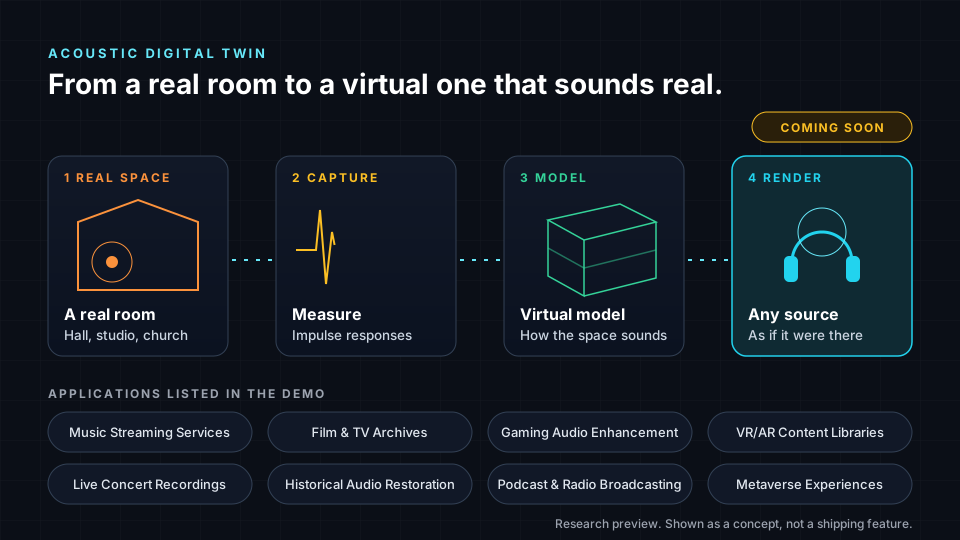
The research pipeline has four stages: start with a real space such as a hall, studio or church; capture how it responds to sound, commonly by recording impulse responses from different positions; build a virtual model from those measurements; and render any source inside the model as if it were performed in that room. The technologies behind this direction are source separation and analysis, intelligent spatial positioning and real-time rendering.
Next steps
- Formats overview: compare the binaural, speaker, Ambisonics and ADM outputs ADT can render.
- Enterprise platforms: connect Spatial9 processing to your existing systems and pipelines.
- Binaural and headphones: understand how headphone rendering and head tracking work.
- Limits and quotas: review the limits that apply to the self-serve API and agent routes.