What Is Eclipsa Audio? The Open 3D Sound Format, IAMF, and the Story of Its First Song
Spatial9 Team · · Updated · 13 min read
Key takeaways
- Eclipsa Audio is an open, royalty-free immersive audio format developed by Google and Samsung and built on IAMF, a standard from the Alliance for Open Media.
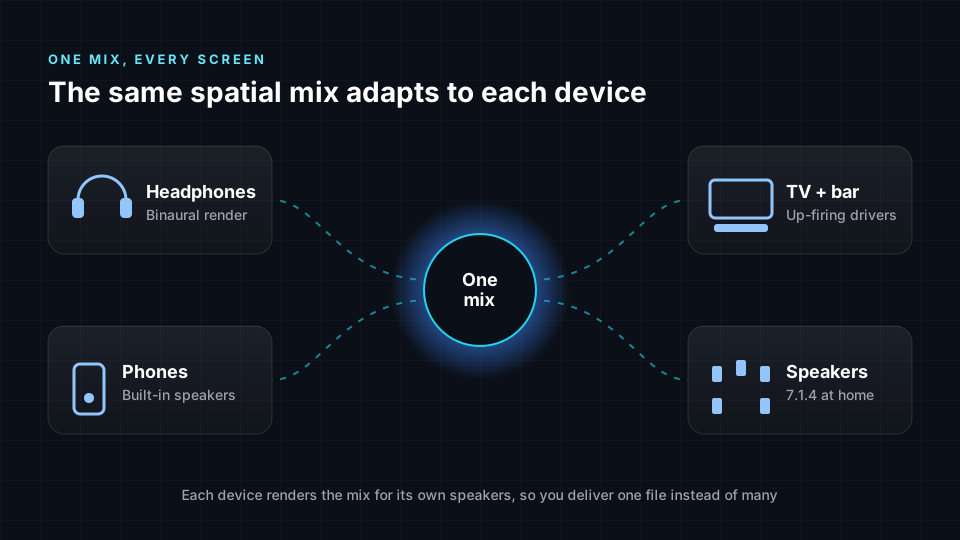
- One Eclipsa Audio file carries the whole 3D mix plus the rules for playing it, so the same file adapts to headphones, phones, TVs, soundbars and full speaker rooms.
- IAMF is a container, not a codec: it carries audio coded with Opus, AAC, FLAC or uncompressed PCM, in channel layouts up to 7.1.4 or as an Ambisonics sound field.
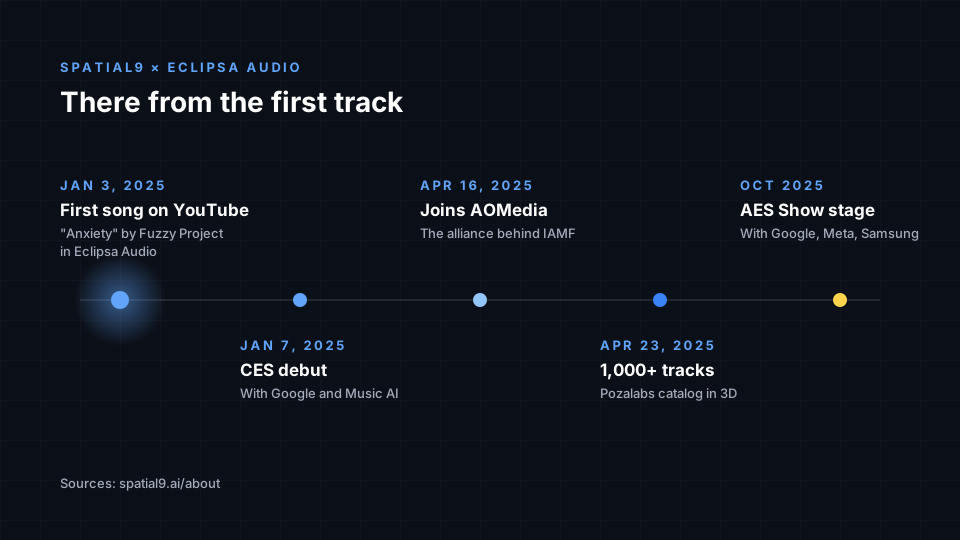
- On January 3, 2025, Spatial9 released the first music on YouTube in Eclipsa Audio, "Anxiety" by Fuzzy Project, and four days later debuted Eclipsa Audio music with Google and Music AI at CES 2025.
- Today anyone can make Eclipsa Audio with Spatial9: spatialize a stereo song with AI, or convert a Dolby Atmos ADM master for free.
Some formats arrive quietly. Eclipsa Audio arrived with a song.
On January 3, 2025, before most of the industry had heard the name, Spatial9 published a music video on YouTube called "Anxiety" by Fuzzy Project. Under the picture was something nobody had released on the platform before: music in Eclipsa Audio, the new open format for 3D sound from Google and Samsung. That same morning, Samsung announced Eclipsa Audio for its 2025 TVs and soundbars. Four days later, Spatial9 stood with Google and Music AI at CES in Las Vegas to present immersive music rendered in the format to the world.
Every song you will ever hear in Eclipsa Audio on YouTube traces back to this moment. Press play and hear where open 3D sound began:
Watch: "Anxiety" by Fuzzy Project, the first music on YouTube in Eclipsa Audio
Published by Spatial9 on January 3, 2025. The full 3D mix plays on Eclipsa Audio TVs and soundbars; other devices hear a version made for them.

This guide explains what Eclipsa Audio is, how it works, how it relates to IAMF, where you can hear it, and the part Spatial9 has played since the very first track.
What is Eclipsa Audio?
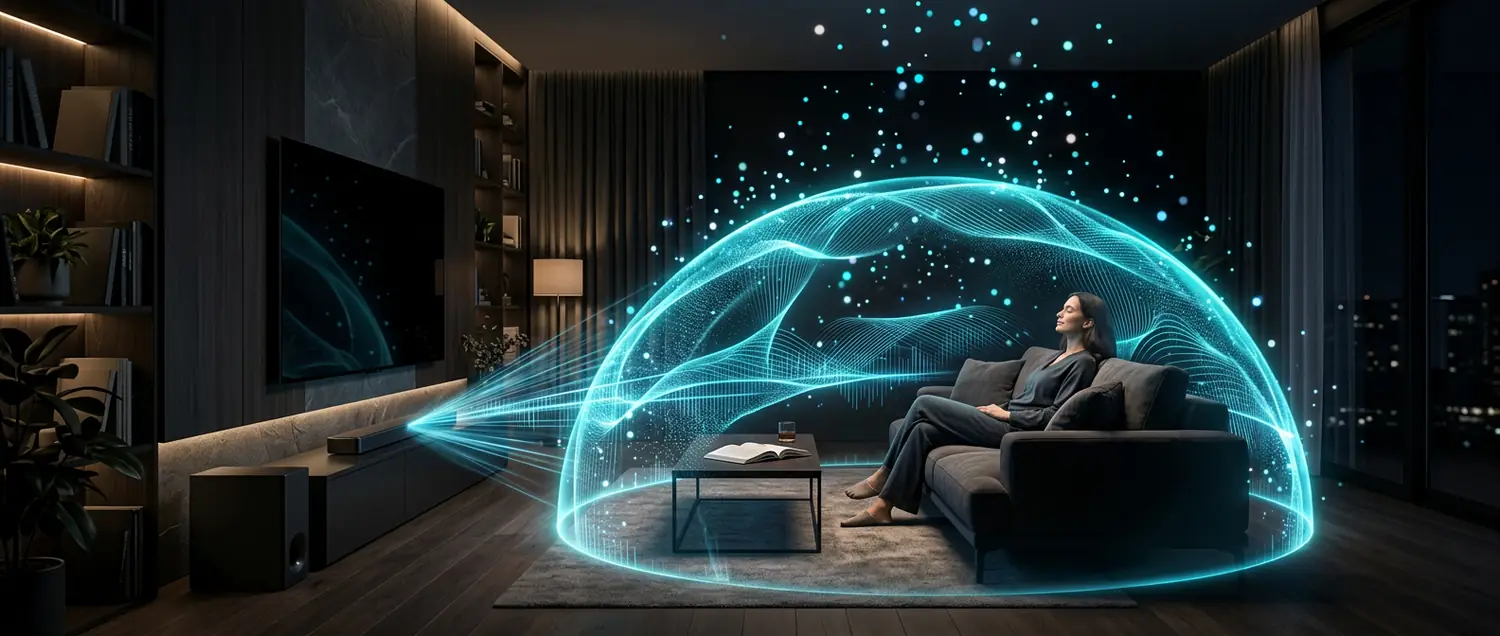
Eclipsa Audio is an open, royalty-free format for immersive 3D sound, developed by Google and Samsung and built on IAMF (Immersive Audio Model and Formats), a standard from the Alliance for Open Media. It places sound all around the listener, in front, to the sides, behind and above, and one file plays correctly on headphones, phones, TVs, soundbars and full speaker systems.
Think of it as the open answer to a question that used to have only closed answers. For years, mixing music in 3D meant licensed tools, licensed devices and licensed streaming services. Google's own announcement put it simply: creating spatial audio had been "mostly limited to professionals in the movie or music industries", so Google and Samsung released Eclipsa Audio as "an open source spatial audio format for everyone."
- Open. The specification and reference software are public. Anyone can read them, build with them and improve them.
- Royalty-free. Creators do not pay a fee per track, and device makers do not pay a fee per device to use the format. Devices that carry the Eclipsa Audio logo go through a certification program run with Korea's Telecommunications Technology Association (TTA).
- One mix for every device. The file carries the mix and the instructions for playing it, so the player adapts it to whatever the listener has.
Eclipsa Audio and IAMF: what is the difference?
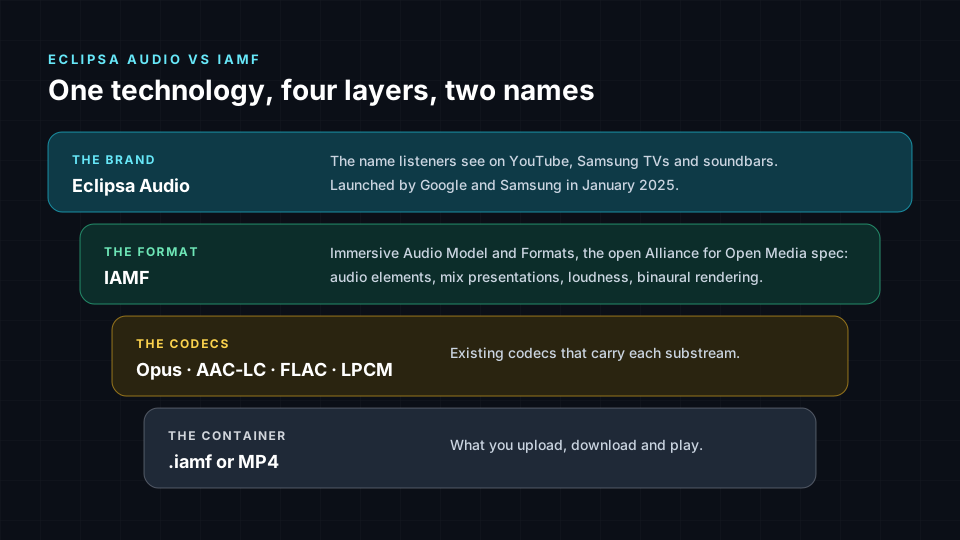
The two names describe the same technology from two angles.
- IAMF is the technical standard. The Alliance for Open Media (AOMedia), the group behind the AV1 video codec, released it on November 9, 2023 as its first audio specification under its royalty-free license. Google, Samsung and other members built it together.
- Eclipsa Audio is the consumer brand for IAMF, launched by Google and Samsung in January 2025. When a TV, a soundbar or a YouTube upload says Eclipsa Audio, the file inside is IAMF.
So when someone asks "what is IAMF?", the short answer is: IAMF is the open standard that Eclipsa Audio is made of. Developers talk about IAMF. Listeners see Eclipsa Audio.
How Eclipsa Audio works
IAMF is not a codec. It is a container that wraps audio coded with codecs you already know, together with instructions for playing it back.
- The audio. IAMF can carry audio compressed with Opus, AAC or FLAC, or uncompressed PCM. Opus keeps files small for streaming. FLAC and PCM keep every bit of a master.
- Audio elements. Each piece of sound in the file is either channel-based, laid out for speakers such as 5.1.2 or 7.1.4, or scene-based, a full sphere of sound recorded or mixed as Ambisonics.
- Mix presentations. These describe how to combine and render the audio elements, including loudness information. A creator can offer more than one, for example a version where the listener can turn the dialogue up.
- Rendering on the device. Open-source renderers turn the same file into binaural sound for headphones, a stereo fold-down for a phone speaker, or a full layout for a room of speakers.
- Delivery in MP4. IAMF fits inside standard MP4 files, which is how it travels with video to YouTube.
The standard defines profiles that set how much a file may contain. IAMF 1.0 defined the Simple and Base profiles, and version 1.1 added Base-Enhanced for larger mixes. For the bitstream, the profiles and working code, read our IAMF technical deep dive.
Where you can hear Eclipsa Audio
- YouTube. Since January 2025, creators can upload videos with Eclipsa Audio tracks. Viewers on supported devices hear the immersive mix, and everyone else hears a version made for their device. Our YouTube creator guide shows how to upload and check it.
- Samsung TVs and soundbars. Samsung was the first device maker to adopt Eclipsa Audio, across its 2025 TV lineup from Crystal UHD to Neo QLED 8K, and its 2025 soundbars.
- More devices to come. In January 2025, Google said it planned to bring Eclipsa Audio to the Chrome browser, to TVs and soundbars from more manufacturers, and to Android.
- Your browser, right now. The free Spatial9 Player plays .iamf and MP4 files on any computer, and lets you switch between stereo and binaural on headphones.
Spatial9 IAMF Web Player (Eclipsa Audio player)
A free IAMF and Eclipsa Audio web player that decodes in your browser and never uploads your file. Drop a standalone .iamf bitstream or an MP4 with an IAMF track, or play a bundled sample: a 7.1.4 speaker callout in Opus or FLAC, and an animated third-order ambisonics scene from the Alliance for Open Media iamf-tools project.
- Codecs: Opus, AAC-LC, FLAC and LPCM (the iamf-tools web demo does not decode AAC)
- Audio elements: channel-based layouts up to 9.1.6 and scene-based ambisonics
- Instant A/B between a stereo fold-down and binaural headphone rendering, with live channel meters
- Profile, codec, audio element and mix presentation details
- Optional quality check: BS.1770 loudness, true peak, clipping and silence, with a downloadable report
Use headphones to hear the binaural version. It is a preview, not a reference renderer. Full page: Eclipsa Audio Player.
How Eclipsa Audio compares with other formats
| Eclipsa Audio (IAMF) | Dolby Atmos | Sony 360 Reality Audio | |
|---|---|---|---|
| Who controls it | Open standard from AOMedia | Dolby | Sony |
| Licence fees | Royalty-free | Licensed | Licensed |
| Where it plays | YouTube, Samsung 2025 TVs and soundbars, open players | Apple Music, Amazon Music, TIDAL, cinemas, many devices | Amazon Music, some Sony devices |
| How it is made | Channels and Ambisonics scenes in an open container | Beds and objects | Objects on a sphere |
Each format has a home, and many artists release in more than one. For the detail, compare Eclipsa Audio vs Dolby Atmos, Eclipsa Audio vs Apple Spatial Audio and Eclipsa Audio vs Sony 360 Reality Audio.
Spatial9 and Eclipsa Audio: there from the first track
Every format needs someone to go first. Someone has to take a specification and turn it into music that moves people, test it on real devices in real rooms, and prove that it works before anyone else is listening. For Eclipsa Audio, that was Spatial9.
The first music on YouTube in Eclipsa Audio
Before launch, Spatial9 worked with Google to develop, test and create content for the format. "We focused on refining the technology to ensure it delivers high audio quality and a strong immersive experience," said Alan Silva, Co-Founder and CTO of Spatial9. "Our team tested the format on various devices and in different environments to improve the Eclipsa Audio rendering process. With Google, we created a wide range of content that shows what this format can do, from music to movies."
Then, on January 3, 2025, Spatial9 pressed publish. Fuzzy Project, "Anxiety", in Eclipsa Audio went live on our YouTube channel: the first music released on YouTube in the format.
Think about what that moment meant. For years, 3D music had lived behind licence fees, special tools and closed platforms. Google and Samsung built Eclipsa Audio to tear that wall down, so that any artist could create in 3D and any listener could enjoy it. A new open standard is only a promise until someone puts music in it. On January 3, that promise got its first song.
It went up the same day Samsung announced Eclipsa Audio for its TVs, and twelve days before Google introduced the format on its Open Source Blog. The format was brand new. The music was already there.
Every Eclipsa Audio track that has followed, from Marcos Valle's catalog classics to more than 1,000 Pozalabs tracks, walks a path that started with this one song. If you have not heard it yet, scroll back up and press play, ideally on an Eclipsa Audio TV or soundbar, where the full 3D mix comes alive.
The story of "Anxiety": a founder's song
"Anxiety" was not a track picked from a library. Fuzzy Project is one of the music projects of Luiz Zanardo, the founder and CEO of Spatial9, and the song came from the same person who was building the company. That is why it could arrive first: the artist, the engineers and the technology were all on the same team.
Owning the music meant the team could open up every part of it, place each sound around the listener, and test the result on device after device without waiting for anyone's permission. When Eclipsa Audio was ready for the world, the song was ready too.
There is something fitting in the name. Anxiety is the feeling right before a first step, when nobody knows yet whether a new idea will land. On January 3, 2025, that first step was taken, and 3D sound on YouTube had a song to point to.
Who is Luiz Zanardo?
Luiz Zanardo lives in two worlds and has never had to choose between them.
- Music. He is an electronic music artist signed to Armada Music and Black Hole Recordings, with support from Armin van Buuren, Paul van Dyk, Ferry Corsten and Nora En Pure.
- Data and AI. He built his career across HP, Intel, Cloudera and Databricks, the companies that shaped the modern data and AI era, and contributed to Dolly 2.0, the open-source language model from Databricks.
- Intelligence. He led global engineering teams that designed intelligence-grade data and AI systems for defense, the intelligence community and some of the largest enterprises in the world.
- Spatial9. In 2024 he co-founded Spatial9 with Alan Silva and Carlos Freitas, to bring that same precision to the way music is heard.
"Anxiety" is where those worlds meet: a song by an artist, placed in 3D by the AI his team built, released in an open format the whole industry can use.
The start of a new era, built in the open
For most of its history, immersive sound has been a closed club: licensed tools, licensed devices, licensed platforms. Eclipsa Audio changes the rules. It is built on IAMF, an open standard from the Alliance for Open Media, it is royalty-free, and anyone can build with it.
That is the era "Anxiety" opened. Not one company's format, but a shared one, moved forward by an open-source community of engineers, researchers and artists. Spatial9 joined the Alliance for Open Media in April 2025, published an open patch for Google's open-source Eclipsa Audio plugins, and keeps building tools that let every creator, not only big studios, release music in 3D.
A first song is a beginning, not a finish line. The next thousand songs in Eclipsa Audio belong to everyone.
Making history at CES 2025
On January 7, 2025, Spatial9, Google and Music AI introduced immersive music rendered in Eclipsa Audio to the world, and demonstrated it in Las Vegas at CES 2025. Spatial9's AI rendering turned stereo music into Eclipsa Audio tracks that play on YouTube, and Music AI's platform gave creators access to it from day one.
"Our partnership with Google and Music AI to launch Eclipsa Audio-rendered music is a monumental step toward democratizing immersive audio for the masses," said Luiz Zanardo, Co-Founder and CEO of Spatial9. "Eclipsa Audio represents the future of 3D sound."
"With Spatial9, we're excited to showcase the potential of Eclipsa Audio," said Jani Huoponen, Product Lead for the Eclipsa Audio format at Google. "This collaboration demonstrates how Eclipsa Audio's platform-agnostic design can bring immersive audio to billions of users around the world."
Read the full story in Google, Spatial9 and Music AI present music in Eclipsa Audio at CES 2025.
Building the open future, in the open
Spatial9 did not stop at the launch. In April 2025 it joined the Alliance for Open Media, the home of IAMF, to help shape where open immersive audio goes next. Since then, the pioneer has kept building, so that every creator can do what Spatial9 did first:
- AI spatializing. The Spatializer for Music separates a stereo song into its instruments, places each one in 3D and exports Eclipsa Audio for YouTube, in a few minutes per song.
- Free conversion for Dolby Atmos masters. The free ADM to Eclipsa converter turns an existing Atmos master into Eclipsa Audio without remixing, with no watermark. You can even ask ChatGPT, Claude, Gemini or Grok to do it.
- A free web player. The Spatial9 Player lets anyone hear Eclipsa Audio in a browser, on any computer.
- AI motion for the official plugin. Our Eclipsa Audio plugin patch adds editable 3D motion plans and AI assistant control to Google's open-source plugin.
- Checking real files. Try your current files reads any Eclipsa, Atmos or stereo file and tells you what is really inside.
Google and Samsung created Eclipsa Audio. Spatial9 gave it its first song, and has been filling it with music ever since.
Why Eclipsa Audio matters
For a century, every big leap in recorded sound has eventually become something everyone could use. Stereo went from a laboratory to every pocket. Eclipsa Audio is the same kind of moment for 3D sound, and this time it is open from the start.
- For artists, immersive music no longer requires a closed toolchain. A song made in your bedroom can reach the same 3D format as a major-label release, on the biggest video platform in the world.
- For listeners, there is nothing extra to buy. Ordinary headphones are enough for the binaural version, and the same file sounds better as your system gets better.
- For the industry, an open standard means any company can build players, tools and devices without asking permission. That is how open source has driven progress before, and it is how it can happen again.
How to make your own Eclipsa Audio
- Start with what you have. A stereo song works. So do stems, a surround mix or a Dolby Atmos ADM master.
- Choose your route. Spatialize a stereo song or stems with the Spatializer for Music, convert an Atmos master for free, or mix by hand with Google's open-source plugin.
- Listen before you publish. Check the binaural version on headphones and the stereo version on a phone speaker.
- Upload to YouTube. Follow our step-by-step creator guide to upload the MP4 and confirm that YouTube detected the Eclipsa Audio track.
Frequently asked questions
What is Eclipsa Audio?
Eclipsa Audio is an open, royalty-free immersive audio format developed by Google and Samsung. It is built on IAMF from the Alliance for Open Media, and it delivers 3D sound that adapts to headphones, phones, TVs, soundbars and speaker systems from a single file.
What is IAMF?
IAMF (Immersive Audio Model and Formats) is the open audio standard published by the Alliance for Open Media in November 2023. It is a container that carries Opus, AAC, FLAC or PCM audio in speaker layouts or as an Ambisonics sound field, plus instructions for rendering it. Eclipsa Audio is the consumer brand for IAMF.
Is Eclipsa Audio free to use?
Yes. IAMF is offered under the AOMedia royalty-free license, so creators pay no per-track fees. Devices that want to show the Eclipsa Audio logo go through a certification program.
Do I need special headphones to hear Eclipsa Audio?
No. Any pair of headphones can play the binaural version, which creates the 3D effect for two ears. TVs, soundbars and speaker systems with Eclipsa Audio support play the full mix.
Who released the first music on YouTube in Eclipsa Audio?
Spatial9 did. On January 3, 2025, Spatial9 published "Anxiety" by Fuzzy Project in Eclipsa Audio on YouTube, and on January 7, 2025 it presented immersive music rendered in Eclipsa Audio with Google and Music AI at CES 2025.
Did Spatial9 create Eclipsa Audio?
No. Google and Samsung developed Eclipsa Audio, on top of the IAMF standard from the Alliance for Open Media. Spatial9 helped develop, test and create content for the format before launch, released its first music on YouTube, and is a member of the Alliance for Open Media.
Is Eclipsa Audio better than Dolby Atmos?
They solve different problems. Dolby Atmos is a licensed format with deep support on Apple Music, Amazon Music, TIDAL and in cinemas. Eclipsa Audio is open and royalty-free and plays on YouTube and Samsung devices. Many artists release both, and Spatial9 exports both from the same song.
Hear the difference
Reading about 3D sound only goes so far. Put on headphones and listen to a stereo song next to its immersive version.
Listen to the before and after music examples (best on headphones).
The first Eclipsa Audio song on YouTube was a beginning, not a finish line. The next one could be yours.
Spatialize your first song in Eclipsa Audio
Sources
- Fuzzy Project, "Anxiety", Eclipsa Audio (IAMF), Spatial9 on YouTube, January 3, 2025.
- Google, Spatial9, and Music AI debut 'Eclipsa Audio' immersive format at CES 2025, PR Newswire, January 7, 2025.
- Samsung brings Eclipsa Audio, 3D technology developed with Google, to 2025 TVs and soundbars, Samsung Global Newsroom, January 3, 2025.
- Introducing Eclipsa Audio: immersive audio for everyone, Google Open Source Blog, January 15, 2025.
- Introducing open source DAW plugin for Eclipsa Audio, Google Open Source Blog, June 12, 2025.
- AOMedia releases the IAMF audio specification under its royalty-free license, Alliance for Open Media, November 9, 2023.
- Immersive Audio Model and Formats (IAMF) specification, Alliance for Open Media.
- Eclipsa Audio plugin source code, Google on GitHub.