Why Open Source Matters for Immersive Audio: Eclipsa Audio, IAMF and the Shared Future of Sound
Spatial9 Team ·
In 1675, Isaac Newton wrote to Robert Hooke: "If I have seen further, it is by standing on the shoulders of giants."
It is one of the most quoted sentences in the history of science, and it describes how almost everything we value came to be. No one invents alone. Every song borrows a scale someone else discovered. Every studio uses a microphone design someone else shared. Every engineer learned from someone who chose to explain instead of keeping a secret.
Open source is that idea, made deliberate. It is the decision to publish your work so others can stand on it.
This article is about why that decision matters so much for immersive audio right now, why Eclipsa Audio and IAMF are a turning point, and why we at Spatial9 care about this so deeply. It is part history, part philosophy and part promise.
The idea that cannot be owned
In 1813, Thomas Jefferson described ideas with an image that still feels fresh: "He who receives an idea from me, receives instruction himself without lessening mine; as he who lights his taper at mine, receives light without darkening me."
That is the quiet miracle at the heart of open source. A guitar can only be played by one person at a time. A song, a technique, a piece of code or a file format can be shared with a million people, and the original owner loses nothing. Shared knowledge does not run out. It multiplies.
Music has always worked this way. The blues was passed hand to hand. Jazz standards became a common language that thousands of players reinterpreted. Recording techniques spread from studio to studio through engineers who were generous with what they knew. Culture grows when ideas move freely.
The roots: four centuries of shared progress
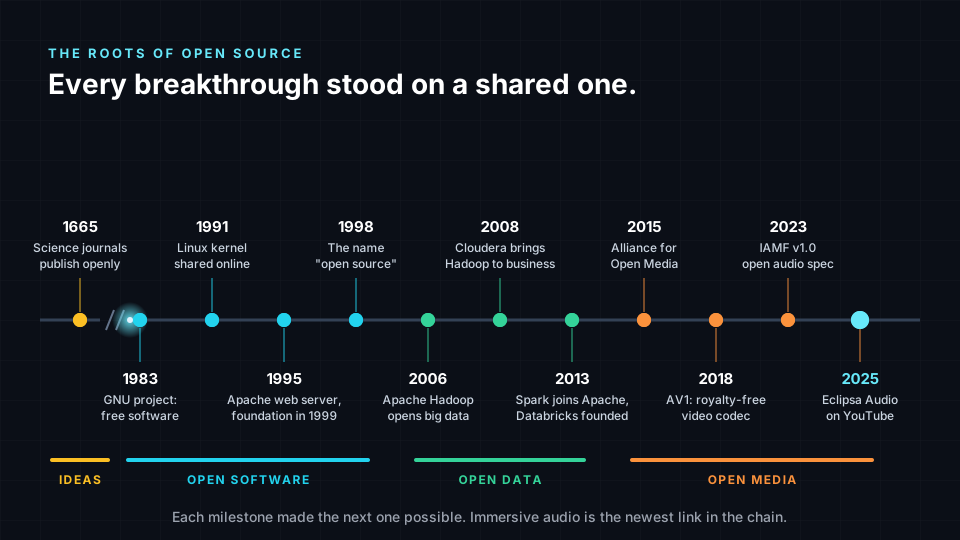
The story starts long before software. In 1665, the Royal Society began publishing Philosophical Transactions, one of the first scientific journals. For the first time, discoveries were printed for anyone to read, check and build on. Science became a conversation instead of a collection of secrets, and progress accelerated.
Three centuries later, the same idea arrived in computing.
- 1983: Richard Stallman announced the GNU project and argued that software should be free to study, change and share.
- 1991: A Finnish student named Linus Torvalds shared a small operating system kernel online, describing it as "just a hobby, won't be big and professional." Linux now runs most of the world's servers, every Android phone and the majority of the cloud.
- 1993: CERN released the World Wide Web software into the public domain. Because nobody owned the web, everybody could build on it.
- 1995: A small group of developers began sharing improvements to a web server by email. That project became the Apache HTTP Server, and in 1999 the group formed the Apache Software Foundation.
- 1998: The term "open source" was coined, giving a name to a movement that was already changing the world.
Each step looked modest at the time. Together they built the digital world we live in.
Open source is a revolution that already happened
It is easy to think of open source as a niche: volunteers, hobby projects, idealists. The numbers say otherwise.
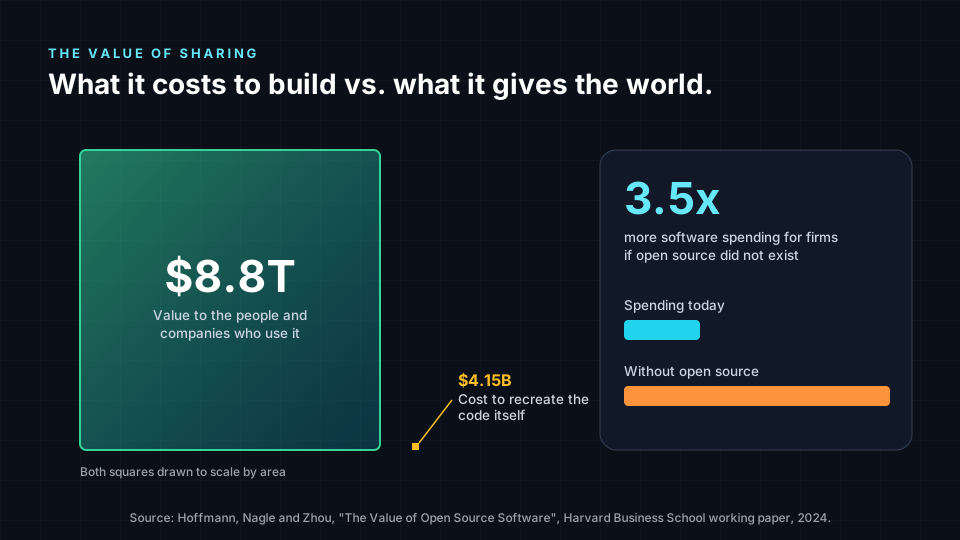
A 2024 study from Harvard Business School estimated that recreating the most widely used open source software from scratch would cost about $4.15 billion. The value of that software to the people and companies who use it is about $8.8 trillion. Without open source, the researchers found, companies would need to spend 3.5 times more on software than they do today.
Read those two numbers again. A few billion dollars of shared work produces trillions in value, because the same code is reused by millions of organisations at once. No other investment in human history scales quite like a good idea given away.
Our roots: Apache, Cloudera, Databricks and the open data revolution
For us at Spatial9, this is not abstract history. It is personal.
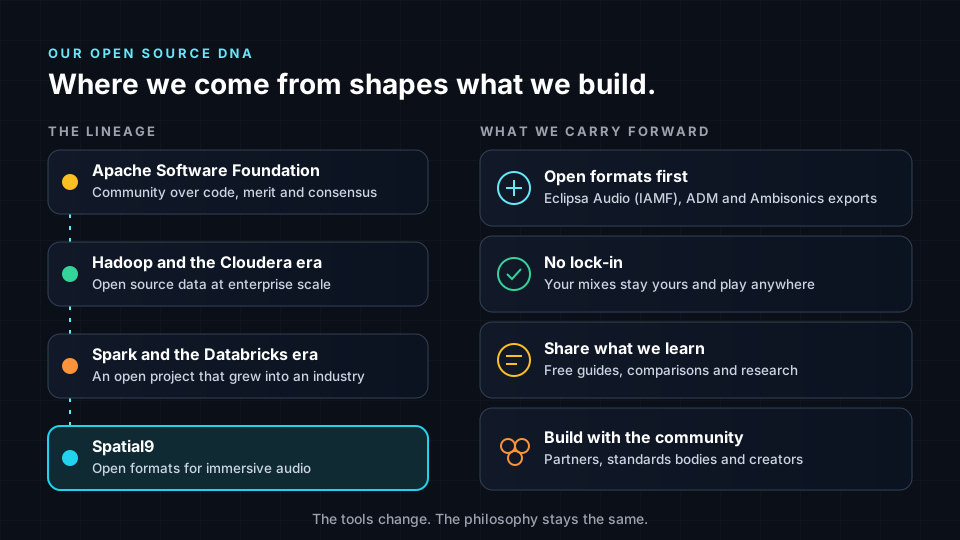
Members of our team come from the Apache Software Foundation community and from companies like Cloudera and Databricks. We were there when open source stopped being an alternative and became the way the world's most important infrastructure gets built.
The Apache Way: community over code
The Apache Software Foundation grew from fewer than a dozen developers sharing code patches by email in 1995 into a home for hundreds of projects used by nearly every company on earth. Its guiding phrase is simple: community over code.
The idea is that great software is a by-product of a healthy community. Decisions are made in the open. Anyone can contribute, and influence is earned by the quality of your contributions, not by your job title. A project belongs to the people who build it, not to a single company. Those principles have kept Apache projects alive and trusted for decades, long after individual companies came and went.
Hadoop and Cloudera: when open source made big data possible
In the mid-2000s, storing and analysing truly huge amounts of data was something only a few giant companies could afford. Then Doug Cutting and Mike Cafarella built Hadoop, named after a toy elephant belonging to Cutting's son, and it became an Apache project in 2006.
Hadoop made large-scale data processing available to everyone. In 2008, Cloudera was founded to bring Hadoop to businesses, with support, tools and enterprise reliability. An entire industry formed around a project nobody owned. Banks, hospitals, retailers, scientists and governments could suddenly ask questions of their data that had been impossible before.
Spark and Databricks: an open project that became an industry
In 2009, researchers at UC Berkeley's AMPLab started a project called Spark to make data processing dramatically faster and easier. It was released as open source, joined the Apache Software Foundation in 2013 and became one of the most active open source projects in the world.
That same year, Spark's creators founded Databricks. The company grew by serving the open community rather than fencing it in, and the project kept getting better because thousands of people contributed to it.
The lesson we carry
We learned something in those years that shapes everything we do: open does not mean giving up value. It means multiplying it. When a technology is open, more people adopt it, more tools are built for it, more problems get solved, and the whole market grows. The companies that thrive are the ones that make the commons stronger.
We saw that happen to data. We believe it is about to happen to sound.
Why immersive audio needs the same revolution
Immersive audio has a complicated history. In the 1970s, quadraphonic sound promised to surround listeners with music. It failed largely because of a format war. Several incompatible systems competed, consumers were confused, and the industry gave up on the idea for decades.
Ambisonics, a brilliant British approach to recording and reproducing full-sphere sound developed in the same decade, struggled commercially for years. It found a second life much later, once its ideas were widely implemented in freely available tools and adopted for virtual reality and 360-degree video. Today, Ambisonics is one of the foundations of spatial audio. You can learn how it works in our Ambisonics guide.
The pattern is clear. Immersive sound has never been held back by imagination. It has been held back by fragmentation, cost and access.
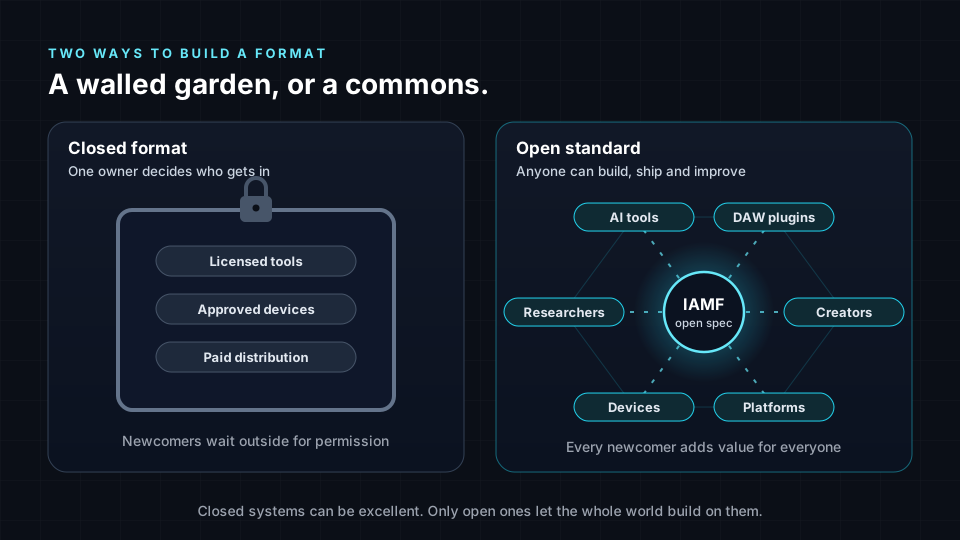
Closed formats can be excellent. Dolby Atmos is a remarkable technology, and it has done more than anything else to bring immersive music to streaming services. But in a closed system, one company decides which tools are licensed, which devices are approved and which creators can afford to take part. Growth depends on that company's priorities.
In an open system, growth depends on everyone. A student can build a plugin. A researcher can publish a better renderer. A startup can create a new kind of player. A television maker can add support without negotiating a licence. Every new participant makes the format more valuable for all the others.
Eclipsa Audio and IAMF: open from the foundation up
Eclipsa Audio is the consumer name for IAMF, the Immersive Audio Model and Formats specification. IAMF was developed by the Alliance for Open Media, the same industry group behind the AV1 video codec, whose members include companies such as Google, Amazon, Netflix, Meta and Microsoft. The first version of the specification was published in 2023, and IAMF is available under a royalty-free licence.
Google and Samsung brought it to the world under the Eclipsa Audio name. Since January 2025, YouTube has accepted videos with Eclipsa Audio, and Samsung's 2025 televisions and soundbars can play it. Spatial9 was proud to be part of the Eclipsa Audio debut at CES 2025.
What makes Eclipsa Audio special is not one feature. It is that every layer is open.
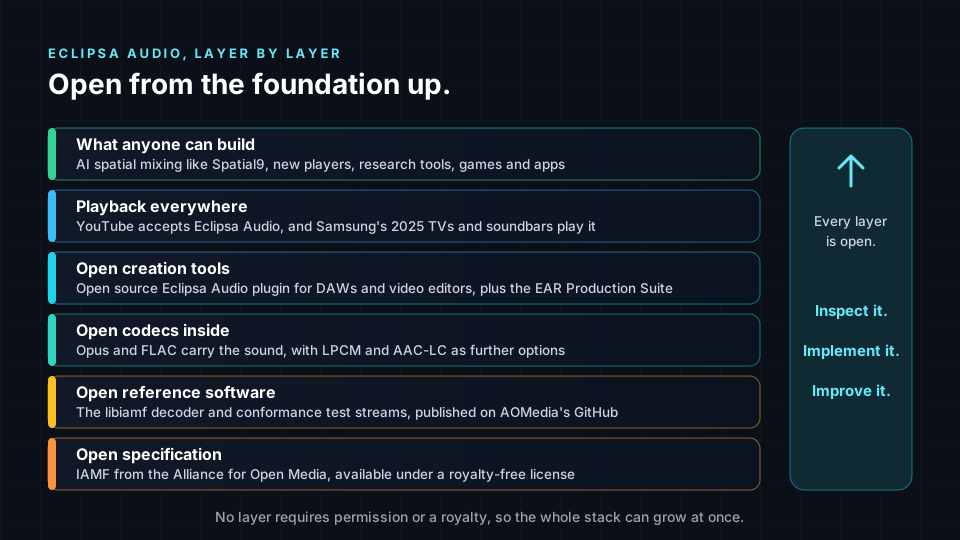
- The specification is public. Anyone can read exactly how IAMF describes immersive sound, from channel-based layouts to scene-based Ambisonics.
- The reference software is open source. The libiamf decoder and conformance test streams are published on the Alliance for Open Media's GitHub, so any developer can check that their player behaves correctly.
- The codecs inside are open. IAMF can carry sound encoded with Opus or FLAC, as well as LPCM and AAC-LC.
- The creation tools are open. In 2025, Google released an open source Eclipsa Audio plugin for digital audio workstations and video editors. Mixes can also be made with the open source EAR Production Suite.
- Playback reaches real audiences. YouTube and a growing range of devices already support it.
That combination is rare. It means a bedroom producer, a film school, a major label and a hardware company all start from exactly the same place, with the same rights. If you want the technical detail, our deep comparison of Eclipsa Audio and Dolby Atmos explains the formats layer by layer, and our guide for YouTube creators using Eclipsa Audio shows how to publish.
Why open wins over time: the flywheel
Open technologies have a way of starting slowly and then becoming unstoppable. The reason is a flywheel that gets faster with every turn.
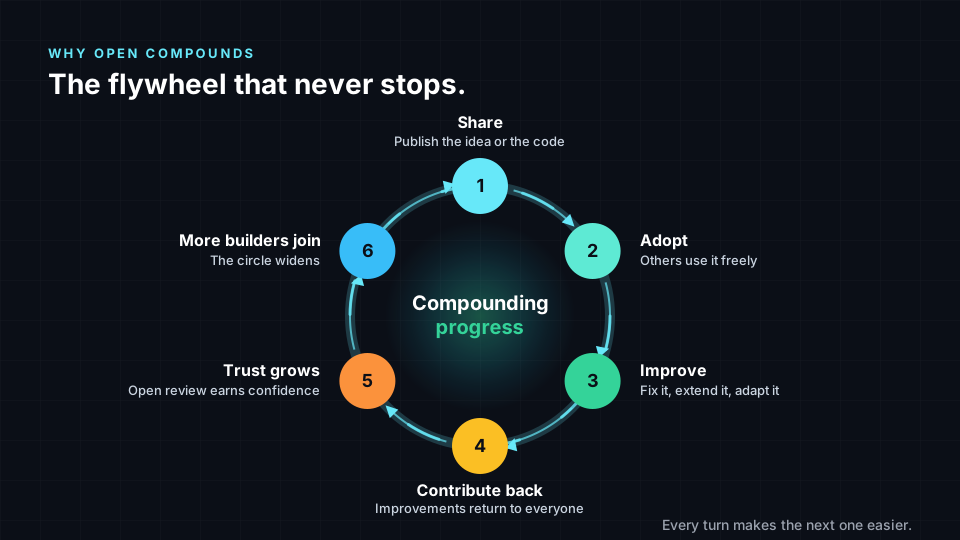
- Share. Someone publishes an idea, a specification or a piece of code.
- Adopt. Others use it freely, because there is no fee or permission standing in the way.
- Improve. Users fix problems, add features and adapt it to new situations.
- Contribute back. Those improvements return to the shared project, so everyone benefits.
- Trust grows. Because everything happens in the open, people can check the work. As Eric Raymond put it in The Cathedral and the Bazaar, "given enough eyeballs, all bugs are shallow."
- More builders join. Trust attracts new contributors, and the circle widens.
We have watched this flywheel spin before. Opus became the standard audio codec for real-time communication on the web. AV1, also from the Alliance for Open Media, spread across browsers, phones and streaming services. Linux went from a hobby to the backbone of the internet. Apache Spark went from a research project to a global industry.
Eclipsa Audio is at the beginning of its flywheel. That is exactly the most exciting moment to be part of it.
Five freedoms open standards give every creator
Philosophy matters most when it changes real lives. Here is what openness means for the people who actually make music and video.
- The freedom to reach. Your immersive mix can play on any device that implements the standard, not only on the devices of a single licensing ecosystem.
- The freedom to last. A public specification means your work can still be read and played decades from now. Closed formats depend on their owners. Open formats belong to history.
- The freedom to learn. Anyone can study how the format works, which turns immersive audio from a secret craft into shared knowledge that schools and creators can teach.
- The freedom to build. Developers, researchers and startups can create new tools, players and experiences without waiting for permission.
- The freedom to begin. No licence fee stands between an independent artist and their first immersive release.
These freedoms are how a technology moves from the top studios in the world to everyone with a story to tell.
Progress is a group project
Eric Raymond described two ways of building things. In the cathedral, a small group of experts works behind closed doors and reveals the finished result. In the bazaar, work happens in public, everyone can contribute, and the result emerges from many hands.
Immersive audio has lived in the cathedral for most of its history: a few specialised rooms, expensive equipment and knowledge passed between a small number of experts. Open standards, open tools and AI are opening the doors of that cathedral and turning it into a bazaar, full of musicians, filmmakers, game designers, students, researchers and listeners.
This is the deepest reason open source matters. Human progress has always been a group project. The printing press, the scientific journal, the public library, the internet and open source software are all versions of the same idea: that when people share what they know, everyone gets further than anyone could alone.
How Spatial9 lives this philosophy
We built Spatial9 with the same values we learned in the open source world.
- Open formats first. Spatial9 delivers to Eclipsa Audio using IAMF, as well as ADM, Ambisonics and binaural audio, depending on the workflow and plan. Your music is never trapped in a format only we can read.
- No lock-in. What you create is yours. You can take your files anywhere, publish them on any platform that supports them and keep them for decades.
- Share what we learn. Our guides, comparisons and research are free for everyone, from what spatial audio is to where to publish it. Knowledge grows when it moves.
- Build with the community. We work alongside partners such as Google and the wider Alliance for Open Media ecosystem, and we listen closely to the artists, engineers and labels who use our platform.
Our mission is to make immersive sound accessible to every independent musician, video creator, label and production team. Our AI does the heavy lifting of turning stereo music and soundtracks into immersive mixes. Open standards make sure those mixes can travel everywhere. The two go together: AI lowers the cost of creating immersive audio, and open formats remove the cost of sharing it. You can read more about how that changes the craft in our article on the future of spatial and immersive audio engineering.
The future we can build together
Imagine a world where immersive sound is not a premium feature but the default.
Where an independent artist in Lagos, São Paulo or Seoul releases a song that wraps around listeners on any phone, television or pair of headphones. Where a documentary filmmaker places the audience inside the rainforest they filmed. Where a music teacher shows students how a string quartet surrounds a listener. Where a researcher invents a better way to render sound for people with hearing loss and shares it with the world the next day.
None of that requires a miracle. It requires what has always moved humanity forward: open ideas, generous people and tools that anyone can use.
Newton stood on the shoulders of giants. Apache, Linux, Hadoop and Spark let millions of developers stand on theirs. Eclipsa Audio and IAMF are giving the creators of sound that same foundation.
Frequently asked questions
What is Eclipsa Audio?
Eclipsa Audio is the consumer name for IAMF (Immersive Audio Model and Formats), an open immersive audio standard developed by the Alliance for Open Media. It carries three-dimensional sound, including height, and adapts it to headphones, speakers and televisions. YouTube accepts Eclipsa Audio, and Samsung's 2025 televisions and soundbars can play it.
Is Eclipsa Audio really free to use?
IAMF is available under a royalty-free licence from the Alliance for Open Media, its specification is public and its reference software is open source. Creators and developers can make and play Eclipsa Audio without paying format royalties. The tools you choose to create it with may have their own pricing.
Why does open source matter for immersive audio?
Immersive audio has historically been held back by competing formats, licensing costs and limited access. Open standards let anyone build tools, players and devices without permission, which brings in more creators, more platforms and more listeners. The same pattern built the web, Linux and modern data platforms.
Is Eclipsa Audio replacing Dolby Atmos?
Not necessarily. Dolby Atmos is the main format for immersive music on streaming services such as Apple Music, Tidal and Amazon Music, while Eclipsa Audio is an open format designed for wide distribution, starting with YouTube and supported devices. Many creators will deliver both, and a mix can be converted from one to the other.
How is Spatial9 connected to open source?
Members of the Spatial9 team come from the Apache Software Foundation community and from companies such as Cloudera and Databricks, where open source created entire industries. Spatial9 was part of the Eclipsa Audio debut at CES 2025, delivers to open formats such as Eclipsa Audio, ADM and Ambisonics, and shares its knowledge freely through guides and research.
How can I create Eclipsa Audio with Spatial9?
Upload a stereo song or stems to Spatial9, and the platform generates an immersive arrangement that you can review and export to Eclipsa Audio using IAMF, along with other formats depending on your plan. You can then publish the result on YouTube or other supporting platforms.
Dolby and Dolby Atmos are trademarks of Dolby Laboratories. Spatial9 is not affiliated with or endorsed by Dolby Laboratories.
Sources
- Introducing Eclipsa Audio: immersive audio for everyone, Google Open Source Blog, January 2025.
- Introducing open source DAW plugin for Eclipsa Audio, Google Open Source Blog, June 2025. YouTube support since January 2025 and Samsung 2025 devices.
- What is IAMF?, Alliance for Open Media. Royalty-free licence, codec-agnostic design and open reference decoder.
- libiamf: reference software for IAMF, Alliance for Open Media on GitHub.
- ASF history, The Apache Software Foundation. Origins in 1995 and incorporation in 1999.
- The Value of Open Source Software, Hoffmann, Nagle and Zhou, Harvard Business School working paper, 2024.
- Isaac Newton, letter to Robert Hooke, 1675. Thomas Jefferson, letter to Isaac McPherson, 1813. Eric S. Raymond, The Cathedral and the Bazaar, 1999.
Build on open foundations
Your music deserves to be heard everywhere, in every dimension. Try Spatial9 free and turn your next song or video into an immersive experience in an open format the whole world can play.